From Popular Science – New Technology, Science News, The Future Now: Students Invent a Pothole Repair Patch Made from a Non-Newtonian Fluid

Pothole Repairs Pothole repair usually involves pouring hot asphalt into holes as a temporary patch. Alan Stanton via Flickr

Sometime soon, when you spot a pothole in the street, you won’t have to swerve around it and curse when your wheel dips in. Instead, you would deliberately drive over it, so the pressure of your car tires will stiffen the little plastic baggie the city dropped in there as a temporary fix. A little non-Newtonian fluid pothole filler could spare your wheel alignment after a harsh winter, saving municipal money and traveler troubles.

Non-Newtonian fluids are those that ooze in some conditions and stiffen in others as they respond to forces applied to them. Newtonian fluids, by contrast, act like fluids no matter what’s done to them. The classic mixture of cornstarch and water is one example of a non-Newtonian fluid. A group of students at Case Western Reserve University in Cleveland decided to use these mixtures as pothole fillers, as part of a contest by the French materials company Saint-Gobain, according to ScienceNow.

Here’s how it could work: Instead of driving around with a mixture of hot asphalt, road-repair crews or even police cars would carry plastic bags full of a water-powder mix. The students plan to patent their idea, so they haven’t divulged their recipe, but they say it’s biodegradable and even edible. When a city worker comes upon a pothole, he or she would drop a baggie into the hole, and then cover it up with black tape so a driver wouldn’t mistake it for an obstacle. When a car drives over it, the fluid behaves like a solid – voila, a filled pothole.

This is because it’s a shear-thickening fluid, as ScienceNow explains. Where shear-thinning fluids will squirt and flow when a force is applied, shear-thickening fluids will stiffen up, behaving more like a solid. Like this.

The students have already road-tested their plastic bag trick and say it holds up well, even after a week of continuous use. They are meant to be sturdy enough to last weeks at a time, even in wet and salty-road conditions, until pockmarked roads can be properly filled and smoothed over, the team said. The city of East Cleveland plans to help with further testing, ScienceNow said.

[ScienceNow]

from Popular Science – New Technology, Science News, The Future Now

From Geeks are Sexy Technology News: Pre-teen engineer turns cardboard into college fund


A nine-year-old who built a games arcade from cardboard has earned enough cash to fund his way through college.

It’s a story that’s almost too perfect to be true, but if it’s some sort of stunt or hoax, I don’t really want to know.

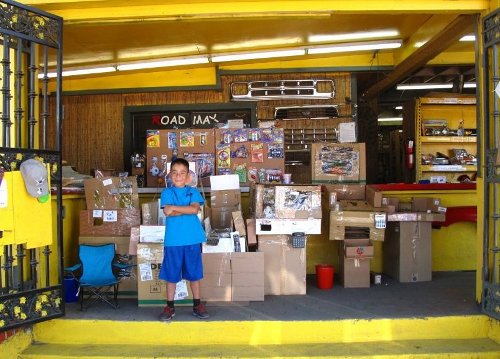
Caine Monroy first built the arcade last summer as a way to keep busy while hanging around at his father’s auto part store in East LA. The games aren’t electronic, but rather mechanical, with the main materials being cardboard boxes and packing tape.

Playing on the arcade costs $1 for four games, though frankly you’d be a fool to take that option. Instead there’s a $2 fun pass that offers 500 games within a one month period. To prevent counterfeiting, each pass has a short PIN code and a lengthy validation number: the passes can be checked on a security device attached to each game on which you type in the PIN code, press a check key and make sure the displayed number matches that on the pass.

(Spoiler: the device is a calculator and the check key is the square root function.)

The story goes that with the arcade located in an industrial estate and most of Monroy’s father’s business now being done online, there was little passing trade and a man named Nirwan Mullick became the first customer of the arcade when visiting to collect some spare parts in person.

Mullick happens to be a filmmaker and began making a short documentary about the arcade. He attracted some interest from his own online followers, some of whom even organized a “flash mob” where several hundred people visited the arcade last October.

The lengthy editing process is now complete and the documentary debuted online on Monday, since which time it’s attracted nearly 400,000 views at the time of writing.

Seeing the huge interest, Mullick then suggested viewers could donate a dollar towards a college fund for Caine, pondering “Imagine what this kid could build with an Engineering degree.” That appeal smashed an initial target and has so far raised well over $70,000 and looks likely to hit a near target of $100,000, designed to fund a full four-year degree.

(Image credit: Caine’s Arcade Facebook page)

No related posts.


from Geeks are Sexy Technology News

From Autoblog: Report: Auto industry pays $135 billion in taxes annually

money

How important is the auto industry to state and federal governments? According to the Center for Automotive Research, the industry accounts for $135 billion in annual taxes. In fact, a reported 13 percent of all state taxes comes from the automobile, or $91.5 billion in total.

Just as impressive is the overall money that Americans pour into their four-wheeled transportation. CAR estimates that auto sales come in at $564 billion, and parts, repairs and other services add in another $173 billion. And those are the staggering numbers generated in an auto market of only 12 million units per year. So far, 2012 auto sales appear to be moving closer to 14 million units, which should help push the $735 billion total closer to the $1 trillion mark.

The income generated by cars and trucks is certainly significant, but a good portion of that income goes toward new roads. Of the $43 billion that ends up in federal coffers, $29 billion comes from fuel taxes. On the state level, two-thirds of the $91.5 billion comes from taxes on fuel. Still, that amounts to 10 percent of California’s overall revenue and a knee-wobbling 23 percent of revenue in Oklahoma.

Auto jobs also contribute serious coin to Uncle Sam, with Michigan leading the way. Uncle Sam took in $2.2 billion from The Mitten State, followed by Ohio and California. Hit the jumpto read the CAR press release.

Continue reading Auto industry pays $135 billion in taxes annually

from Autoblog