From Ars Technica: CEO dares Microsoft to sue him over virtual desktops that flout licensing


We recently told you about a virtual desktop service for iPads and other devices that seems to exist only because it breaks Microsoft’s Windows licensing rules in order to provide an unbeatable price: free, with the option to upgrade to a more robust service for just $5 a month.

The hosted virtual desktop service, from gaming company OnLive, has virtualization vendors who play by Microsoft’s rules seething. Instead of suing OnLive, as one might expect, Microsoft responded to criticism of OnLive’s favorable arrangement with a blog post stating “We are actively engaged with OnLive with the hope of bringing them into a properly licensed scenario.”

Read the rest of this article...


from Ars Technica

From Popular Science – New Technology, Science News, The Future Now: Holey Optochip! The One-Trillion-Bits-Per-Second Chip is Here

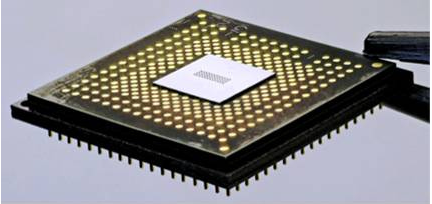
IBM’s Holey Optochip IBM

The high data loads of the future–and even the present–require that optical communications platforms continue to get faster, leaner, and cheaper. At the Optical Fiber Communication Conference in Los Angeles today, IBM will report on a prototype optical chip it has developed that has hit a significant milestone in optical data transfer: one terabit–that’s one trillion bits–per second.

That’s like downloading 500 HD movies at once, a speed matching the bandwidth consumed by 100,000 users at today’s average high-speed Web rates. It’s important to note that this a parallel optics chip technology, not a long-range fiber optic serial communications technology, so it’s not going to instantaneously boost the speed at which data traverses the oceans. But between computers on a local network (between different servers in a data center, for instance) this technology could provide some pretty searing speeds.

The chip itself gets its name from the fact that there are 48 tiny holes bored through a standard silicon CMOS chip that connects on the back side with 24 receiver and 24 transmitter channels. These channels allow a whole lot of data to move through the chip in both directions simultaneously, allowing for these terabit-per-second transfer speeds.

What’s more, in proper IBM fashion the chip isn’t some kind of behind-the-glass prototype never destined for commercial production. The company claims it achieves these record data speeds with excellent power efficiency–that a 100-watt light bulb could power 20 of the optical modules. They are also constructed from off-the-shelf, commercially available components. But there’s no word yet on when, exactly, this manufacturer-friendly optical device might begin taking advantage of those economies of scale and deliver the next-generation of cloud computing and data center technologies.

[IBM]

from Popular Science – New Technology, Science News, The Future Now

From Ars Technica: Holey chip! IBM drills holes into optical chip for terabit-per-second speed


IBM researchers have built a prototype optical chip that can transfer a terabit of data per second, using an innovative design requiring 48 tiny holes drilled into a standard CMOS chip, facilitating the movement of light. Much faster and more power-efficient than today’s optics, the so-called “Holey Optochip” technology could enhance the power of supercomputers.

Optical chips, which move data with light instead of electrons, are commonly used for interconnects in today’s supercomputers and can be found in IBM systems such as Power 775 and Blue Gene. Optical technology is favored over electrical for transmitting high-bandwidth data over longer distances, which is why it’s used for telecommunications networks, said IBM Optical Links Group manager Clint Schow.

Read the rest of this article...


from Ars Technica

From Ars Technica: Raspberry Pi, activist tool


The tiny, $35, Linux-based Raspberry Pi computer has drawn a lot of attention in the last few months, and though it was originally developed to teach computer programming to young students, Internet activists have taken notice as well. A recent BBC interview with developer Nadim Kobeissi, creator of a web-based secure communications program called Cryptocat, shows off just one potential use of the low-cost hardware and free software system. Kobeissi says he’s looking forward to the arrival of Raspberry Pi as a way to bring extra-secure communication to web chat, especially in places where conversations might be watched.

Kobeissi’s Cryptocat is an open-source program that encrypts chat conversations before they’re sent to a server. For relatively little money, he plans to buy Raspberry Pi computers, set them up as servers running Cryptocat, and send them to areas where free speech is monitored or prohibited. The small, modifiable nature of Raspberry Pi computers make them well-adapted to foster chat privacy.

Considering general privacy concerns and recent NSA surveillance probes, the idea could be intriguing for westerners too. “Big Data continue to amass gigantic amounts of personal information without providing any guarantee of privacy, while encryption remains largely inaccessible,” Cryptocat’s website claims, “Cryptocat aims to bridge the gap for those who need easy, encrypted communication.”

Earlier this week, Raspberry Pi became available for pre-order through two Britain-based manufacturers, and the demand for the little open-source system was so great that both manufacturers sites went down on Tuesday evening. When the Pi becomes more widely available, Kobeissi plans to put the software for turning the Raspberry Pi into a chat server online for anyone to use.


from Ars Technica

From Ars Technica: Zemlin praises $25 Linux computer: a Windows license costs more than four Raspberry Pis


In a blog post written this morning, Linux Foundation executive director Jim Zemlin praised the Raspberry Pi foundation’s $35 Linux computer, which met tremendous demand when it launched this week. In his blog post, Zemlin discussed the important role that the Linux platform plays in enabling innovation around low-cost computing.

The Raspberry Pi foundation launched with the aim of building an inexpensive system that could be used to teach computer programming to young students. They developed a pair of bare ARM boards priced at $25 and $35 that include a 700Mhz ARM11 CPU and a 256MB of RAM. The devices are roughly the same size as a deck of playing cards.

Read the rest of this article...


from Ars Technica