
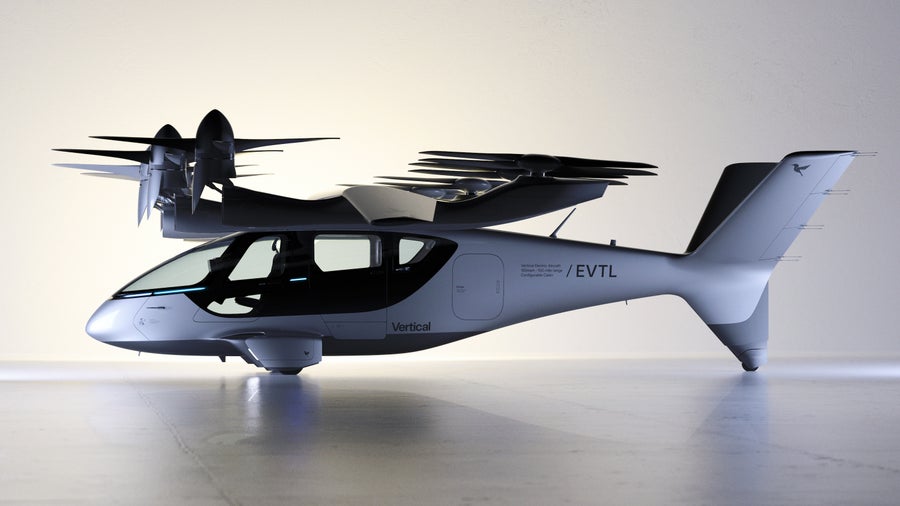
On the morning of April 14, 2026, at Cotswold Airport in southwest England, a test pilot rose straight into the air. He was testing the VX4—an electric vertical takeoff and landing (eVTOL) aircraft, or air taxi—built by the British firm Vertical Aerospace. During the test, the VX4’s eight propellers lifted it like a drone. Then the four front propellers tilted forward, and the aircraft accelerated, no longer hanging on its rotors like a helicopter but cruising on its wings like a small airplane. Moments later, it reversed the sequence: the propellers tilted back up, and the aircraft decelerated, returned to a hover and landed vertically on the same pad it had left.
In completing this test, Vertical—founded in 2016 and based in Bristol—accomplished one of the hardest feats in eVTOL development: its prototype changed from flying like a helicopter to flying like an airplane, then back again. But a prototype is allowed to fly because a regulator has agreed it is safe enough to test. A certified commercial aircraft, meanwhile, has to be safe enough for strangers to buckle their children into it.
Vertical is among the first Western developers to demonstrate piloted transition, but the April flight also matters because of the regulatory context. Other developers have flown to prove the technology works; Vertical is trying to build a case for certification. “The significance of this flight is that it has been achieved in a way that is aligned with the certification pathway from the outset,” says David King, Vertical’s chief engineer. In other words, Vertical is getting closer to the actual business of running an air taxi company.
On supporting science journalism
If you’re enjoying this article, consider supporting our award-winning journalism by subscribing. By purchasing a subscription you are helping to ensure the future of impactful stories about the discoveries and ideas shaping our world today.
King’s journey to eVTOLs began with his work at Boeing in 1989, on a military aircraft called the V-22 Osprey. The Osprey was the first production tiltrotor—an aircraft with propellers that can swivel on their mounts, pointing up for vertical takeoff and tilting forward for horizontal flight. For most of the next three decades, at Bell and then at Italian aerospace firm Leonardo, King worked on civil tiltrotors, the passenger-carrying cousins of the Osprey.
Vertical Aerospace’s Valo, the company’s planned commercial eVTOL aircraft and successor to the VX4 prototype. Vertical unveiled the aircraft in December 2025.
King decided to join Vertical in 2023 because the VX4 is essentially a tiltrotor with electric motors. “The beauty of the tiltrotor is it takes you less than a minute from the time you apply power to cruising on a wing,” he says. “The basic magic of being able to transition from thrustborne to wingborne is proven.” What remains is to tune the system to carry different loads in varied weather and on different routes.
Daniel Pleffken, an assistant professor at Embry-Riddle Aeronautical University in Florida, who specializes in aircraft certification, is more measured about what the flight proves. “A successful flight shows that something can work,” he says. “Certification requires proving that it works safely, consistently and under all expected conditions.” The aircraft still must accumulate evidence from failure tests, repeat flights and design reviews before regulators will let it carry passengers.
Vertical’s situation is unusual. Since 2023 the U.K. Civil Aviation Authority (CAA) has overseen every test flight of the VX4. Most eVTOL companies fly their prototypes under research flight licenses, but the data they produce don’t count toward certification. Vertical flies under an arrangement that has been accumulating evidence toward certification for three years. “We are demonstrating to the regulator that we have the engineering capability, design assurance processes and internal governance required for full type certification,” King says.
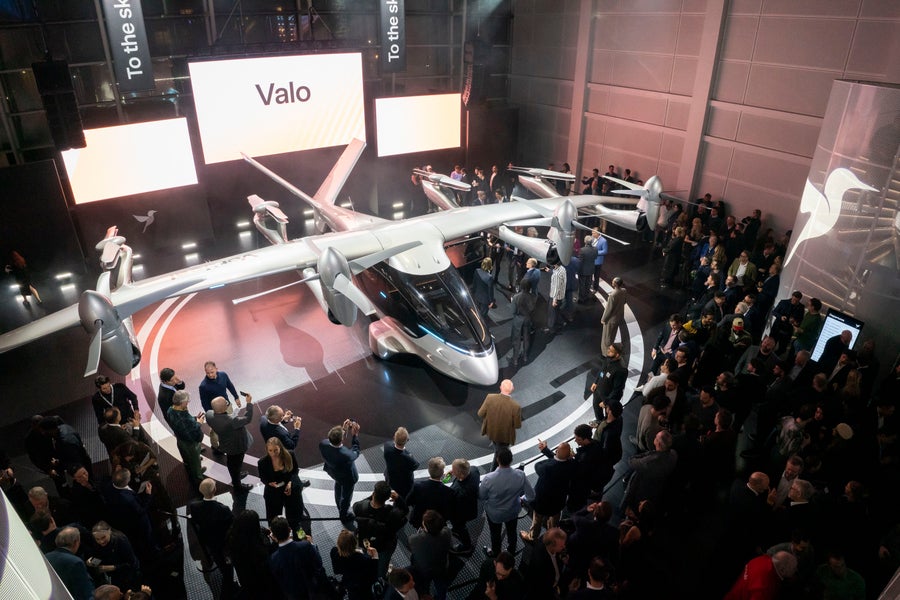
Vertical Aerospace displays its Valo electric aircraft at the company’s London launch event.
The other two Western developers that have flown piloted transitions, California-based Joby Aviation and Vermont-based BETA Technologies, have done so under the U.S. Federal Aviation Administration’s (FAA) experimental permit system. Chinese developers have moved faster—EHang received the world’s first eVTOL type certificate from Chinese regulators in 2023—but under a regulatory framework that Western airlines and aviation authorities don’t treat as equivalent. An experimental permit lets you fly but does not build the same certification file. The European Union Aviation Safety Agency (EASA), whose eVTOL rules the CAA has adopted, built a single new rule book. The FAA, by contrast, is certifying eVTOLs by stitching together rules written for small airplanes and helicopters. The European framework “is generally clearer because it was designed specifically for this class of aircraft,” Pleffken says.
But clarity, Pleffken stresses, isn’t the same as leniency. “The FAA, CAA and EASA are using different regulatory architectures, but the underlying safety intent is not necessarily lower in one system than in another,” he says. The European system is cleaner to navigate because its rule book was written for eVTOLs from the start—but that makes it a clearer test to study for, not an easier one to pass. Vertical’s test flight counts, in other words, because the company has been studying for the right test, with the proctor in the room, for three years.
Even certification would not solve the whole problem. An air taxi is just one piece of a transportation infrastructure that barely exists yet. “The main constraint is increasingly the operational ecosystem, not just the aircraft,” Pleffken says. “Vertiports, charging infrastructure, airspace integration, pilot training, maintenance and operational procedures all need to mature together. If one element lags, the entire system lags.” Vertiports are purpose-built takeoff and landing pads with chargers and air-traffic coordination—essentially, tiny airports scaled for aircraft the size of a large SUV. Few have been built. The air-traffic rules for how dozens of these aircraft will share low-altitude urban airspace with helicopters, drones and one another are still being written.
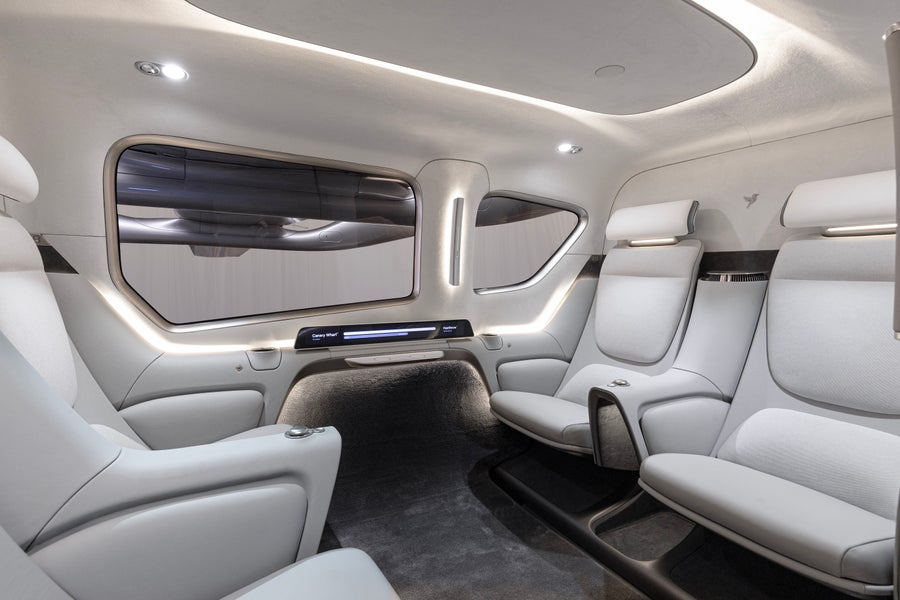
The interior of Vertical Aerospace’s Valo electric aircraft.
The ecosystem question is a specialty of Laurie Garrow, a professor at Georgia Institute of Technology and co-director of the university’s Center for Urban and Regional Air Mobility. Her research group has spent nearly a decade trying to answer the question that flight demonstrations can’t: Will people actually pay to fly in these things? The industry has not even settled on what an eVTOL should look like. Vertical’s VX4 is a tiltrotor, but competitors have built aircraft with separate propellers for lift and for cruise or with many small rotors arranged like a scaled-up drone. “The design of the eVTOLs is the Wild West right now,” Garrow says. “We haven’t done this before, so we don’t know which design is going to be the best for given missions or given situations.”
Vertical aims to earn passenger certification from CAA and EASA simultaneously by the end of 2028. The FAA would follow, reviewing the European findings and deciding whether to accept them for U.S. operations. For that final certificate, Vertical plans to build seven preproduction Valo aircraft, a new model similar to the VX4 but modified based on three years of flight-test data.
Garrow also flags a problem that air taxi engineers can’t fly their way out of: competition on the ground. Self-driving cars are operating commercially in some cities, and a relaxing, productive commute in an autonomous car competes for the same customer an eVTOL is trying to attract. “We are now getting our first autonomous ground vehicles on the road,” she says. “There have been studies that have shown that it’s much more relaxing, and you can be much more productive, being in an autonomous ground vehicle. So you’re not willing to pay as much to be on an aircraft or in an eVTOL.”
In a 2021 paper, Garrow and her colleagues ranked 40 U.S. metropolitan areas for air-taxi commuting potential and found that about half of the trips the country’s commuters might realistically take by eVTOL are concentrated in six of those metros. That concentration suggests a narrower market than the industry’s urban-commuter pitch implies. “My personal opinion is that we’re going to see some of the first use cases in tourist applications,” she says, “over Hawaiian volcanoes or the Grand Canyon, where currently we’re flying helicopters.” She compares the present moment to the years after commercial jet engines arrived. When jet airliners first flew, a trip from London to Tokyo took more than 24 hours and as many as 10 stops, she says, and the fares, adjusted for inflation, were about what a first-class ticket costs today. The technology was real. The market for it took time to build.
via Scientific American https://ift.tt/C1QE9yj
April 25, 2026 at 05:44AM