
The Raspberry Pi is here at last —now what can you do with it? Here is our pick of the project ideas that you can try with your Pi. More »
from Gizmodo

For everything from family to computers…
The Raspberry Pi is here at last —now what can you do with it? Here is our pick of the project ideas that you can try with your Pi. More »
from Gizmodo

FXI is preparing to launch the Cotton Candy, a tiny computer that looks like a USB thumb drive. The device, which can run either Ubuntu or Android 4.0, has a dual-core 1.2GHz ARM Cortex-A9 CPU, 1GB of RAM, and a Mali 400MP GPU that allows it to decode high-definition video.
It has a USB plug on one side, which is used to power the system, and an HDMI plug on the other side, which allows it to be plugged into a display. It also has built-in WiFi and Bluetooth radios for connectivity and supporting input devices. The system can boot standalone and operate as a complete computer when plugged into a display. It’s also possible to plug the Cotton Candy into a conventional computer and boot from it like you would from a regular USB mass storage device.
FXI announced today that the Cotton Candy is available for preorder. The standard retail price is $199 plus tax and shipping. The product is expected to ship in March. The small form factor and relatively high specs make the product seem like a compelling choice for enthusiasts who are looking for an ultra-compact Linux system.
Read the comments on this post
from Ars Technica

After a blockbuster period of invention, a fall in prices and the global recession in 2006 forced the company to enter restructuring with a 30 billion Yen ($372.54 million) Government-backed loan. That swathe of cash was used to pump more money into investment and R&D, but the combination of strong Yen and the Thailand flooding has once again forced the company to come clean about its finances. It revealed today that it had debts of 448,033 million Yen, or $5.5 billion and without the protection of the court wouldn’t last too much longer. Times of Japan points to the strength of Samsung’s memory offerings as being a big contributor to Elpida’s collapse, with president Sakamoto saying that DRAM is now as cheap as a “rice ball.”
from Engadget

Engineers at the University of Pennsylvaniahave flipped the switch on a new type of computer circuit. Unlike conventional silicon, the new chip uses light — not electricity — to perform its logic. By creating an array of nano-rods, light-flow can be treated like voltage and current. These rods can then be configured to emulate electrical components such as resistors, inductors and capacitors. The benefits of the so-called “metatronic” system would be smaller, faster and more efficient computer chips, which is clearly a welcome prospect. Another curious property the team discovered, is what it calls “stereo-circuitry.” Effectively one set of nano-rods can act as two different circuits, depending on the plane of the field. This means your CPU could become a GPU just by changing the signal. We can’t speak for the light itself, but our minds are certainly bent.
from Engadget

The other announcement from Samsung so far at MWC - aside from the disappointment Galaxy Tab 2 (10.1) – is an interesting phone, to say the least. It’s called the Galaxy Beam and includes everything that you have come to expect from a smartphone now a days, but Sammie then packed a projector inside. That’s not a type-o. This phone actually has a real projector inside that can project video, pictures, or other media onto just about any wall or flat surface. Think about that for a second. Wherever you are with this phone, you can essentially beam a 50″ representation of your screen onto a wall. It’s tough to tell how locked up the feature is, but I’m just imagining what devs could potentially do with this.
Other than the projector, the Beam sports a dual-core processor, 6GB of RAM (that’s what the spec list says and has to be an error), 5MP camera, front camera, 4″ WVGA display, 2000mAh battery, and Gingerbread. It’s no HTC One X, but it’s not bad.
Is anyone even slightly interested? Projector, baby?
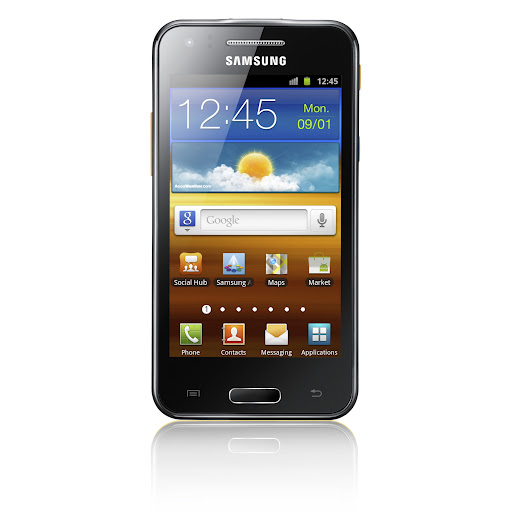

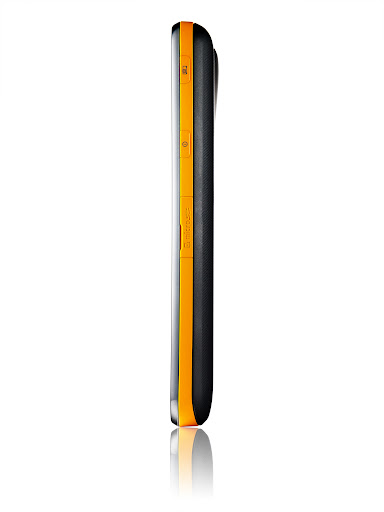
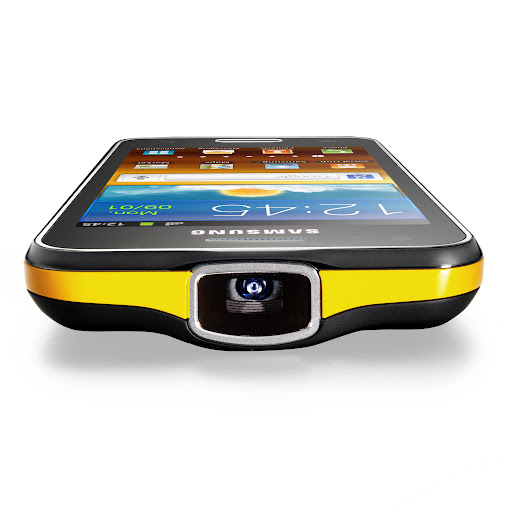
Share the Fun with Samsung GALAXY Beam
February 26, 2012
Samsung’s projector smartphone offers unforgettable shared experience for playing multimedia content anytime, anywhere
Barcelona – February 26, 2012 – Samsung Electronics Co., Ltd, a global leader in digital media and digital convergence technologies, today introduced Samsung GALAXY Beam, the projector smartphone that allows users to display and share multimedia content anywhere on a large luminous projector screen.
GALAXY Beam lets users spontaneously share photos, videos or other digital media with family or friends by beaming content stored on the device directly onto walls, ceilings or improvised flat surfaces, so that everyone can share the fun without the need to huddle around smartphone or pad-sized screens. GALAXY Beam’s ultra-bright 15 lumens projector allows users to freely share life’s memorable moments instantly and in crisp clarity, even in outdoor environments.
“GALAXY Beam provides mobile freedom, enabling a unique shared experience around digital content for everyone—anywhere and instantly—from a smartphone as slim and portable as any on the market,†said JK Shin, President of IT & Mobile Communications Division at Samsung Electronics.
“GALAXY Beam is a device borne out of Samsung’s insight and innovation, demonstrating Samsung’s commitment to providing extraordinary experiences for consumers with products that let them express and fulfill themselves.â€
Video clips, maps, business information, games – a whole range of multimedia content can be beamed instantly by GALAXY Beam on a crisp, high-definition projection up to 50’’ wide. The device features a projector-dedicated application which makes it easy to select content and activate projection in a few simple steps.
Add a dose of ambience or entertainment to a friends’ gathering by transforming any household room or outdoor deck into an instant mini home-theater, projecting full-screen video clips on a ceiling or wall for common sharing, at the touch of a button. Or capture your favorite holiday moments using the GALAXY Beam’s 5MP camera, then display a full photo slideshow to family members on a dining room wall while playing accompanying music straight from the device, so that everyone shares the experience.
For young users who depend on constant, immediate socializing of digital content and entertainment, GALAXY Beam introduces a new way of sharing. It becomes much more than a phone—a handy digital tool, deployable anywhere, which can add visual entertainment to a simple street gathering, set the mood for a small party, or simply turn life’s moments into something personally and immediately sharable. With GALAXY Beam, a birthday or anniversary party can be enlivened in seconds by sharing YouTube or Hulu music videos straight onto a ceiling or door. Likewise, students can collectively share videos or study-work in any dormitory room or student lounge, turning group study into a whole new interactive experience right from a desk table or from the palm of their hands. GALAXY Beam is also ideal for action-packed interactive gaming: Users can upload their own games or choose from over 1,000 games available via Game Hub, Samsung’s dedicated virtual gaming store, then project games to co-players or observers to turn gaming into an unbeatably interactive, shared experience. Additionally, GALAXY Beam is convenient tool for mid-sized business workers. An estate agent can beam images of candidate properties to customers as they tour them; or an architect can display draft concepts or designs to co-workers on the spot at a building site or public location.
Despite featuring a full built-in projector, the GALAXY Beam does not compromise on style or portability, measuring just 12.5mm thick and featuring an elegant, ergonomic design. It runs on Android 2.3 Gingerbread which is powered by an impressive 1.0GHz dual-core processor, ensuring great versatility and a highly responsive user interface. An impressive 8GB of internal memory allows ample multimedia storage without compromises, and a powerful 2000 mAh battery ensures greater display power and content freedom.
The GALAXY Beam is exhibited at Samsung stand (Hall 8), Mobile World Congress 2012. For multimedia content and more detailed information, please visitwww.samsungmobilepress.com.
from Droid Life

Samsung has no plans to officially announce the Galaxy S III at Mobile World Congress this year, but information on the handset is trickling out anyway, according to Boy Genius Report. Among the phone’s more interesting features are a quad-core processor, 1080p screen, and a ceramic case.
The successor to the universally beloved Galaxy S and Galaxy S II will have a 1.5GHz quad-core Samsung Exynos processor, the same make as in certain versions of the S II. The phone will have a 4.8-inch 1080p 16:9 screen, 0.15 inches larger than the Samsung Galaxy Nexus. Without a reference for scale in the mockup above, the display’s margins are small enough for it to look like a flat panel TV.
An 8-megapixel camera will adorn the back and a 2-megapixel camera will be embedded in the front of the Galaxy S III. The handset will have a “ceramic case” and will run Android 4, though no details yet on whether Samsung plans to skin the OS with a new version of its TouchWiz. Android 4 has already undergone a skinning job from HTC’s Sense with its new line of Android 4 smartphones.
The Galaxy S III will be 4G LTE-capable, according to BGR, but a carrier has not been specified. Information on the launch date, likewise, remains murky, but we wouldn’t expect it much later than the second quarter, and certainly no later than the third.
from Ars Technica
