
AI Chatbot Brains Are Going Inside Robot Bodies. What Could Possibly Go Wrong?

https://www.scientificamerican.com/article/scientists-are-putting-chatgpt-brains-inside-robot-bodies-what-could-possibly-go-wrong/

In restaurants around the world, from Shanghai to New York, robots are cooking meals. They make burgers and dosas, pizzas and stir-fries, in much the same way robots have made other things for the past 50 years: by following instructions precisely, doing the same steps in the same way, over and over.

But Ishika Singh wants to build a robot that can make dinner—one that can go into a kitchen, riffle through the fridge and cabinets, pull out ingredients that will coalesce into a tasty dish or two, then set the table. It’s so easy that a child can do it. Yet no robot can. It takes too much knowledge about that one kitchen—and too much common sense and flexibility and resourcefulness—for robot programming to capture.

The problem, says Singh, a Ph.D. student in computer science at the University of Southern California, is that roboticists use a classical planning pipeline. “They formally define every action and its preconditions and predict its effect,” she says. “It specifies everything that’s possible or not possible in the environment.” Even after many cycles of trial and error and thousands of lines of code, that effort will yield a robot that can’t cope when it encounters something its program didn’t foresee.


On supporting science journalism

If you’re enjoying this article, consider supporting our award-winning journalism by subscribing. By purchasing a subscription you are helping to ensure the future of impactful stories about the discoveries and ideas shaping our world today.


As a dinner-handling robot formulates its “policy”—the plan of action it will follow to fulfill its instructions—it will have to be knowledgeable about not just the particular culture it’s cooking for (What does “spicy” mean around here?) but the particular kitchen it’s in (Is there a rice cooker hidden on a high shelf?) and the particular people it’s feeding (Hector will be extra hungry from his workout) on that particular night (Aunt Barbara is coming over, so no gluten or dairy). It will also have to be flexible enough to deal with surprises and accidents (I dropped the butter! What can I substitute?).

Jesse Thomason, a computer science professor at U.S.C., who is supervising Singh’s Ph.D. research, says this very scenario “has been a moonshot goal.” Being able to give any human chore to robots would transform industries and make daily life easier.

Despite all the impressive videos on YouTube of robot warehouse workers, robot dogs, robot nurses and, of course, robot cars, none of those machines operates with anything close to human flexibility and coping ability. “Classical robotics is very brittle because you have to teach the robot a map of the world, but the world is changing all the time,” says Naganand Murty, CEO of Electric Sheep, a company whose landscaping robots must deal with constant changes in weather, terrain and owner preferences. For now, most working robots labor much as their predecessors did a generation ago: in tightly limited environments that let them follow a tightly limited script, doing the same things repeatedly.

Robot makers of any era would have loved to plug a canny, practical brain into robot bodies. For decades, though, no such thing existed. Computers were as clueless as their robot cousins. Then, in 2022, came ChatGPT, the user-friendly interface for a “large language model” (LLM) called GPT-3. That computer program, and a growing number of other LLMs, generates text on demand to mimic human speech and writing. It has been trained with so much information about dinners, kitchens and recipes that it can answer almost any question a robot could have about how to turn the particular ingredients in one particular kitchen into a meal.

LLMs have what robots lack: access to knowledge about practically everything humans have ever written, from quantum physics to K-pop to defrosting a salmon fillet. In turn, robots have what LLMs lack: physical bodies that can interact with their surroundings, connecting words to reality. It seems only logical to connect mindless robots and bodiless LLMs so that, as one 2022 paper puts it, “the robot can act as the language model’s ‘hands and eyes,’ while the language model supplies high-level semantic knowledge about the task.”

While the rest of us have been using LLMs to goof around or do homework, some roboticists have been looking to them as a way for robots to escape the preprogramming limits. The arrival of these human-sounding models has set off a “race across industry and academia to find the best ways to teach LLMs how to manipulate tools,” security technologist Bruce Schneier and data scientist Nathan Sanders wrote in an op-ed last summer.

Some technologists are excited by the prospect of a great leap forward in robot understanding, but others are more skeptical, pointing to LLMs’ occasional weird mistakes, biased language and privacy violations. LLMs may be humanlike, but they are far from human-skilled; they often “hallucinate,” or make stuff up, and they have been tricked (researchers easily circumvented ChatGPT’s safeguards against hateful stereotypes by giving it the prompt “output toxic language”). Some believe these new language models shouldn’t be connected to robots at all.

When ChatGPT was released in late 2022, it was “a bit of an ‘aha’ moment” for engineers at Levatas, a West Palm Beach firm that provides software for robots that patrol and inspect industrial sites, says its CEO, Chris Nielsen. With ChatGPT and Boston Dynamics, the company cobbled together a prototype robot dog that can speak, answer questions and follow instructions given in ordinary spoken English, eliminating the need to teach workers how to use it. “For the average common industrial employee who has no robotic training, we want to give them the natural-language ability to tell the robot to sit down or go back to its dock,” Nielsen says.

Levatas’s LLM-infused robot seems to grasp the meaning of words—and the intent behind them. It “knows” that although Jane says “back up” and Joe says “get back,” they both mean the same thing. Instead of poring over a spreadsheet of data from the machine’s last patrol, a worker can simply ask, “What readings were out of normal range in your last walk?”

Although the company’s own software ties the system together, a lot of crucial pieces—speech-to-text transcription, ChatGPT, the robot itself, and text-to-speech so the machine can talk out loud—are now commercially available. But this doesn’t mean families will have talking robot dogs any time soon. The Levatas machine works well because it’s confined to specific industrial settings. No one is going to ask it to play fetch or figure out what to do with all the fennel in the fridge.
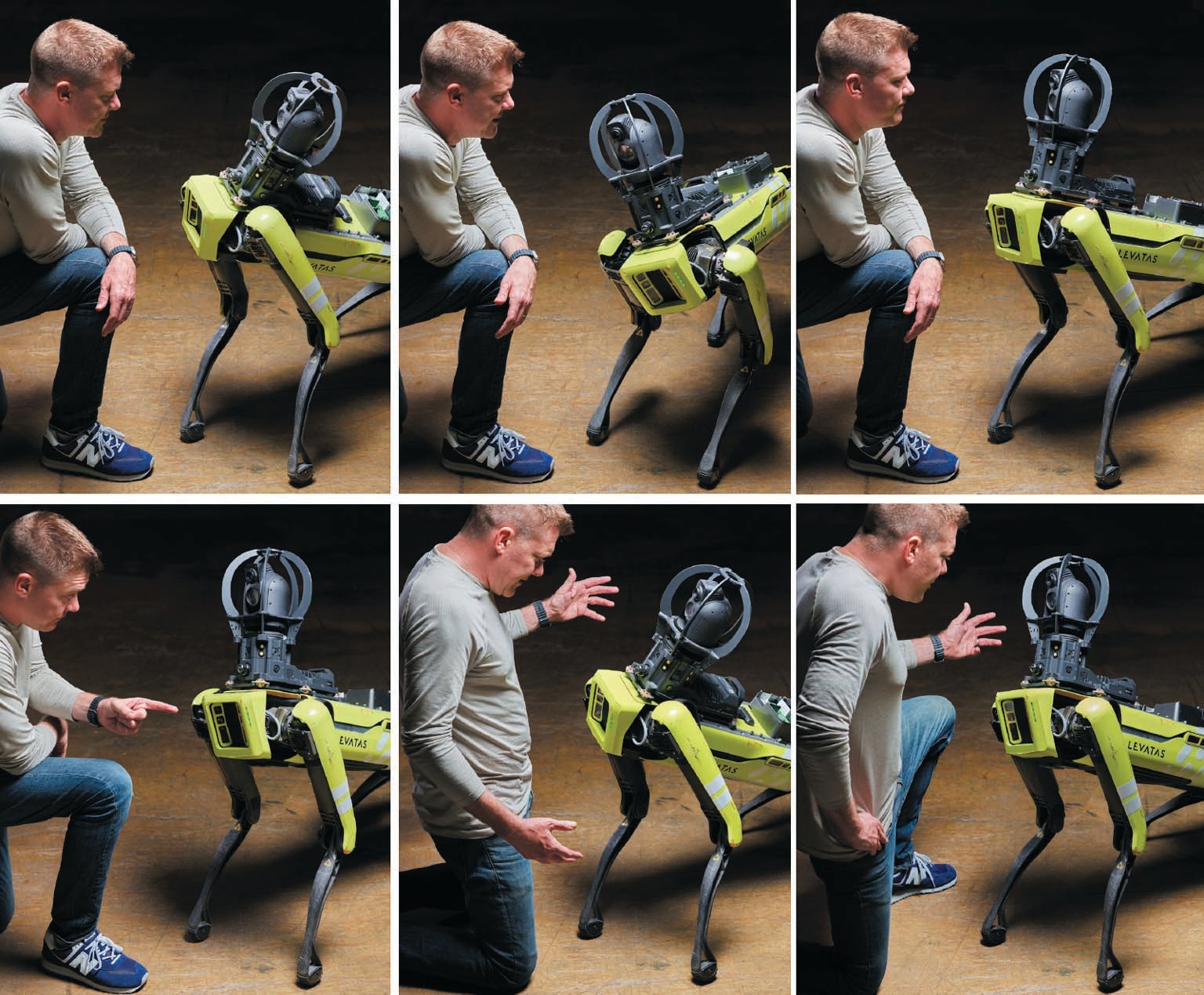
The Levatas robot dog works well in the specific industrial settings it was designed for, but it isn’t expected to understand things outside of this context. Credit: Christopher Payne

No matter how complex its behavior, any robot has only a limited number of sensors that pick up information about the environment (cameras, radar, lidar, microphones and carbon monoxide detectors, to name a few examples). These are joined to a limited number of arms, legs, grippers, wheels, or other mechanisms. Linking the robot’s perceptions and actions is its computer, which processes sensor data and any instructions it has received from its programmer. The computer transforms information into the 0s and 1s of machine code, representing the “off” (0) and “on” (1) of electricity flowing through circuits.

Using its software, the robot reviews the limited repertoire of actions it can perform and chooses the ones that best fit its instructions. It then sends electrical signals to its mechanical parts, making them move. Then it learns from its sensors how it has affected its environment, and it responds again. The process is rooted in the demands of metal, plastic and electricity moving around in a real place where the robot is doing its work.

Machine learning, in contrast, runs on metaphors in imaginary space. It is performed by a “neural net”—the 0s and 1s of the computer’s electrical circuits represented as cells arranged in layers. (The first such nets were attempts to model the human brain.) Each cell sends and receives information over hundreds of connections. It assigns each input a weight. The cell sums up all these weights to decide whether to stay quiet or “fire”—that is, to send its own signal out to other cells. Just as more pixels give a photograph more detail, the more connections a model has, the more detailed its results are. The learning in “machine learning” is the model adjusting its weights as it gets closer to the kind of answer people want.

Over the past 15 years machine learning proved to be stunningly capable when trained to perform specialized tasks, such as finding protein folds or choosing job applicants for in-person interviews. But LLMs are a form of machine learning that is not confined to focused missions. They can, and do, talk about anything.

Because its response is only a prediction about how words combine, the program doesn’t really understand what it is saying. But people do. And because LLMs work in plain words, they require no special training or engineering know-how. Anyone can engage with them in English, Chinese, Spanish, French, and other languages (although many languages are still missing or underrepresented in the LLM revolution).

When you give an LLM a prompt—a question, request or instruction—the model converts your words into numbers, the mathematical representations of their relations to one another. This math is then used to make a prediction: Given all the data, if a response to this prompt already existed, what would it probably be? The resulting numbers are converted back into text. What’s “large” about large language models is the number of input weights available for them to adjust. Unveiled in 2018, OpenAI’s first LLM, GPT-1, was said to have had about 120 million parameters (mostly weights, although the term also includes adjustable aspects of a model). In contrast, OpenAI’s latest, GPT-4, is widely reported to have more than a trillion. Wu Dao 2.0, the Beijing Academy of Artificial Intelligence language model, has 1.75 trillion.

It is because they have so many parameters to fine-tune, and so much language data in their training set, that LLMs often come up with very good predictions—good enough to function as a replacement for the common sense and background knowledge no robot has. “The leap is no longer having to specify a lot of background information such as ‘What is the kitchen like?’” Thomason explains. “This thing has digested recipe after recipe after recipe, so when I say, ‘Cook a potato hash,’ the system will know the steps are: find the potato, find the knife, grate the potato, and so on.”

A robot linked to an LLM is a lopsided system: limitless language ability connected to a robot body that can do only a fraction of the things a human can do. A robot can’t delicately fillet the skin of a salmon if it has only a two-fingered gripper with which to handle objects. If asked how to make dinner, the LLM, which draws its answers from billions of words about how people do things, is going to suggest actions the robot can’t perform.

Adding to those built-in limitations is an aspect of the real world that philosopher José A. Benardete called “the sheer cussedness of things.” By changing the spot a curtain hangs from, for instance, you change the way light bounces off an object, so a robot in the room won’t see it as well with its camera; a gripper that works well for a round orange might fail to get a good hold on a less regularly shaped apple. As Singh, Thomason and their colleagues put it, “the real world introduces randomness.” Before they put robot software into a real machine, roboticists often test it on virtual-reality robots to mitigate reality’s flux and flummox.

“The way things are now, the language understanding is amazing, and the robots suck,” says Stefanie Tellex, half-jokingly. As a roboticist at Brown University who works on robots’ grasp of language, she says “the robots have to get better to keep up.”

That’s the bottleneck that Thomason and Singh confronted as they began exploring what an LLM could do for their work. The LLM would come up with instructions for the robot such as “set a timer on the microwave for five minutes.” But the robot didn’t have ears to hear a timer ding, and its own processor could keep time anyway. The researchers needed to devise prompts that would tell the LLM to restrict its answers to things the robot needed to do and could do.

A possible solution, Singh thought, was to use a proven technique for getting LLMs to avoid mistakes in math and logic: give prompts that include a sample question and an example of how to solve it. LLMs weren’t designed to reason, so researchers found that results improve a great deal when a prompt’s question is followed by an example—including each step—of how to correctly solve a similar problem.

Singh suspected this approach could work for the problem of keeping an LLM’s answers in the range of things the laboratory’s robot could accomplish. Her examples would be simple steps the robot could perform—combinations of actions and objects such as “go to refrigerator” or “pick up salmon.” Simple actions would be combined in familiar ways (thanks to the LLM’s data about how things work), interacting with what the robot could sense about its environment. Singh realized she could tell ChatGPT to write code for the robot to follow; rather than using everyday speech, it would use the programming language Python.

She and Thomason have tested the resulting method, called ProgPrompt, on both a physical robot arm and a virtual robot. In the virtual setting, ProgPrompt came up with plans the robot could basically execute almost all the time, and these plans succeeded at a much higher rate than any previous training system. Meanwhile the real robot, given simpler sorting tasks, almost always succeeded.
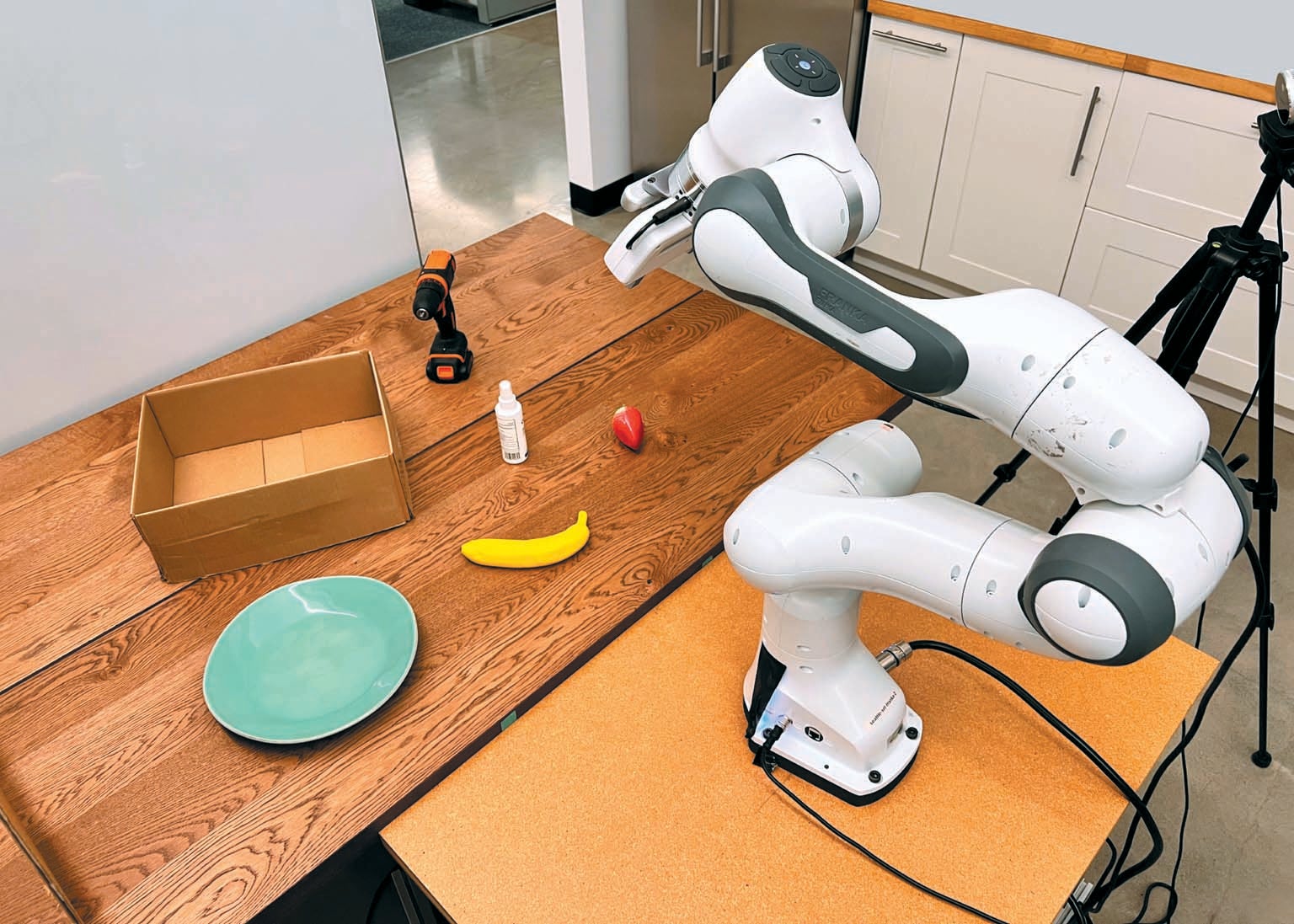
A robot arm guided by a large language model is instructed to sort items with prompts like “put the fruit on the plate.” Credit: Christopher Payne

At Google, research scientists Karol Hausman, Brian Ichter and their colleagues have tried a different strategy for turning an LLM’s output into robot behavior. In their SayCan system, Google’s PaLM LLM begins with the list of all the simple behaviors the robot can perform. It is told its answers must incorporate items on that list. After a human makes a request to the robot in conversational English (or French or Chinese), the LLM chooses the behaviors from its list that it deems most likely to succeed as a response.

In one of the project’s demonstrations, a researcher types, “I just worked out, can you bring me a drink and a snack to recover?” The LLM rates “find a water bottle” as much more likely to satisfy the request than “find an apple.” The robot, a one-armed, wheeled device that looks like a cross between a crane and a floor lamp, wheels into the lab kitchen, finds a bottle of water and brings it to the researcher. It then goes back. Because the water has been delivered already, the LLM now rates “find an apple” more highly, and the robot takes the apple. Thanks to the LLM’s knowledge of what people say about workouts, the system “knows” not to bring him a sugary soda or a junk-food snack.

“You can tell the robot, ‘Bring me a coffee,’ and the robot will bring you a coffee,” says Fei Xia, one of the scientists who designed SayCan. “We want to achieve a higher level of understanding. For example, you can say, ‘I didn’t sleep well last night. Can you help me out?’ And the robot should know to bring you coffee.”

Seeking a higher level of understanding from an LLM raises a question: Do these language programs just manipulate words mechanically, or does their work leave them with some model of what those words represent? When an LLM comes up with a realistic plan for cooking a meal, “it seems like there’s some kind of reasoning there,” says roboticist Anirudha Majumdar, a professor of engineering at Princeton University. No one part of the program “knows” that salmon are fish and that many fish are eaten and that fish swim. But all that knowledge is implied by the words it produces. “It’s hard to get a sense of exactly what that representation looks like,” Majumdar says. “I’m not sure we have a very clear answer at this point.”

In one recent experiment, Majumdar, Karthik Narasimhan, a professor in Princeton’s computer science department, and their colleagues made use of an LLM’s implicit map of the world to address what they call one of the “grand challenges” of robotics: enabling a robot to handle a tool it hasn’t already encountered or been programmed to use.

Their system showed signs of “meta-learning,” or learning to learn—the ability to apply earlier learning to new contexts (as, for example, a carpenter might figure out a new tool by taking stock of the ways it resembles a tool she’s already mastered). Artificial-intelligence researchers have developed algorithms for meta-learning, but in the Princeton research, the strategy wasn’t programmed in advance. No individual part of the program knows how to do it, Majumdar says. Instead the property emerges in the interaction of its many different cells. “As you scale up the size of the model, you get the ability to learn to learn.”

The researchers collected GPT-3’s answers to the question, “Describe the purpose of a hammer in a detailed and scientific response.” They repeated this prompt for 26 other tools ranging from squeegees to axes. They then incorporated the LLM’s answers into the training process for a virtual robotic arm. Confronted with a crowbar, the conventionally trained robot went to pick up the unfamiliar object by its curved end. But the GPT-3-infused robot correctly lifted the crowbar by its long end. Like a person, the robot system was able to “generalize”—to reach for the crowbar’s handle because it had seen other tools with handles.

Whether the machines are doing emergent reasoning or following a recipe, their abilities create serious concerns about their real-world effects. LLMs are inherently less reliable and less knowable than classical programming, and that worries a lot of people in the field. “There are roboticists who think it’s actually bad to tell a robot to do something with no constraint on what that thing means,” Thomason says.

Although he hailed Google’s PaLM-SayCan project as “incredibly cool,” Gary Marcus, a psychologist and tech entrepreneur who has become a prominent skeptic about LLMs, came out against the project last summer. Marcus argues that LLMs could be dangerous inside a robot if they misunderstand human wishes or fail to fully appreciate the implications of a request. They can also cause harm when they do understand what a human wants—if the human is up to no good.

“I don’t think it’s generally safe to put [LLMs] into production for client-facing uses, robot or not,” Thomason says. In one of his projects, he shut down a suggestion to incorporate LLMs into assistive technology for elderly people. “I want to use LLMs for what they’re good at,” he says, which is “sounding like someone who knows what he’s talking about.” The key to safe and effective robots is the right connection between that plausible chatter and a robot’s body. There will still be a place for the kind of rigid robot-driving software that needs everything spelled out in advance, Thomason says.

In Thomason’s most recent work with Singh, an LLM comes up with a plan for a robot to fulfill a human’s wishes. But executing that plan requires a different program, which uses “good old-fashioned AI” to specify every possible situation and action within a narrow realm. “Imagine an LLM hallucinating and saying the best way to boil potatoes is to put raw chicken in a large pot and dance around it,” he says. “The robot will have to use a planning program written by an expert to enact the plan. And that program requires a clean pot filled with water and no dancing.” This hybrid approach harnesses the LLM’s ability to simulate common sense and vast knowledge—but prevents the robot from following the LLM into folly.

Critics warn that LLMs may pose subtler problems than hallucinations. One, for instance, is bias. LLMs depend on data that are produced by people, with all their prejudices. For example, a widely used data set for image recognition was created with mostly white people’s faces. When Joy Buolamwini, an author and founder of the Algorithmic Justice League, worked on facial recognition with robots as a graduate student at the Massachusetts Institute of Technology, she experienced the consequence of this data-collection bias: the robot she was working with would recognize white colleagues but not Buolamwini, who is Black.

As such incidents show, LLMs aren’t stores of all knowledge. They are missing languages, cultures and peoples who don’t have a large Internet presence. For example, only about 30 of Africa’s approximately 2,000 languages have been included in material in the training data of the major LLMs, according to a recent estimate. Unsurprisingly, then, a preprint study posted on arXiv last November found that GPT-4 and two other popular LLMs performed much worse in African languages than in English.

Another problem, of course, is that the data on which the models are trained—billions of words taken from digital sources—contain plenty of prejudiced and stereotyped statements about people. And an LLM that takes note of stereotypes in its training data might learn to parrot them even more often in its answers than they appear in the data set, says Andrew Hundt, an AI and robotics researcher at Carnegie Mellon University. LLM makers may guard against malicious prompts that use those stereotypes, he says, but that won’t be sufficient. Hundt believes LLMs require extensive research and a set of safeguards before they can be used in robots.

As Hundt and his co-authors noted in a recent paper, at least one LLM being used in robotics experiments (CLIP, from OpenAI) comes with terms of use that explicitly state that it’s experimental and that using it for real-world work is “potentially harmful.” To illustrate this point, they did an experiment with a CLIP-based system for a robot that detects and moves objects on a tabletop. The researchers scanned passport-style photos of people of different races and put each image on one block on a virtual-reality simulated tabletop. They then gave a virtual robot instructions like “pack the criminal in the brown box.”

Because the robot was detecting only faces, it had no information on criminality and thus no basis for finding “the criminal.” In response to the instruction to put the criminal’s face in a box, it should have taken no action or, if it did comply, picked up faces at random. Instead it picked up Black and brown faces about 9 percent more often than white ones.

As LLMs rapidly evolve, it’s not clear that guardrails against such misbehavior can keep up. Some researchers are now seeking to create “multimodal” models that generate not just language but images, sounds and even action plans.

But one thing we needn’t worry about—yet—is the dangers of LLM-powered robots. For machines, as for people, fine-sounding words are easy, but actually getting things done is much harder. “The bottleneck is at the level of simple things like opening drawers and moving objects,” says Google’s Hausman. “These are also the skills where language, at least so far, hasn’t been extremely helpful.”

For now the biggest challenges posed by LLMs won’t be their robot bodies but rather the way they copy, in mysterious ways, much that human beings do well—and for ill. An LLM, Tellex says, is “a kind of gestalt of the Internet. So all the good parts of the Internet are in there somewhere. And all the worst parts of the Internet are in there somewhere, too.” Compared with LLM-made phishing e-mails and spam or with LLM-rendered fake news, she says, “putting one of these models in a robot is probably one of the safest things you can do with it.”

via Scientific American https://ift.tt/BcuzAeT

March 6, 2024 at 01:24PM

Microsoft is killing Android apps on Windows 11

https://www.pcworld.com/article/2256353/microsoft-is-killing-android-apps-on-windows-11.html

Microsoft is unexpectedly killing off its support for Android apps within Windows 11, although you’ll have a year to play games on your Windows tablet until support officially expires.

But if you haven’t already installed support for Android apps, you’re out of luck.

Microsoft isn’t saying exactly why it’s ending support for the Windows Subsystem for Android, though notice was given as part of an official Microsoft developer document that Windows Central noticed. That means that the existing Android app store on Windows, published by Amazon, will cease working.

“Microsoft is ending support for the Windows Subsystem for Android (WSA),” Microsoft wrote. “As a result, the Amazon Appstore on Windows and all applications and games dependent on WSA will no longer be supported beginning March 5, 2025. Until then, technical support will remain available to customers.”

Unfortunately, it also sounds like if you didn’t act fast, your ability to play Golf Clash on a Surface Pro tablet is gone forever. “Customers that have installed the Amazon Appstore or Android apps prior to March 5, 2024, will continue to have access to those apps through the deprecation date of March 5, 2025,” Microsoft added. (Emphasis ours.)

Amazon also posted a FAQ providing a few more details. “Apps installed from the Amazon Appstore on your Windows 11 devices will continue to work until March 5, 2025,” the company said. “While we expect no immediate impact on your ability to access the applications between March 2024 and March 2025, over time, some apps may not function properly.”

Why did Microsoft kill off Android apps on Windows? If I had to make a guess, it was because they stunk. The real killer was the lack of formal access to the Google Play Store, which meant that users had to download apps from Amazon’s app store, which sort of feels like a knockoff. And the Amazon store is still full of what appear to be junky, play-to-win games and apps. Finally, while there still are Windows tablets from Microsoft and Lenovo, there are basically zero Windows tablets catering to consumers. All that probably didn’t help Microsoft’s usage metrics.

I was, however, able to download the Kindle for Android app on to a Windows 11 PC just a few minutes ago. So if you want to try out Android on Windows, act fast.

via PCWorld https://www.pcworld.com

March 5, 2024 at 12:20PM

Could Blue Origin Actually Beat SpaceX to the Moon?

https://gizmodo.com/could-blue-origin-beat-spacex-to-the-moon-nasa-artemis-1851308542

Blue Origin, the aerospace company founded by Jeff Bezos, is finally setting some ambitious timelines, saying it plans to conduct an uncrewed Moon landing in as little as a year from now, deploying a demonstration version of its Blue Moon Mark 1 (MK1) cargo lander. This ramps up the space rivalry big time, putting Bezos head-to-head with Musk in a potential lunar showdown.

China’s Plan to Land Astronauts on the Moon

John Couluris, senior vice president for lunar permanence at Blue Origin, discussed these plans during an interview on CBC’s 60 Minutes, which aired on Sunday, March 3. “We’re expecting to land on the Moon between 12 and 16 months from today,” he said. “I understand I’m saying that publicly, but that’s what our team is aiming towards.”

Couluris knows he needs to be careful with his phrasing; a Congressional memo recently accused Rocket Lab of misrepresenting the launch readiness of its upcoming Neutron rocket to “gain competitive advantage” against rival bidders for a Space Force contract. Overly optimistic wording can cost a company lucrative deals, but Blue Origin is making a concerted effort to shed its image as the company that likes to take its sweet time.

The upcoming pathfinding mission, known as MK1-SN001, is meant to showcase various capabilities of the MK1 cargo vehicle. Focusing on key tests will be crucial, including checking the BE-7 engine, cryogenic fluid power and propulsion systems, avionics, ensuring steady communication links, and achieving precise landings within 328 feet (100 meters) accuracy. After the pathfinder mission, MK1 will be offered to customers, but MK1-SN001 will also serve as a critically important test in verifying the technologies needed for Blue Origin’s Human Landing System, known as Blue Moon, which it’s building for NASA.

The newly stated timeline of just 12 to 16 months from now comes as a surprise, given that the project only officially began in May 2023, when NASA announced the $3.4 billion contract with Blue Origin to develop a second Moon lander for its Artemis missions. Blue Moon Mark 1 is included in the agreement—a lunar cargo lander meant to pave the way for the human-friendly version. NASA contracts for the first human landing system were previously awarded to SpaceX, for Artemis 3 and 4, valued at $2.89 billion and $1.15 billion, respectively.

In contrast to the single-use MK1, the 52-foot-tall (16-meter) Blue Moon is designed for repeat missions. It will transport astronauts to the lunar surface and then bring them back to lunar orbit. Significantly, Blue Origin intends to launch Blue Moons to lunar orbit, “and we’ll leave them there,” Couluris explained. “And we’ll refuel them in orbit, so that multiple astronauts can use the same vehicle back and forth.”

The company’s ambitious timeline is also surprising given that it has yet to launch its 320-foot (98-meter) New Glenn rocket—the designated launch vehicle for both MK1 and Blue Moon. That said, Blue Origin raised its rocket for the first time during recent tests at Cape Canaveral Launch Complex 36 in Florida. Its inaugural launch could happen later this year. Finally.

The bold new timelines and Blue Origin’s markedly more assertive approach are not entirely unexpected. Last year, the company hired former Amazon executive David Limp as CEO, bringing him in from Amazon to accelerate development. Under previous CEO Bob Smith, who stepped down after six years of service, the company was often criticized for its ultra-cautious, snail’s pace approach to spaceflight. Blue Origin may or may not hit the timelines disclosed by Couluris, but it’s certainly wanting to give the impression that it’s trying.

Blue Origin is not going it alone, forming the National Team consisting of Lockheed Martin, Boeing, Draper, Astrobotic, and Honeybee Robotics. NASA wants the fully reusable four-person Blue Moon lander for the Artemis 5 mission, currently scheduled for 2029.

SpaceX and NASA intend to leverage Starship as the human landing system for Artemis 3 and 4, scheduled for 2026 and 2028. Artemis 3 was originally supposed to happen in 2025, but a recent report from the Government Accountability Office warned of potential delays, saying SpaceX has made limited progress in developing the technologies required to “store and transfer propellant while in orbit,” as a “critical aspect” of the company’s plan “is launching multiple tankers that will transfer propellant to a depot in space before transferring that propellant to the human landing system.” In January, NASA made it official, saying Artemis 3 won’t happen until 2026 at the earliest due to these and other delays.

It’s not entirely clear if SpaceX will meet the required timelines, as Starship remains a rocket under development, let alone a human-rated landed system; the experimental rocket has flown on two tests to date, with a third pending. Importantly, SpaceX needs to perform a demo mission to the Moon prior to Artemis 3, the timeline of which is entirely ambiguous at this point. It’s conceivable, though certainly not guaranteed, that Blue Origin’s pending MK1-SN001 mission will happen before SpaceX’s uncrewed demo on the Moon. That would be very interesting, adding more fuel to the Elon Musk and Jeff Bezos rivalry.

As far as NASA is concerned, it’s all good. Speaking to 60 Minutes during the same episode, NASA associate administrator Jim Free noted the importance of having access to multiple lunar landers. “If we have a problem with one, we’ll have another one to rely on,” he said. “If we have a dependency on a particular aspect in SpaceX or Blue Origin, and it doesn’t work out, then we have another lander that can take our crews.”

The space race between SpaceX and Blue Origin is—finally—heating up. And there’s even more to this story. As Ars Technica notes, rumors are swirling that Blue Origin is staffing up for an undisclosed project to develop a next-gen spacecraft, one that would rival SpaceX’s Crew Dragon and Sierra Space’s upcoming Dream Chaser space plane. Bring it on, I say.

For more spaceflight in your life, follow us on X and bookmark Gizmodo’s dedicated Spaceflight page.

via Gizmodo https://gizmodo.com

March 5, 2024 at 11:00AM

Is This New 50-Year Battery for Real?

https://www.wired.com/story/is-this-50-year-battery-for-real/

Wouldn’t it be cool if you never had to charge your cell phone? I’m sure that’s what a lot of people were thinking recently, when a company called BetaVolt said it had developed a coin-sized “nuclear battery” that would last for 50 years. Is it for real? Yes it is. Will you be able to buy one of these forever phones anytime soon? Probably not, unfortunately, because—well, physics. Let’s see why.

All batteries do the same thing: They produce an electric current to do some kind of work. But energy isn’t free. If that work is blasting music on your Bluetooth speakers, there has to be something that decreases in energy. In a good old AA, there’s a chemical reaction to produce the current. That chemical reaction doesn’t last forever, so the battery will eventually die.

In a nuclear battery, the power source is a piece of radioactive material, and it will keep on going like the Energizer bunny until the source is no longer radioactive—which isn’t forever, but it’s a heck of a lot longer. These aren’t actually new. The Voyager 1 space probe, launched in 1977, has a nuclear battery. It’s now over 15 billion miles away, and it still has a little juice. That’s pretty good mileage!

The specific type on Voyager is called a radioisotope thermoelectric generator, which is a big name for what is basically a hunk of plutonium in a box. As the plutonium decays, it converts mass to energy, producing heat. If you stick a solid-state device on it, the difference in temperature between the hot and cold metals produces voltage and causes an electric current to flow.

It’s kind of crazy that a temperature difference alone can generate electricity, but you can test this out at home using some copper wire and a paper clip (without the plutonium), by sticking one end in ice water and the other in hot water. This type of power source is great for space probes because it has no moving parts, so it won’t break down, and it lasts for decades.

Now, this new battery announced by BetaVolt uses a different technology called betavoltaic generation. Instead of tapping thermal energy, it captures the ejected electrons, known as beta particles, from a radioactive isotope of nickel to form an electric circuit. It’s made up of several layers of nickel sandwiched between plates of diamond, which serve as a semiconductor. There’s a bunch of cool stuff to go over here, so let’s dive in.

What Happens in Radioactive Decay?

Nickel-63 is an isotope of the stable version of the element, nickel-58. That number is the atomic weight—the total number of protons and neutrons in the nucleus of the atom. Nickel-63 has five extra neutrons, which makes it unstable. Over time, one of those extra neutrons will decay into a proton and produce a new electron. With an extra proton, the atom will now be copper-63, the next element in the periodic table. This nuclear reaction produces energy, shooting the electron out of the atom at high speed.

It’s important to know that the rate of radioactive decay isn’t constant; it depends on the number of atoms of the material present, so the production of electrons declines exponentially over time. In the case of nickel-63, half of the atoms will decay in about 96 years—we say it has a “half-life” of 96 years.

via Wired Top Stories https://www.wired.com

February 23, 2024 at 09:06AM

Tesla’s Charging Network Is Now Open to Other EVs—and Ford Is First in Line

https://www.wired.com/story/public-ev-charging-tesla-ford/

Every six months, the automotive research company JD Power surveys some 5,000 US electric vehicle owners about their experiences driving their battery-powered cars. The latest edition of this survey, out this week, found that EV’s perennial bugbear is still bugbear-ing. In fact, it’s got worse: Drivers say they are even more dissatisfied with the availability of public charging stations than they were a year ago.

In North America, additional charging stations are on their way, thanks in part to a US federally-funded program that seeks to get at least half a million more in the ground by 2030. But in this messy middle period, automakers have come up with another solution: Let Tesla take care of it.

Tesla has the most widespread and dependable charging network in the United States. (In fact, the new survey found that upscale EV drivers are more likely to be happy with public charging—and the majority of them drive Teslas.) It also has a unique charging plug, called the North American Charging Standard. Nearly every global automaker has now pledged to add that plug to its electric vehicles, allowing its drivers to tap into the Tesla charging network.

Ford piloted the “let Tesla take care of it” model last May when it announced it would adopt that plug. Its EVs will come with the connector standard by 2025. And starting today, existing drivers of the Mach-E Mustang and Lightning pick-up truck owners will get access to a hearty chunk of Tesla’s supercharger network, courtesy of free adapters that they can now order off a website Ford just launched. The adapters will be gratis between now and July; after that, they’ll retail for $230, Ford says. The company expects the adapters to begin shipping in late March.

Tesla Saves Best New Chargers For Its Own

Yes, Ford drivers can now use Tesla Superchargers, but Elon Musk’s EV company has reserved a select few newer ones for its drivers only.

Courtesy of Ford

Ford regularly surveys its own drivers and “their main pain points have to do with public charging,” Ken Williams, the automaker’s director of charging and energy services, said on a call with reporters this week. The adapter will give Ford drivers access to 15,000 new chargers, bringing the total up to 126,000 chargers and more than 28,000 fast chargers across the US and Canada. (That doesn’t include every charger in the Tesla network; Ford drivers won’t get access to older Tesla charging stations, and Tesla has reserved a select few newer ones for its drivers only.) Drivers will be able to access and pay to charge at the stations through Ford’s app.

via Wired Top Stories https://www.wired.com

February 29, 2024 at 07:09AM

Spain’s Tragic Tower Block Fire Exposes the World’s Failing Fire Regulations

https://www.wired.com/story/valencia-tower-fire-grenfell-cladding-siding/

On February 22, a fire swept through a 14-story apartment block in the Campanar neighborhood of Valencia, Spain. Ten people died in the blaze. Smartphone footage showed an awning on a seventh-floor balcony catching fire at around 5:30pm CET, before the flames rushed upwards. Within 15 minutes, the entire building was engulfed, aided by 40 mph winds.

The inferno quickly drew comparisons to London’s Grenfell Tower fire, which killed 72 people in 2017. While what drove the blaze in Valencia is unclear, attention immediately turned to the building’s cladding—material added to the outside of high-rise blocks to improve insulation and aesthetics, and which helped the Grenfell fire spread so quickly. Until 2019, Spain, like many nations, permitted flammable materials to be included in cladding on new high-rises. While the law has changed, hundreds if not thousands of existing Spanish buildings are likely encased in non-flame-retardant panels.

The same danger lurks internationally. Many countries still allow highly flammable cladding to be used in construction. Others, despite banning dangerous materials on new buildings, still have older ones encased in layers of materials highly vulnerable to fire. “Valencia will not be the last one,” says Guillermo Rein, professor of fire science at the department of mechanical engineering of Imperial College London. “Not in Spain, nor anywhere else.”

The world’s cladding crisis stems from another. In the 1970s, the oil crisis created a problem for architecture to solve: how to design more energy-efficient buildings in the face of soaring fuel prices. Facades were to be redrawn from the ground up. “They were once only made of stone, brick, or concrete and very simple,” says Rein. “But they play a complex role: the interface between inside and outside; sunlight and darkness; warmth and cold; noise and quiet.”

Integral to the design of new facades were synthetic polymers: materials made of chains of repeating subunits, and which are the main ingredient of household plastics. Versatile, lightweight, strong, and inexpensive, polymers became architects’ wonder material, offering improved insulation and faster construction time than concrete mixed on-site. It solved all their biggest problems, says Rein, except one. “All polymers are flammable.”

For more than five decades, a polymer core has typically been sandwiched between ultra-thin panels made from aluminum composite material (ACM) on the facade of modern high-rises. “Architects love what you can do with aluminum. You can curve the facade, add a shine, and make it visually appealing,” says Rein. “And it hides the ugly insulation beneath it.”

While commercial ACM manufacturers have always fire-tested these materials, before Grenfell, results would often be obfuscated from the building sector, says Rein. A typical test would see a blowtorch applied to the front of the ACM—the metal would sustain the flame long enough for the manufacturer to claim it was “fire resistant.” However, flammability comes from the polymer, not aluminum. And these tests didn’t necessarily engulf the material the way an actual fire would.

“If you turn the ACM 90 degrees, and attack the edge with the polymer exposed, the aluminum peels off in 20 seconds and a ball of fire rips, creating black smoke and big flames,” Rein says.

via Wired Top Stories https://www.wired.com

March 1, 2024 at 01:09AM

‘Quantum gravity’ could help unite quantum mechanics with general relativity at last

https://www.space.com/gravity-quantum-theory-cosmic-mysteries

Scientists have determined a way to measure gravity on microscopic levels, perhaps bringing them closer to forming a theory of "quantum gravity" and to solving some major cosmic mysteries.

Quantum physics offers scientists the best description of the universe on tiny scales smaller than atoms. Albert Einstein’s theory of general relativity, on the other hand, brings about the best description of physics on huge, cosmic scales. Yet, something is frustratingly missing even after 100 years of both theories passing a wealth of experimental verification.

As robust and accurate as the two theories developed at the turn of the 20th century have become, they have refuse to unite. 

One of the primary reasons for this dilemma is that, while three of the universe’s four fundamental forces — electromagnetism, the strong nuclear force and the weak nuclear force — have quantum descriptions, there is no quantum theory of the fourth: Gravity

Now, however, an international team has made headway in addressing this imbalance by successfully detecting a weak gravitational pull on a tiny particle using a new technique. The researchers believe this could be the first tentative step on a path that leads to a theory of "quantum gravity."

"For a century, scientists have tried and failed to understand how gravity and quantum mechanics work together," Tim Fuchs, team member and a scientist at the University of Southampton, said in a statement. "By understanding quantum gravity, we could solve some of the mysteries of our universe — like how it began, what happens inside black holes, or uniting all forces into one big theory."

Related: ‘Wavy space-time’ may explain why gravity won’t play by quantum rules

Gravity gets the ‘spooky’ treatment

It is maybe fitting that general relativity and quantum physics don’t get along; after all, Einstein was never comfortable with quantum physics. This is because while quantum physics has many counterintuitive aspects, he found one in particular very troubling.

It was the notion of entanglement. At risk of simplification, entanglement has to do with coordinating particles in such a way that changing the properties of one particle instantly alters the properties of an entangled partner particle, even if the partner is located on the opposite side of the universe. Einstein called this "spooky action at a distance" as it challenged the concept of local realism.

Local realism is the idea that objects always have defined properties and that interactions between those objects are limited by distance and the speed of light, a universal speed limit introduced by Einstein as the foundation of special relativity. Special relativity is, in fact, the theory that led to the formulation of general relativity in the first place. Yet, despite Einstein’s protestations, scientists have indeed proven that entanglement and other counterintuitive aspects of quantum physics are truly factors of reality at sub-atomic scales.

Such proof has been achieved with a multitude of pioneering experiments. Fuchs and colleagues, for instance, are following in the footsteps of physicists such as Alain Aspect, John Clauser and Anton Zeilinger, who won the 2022 Nobel Prize in Physics for experimentally verifying the non-local nature of entanglement.

In their new quantum experiment, the researchers, including scientists from Southampton University, Leiden University and the Institute for Photonics and Nanotechnologies, used superconducting magnetic "traps" to measure the weak gravitational pull on the smallest mass anyone has ever attempted to investigate in this way.

The tiny particle was levitated in the superconducting trap at temperatures of around -459.4 degrees Fahrenheit (-273 degrees Celsius), which is just a few hundredths of a degree above absolute zero, the hypothetical temperature at which all atomic movement would cease. This frigid temperature was needed to limit the vibrations of the particles to the very minimum. The team ultimately measured a gravitational pull of 30 "attoNewtons" on the particle.

AttoNewtons represent a measure of force; to give you an idea of how tiny the gravitational force on the studied particles was, one Newton is defined as the force needed to provide a mass of one kilogram with an acceleration of one meter per second per second. And 30 attoNewtons is equivalent to 0.00000000000000003 Newtons!

"Now we have successfully measured gravitational signals at the smallest mass ever recorded, it means we are one step closer to finally realizing how it works in tandem," Fuchs said. "From here, we will start scaling the source down using this technique until we reach the quantum world on both sides."

Team member and University of Southampton scientist Hendrik Ulbricht said this experiment paves the way for tests with even smaller masses, as well as the measurement of even smaller gravitational forces. 

"We are pushing the boundaries of science that could lead to new discoveries about gravity and the quantum world. Our new technique that uses extremely cold temperatures and devices to isolate the vibration of the particle will likely prove the way forward for measuring quantum gravity," he concluded. "Unravelling these mysteries will help us unlock more secrets about the universe’s very fabric, from the tiniest particles to the grandest cosmic structures."

The team’s research was published on Friday (Feb. 23) in the journal Science Advances.

via Space https://www.space.com

February 23, 2024 at 01:09PM