A nerdy father of two, a husband of a beautiful and understanding wife, an engineer who loves anime and tinkering with PCs and games, but most of all, loves God.
There is a solar-powered revolution going on in the fields of India. By 2026, more than 3 million farmers will be raising irrigation water from beneath their fields using solar-powered pumps. With effectively free water available in almost unlimited quantities to grow their crops, their lives could be transformed. Until the water runs out.
The desert state of Rajasthan is the Indian pioneer and has more solar pumps than any other. Over the past decade, the government has given subsidized solar pumps to almost 100,000 farmers. Those pumps now water more than a million acres and have enabled agricultural water use to increase by more than a quarter. But as a result, water tables are falling rapidly. There is little rain to replace the water being pumped to the surface. In places, the underground rocks are now dry down to 400 feet below ground.
That is the effective extraction limit of the pumps, many of which now lie abandoned. To keep up, in what amounts to a race to the bottom of the diminishing reserves, richer farmers have been buying more powerful solar pumps, leaving the others high and dry or forcing them to buy water from their rich neighbors.
Water wipeout looms. And not just in Rajasthan.
Solar pumps are spreading rapidly among rural communities in many water-starved regions across India, Africa, and elsewhere. These devices can tap underground water all day long at no charge, without government scrutiny.
For now, they can be great news for farmers, with the potential to transform agriculture and improve food security. The pumps can supply water throughout the daylight hours, extending their croplands into deserts, ending their reliance on unpredictable rains, and sometimes replacing existing costly-to-operate diesel or grid-powered pumps.
But this solar-powered hydrological revolution is emptying already-stressed underground water reserves—also known as groundwaters or aquifers. The very success of solar pumps is “threatening the viability of many aquifers already at risk of running dry,” Soumya Balasubramanya, an economist at the World Bank with extensive experience of water policy, warned in January.
An innovation that initially looked capable of reducing fossil-fuel consumption while also helping farmers prosper is rapidly turning into an environmental time bomb.
Solar panels power pumping at a farm near Kafr el-Dawwar, Egypt.Photograph: KHALED DESOUKI/Getty Images
What’s the simplest way to create AI art on your PC? An application called Fooocus. Although Stable Diffusion is often seen as the best way to create AI art on your PC, Fooocus offers a simple setup experience, with rewarding depth for those who wish to dive deeper.
Stable Diffusion debuted two years ago as the way to create AI art on your PC. While I’ve used some of the techniques that David Wolski outlined in his tutorial on using Stable Diffusion, it just feels so complicated to set up. Fooocus (yes, three “o’s) offers essentially a one-click setup process in the same vein as something like winget: You tell it what to do, and then Fooocus goes out and does it. It’s an absolutely free app that runs on Windows, with no hidden costs. You will need a pretty powerful PC to run it, though.
Just a reminder: There are many ways of running AI art, and yes, many of the established ways are quite good. Both Google Bard and Microsoft Copilot (previously Bing Image Creator) will generate AI art for you while running in the cloud, and both offer detailed creations that you can download and use, too.
Running localized AI art, however, can be almost as fast with the right hardware, and the images are arguably just as good or better. You’ll also have more freedom to choose the subject matter, and you can resize them, edit them, or use other images as source art. And, of course, it’s all free. Fooocus also takes its cues from Midjourney, long recognized as a pioneer in premium AI art: Instead of literally taking your instructions and turning them into AI art, it makes some behind-the-scenes guesses about what you’ll like and optimizes its own requests accordingly.
If you’re a gamer, or just have a powerful PC, it’s worth giving Fooocus a try. There are no specific hardware requirements, but we’d make sure you have a few dozen gigabytes of spare storage space on your SSD, and a discrete GPU (Nvidia preferred, but not necessary) is almost a must.
How to download and set up Fooocus
Fooocus is open source, and its code may be found on GitHub where the code has been probed and prodded. This Fooocus download link will actually bring you to developer Illyasviel’s Fooocus GitHub page, while the real download link can be found by scrolling down Illyasviel’s page. It leads to a 1.8GB .7z file. (If you don’t want to run Fooocus from your Downloads folder, move it somewhere else on your PC.)
Our download link won’t take you to the multi-gigabyte download itself. The page’s download link looks like this, midway down the page.
Mark Hachman / IDG
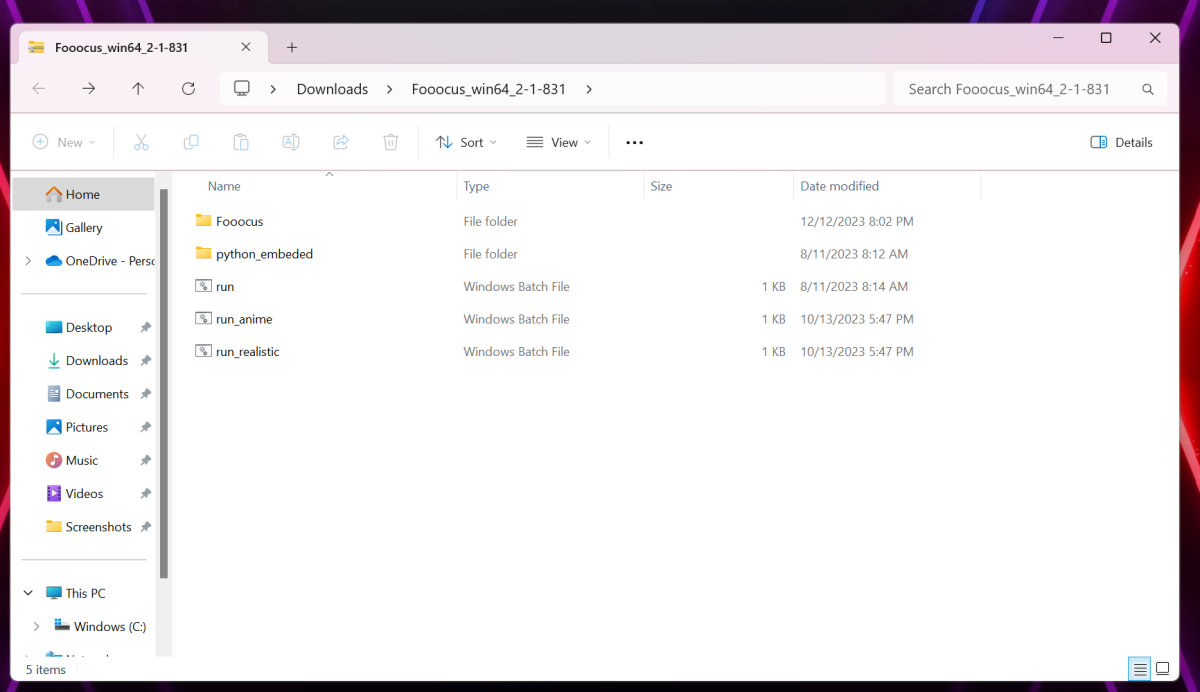
Normally, the .7z file format would imply that you have to unzip with 7Zip — which your PC will do, but only after you click the “Run.bat” batch file. This extracts about 5.5GB of data, which appears like it will take a long time to decompress but took my system about 10 minutes.
Fooocus is a little weird in that you can click the “run” batch file, and it will set everything up, with an emphasis on generic models. But you can also come back to it in the future and click the “run_anime” batch file and it will set up an alternate configuration that’s more optimized for anime. You can do the same for “run_realistic,” too.
Mark Hachman / IDG
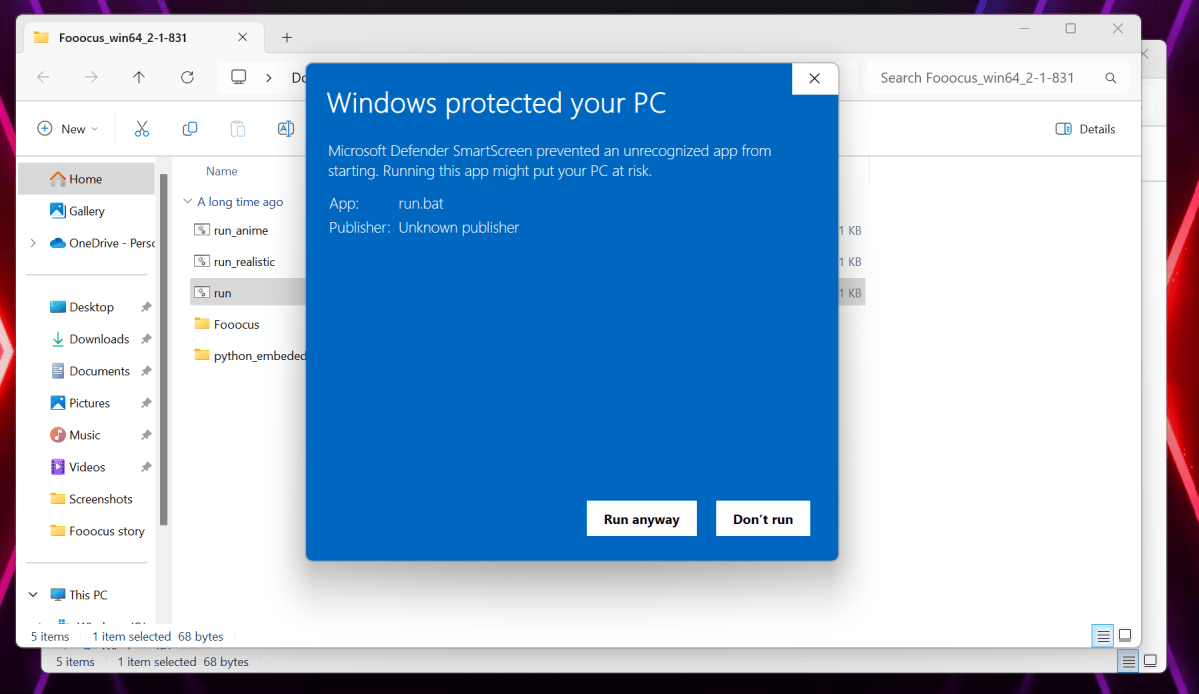
When you do, however, chances are that you’ll see a Windows Smartscreen warning. Fooocus isn’t a well-known application that Microsoft Windows has seen much of, so you’ll need to manually approve the download.
Mark Hachman / IDG
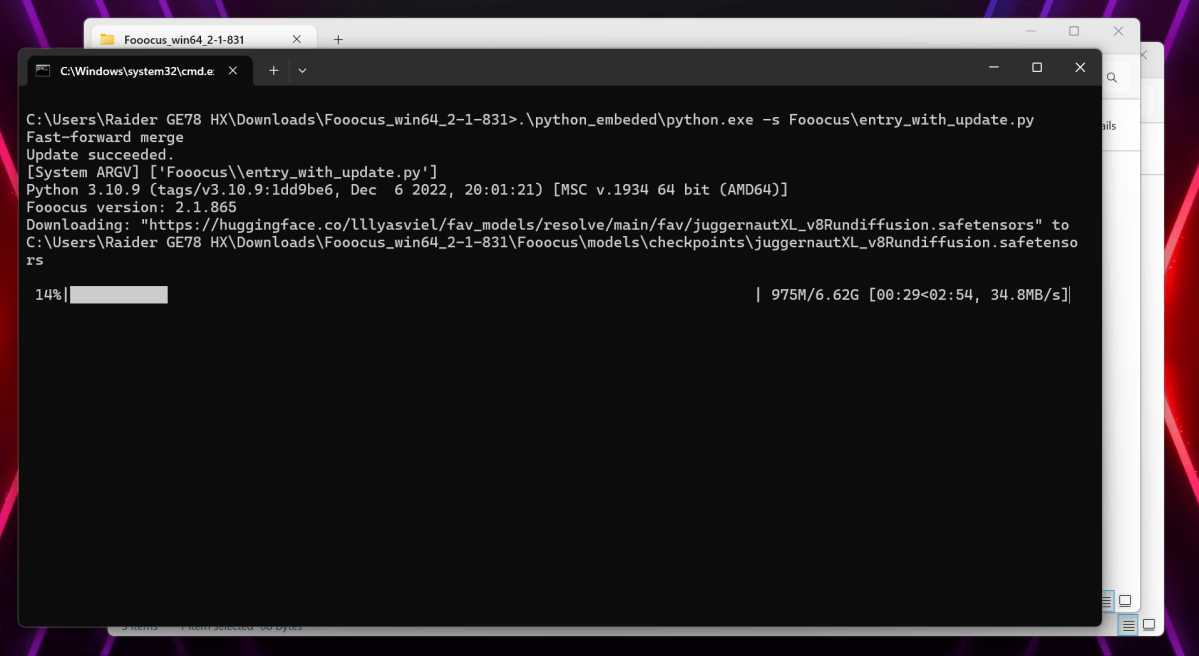
If you do, Foooocus downloads all of the software infrastructure it will need to run, which will require yet another few more gigabytes and a few more minutes to download. It will download them from HuggingFace.com, the internet’s repository for AI applications.
You’ll see this Command Line screen while it does so.
Mark Hachman / IDG
Very soon, however, you’ll see the Fooocus interface, which will launch inside your web browser. This isn’t unusual for AI applications. But there’s a lot of white space, which we’ll try to briefly explain. But, basically, you’re done.
How to use Foocus: Styles and prompts
Once you do see the Fooocus web interface below, you’re in business. There’s a prompt box at the bottom of the screen, where you can decide what the scene should have in it. Clicking “Generate” kicks off the generation process and creates your art. Absolutely feel free to click the tiny “Advanced” checkbox at the very bottom of the screen! This opens up a wealth of stylistic options, which many of my examples have enabled.
Mark Hachman / IDG
A prompt like “a cat” will work, of course, though that’s nothing you haven’t seen before. “A cat wearing a pirate hat” adds some variety. “A cat wearing a pirate hat at a burger restaurant” is even more creative.
If you’d like, you can specify the style you’d like in the prompt, such as “sinister” or “epic.” This is open to interpretation, of course. Fooocus prefers a rather photographic style by default.
Mark Hachman / IDG
If you do have a GPU in your system, Fooocus will automatically load itself onto it if it can, speeding up the process considerably.
When you click “Generate,” Fooocus will step through multiple iterations of the image (30, by default), refining and enhancing with each step. I’ve run Fooocus on a pair of systems (a 13th-gen Core desktop, with a GeForce RTX 3090; and a 14th-gen Intel Core HX laptop, with an RTX 4090) and the images took about 10 seconds or less to generate on the default “Speed” setting. You can choose either “Quality” or “Extreme Speed” to adjust the iterative steps, but it’s really not necessary.
You can get crazy with prompt generation, but there are limits: “A cat walking on the rings of Saturn” didn’t give me a recognizable result. But it’s all about experimentation. And yes, Fooocus is trained on celebrities and public figures, and it won’t offer too many limits on NSFW material. If you want to imagine Donald Trump and Joe Biden kissing each other, well, yes, you can. And aside from some AI weirdness where it doesn’t really understand lips, it looks pretty realistic.
Feel free to get weird. Is there a “goddess of cheese”? Now there is.
Mark Hachman / IDG
By default, Fooocus creates a pair of images based upon your prompt, and will also store them in folders, organized by day, inside the Fooocus directory.
Again, one of the strengths of Fooocus is that it does some behind-the-scenes work to make your generated images look great without requiring you to enter specifics such as the depth of field, artistic influences, and so on. But the “Advanced” checkbox does allow you to adjust the proportions of the generated image as part of the “Setting” tab. You can also issue “negative” prompts, too: Perhaps you want Fooocus to draw you a plate of spaghetti. Adding “meatballs” to the “negative” prompt box will ensure that detail isn’t added.
Here, both the Setting and Style tabs are highlighted, as well as some of the options for various styles.
The “Style” tab is a quick way to tailor the output in ways you might not be able to easily describe. Want an image that looks like it might grace the cover of an old Saturday Evening Post? Click the “Ads Fashion Editorial” checkbox. Each style has a small illustration of a cat in the selected style to help you pick, and there are tons of them to choose from. (Selecting “Terragen,” for example, gives you a nice landscape-y backdrop.) But you’re free to specify your own style in the prompt box: If you want a Viking princess (or Queen Elizabeth!) in the style of Gustav Klimt, give it a whirl.
While I’m not going to delve into the finer details of how to fine-tune prompts to tweak AI art, I do want to point out one advanced feature that might be worth playing with: Low-Rank Adaptations, or LoRAs. These are absolutely optional, and if you don’t want to deal with them, you can stop here. Enjoy!
Advanced work: Downloading additional LoRAs
You may have already played around with the filter options within Fooocus. LoRAs are even more specialized tools for specific types of art. They’re absolutely not necessary, but if you want to focus on a certain effect, adding a LoRA may allow the model a greater range of options. One featured LoRA I saw recently specifically focuses on lightning and lightning effects.
Put another way, a LoRA is just a plugin, like a browser extension for Fooocus. The site I use to find them is called Civitai.com, and there are a ton of LoRAs available for download. (You’ll need to sign up for a free account, and choose a number of content preferences. Some of the LoRA options cater to the NSFW, but you can filter those out.)
This is a neat artistic style that you can add to your model.
Mark Hachman / IDG
There are a couple of tricks. For now, you’ll need to filter the models by “SDXL,” the base model which Foocus runs on top of. You’ll also need to download or copy the LoRA into the appropriate directory, such as Fooocus\models\loras.
Once you download the additional LoRAs, you can turn them “on” within the Fooocus Advanced Menu (under the Model tab), and use them to influence your AI art output. Again, it requires some experimentation to see what works and what doesn’t.
Remember, AI art is deterministic, which means that (by default) the model is starting with a random example (or seed) each time. That means that there’s an element of randomness in AI art — you may need to try a few times to get a good result. If you do, you can dive deeper into the Fooocus documentation for learning how to upscale the art for either printing or a desktop background, editing it, or more.
And that’s it. Just remember: Try things out, and have fun!
For Engadget’s 20th anniversary, we put together a package of stories about the most pivotal pieces of technology from the past two decades, and mine was on Steam. It’s difficult to overstate how influential Steam is to PC gaming, or how rich the storefront has made Valve. As a private company with infinite piles of Steam cash, Valve has the freedom to ignore market pressure from consumers, creators and competitors. It famously has a flat hierarchy with no strict management structure, and developers are encouraged to follow their hearts.
This has all resulted in an incredibly rich studio that doesn’t produce much. It may be a tired joke that Valve can’t count to three in its games, but we’re not talking about Half-Life today. We’re talking about Valve’s history of buying exciting franchises and talented developers, playing with them for a while, and then forgetting they exist. Real fuckboi behavior — but it’s just how Valve does business.
Let’s take a look at Valve’s history of talent acquisition. One of its oldest franchises, Team Fortress, started as a Quake mod built by a small team in Australia, and Valve bought its developers and the rights to the game in 1998. Team Fortress 2 came out in 2007 and it received a few good years of updates and support. Today, the game has a devoted player base, but it’s riddled with bots and it’s unclear whether anyone at Valve is consistently working on TF2.
Portal began life as a student project called Narbacular Drop, and Valve hired its developers after seeing their demo in 2005. Portal officially came out in 2007, Portal 2 landed in 2011, and both were instant classics. There hasn’t been a whiff of another Portal game since, even though one of the series writers, Erik Wolpaw, really, really wants Valve to make Portal 3.
Of all the Valve franchises that have been left to wither and die, I miss Left 4 Dead the most. Turtle Rock started building Left 4 Dead in 2005, and by the time that came out in 2008, Valve had purchased the studio and its IP outright. Citing slow progress and poor communication, Turtle Rock left Valve before helping the company make Left 4 Dead 2 in 2009. Turtle Rock went on to release Evolve in 2015 and Black 4 Blood in 2021, and is now owned by Tencent. Meanwhile, I’m here, dreaming of that third Left 4 Dead game.
In 2010, Valve secured the rights to the Warcraft III mod Defense of the Ancients, and hired its lead developer. Dota 2 came out in 2013 and became an incredibly successful esports title. Now, eleven years later, Dota 2 players are complaining about a lack of support and communication from Valve, especially in comparison with games like League of Legends.
Counter-Strike has received the most attention from Valve in recent memory, with the rollout of Counter-Strike 2 late last year. The original Counter-Strike was a Half-Life mod, and Valve acquired it and its developers in 2000. Counter-Strike 2 is the fifth installment in the series, released 11 years after its predecessor, Counter-Strike: Global Offensive. After this recent attention, it’s about time for Valve to start ignoring the Counter-Strike community again.
Valve has quietly continued to make acquisitions. In 2018, Valve hired all 12 developers at Firewatch studio Campo Santo, who were at the time working on a very-rad-looking new game, In the Valley of Gods. This could turn out to be another spectacular, genre-defining franchise for Valve’s resume of acquired IP, but there have been no updates from that team in nearly six years. In April 2018, Campo Santo said they were still building In the Valley of Gods at Valve, and promised regular blog posts and quarterly reviews. And then, nothing.
Matt Wood worked at Valve for 17 years, where he helped build Left 4 Dead, Left 4 Dead 2, Portal 2, CS:GO and both episodes of Half-Life 2. He left in 2019 and is now preparing to release his first independent game, Little Kitty, Big City. Wood told me in 2023 that Valve was “sitting on their laurels a little bit, and it’s like they weren’t really challenging themselves, taking risks or doing anything. Steam’s making a lot of money so they don’t really have to.”
Steam’s unwavering success has helped turn Valve into a senior resort community for computer science nerds, where game developers go to live out their final years surrounded by fantastic amenities, tinkering and unsupervised. It’s a lovely scenario. At least developers there aren’t getting laid off — and I mean that sincerely. Steam is a great service, and Valve seems at least temporarily committed to the Steam Deck hardware, which is very cool. Still, I miss the games that Valve devoured. I have to wonder if the developers there do, too.
Valve’s treatment of legendary franchises and developers raises questions about its commitment to… anything, including Steam. What happens if Valve decides to pivot, or sell, or Gabe Newell retires and blows everything up? What would happen if Steam shut down? As a service with native DRM, all of our games would instantly disappear. Just like all those game devs.
This week’s news
Playdate update
Playdate is one of my favorite gaming gadgets of the past decade, not only because it has an incredibly cute crank, but also because its low-res screen belies a buffet of strange and beautiful experiences pushing the boundaries of traditional play. Panic held a showcase for new Playdate games last week and the headliner was Lucas Pope’s Mars After Midnight, which is coming out on March 12. Pope is the developer of Papers, Please and Return of the Obra Dinn, two incredible games, and Mars After Midnight is set in the doorway of a crowded alien colony. Pope’s games were made for Playdate, this time literally.
Yuzu and Citra are gone
A week after Nintendo threatened to sue the creators of Yuzu into oblivion, the popular Switch emulator has been pulled off the market as part of a $2.4 million settlement. To make matters worse for the emulation community, the lead developer of Yuzu announced that they are also killing the 3DS emulator Citra. Both emulators were open-source, so it’s likely we’ll see Citra at least maintained by the broader community. It’s not clear whether anyone is willing to take on a fork of Yuzu and risk a lawsuit.
Bonus Content
Ghost of Tsushima will hit PC on May 16. It comes with all of its DLCs, and Sony says it’ll run on anything from high-end PCs to portable PC gaming devices.
Capcom’s Kunitsu-Gami: Path of the Goddess is apparently coming out this year on PC, PlayStation and Xbox. It debuted at Summer Game Fest and looks pretty unique.
Hadeshits iOS as a Netflix mobile exclusive on March 19. There are currently no plans for an Android version, which sucks for me.
Now Playing
I found This Bed We Made while doing research for the GLAAD Gaming report I covered a few weeks ago, and I’m incredibly pleased about it. This Bed We Made is an exploration and narrative-driven game set in a 1950s hotel, and it’s absolutely oozing drama and mystery. The writing is fantastic, the characters are complex, and there’s a thrilling storyline running through the whole thing. It’s available on PC and consoles now.
This article originally appeared on Engadget at https://ift.tt/4n3DAqH
The world’s population apparently is increasingly using two phone numbers to manage their lives, and that often means the need to carry two phones. This is according to Verizon, who announced a new add-on to your plan today that gets you a second phone number for an additional monthly fee.
The new add-on is called Verizon Second Number and it is as I described above – Verizon will sell you a second phone number to run on your phone. To start, it’ll cost customers $10/mo as long as you sign-up through June 5. If you sign-up after June 5, the price will jump to $15/mo. Again, this only gets you a second phone number, not a new plan or anything else.
Who needs something like this? People who want separate phone and personal lines, yet don’t want to carry two phones. Maybe you want to move your old land line to your mobile phone. Maybe you just want a phone number that can be used to gobble up sign-ups and take on all of your spam calls.
Verizon says that Second Number uses eSIM to let you “swap between lines for phone and messaging apps,” plus it’ll show you which line is receiving a call or text as they come in. In other words, you are adding a second phone number as an eSIM on your phone that you can toggle between in specific apps, like calling or messaging apps. That all makes sense.
Of course, in order to use Second Number, you need a device that supports dual SIM. At this point, most phones support this type of setup. Your latest Samsung and Google and iPhones all do.
Interested? Well, Google Voice exists and it’s free (here). It’ll give you a second number at no cost. If that doesn’t sound like a fun thing to manage, you can sign-up for for Verizon Second Number here.
Two researchers found a way to use social engineering to potentially steal Teslas parked at charging stations.Kena Betancur/Getty Images
Hackers have a potential new way to steal your Tesla.
Researchers created a fake Tesla WiFi network to steal the owner’s login info and set up a new phone key.
Teams have previously found other hacking vulnerabilities in the high-tech Teslas.
If you own a Tesla, you might want to be extra careful logging into the WiFi networks at Tesla charging stations.
Security researchers Tommy Mysk and Talal Haj Bakry of Mysk Inc. published a YouTube video explaining how easy it can be for hackers to run off with your car using a clever social engineering trick.
Here’s how it works.
Many Tesla charging stations — of which there are over 50,000 in the world — offer a WiFi network typically called "Tesla Guest" that Tesla owners can log into and use while they wait for their car to charge, according to Mysk’s video.
Using a device called a Flipper Zero — a simple $169 hacking tool — the researchers created their own "Tesla Guest" WiFi network. When a victim tries to access the network, they are taken to a fake Tesla login page created by the hackers, who then steal their username, password, and two-factor authentication code directly from the duplicate site.
Although Mysk used a Flipper Zero to set up their own WiFi network, this step of the process can also be done with nearly any wireless device, like a Raspberry Pi, a laptop, or a cell phone, Mysk said in the video.
Once the hackers have stolen the credentials to the owner’s Tesla account, they can use it to log into the real Tesla app, but they have to do it quickly before the 2FA code expires, Mysk explains in the video.
One of Tesla vehicles’ unique features is that owners can use their phones as a digital key to unlock their car without the need for a physical key card.
Once logged in to the app with the owner’s credentials, the researchers set up a new phone key while staying a few feet away from the parked car.
The hackers wouldn’t even need to steal the car right then and there; they could track the Tesla’s location from the app and go steal it later.
Mysk said the unsuspecting Tesla owner isn’t even notified when a new phone key is set up. And, though the Tesla Model 3 owner’s manual says that the physical card is required to set up a new phone key, Mysk found that that wasn’t the case, according to the video.
"This means with a leaked email and password, an owner could lose their Tesla vehicle. This is insane," Tommy Mysk told Gizmodo. "Phishing and social engineering attacks are very common today, especially with the rise of AI technologies, and responsible companies must factor in such risks in their threat models."
When Mysk reported the issue to Tesla, the company responded that it had investigated and decided it wasn’t an issue, Mysk said in the video.
Tesla didn’t respond to Business Insider’s request for comment.
Tommy Mysk said he tested the method out on his own vehicle multiple times and even used a reset iPhone that had never before been paired to the vehicle, Gizmodo reported. Mysk claimed it worked every time.
Mysk said they conducted the experiment for research purposes only and said no one should steal cars (we agree).
At the end of their video, Mysk said the issue could be fixed if Tesla make physical key card authentication mandatory and notified owners when a new phone key is created.
This isn’t the first time savvy researchers have found relatively simple ways to hack into Teslas.
If you use your phone’s navigation apps a lot, then you’ve probably spent a good deal of time with Google Maps, or even Apple Maps; both offer solid navigational experiences. But Google’s other navigation app, Waze, also continues to receive new updates that make it extremely worthwhile for some trips.
If you live in busy urban area, then Waze might be your best option thanks to its crowd-sourced data. And the latest update to the Waze app aims to make that data even more useful. Here are six changes for the better:
Better directions for navigating roundabouts
One of the most useful new updates is an improvement to how Waze handles roundabouts. While these traffic circles might be handy for mitigating traffic congestion, they can be really confusing for drivers using navigation apps. Now, Waze will tell you exactly which lane to choose when you enter the roundabout so that you won’t miss your exit.
Better speed limit notifications
Waze is also adding a better way to keep up with shifting speed limits. It can be easy to miss speed limit changes, especially when you’re traveling in urban areas where it happens a lot. Now, Waze will provide up-to-date information about where speed limits change, including providing clear markers of the new speed along your route.
Better alerts for emergency responders
Google is also adding new alerts to help you keep up with first responders, which the company says should help keep them safe along your routes. The update will show you a marker of where an emergency vehicle was reported; you can confirm that its still there or tell others that it has since left. This feature is only available in a few countries right now, but Google is looking to expand it.
Better parking information
Waze is hoping to improve how you find parking during your travels, too. Now you’ll be able to look at more in-depth information about parking garages, including what they cost, whether they have wheelchair access, if they have valet options, and even if they offer EV charging. Google teamed up with Flash to to make these updates happen, and its slowly rolling out to major cities across the U.S. and Canada.
Better information about road hazards and local conditions
Finally, Google and Waze say that the latest update will give you alerts about road hazards like bad weather, railroad crossings, and potholes, to help you "navigate like a local." Given how active the Waze community is, the result should be more helpful information in places with lots of Waze users. Waze will likewise offer better information about traffic conditions and the causes of delays.
In the near century since Robert Goddard, the founder of modern rocketry, fired the first liquid-fuel rocket into the sky, rocket scientists worldwide have favored liquid-fuel engines to power everything from the V-2 missile to the Saturn V moon booster to the Falcon 9 launcher. A liquid rocket motor works by pumping fuel and oxidant into a combustion chamber, where they mix and burn to create hot exhaust gases that expand out the nozzle, propelling the rocket forward.
But all that seems about to change. There’s a new liquid rocket on the launchpad, and it’s definitely not like the rockets of days past. It’s called a rotating detonation engine, or RDE, and those detonations are what make it so different. The fuel in a standard liquid rocket engine doesn’t detonate at all; instead it deflagrates—the technical term for an ignition front that spreads at subsonic speeds, as in piston engines, turbine engines and even candle flames, says Doug Perkins, a detonation propulsion scientist, who has worked at NASA’s Glenn Research Center since the 1990s. When fuel ignites in an RDE, by contrast, it doesn’t “burn” so much as it “bangs,” consumed more completely and near instantaneously via intense compression and heating by a supersonic shockwave. Simply put, rather than burning fuel as in existing powerplants, he says, an RDE explodes it to produce more thrust. Thus an RDE can capture more of the propellant’s energy to power vehicles farther, faster and with larger payloads.
“The power density—the amount of energy release we get within a certain volume—is an order of magnitude higher than today’s devices. And that’s exciting,” says Steve Heister, a Purdue University engineering professor and longtime propulsion researcher. The circa 1,200-degree Celsius combustion that occurs inside an RDE is like “hellfire,” he jests, calling it “the fastest way to eat propellant.”
On supporting science journalism
If you’re enjoying this article, consider supporting our award-winning journalism by subscribing. By purchasing a subscription you are helping to ensure the future of impactful stories about the discoveries and ideas shaping our world today.
The potential benefits of theoretical detonation engines have long been known from the basic thermodynamics of combustion, Perkins says, but for decades most propulsion experts had considered the challenge of controlling the engine cycle’s explosive instabilities too daunting for serious technical development. Today, however, a growing number of aerospace engineers believe the dawn of RDE rocketry is at hand.
“Rocketry has struggled with combustion instability since the very earliest days of liquid rocket engines,” Heister says. “With RDEs, we’re embracing the instability. Let’s make it unstable, but let’s try to control the way it’s unstable.”
During operation, a restless ring of fire runs at the heart of every RDE, with detonation-driven shockwaves whirling in resonance around a high-walled, torus-shaped combustor cavity at constant velocities from Mach 3 up to Mach 6. The expanding gases barber-pole around and out the cylindrical combustion chamber, delivering steady thrust. That racetracklike circulation starts when a pump sprays propellants through perforations in the floor of the annular cavity, and after ignition, the detonation waves can rocket out until the fuel tanks empty. Surprisingly, RDEs have no moving parts. Rather than high-speed fuel injectors, it is the high pressures of the supersonic shockwaves flashing around the precisely engineered circuit that automatically close and open the fuel ports just in time to instantly fuel the next fiery tidal wave that’s sweeping in fast behind.
RDE flight hardware—high-performance, fuel-efficient, compact, affordable rocket motors—will likely first soar aloft by 2030, according to NASA forecasts. In time, RDE applications could range from Mach 5 attack missiles and hypersonic aircraft for the Defense Department to second-stage launchers, deep-space transports, and lunar and Martian landers for NASA, and perhaps even to supersonic transports for the commercial airline industry.
It’s no wonder, then, that significant RDE developments are already appearing. Last year engineers from NASA, Purdue and In Space LLC conducted a series of ground tests of a full-scale RDE rocket at NASA’s Marshall Space Flight Center that, with the help of a cooling system, produced 5,800 pounds of thrust for 251 seconds, says NASA combustion devices engineer Thomas Teasley, who leads the NASA effort. For perspective, most RDE test firings last one or two seconds.
NASA is pursuing RDE rockets as powerplants for planetary landers and interplanetary spacecraft, where their high performance and compact sizes could allow design efficiencies that benefit other mission areas, Teasley says. “For a typical lander engine, we’re talking a combustor that’s a foot, foot-and-a-half long,” he explains. “With RDEs, that’s down to a couple of inches.”
Also last year GE Aerospace, one of the world’s biggest jet engine builders, sent supersonic air through a subscale lab rig that combined a Mach 2.5-class turbofan with a rotating detonation-enabled “dual-mode ramjet” thought to be capable of Mach 5 velocities. The RDE would supply the Mach 3 speeds needed to start up the ramjet in flight, velocities turbines have difficulty reaching. Joseph Vinciquerra, senior director of aerospace research at GE Aerospace, told FlightGlobal that the engine is “platform agnostic,” meaning that it could someday power missiles, aircraft or even spaceplanes bound for orbit.
Under a U.S. Department of Energy program, researchers at Purdue and Argonne National Laboratory developed a hydrogen-air RDE with innovative nozzle guide vanes for gas turbine power generation. Their plans call for retrofitting a Rolls-Royce turbine with an RDE this year.
And last fall the Defense Advanced Research Projects Agency (DARPA) selected RTX, another big aerospace group, to develop a next-gen missile called Gambit, with RTX’s Pratt & Whitney Military Engines unit developing the air-breathing RDE unit that’s to power it. “RDE is a disruptive, game-changing technology,” says Pratt & Whitney’s Military Engines president Jill Albertelli, a veteran aerospace engineer who has a team of 50 people working on the project. “The RDE has attributes that make for a pretty great missile. It has clear potential to provide high-performance, high-efficiency, long-range propulsion in a compact, cost-effective package.”
Yet despite so many fresh advances, Perkins stresses that the RDE field is still in its experimental stage: “any combustion is an unsteady process” that includes instabilities, turbulence and nonlinear behaviors, so gaining greater insight into the underlying physical and chemical forces that prevail under such extreme conditions is critical. Beyond “getting the fuel mixture just right,” many of the current and hoped-for innovations boil down to better understanding the chemical kinetics, the fluid dynamics and thermoacoustics of RDE combustors, which are said to ring like bells during firing. For instance, innovations should derive from enhanced laser diagnostics and optical techniques to map at smaller scales the convoluted flow fields that form as the submicron-thick leading edges of supersonic shockwaves shear through fuel mixtures. Making such exacting measurements of velocity, pressure, density, temperature and chemical species through fireproof quartz viewing windows in laboratory combustion chambers can provide the real-world observations needed to validate the complex computer simulations that help guide research and development.
One development that’s accelerated the critical experimental “build-and-burn” series testing and redesign that powers RDE progress in recent decades has been the arrival of more affordable ultra-high-speed cameras that can visualize events that occur at a hundredth of a microsecond, says Jiro Kasahara, the Nagoya University propulsion researcher who led the team that first operated an RDE in space. More recently NASA Marshall’s development of stronger heat-resistant metal alloys and its innovative use of laser 3D-printing systems has also helped drive progress by enabling high-performance test hardware to be built more quickly and at lower cost than by previous methods.
Pratt & Whitney, which is building on the two decades of detonation engine research it conducted in collaboration with the pioneering propulsion research groups at the Air Force Research Laboratory, is closing in on a fieldable RDE rocket motor. The latest ground tests of a prototype RDE motor “look really good,” Albertelli says. “The results are validating the model architecture that our team has developed during five years of theory and analysis of the needed speeds, flows and pressures.” The next step is to integrate the motor into a vehicle airframe and start ground testing.
Even though the theoretical concepts have been around for nearly 90 years, RDEs are still in their early days. “We really don’t know what an optimized RDE even would look like yet,” NASA’s Perkins says. “I can count the people with significant expertise in this area on 10 fingers.” Nevertheless, rising excitement is spurring RDE startup launches. Alexis Harroun, one of Steve Heister’s recent Purdue graduate students, just founded an RDE startup, Juno Propulsion, with help from an NSF small-business-incubator program. “We just hired our first employee,” she says.
Meanwhile four-year-old, Houston-based Venus Aerospace is busy testing RDE rockets that produce 4,000 pounds of thrust and more, says CTO and co-founder Andrew Duggleby. The company’s 100 employees aim to fly a Mach 5 drone powered by their RDE design to provide hypersonic-flight-testing services to defense contractors. Venus’ RDE rocket augments its burn by drawing in outside air into the combustor while adding extra fuel to the mix, creating a sort of supercharged afterburner effect that boosts speeds sufficiently to start up a ramjet stage.
In January Venus and NASA Marshall announced they had partnered on a cooled RDE rocket featuring a company-designed injector that operated for four minutes of hot-fire testing. “We’ll build a combustor design out of copper, which costs $20,000 and lasts for two seconds,” Duggleby says. “Then we iterate, iterate, iterate. And when we find a design we love, we’ll 3D-print it from NASA’s refractory alloys with integral cooling channels and test it at higher thrusts and for longer durations.”
As global interest in RDE takes off, aerospace engineering labs in the U.S., Japan, China, Europe and elsewhere comprise an emerging international R&D community, though it’s one that includes a large classified component. In any case, nearly 80 research papers on detonation propulsion were presented at January’s SciTech Forum of the American Institute of Aeronautics and Astronautics in Orlando, Fla. Who knows? Maybe rocketry’s next Goddard was there.