Windows includes built-in ransomware protection. Here’s how to turn it on

https://www.pcworld.com/article/2245853/how-to-turn-on-windows-ransomware-protection.html

Ransomware is nasty stuff. This type of malware encrypts files on your PC so that you can’t access them—unless you must pay the attacker to unlock the data. In other words, your files are held hostage until you cough up the demanded ransom.

The best defense against ransomware is avoiding sites and downloads riddled with it, but you can take other protective measures, too. Modern antivirus software often restrict which apps can change files in folders commonly targeted by ransomware. Microsoft Defender, which is built into Windows, can do this too. (Microsoft changed the name from Windows Defender several years ago, but it’s the same program.) Some antivirus suites also run automatic backups, in case you need to restore your files.

The catch? Unlike third-party antivirus software, these extra safeguards are not turned on by default in Microsoft Defender. You have to enable them yourself.

Further reading: PCWorld’s top picks for best antivirus software 2024.

How to turn on ransomware protection in Windows

Step One: Open Windows Security

Open the Windows Security app on your PC. You can access it in one of several ways:

  • Press Alt + Spacebar on your keyboard, type in windows security, then hit Enter
  • Open your Start Menu and type in windows security, then press Enter
  • Open your Settings app, then choose Windows Security in the left pane

Step Two: Find your ransomware settings

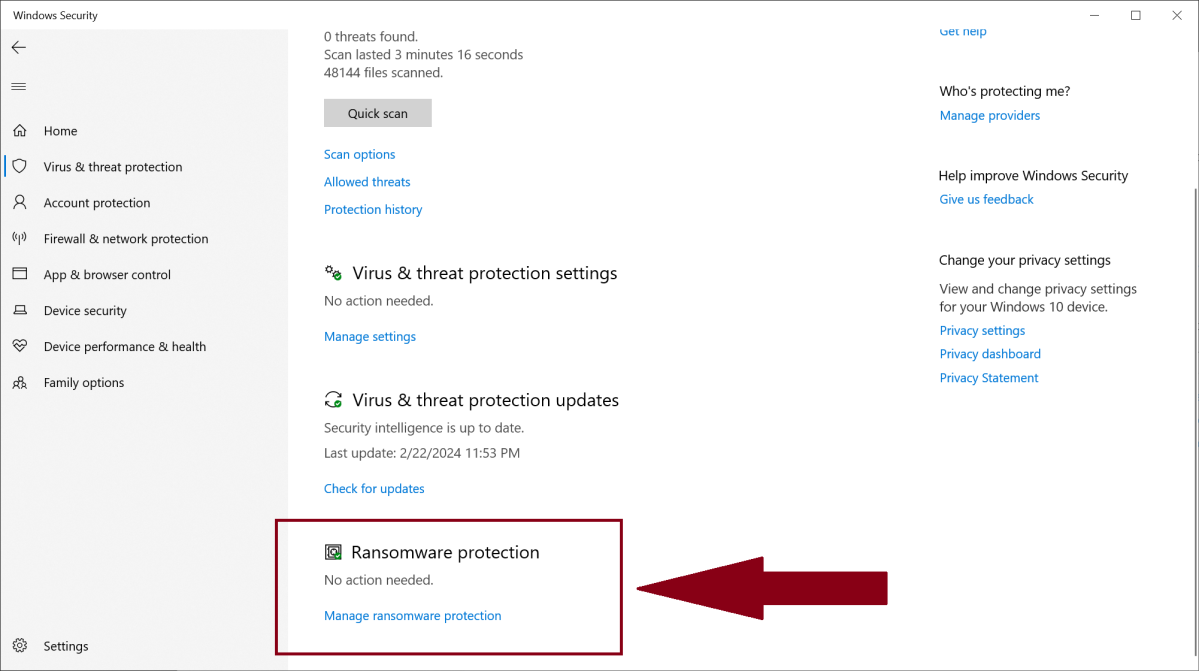
In the Windows Security app, click on Virus & threat protection. Then click Manage ransomware protection at the bottom of the screen.

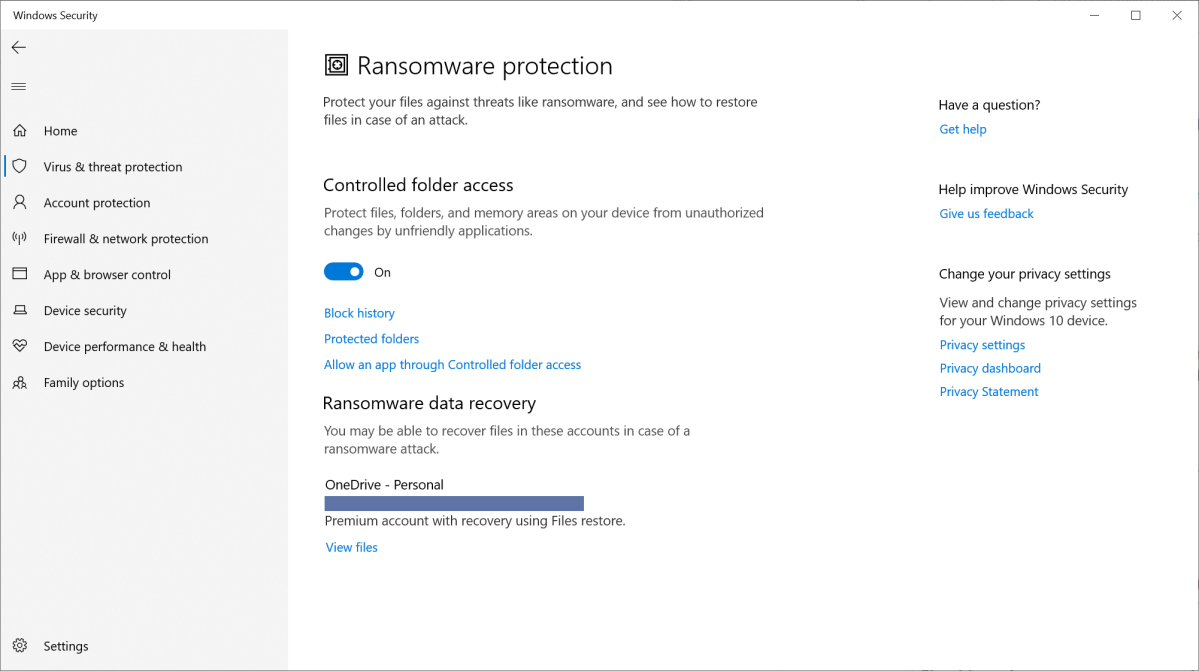
Next, turn on Controlled folder access. This setting restricts app access to your PC’s default OneDrive, Documents, Pictures, Videos, Music, and Favorites folders. You can also manually add other folders to the list.

Not all apps will be barred from these areas in Windows—Microsoft Office programs are automatically allowed to open and alter files. But if it’s not on Microsoft’s internal list of trusted apps, a program can’t see anything in those folders until explicit permission is granted in Windows Security.

Step three: Make sure you’re logged into OneDrive

Limiting access to files and folders won’t completely protect them. Another important method of defense is to have good backups—which Windows automatically does if you’re logged into OneDrive. (You can either connect a Microsoft account to your whole Windows PC, or just the OneDrive app specifically.)

To confirm that this protection is on, you can look at Ransomware protection > Ransomware data recovery.

Of course, for the purpose of warding off ransomware’s worst effects, the safest backup of your files is the one you keep offline. You should make one in addition to anything stored in the cloud—if you only have one copy of your data, you’re not properly backed up after all.

Should you turn on ransomware protection in Windows?

Security and convenience live on opposite ends of a spectrum, and that’s the case here, too. Controlling folder access in Windows can keep attackers out of your important folders, but it can also be slightly inconvenient. Gamers, for example, may find that access to save files might be blocked by default, as they’re often saved in your Documents folder.

You can solve this problem with minimal work—add the app to the access list. Or save game files to a different folder on your PC that does not have controlled access to it. (You’ll just have to use third-party software to set up a schedule for regular backups.)

OUr CURRENT PICK FOR BEST ANTIVIRUS SOFTWARE

Norton 360 Deluxe

Norton 360 Deluxe

Price When Reviewed:


$49.99 for the first year

Protect your Windows PC from other online threats, too

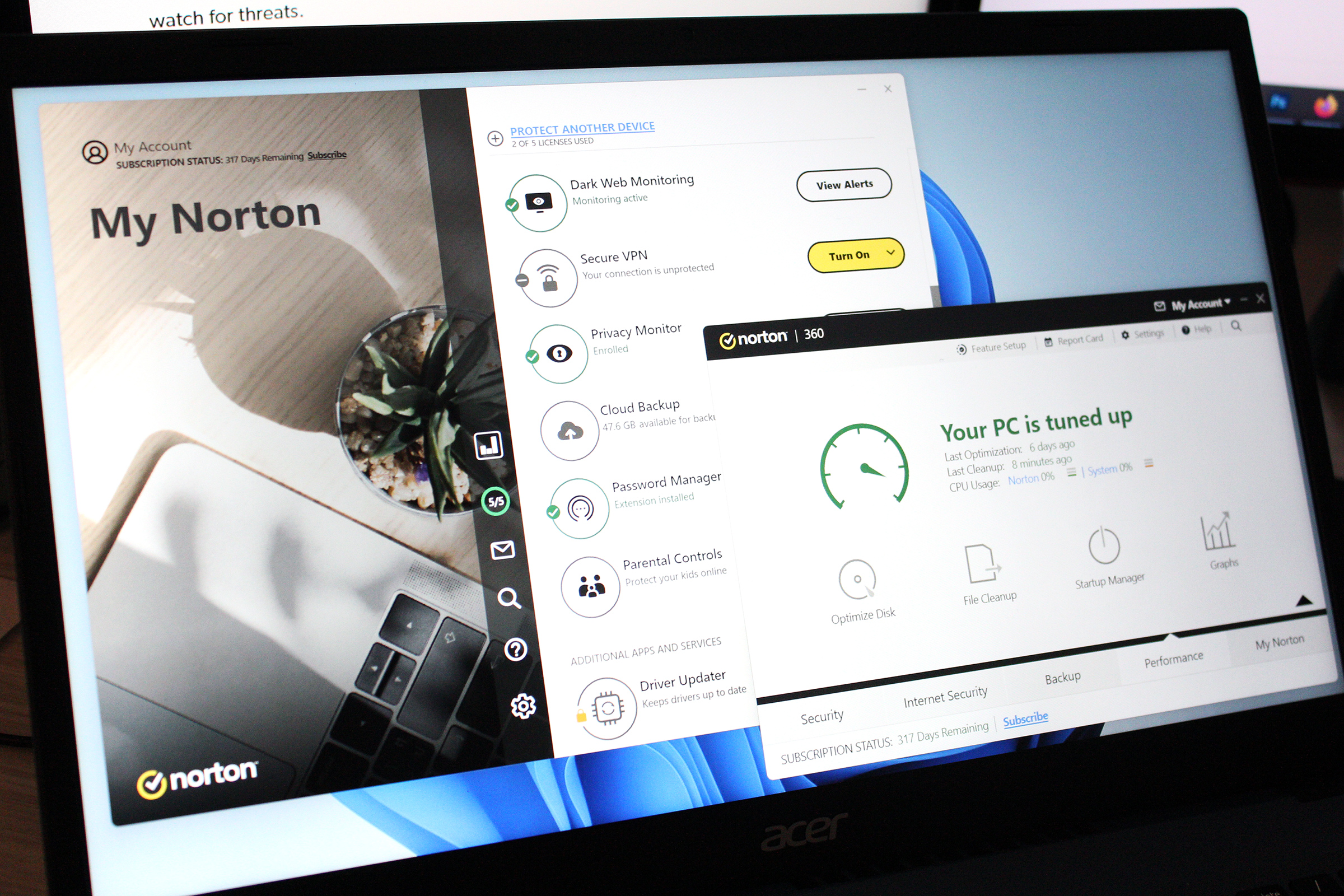
For more information about Windows Security (and its different components), you can check out our video overview on YouTube. If you prefer more sophisticated software, plus additional protections, you can also look into upgrading your antivirus software. For example, Norton 300 Deluxe, our current top pick for antivirus, bundles strong malware protection with a VPN, password manager, dark web monitoring for your personal data, and more. It can help simplify staying safer online.

via PCWorld https://www.pcworld.com

March 1, 2024 at 05:33AM

Scientists Suggest Dehydrating a Layer of Earth’s Atmosphere to Fight Global Warming

https://gizmodo.com/geoengineering-dehydrate-stratosphere-climate-change-1851293611

A new climate intervention strategy aims to decrease the amount of water vapor in the stratosphere by injecting it with ice-forming nuclei. The idea is that, by reducing the water content, more heat in the form of infrared radiation would leak out into space.

Prepping the Sandworm Scenes in Dune: Part Two

Scientists described the strategy a study published Wednesday in Science Advances. “It’s not a very complicated idea,” Joshua Schwarz, a researcher at National Oceanic and Atmospheric Administration’s Earth System Research Laboratory and lead study author, told Gizmodo. “But this idea… it’s not a silver bullet, it’s not the magic solution that nobody knows about. It’s just one alternative that will do a little something in the right direction.”

Water vapor acts as a greenhouse gas in Earth’s atmosphere, absorbing radiation from the Sun and then emitting it to the surface of our planet. The scientists behind the new study want to target a small amount of the water vapor found in the stratosphere, the second layer of Earth’s atmosphere, by adding ice-nucleating particles. With water vapor condensing to ice, there would be less trapped heat. Removing around 3% of the water vapor would have a global effect, according to the study.

Using observations from NASA’s Airborne Tropical TRopopause EXperiment (ATTREX), a research aircraft that tracked the transport of water vapor into the upper atmosphere, the team created a model to examine the amount of particles needed to pull off stratospheric dehydration and their predicted trajectories. The models suggested that the idea can work to help mitigate the effects of global warming, but a lot of technical challenges still lie ahead in terms of implementing the strategy.

“We have confidence that it would be a win… that it wouldn’t do anything bad and we know exactly how to do it,” Schwarz said. “We didn’t find anything that said, this is impossible, give up. Instead, we only learned that there’s still more to know.”

The stratosphere extends from 4 to 12 miles (6 to 20 km) above Earth’s surface to around 31 miles (50 km) up. There are aircraft capable of reaching those heights, but the idea still needs the development of an engineering capability to inject the nuclei into the stratosphere. And much more work would need to be done to identify the potential risks and unintended effects.

“If we had one magic way to [address climate change] I wouldn’t say, oh we shouldn’t use it,” Schwarz said. “At this point, my feeling is we need more ideas and to explore the implications of the approaches we decided to take…it might be easier to get a mixture of options that’s better for the planet and humanity than just one approach.”

via Gizmodo https://gizmodo.com

February 28, 2024 at 03:03PM

Ultra-Processed Foods Have Disturbing Health Effects, Large Review Finds

https://gizmodo.com/ultra-processed-foods-health-effects-depression-sleep-1851298904

A lifetime of snacking and frozen food dinners may affect your body in lots of surprising ways, new research suggests. The study, a large-scale review of the existing evidence, found an association between regularly eating ultra-processed foods and a higher risk of many health problems. It also found that these foods were associated with an early death.

Prepping the Sandworm Scenes in Dune: Part Two

Many studies have indicated that ultra-processed foods are uniquely bad for our health. But the authors of this latest research, published Wednesday in the BMJ, say there hasn’t yet been a comprehensive, bird’s-eye view of the scientific literature surrounding these foods. To remedy that, they decided to conduct an “umbrella review”—a review of other reviews and meta-analyses on a particular topic.

All told, the team looked at data from 14 reviews that collectively involved nearly 10 million people, none of which were funded by manufacturers of ultra-processed foods. Across the board, they found that a higher exposure to these foods was associated with a higher risk of 32 health outcomes, from heart disease to trouble sleeping to depression. Greater intake of ultra-processed foods was also tied to a greater risk of dying from any cause (21% higher), as well as a greater risk of heart-related death specifically (66% higher).

“This umbrella review found consistent evidence of a higher risk of adverse health outcomes associated with greater ultra-processed food exposure,” the authors wrote.

It can be very difficult to tease out just how unhealthy any one group of foods can be, and the authors note that the evidence for some of these links is much stronger than others. With conditions like Crohn’s disease, obesity, and colon cancer, for instance, the authors found weak to no evidence for a potential association. Conversely, the strongest evidence for a higher risk was seen with heart-related deaths, common mental health disorders, and type 2 diabetes.

Another limitation of this research is that not everyone might agree on what exactly is an ultra-processed food. The criteria used by the authors and many other researchers is known as the NOVA Food Classification system, which defines these foods as anything “made entirely or mostly from substances extracted from foods, derived from food constituents, or synthesized in laboratories from food substrates or other organic sources.” Common examples of ultra-processed foods include soft drinks, candy, and ready-to-eat meals. But there has been some debate over how useful this system really is and whether even food experts can reliably identify an ultra-processed food based on this criteria.

That said, small randomized and controlled experiments have found that ultra-processed foods might be especially bad for us. And given all of the data collected, it would be very strange if there wasn’t some genuine health risk from eating too many of these foods. For their part, the authors say that more rigorous research is needed to understand exactly how these foods can negatively affect our health, but they also argue that policymakers should already be doing more to reduce our dependence on them. Other research has suggested that everyone’s diets—including the diets of kids and teens—are far too full of these foods.

“These findings support urgent mechanistic research and public health actions that seek to target and minimize ultra-processed food consumption for improved population health,” the study authors wrote.

via Gizmodo https://gizmodo.com

February 29, 2024 at 04:03PM

Google Pauses Gemini’s Image Generator After It Was Accused of Being Racist Against White People

https://gizmodo.com/google-pauses-gemini-ai-image-generator-white-racism-1851277547

Google is pausing the ability of its AI chatbot Gemini to generate images of people after a slew of historically inaccurate and racially diverse creations, such as images of Black Nazi soldiers and a Black medieval British king, went viral and led some to say the company was racist against white people.

Google’s Antitrust Case Is the Best Thing That Ever Happened to AI

“We’re already working to address recent issues with Gemini’s image generation feature,” Google said in a statement on X, formerly known as Twitter, on Thursday morning. “While we do this, we’re going to pause the image generation of people and will re-release an improved version soon.”

The company initially addressed the controversy, which caused wide outrage among the anti-woke crowd, on Wednesday and said it was taking immediate action to fix the issues. In a statement, Google said that while Gemini’s ability to generate diverse images of people was “generally a good thing,” a nod to the challenges AI image generators have had at creating images of people of color, Gemini was “missing the mark here.”

Gizmodo confirmed that Gemini’s ability to generate images had been disabled in some regions, such as Europe, on Thursday morning. (The Verge was still able to generate images with Gemini using a U.S. VPN). When asked to recreate, for example, an image of a Nazi-era German soldier, the chatbot declined.

“I can’t create images yet so I’m not able to help you with that,” Gemini replied.

However, that doesn’t seem to be boilerplate response. I also tried to ask Gemini to recreate a “historically accurate depiction of a medieval British king,” a prompt generated led to images of Black and Indigenous people on Wednesday.

In this case, Gemini said that while it couldn’t directly create images, it could “certainly guide you towards creating a historically accurate image of a medieval British king!” by providing information on descriptions of kings based on historical accounts and information on types of clothing and hairstyles, among details.

Notably, though, Gemini added that it was important to consider artistic freedom when it came to creating images—which is one of the things that got it in trouble in the first place.

“Remember, historical accuracy is important, but artistic freedom can also add depth and interest to your image,” Gemini said.

via Gizmodo https://gizmodo.com

February 22, 2024 at 06:24AM

Reddit Signs $60 Million Deal to Scrape Your Online Community for AI Parts: Report

https://gizmodo.com/reddit-signs-deal-scrape-your-online-community-ai-parts-1851270475

Reddit reportedly signed a $60 million deal with a “large AI company” to allow its online communities to be scraped for AI training data, according to Bloomberg on Friday. The unnamed AI company will sift through millions of posts on Reddit, and train a large language model on Reddit’s threads.

Reddit Knowingly Downvoting Self | Future Tech

Reddit is reportedly weighing an IPO with a $5 billion valuation, despite only bringing in $800 million in revenue last year. Reddit is not profitable but has a rich valuation because its online communities offer a perfect training ground for AI models. However, licensing out your user base’s thoughts and ideas is not always reciprocated well. The most popular subreddits went dark in protest last year after users took issue with the company charging for access to its application programming interface (API), first announced in April of 2023.

Reddit’s reported deal with an “unnamed large AI company” is exactly what the platform has been looking for. Big Tech is hungry for data, and that has turned legacy news organizations, community forums, and even the University of Michigan into mere content farms. These deals, though upsetting to users, offer Reddit a path to profitability.

“The Reddit corpus of data is really valuable,” said Reddit CEO Steve Huffman to The New York Times in April. “But we don’t need to give all of that value to some of the largest companies in the world for free.”

But when Reddit started charging for API access, it didn’t just charge big companies, it also started charging small, independent researchers. This shift made it more difficult for Reddit’s moderators to manage their communities, and some argued it made for a worse experience for Reddit’s 800 million monthly active users.

“We believe that the longevity and success of this platform rest on preserving the rich ecosystem that has developed around it,” said Reddit moderators in a collective letter from last June. “The potential loss of these services due to the pricing change would significantly impact our ability to moderate efficiently, thus negatively affecting the experience for users in our communities.”

Reddit did not immediately respond to Gizmodo’s request for comment.

Apple was exploring $50 million AI deals with The New York Times, Condé Nast, and other news publishers in December. Shutterstock is also licensing its human-made content to OpenAI for training on its models. Twitter, Instagram, and YouTube have also become increasingly valuable in recent years, as they’re now seen as content gold mines.

The platform also introduced ads in recent years and made it impossible for users to opt out of seeing advertiser content in 2023. As Reddit becomes a public company, there’s a growing concern from users that management will hurt the thriving community forum it has built.

There’s also a bigger concern about how AI companies are licensing data. Content platforms are signing million-dollar licensing agreements with AI companies, but the actual people who created this content aren’t getting a thing. Meanwhile, AI threatens to replace content creators in the editorial, graphic design, and film industries.

via Gizmodo https://gizmodo.com

February 20, 2024 at 09:45AM

Secret Mathematical Patterns Revealed in Bach’s Music

https://www.scientificamerican.com/article/secret-mathematical-patterns-revealed-in-bachs-music/

Baroque German composer Johann Sebastian Bach produced music that is so scrupulously structured that it’s often compared to math. Although few among us are emotionally affected by mathematics, Bach’s works—and music in general—moves us. It’s more than sound; it’s a message. And now, thanks to tools from information theory, researchers are starting to understand how Bach’s music gets that message across.

By representing scores as simple networks of dots, called nodes, connected by lines, called edges, scientists quantified the information conveyed by hundreds of Bach’s compositions. An analysis of these musical networks published on February 2 in Physical Review Research revealed that Bach’s many musical styles, such as chorales and toccatas, differed markedly in how much information they communicated—and that the musical networks contained structures that could make their messages easier for human listeners to understand.

“I just found the idea really cool,” says physicist Suman Kulkarni of the University of Pennsylvania, lead author of the new study. “We used tools from physics without making assumptions about the musical pieces, just starting with this simple representation and seeing what that can tell us about the information that is being conveyed.”


On supporting science journalism

If you’re enjoying this article, consider supporting our award-winning journalism by subscribing. By purchasing a subscription you are helping to ensure the future of impactful stories about the discoveries and ideas shaping our world today.


Researchers quantified the information content of everything from simple sequences to tangled networks using information entropy, a concept introduced by mathematician Claude Shannon in 1948.

As its name suggests, information entropy is mathematically and conceptually related to thermodynamic entropy. It can be thought of as a measure of how surprising a message is—where a “message” can be anything that conveys information, from a sequence of numbers to a piece of music. That perspective may feel counterintuitive, given that, colloquially, information is often equated with certainty. But the key insight of information entropy is that learning something you already know isn’t learning at all.

A conversation with a person who can only ever say one thing, such as the character Hodor in the television series Game of Thrones, who only says “Hodor,” would be predictable but uninformative. A chat with Pikachu would be a bit better; the Pokémon can only say the syllables in its name, but it can rearrange them, unlike Hodor. Likewise, a musical piece with just one note would be relatively easy for the brain to “learn,” or accurately reproduce as a mental model, but the piece would struggle to get any kind of message across. Watching a coin flip with a double-headed coin would yield no information at all.

Of course, packing a message full of information isn’t much good if whatever—or whoever—receives it can’t accurately understand that information. And when it comes to musical messages, researchers are still working out how we learn what music is trying to tell us.

“There are a few different theories,” says cognitive scientist Marcus Pearce of Queen Mary University of London, who wasn’t involved in the recent Physical Review Research study. “The main one, I think, at the moment, is based on probabilistic learning.”

In this framework, “learning” music means building up accurate mental representations of the real sounds we hear—what researchers call a model—through an interplay of anticipation and surprise. Our mental models predict how likely it is that a given sound will come next, based on what came before. Then, Pearce says, “you find out whether the prediction was right or wrong, and then you can update your model accordingly.”

Kulkarni and her colleagues are physicists, not musicians. They wanted to use the tools of information theory to scour music for informational structures that could have something to do with how humans glean meaning from melody.

So Kulkarni boiled down 337 Bach compositions into webs of interconnected nodes and calculated the information entropy of the resulting networks. In these networks, each note of the original score is a node, and each transition between notes is an edge. For example, if a piece included an E note followed by a C and a G played together, the node representing E would be connected to the nodes representing C and G.

Networks of note transitions in Bach’s music packed more of an informational punch than randomly generated networks of the same size—the result of greater variation in the networks’ nodal degrees, or the number of edges connected to each node. Additionally, the scientists uncovered variation in the information structure and content of Bach’s many compositional styles. Chorales, a type of hymn meant to be sung, yielded networks that were relatively sparse in information, though still more information-rich than randomly generated networks of the same size. Toccatas and preludes, musical styles that are often written for keyboard instruments such as the organ, harpsichord and piano, had higher information entropy.

“I was particularly excited by the higher levels of surprise in the toccatas than in the chorale works,” says study co-author and physicist Dani Bassett of the University of Pennsylvania. “These two sorts of pieces feel different in my bones, and I was interested to see that distinction manifest in the compositional information.”

Network structures in Bach’s compositions might also make it easier for human listeners to learn those networks accurately. Humans don’t learn networks perfectly. We have biases, Bassett says. “We kind of ignore some of the local information in favor of seeing the bigger informational picture across the entire system,” they add. By modeling this bias in how we build our mental models of complex networks, the researchers compared the total information of each musical network to the amount of information a human listener would glean from it.

The musical networks contained clusters of note transitions that might help our biased brains “learn” the music—to reproduce the music’s informational structure accurately as a mental model—without sacrificing much information.

“The particular kind of way in which they capture learnability is pretty interesting,” says Peter Harrison of the University of Cambridge, who wasn’t involved in the study. “It’s very reductive in a certain sense. But it’s quite complementary to other theories we have out there, and learnability is a pretty hard thing to get a handle on.”

This type of network analysis isn’t particular to Bach—it could work for any composer. Pearce says it would be interesting to use the approach to compare different composers or look for informational trends through music history. For her part, Kulkarni is excited to analyze the informational properties of scores from beyond the Western musical tradition.

Music isn’t just a sequence of notes, though, Harrison notes. Rhythm, volume, instruments’ timbre—these elements and more are important dimensions of the musical messages that weren’t considered in this study. Kulkarni says she’d be interested in including these aspects of music in her networks. The process could also work the other way, Harrison adds: rather than boiling musical features down to a network, he’s curious how network features translate to things that a musician would recognize.

“A musician would say, ‘What are the actual musical rules, or the musical characteristics, that are driving this? Can I hear this on a piano?’” Harrison says.

Finally, it’s not yet clear how, exactly, the network patterns identified in the new study translate into the lived experience of listening to a Bach piece—or any music, Pearce says. Settling that will be a matter for music psychology, he continues. Experiments could reveal “if, actually, those kinds of things are perceivable by people and then what effects they have on the pleasure that people have when they’re listening to music.” Likewise, Harrison says he’d be interested in experiments testing whether the types of network-learning mistakes the researchers modeled in this study are actually important for how people learn music.

“The fact that humans have this kind of imperfect, biased perception of complex informational systems is critical for understanding how we engage in music,” Bassett says. “Understanding the informational complexity of Bach’s compositions opens new questions regarding the cognitive processes that underlie how we each appreciate different sorts of music.”

via Scientific American https://ift.tt/Ly8UAn9

February 16, 2024 at 06:40AM