Next year will mark the 10th anniversary of the second-generation Tesla Roadster’s reveal in prototype form, and there’s still no sign of a production model yet.
The new Tesla Roadster has been delayed at least eight times since its initial unveiling in 2017, with the latest estimates suggesting a production start in 2027 or 2028. Given that time frame, there’s a high chance a surprise Chinese electric supercar equipped with rocket boosters will beat the Roadster—which should offer an optional SpaceX package featuring 10 cold-gas thrusters—to market.
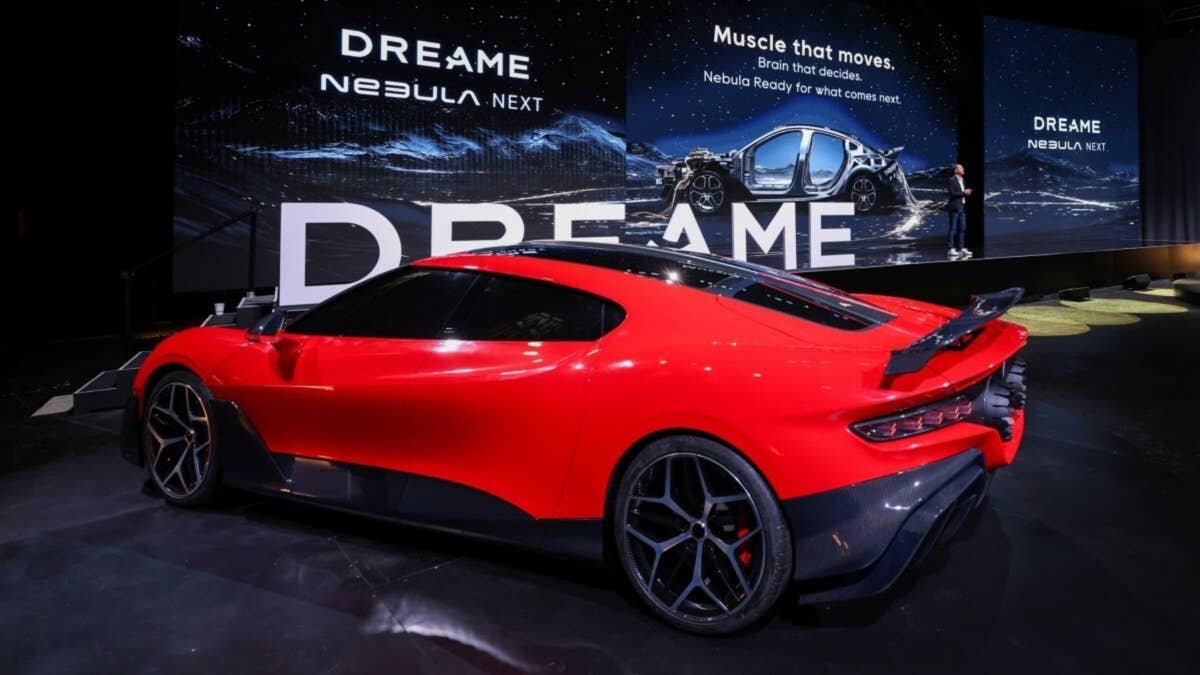
We’re talking about the Nebula Next 01 Jet Edition, a bonkers electric four-door supercar project coming from the most unlikely of manufacturers—Chinese robot vacuum maker Dreame Technology (which also makes a bunch of other smart home appliances).
The Rocket-Boosted Electric Supercar That Came Out of Nowhere
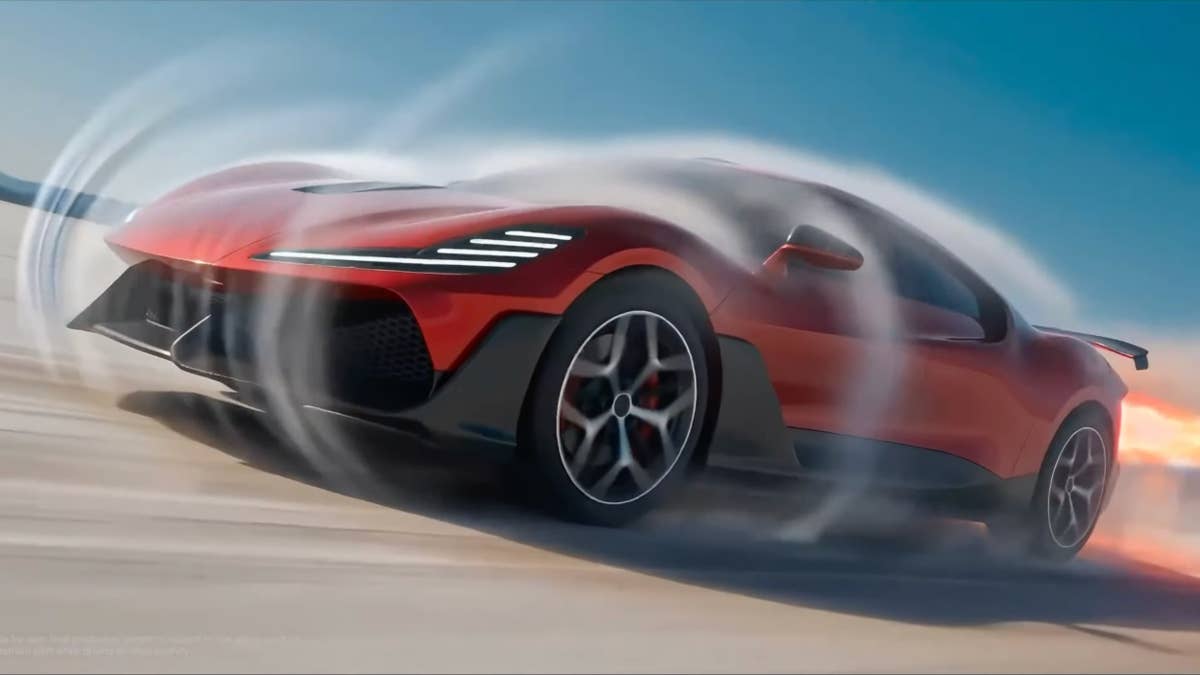
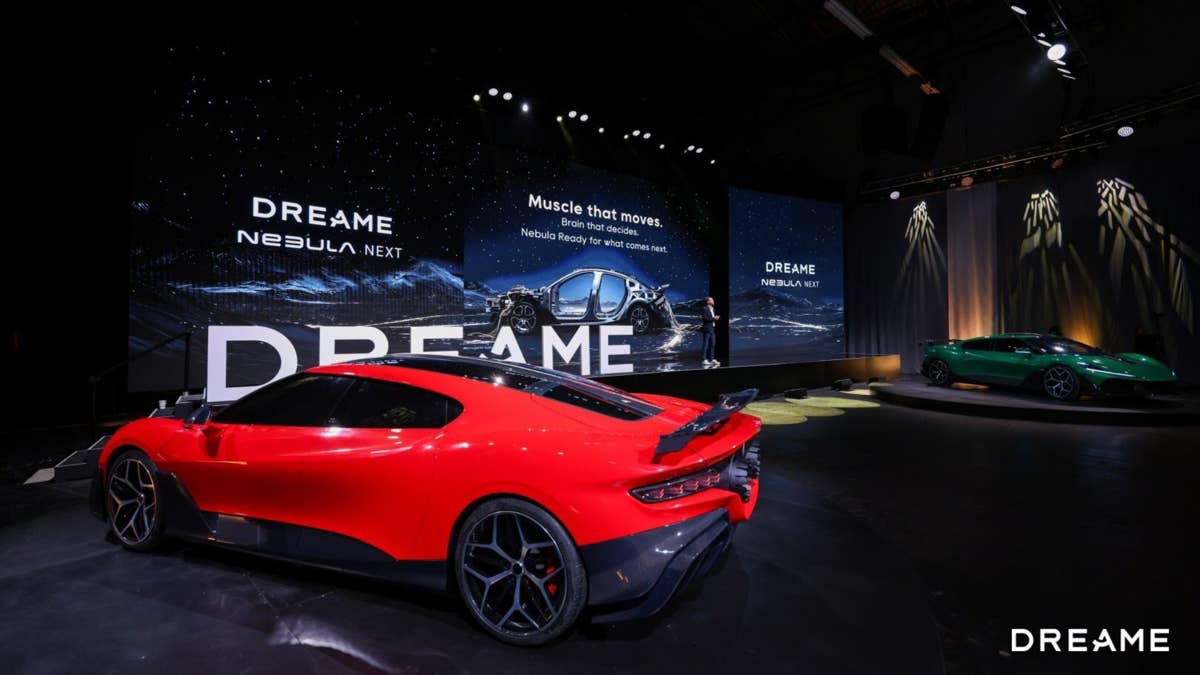
Unveiled yesterday at the Dreame Next event in San Francisco, the Nebula Next 01 Jet Edition is a rocket-powered electric vehicle featuring a custom-built dual solid-fuel rocket booster system that gives it otherworldly performance—at least on paper.
Dreame Technology claims a neck-snapping 0-62 mph time of 0.9 seconds, which is unprecedented for a production vehicle. Not even the world’s quickest EV, the 2,200-hp Ford Mustang Cobra Jet 2200, can come close, as the electric dragster goes from 0 to 60 mph in 1.66 seconds.
Dreame says in a press release that the Nebula Next 01 Jet Edition’s rocket booster system responds in 150 milliseconds and generates a peak thrust of 100 kN—the equivalent of 22,480 pounds pushing down due to gravity.
No other powertrain or performance specs were disclosed, but Dreame did say the vehicle uses a CTP 4.0 (cell-to-pack) battery integration technology, which removes the traditional crossbeams and longitudinal beams from the battery pack to free up vertical space in the chassis. The company also said the car includes an ultra-high-definition DHX1 LiDAR unit for advanced driving assist features.
The Jet Edition appears to be based on the Dreame Nebula 1 electric supercar concept that debuted earlier this year at CES. That vehicle allegedly has a total of 1,876 horsepower from four electric motors and is capable of sprinting from 0 to 62 mph in 1.8 seconds.
Before dismissing the Nebula as vaporware, Dreame claims it has been working on its first car project for more than a decade, with the Nebula Next 01 Jet Edition pitched as a statement of its engineering. Dreame says that its decision to build vehicles “came only after the company had accumulated sufficient depth in technology, organization, capital, and global capability.”
So, what’s next? Last year, Dreame announced plans to build a factory outside Berlin, Germany, not far from Tesla’s Gigafactory Berlin; it hasn’t provided an update on the status of the plant project since. The company says it aims to start production of the Nebula Next 01 Jet Edition there in 2027, which is an insane timeline until you realize Chinese companies operate at a completely different speed than their western counterparts.
The Autopian sent an engineer at the reveal of the Nebula Next 01 Jet Edition concept and he wasn’t very impressed, noting that the two rockets at the rear have no gaps around them and “everything has been blocked by plastic covers.” Plus, the vehicle has no air inlets and outlets, and the grilles are decorative and blocked off. His conclusion was that those aren’t actual rockets, they’re just made to look like the real thing.
Of course, there’s also the possibility that the vehicle is just a design buck showcased for illustration purposes only, and a functional prototype exists somewhere. We’ll see if that’s the case if we ever hear about this rocked-powered EV supercar again.
The residents of Archbald, Pennsylvania have started pushing back against the six planned data centers in the town, which will take up about 14% of its land area.
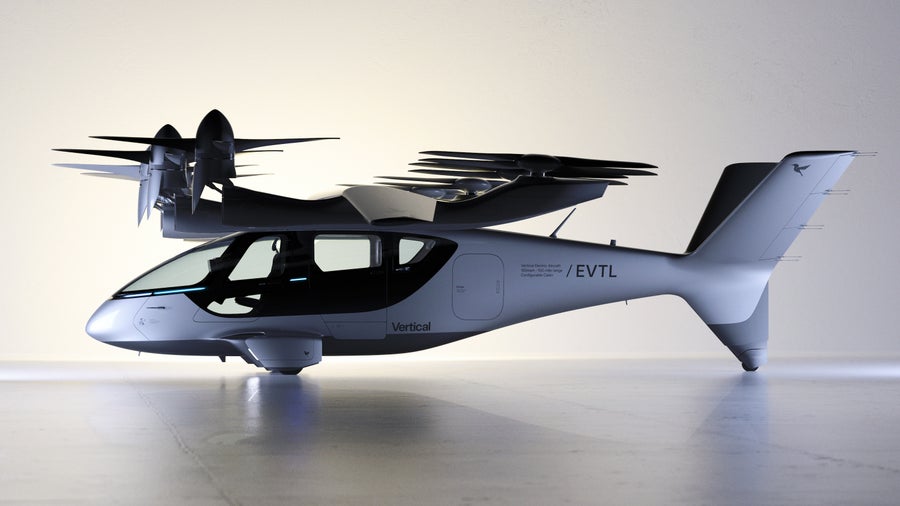
On the morning of April 14, 2026, at Cotswold Airport in southwest England, a test pilot rose straight into the air. He was testing the VX4—an electric vertical takeoff and landing (eVTOL) aircraft, or air taxi—built by the British firm Vertical Aerospace. During the test, the VX4’s eight propellers lifted it like a drone. Then the four front propellers tilted forward, and the aircraft accelerated, no longer hanging on its rotors like a helicopter but cruising on its wings like a small airplane. Moments later, it reversed the sequence: the propellers tilted back up, and the aircraft decelerated, returned to a hover and landed vertically on the same pad it had left.
In completing this test, Vertical—founded in 2016 and based in Bristol—accomplished one of the hardest feats in eVTOL development: its prototype changed from flying like a helicopter to flying like an airplane, then back again. But a prototype is allowed to fly because a regulator has agreed it is safe enough to test. A certified commercial aircraft, meanwhile, has to be safe enough for strangers to buckle their children into it.
Vertical is among the first Western developers to demonstrate piloted transition, but the April flight also matters because of the regulatory context. Other developers have flown to prove the technology works; Vertical is trying to build a case for certification. “The significance of this flight is that it has been achieved in a way that is aligned with the certification pathway from the outset,” says David King, Vertical’s chief engineer. In other words, Vertical is getting closer to the actual business of running an air taxi company.
On supporting science journalism
If you’re enjoying this article, consider supporting our award-winning journalism by subscribing. By purchasing a subscription you are helping to ensure the future of impactful stories about the discoveries and ideas shaping our world today.
King’s journey to eVTOLs began with his work at Boeing in 1989, on a military aircraft called the V-22 Osprey. The Osprey was the first production tiltrotor—an aircraft with propellers that can swivel on their mounts, pointing up for vertical takeoff and tilting forward for horizontal flight. For most of the next three decades, at Bell and then at Italian aerospace firm Leonardo, King worked on civil tiltrotors, the passenger-carrying cousins of the Osprey.
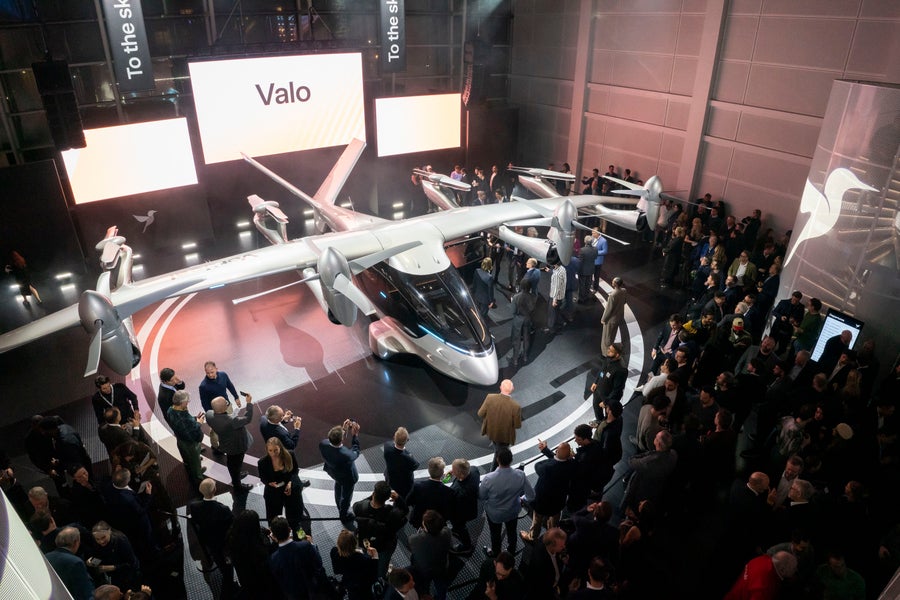
Vertical Aerospace’s Valo, the company’s planned commercial eVTOL aircraft and successor to the VX4 prototype. Vertical unveiled the aircraft in December 2025.
King decided to join Vertical in 2023 because the VX4 is essentially a tiltrotor with electric motors. “The beauty of the tiltrotor is it takes you less than a minute from the time you apply power to cruising on a wing,” he says. “The basic magic of being able to transition from thrustborne to wingborne is proven.” What remains is to tune the system to carry different loads in varied weather and on different routes.
Daniel Pleffken, an assistant professor at Embry-Riddle Aeronautical University in Florida, who specializes in aircraft certification, is more measured about what the flight proves. “A successful flight shows that something can work,” he says. “Certification requires proving that it works safely, consistently and under all expected conditions.” The aircraft still must accumulate evidence from failure tests, repeat flights and design reviews before regulators will let it carry passengers.
Vertical’s situation is unusual. Since 2023 the U.K. Civil Aviation Authority (CAA) has overseen every test flight of the VX4. Most eVTOL companies fly their prototypes under research flight licenses, but the data they produce don’t count toward certification. Vertical flies under an arrangement that has been accumulating evidence toward certification for three years. “We are demonstrating to the regulator that we have the engineering capability, design assurance processes and internal governance required for full type certification,” King says.
Vertical Aerospace displays its Valo electric aircraft at the company’s London launch event.
The other two Western developers that have flown piloted transitions, California-based Joby Aviation and Vermont-based BETA Technologies, have done so under the U.S. Federal Aviation Administration’s (FAA) experimental permit system. Chinese developers have moved faster—EHang received the world’s first eVTOL type certificate from Chinese regulators in 2023—but under a regulatory framework that Western airlines and aviation authorities don’t treat as equivalent. An experimental permit lets you fly but does not build the same certification file. The European Union Aviation Safety Agency (EASA), whose eVTOL rules the CAA has adopted, built a single new rule book. The FAA, by contrast, is certifying eVTOLs by stitching together rules written for small airplanes and helicopters. The European framework “is generally clearer because it was designed specifically for this class of aircraft,” Pleffken says.
But clarity, Pleffken stresses, isn’t the same as leniency. “The FAA, CAA and EASA are using different regulatory architectures, but the underlying safety intent is not necessarily lower in one system than in another,” he says. The European system is cleaner to navigate because its rule book was written for eVTOLs from the start—but that makes it a clearer test to study for, not an easier one to pass. Vertical’s test flight counts, in other words, because the company has been studying for the right test, with the proctor in the room, for three years.
Even certification would not solve the whole problem. An air taxi is just one piece of a transportation infrastructure that barely exists yet. “The main constraint is increasingly the operational ecosystem, not just the aircraft,” Pleffken says. “Vertiports, charging infrastructure, airspace integration, pilot training, maintenance and operational procedures all need to mature together. If one element lags, the entire system lags.” Vertiports are purpose-built takeoff and landing pads with chargers and air-traffic coordination—essentially, tiny airports scaled for aircraft the size of a large SUV. Few have been built. The air-traffic rules for how dozens of these aircraft will share low-altitude urban airspace with helicopters, drones and one another are still being written.
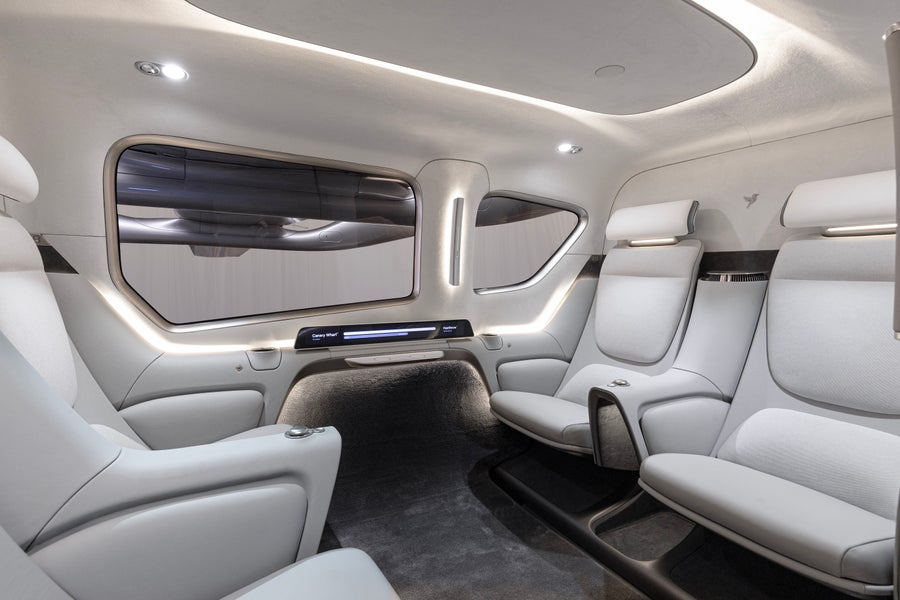
The interior of Vertical Aerospace’s Valo electric aircraft.
The ecosystem question is a specialty of Laurie Garrow, a professor at Georgia Institute of Technology and co-director of the university’s Center for Urban and Regional Air Mobility. Her research group has spent nearly a decade trying to answer the question that flight demonstrations can’t: Will people actually pay to fly in these things? The industry has not even settled on what an eVTOL should look like. Vertical’s VX4 is a tiltrotor, but competitors have built aircraft with separate propellers for lift and for cruise or with many small rotors arranged like a scaled-up drone. “The design of the eVTOLs is the Wild West right now,” Garrow says. “We haven’t done this before, so we don’t know which design is going to be the best for given missions or given situations.”
Vertical aims to earn passenger certification from CAA and EASA simultaneously by the end of 2028. The FAA would follow, reviewing the European findings and deciding whether to accept them for U.S. operations. For that final certificate, Vertical plans to build seven preproduction Valo aircraft, a new model similar to the VX4 but modified based on three years of flight-test data.
Garrow also flags a problem that air taxi engineers can’t fly their way out of: competition on the ground. Self-driving cars are operating commercially in some cities, and a relaxing, productive commute in an autonomous car competes for the same customer an eVTOL is trying to attract. “We are now getting our first autonomous ground vehicles on the road,” she says. “There have been studies that have shown that it’s much more relaxing, and you can be much more productive, being in an autonomous ground vehicle. So you’re not willing to pay as much to be on an aircraft or in an eVTOL.”
In a 2021 paper, Garrow and her colleagues ranked 40 U.S. metropolitan areas for air-taxi commuting potential and found that about half of the trips the country’s commuters might realistically take by eVTOL are concentrated in six of those metros. That concentration suggests a narrower market than the industry’s urban-commuter pitch implies. “My personal opinion is that we’re going to see some of the first use cases in tourist applications,” she says, “over Hawaiian volcanoes or the Grand Canyon, where currently we’re flying helicopters.” She compares the present moment to the years after commercial jet engines arrived. When jet airliners first flew, a trip from London to Tokyo took more than 24 hours and as many as 10 stops, she says, and the fares, adjusted for inflation, were about what a first-class ticket costs today. The technology was real. The market for it took time to build.
Space startup Astrobotic put its rotating detonation rocket engine (RDRE) to the test for the first time, demonstrating a potentially groundbreaking technology that generates thrust by supersonic combustion.
Astrobotic completed a series of hot-fire tests on two engine prototypes at NASA’s Marshall Space Flight Center in Alabama. Each engine produced more than 4,000 pounds of thrust (1,800 kilograms) for a combined 470 seconds of total runtime, including a single 300-second burn.
The recent demonstration brings the private space industry one step closer to a more efficient rocket propulsion system that could allow crewed landers to travel to deep space destinations such as the Moon and Mars.
Fire in the hole
An RDRE produces thrust through a series of detonations that travel around a circular channel, combining highly pressurized propellant with an oxidizer inside a combustion chamber. While traditional rocket engines ignite vehicles through exhaust, RDREs are propelled by shockwaves. As a result, RDREs are designed to be more efficient, using less fuel than other types of propulsion systems, in addition to being compact.
Astrobotic’s prototype engine, named Chakram, is designed and developed with support from two NASA Small Business Innovation Research awards and a Space Act Agreement with NASA Marshall. “This was pulled off by a small group working on a modest budget,” Travis Vazansky, Astrobotic’s RDRE program manager, said in a statement. “Seeing the engine perform flawlessly on its first attempt is a testament to their acumen, ingenuity, and scrappiness.”
The Pittsburgh-based company said that the engine prototypes aced the eight hot fire tests, with no evidence of damage to the engines during the firing. “With any cutting-edge technology like an RDRE, moving from design into testing, you’re always worried about unknown factors that could be critical to performance. But the engine performed even better than expected,” Bryant Avalos, Astrobotic’s principal investigator for the Chakram program, said in a statement.
Over the Moon
Astrobotic is a self-proclaimed Moon company, developing lunar landers for NASA’s Commercial Lunar Payload Services (CLPS) program. The startup became the first U.S. commercial company to launch a lander to the Moon in 2024 with its Peregrine mission, which unfortunately botched its lunar touchdown due to a propulsion system anomaly.
A follow-up mission to the lunar south pole is currently in the works and scheduled to launch sometime this year. Astrobotic is hoping to use engines like Chakram to power its upcoming lunar landers. “RDRE technology could support a wide range of Astrobotic missions, from propulsion on future lunar landers to in-space orbital transfer vehicles, and other capabilities that will help expand operations throughout cislunar space,” Avalos said.
Following the recent hot fire test, Astrobotic will continue developing its engine through a series of upcoming design iterations and test campaigns.
For all the promises of a zero-emission future, the reality of electric vehicle manufacturing remains a dirty business. In South Texas, the consequences are flowing directly into local waterways. Tesla’s billion-dollar lithium refinery outside Corpus Christi—marketed by CEO Elon Musk as a clean, acid-free operation—is now at the center of an environmental crisis. Independent lab tests have detected carcinogenic heavy metals and elevated lithium levels in the 231,000 gallons of wastewater the facility discharges daily into a local drainage ditch.
What’s Your Poison?
The regulatory blind spot enabling this discharge originated when the Texas Commission on Environmental Quality (TCEQ) issued Tesla a wastewater permit in January 2025. Local officials at the Nueces County Drainage District No. 2 were completely unaware of the arrangement until their maintenance workers discovered an unfamiliar pipe expelling black liquid across their easement in early 2026. While the TCEQ conducted a brief investigation in February 2026, state regulators cleared Tesla of any violations because the original permit did not require monitoring for lithium or heavy metals.
The controversy escalated this week following a bombshell report by Eurofins Environment Testing. Commissioned by the local drainage district, the independent lab analyzed the refinery’s wastewater and found distinct traces of toxic metals. The analysis detected arsenic at 0.0025 mg/L and hexavalent chromium—the notorious carcinogen from the Erin Brockovich case—at 0.0104 mg/L. Investigators also identified abnormally high concentrations of lithium, manganese, and sodium, establishing a distinct chemical signature pointing directly back to the battery plant. Armed with this data, the Nueces County Drainage District No. 2 immediately issued a cease-and-desist letter to Tesla.
The Consequence
The environmental and public health repercussions for South Texas residents are immediate and severe. The drainage ditch funneling Tesla’s industrial waste directly feeds into Petronila Creek and ultimately empties into Baffin Bay, a critical ecological zone and longtime fishing destination whose health has already been deteriorating. The chemical discharge creates conditions 10 to 20 times saltier than normal surface water, threatening the ditch’s infrastructure and its ability to protect surrounding neighborhoods from flooding. For the American consumer aggressively pushed toward EV adoption, these statistics expose a grim tradeoff: zero tailpipe emissions at the expense of localized toxic pollution.
Right now, enforcement is a bureaucratic stalemate. Tesla maintains that it operates in full compliance with its state-issued wastewater permit. Because the TCEQ failed to include limits for lithium, arsenic, or chromium in its initial authorization, the state has yet to penalize the automaker or halt operations. The burden of enforcement has entirely fallen on local county officials, whose cease-and-desist order faces an uncertain legal future against the automaker.
Tesla
Conscious Choices
The electric vehicle transition cannot run on regulatory loopholes. The next time an automaker touts a multi-billion-dollar manufacturing footprint as a total victory for the environment, verify the permit details. True sustainability means demanding corporate accountability across the entire supply chain, ensuring the water flowing out of the factory is as clean as the cars rolling off the line, because the truth of the matter is the environmental cleanliness of EVs depends almost entirely on the local governance and energy generation.
If you bought a Tesla from before 2023 in the hopes that a future software upgrade would render it capable of unsupervised full self-driving—the as-yet unrealized dream of a truly self driving car, in other words—that’s never going to happen, Elon Musk admitted on an earnings call Wednesday.
It’s possible you might be able to get a hardware upgrade, rather than having to trade in your Tesla for a new one, but from the sound of it, retrofitting hundreds of thousands of cars with new computers and cameras is going to be a colossal new project for Tesla.
“Unfortunately, Hardware 3, I wish it were otherwise, but Hardware 3 simply does not have the capability to achieve unsupervised FSD,” Musk said during the call on Wednesday. “We did think at one point it would, but relative to Hardware 4 it has only 1/8 the memory bandwidth of Hardware 4.”
Seemingly in an effort to stave off a customer revolt over the revelation that the Hardware 3 package will never be capable of unsupervised driving, Musk has described the following program:
“For customers that have bought FSD, what we’re offering is essentially a trade-in, like a discounted trade-in, for cars that have AI4 hardware. And we’ll also be offering the ability to upgrade the car to replace the computer.”
He also threw in this curveball:
“And you also need to replace the cameras, unfortunately, to go to Hardware 4.”
In other words, your car has to be retrofit with multiple new parts in order to even stand a chance of ever receiving a software upgrade that enablesTesla’s unsupervised self-driving mode.
Musk claimed on the call that Tesla plans to create “micro-factories, or small factories,” concentrated in population centers, where “mini production lines” will change out the hardware. Relying on local service centers, where mechanics would intersperse this hardware upgrade with their other tasks, would be “extremely slow,” he said.
The visual side of human culture is full of symbols that carry historical meaning. They convey language and emotion, and act as a record of our evolution. More recently, engineers have been drawing inspiration from these cultural forms, as their geometries may harbor untapped potential for robust materials. Take the ancient art of origami, a culturally rich recreational practice that has provided the basis for surprisingly durable designs, leading to advancements in aerospace, biomedical implants, and robotics.
Now, researchers from the University of Edinburgh have tested 3D-printed materials made from different Chinese characters for their strength, density, and stiffness. As described in their paper, published in the Journal of Applied Physics, one character performed especially well, suggesting potential for a wide range of engineering applications.
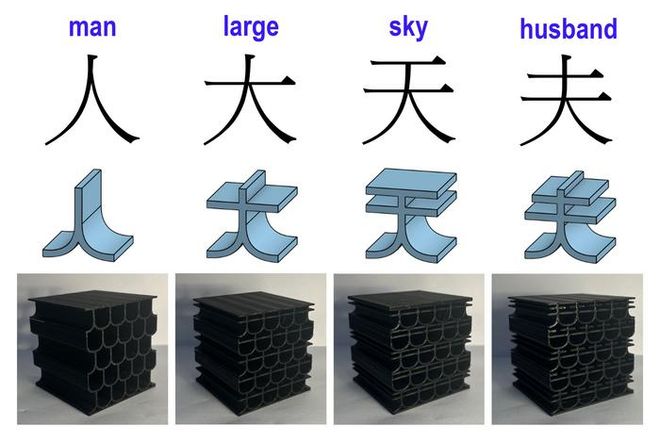
Chinese characters (top), unit cell designs (middle), and resulting 3D-printed metamaterials (bottom).
(Image Credit: Chloe Doey Leung and Parvez Alam)
What Makes Chinese Characters So Interesting for Engineers?
In the search for new and durable designs, engineers have increasingly turned to culturally rooted patterns. Beyond the success of applying origami principles to modern industrial design, the intricate geometric symmetry found in Islamic tile patterns has also inspired design software and structural engineering.
Now, scientists are hoping to build on this momentum by studying the durability of Chinese characters as structural patterns, potentially expanding their use beyond written language.
“Certain Chinese characters have strong, distinctive geometries, and these are shapes that ‘felt’ like they could exhibit unique mechanical properties and behaviors,” said study co-author Parvez Alam from the School of Engineering at the University of Edinburgh in a press release.
Chinese characters differ from the Latin alphabet in that they often consist of curves, crossbeams, and graduated features that fill square forms, shapes that are theoretically ideal for creating repetitive, functional units.
“These are architectural qualities that we see applied to metamaterials in general,” said Alam. “And a question that came to mind was whether these ancient characters might also serve as unconventional metamaterial architectures with specialized properties and behaviors.”
Some 3D-Printed Chinese Characters Perform Better Than Others
Metamaterials are materials that are defined more by their patterned structure than by their composition. To test whether Chinese characters could be used in functional designs, the researchers selected four simple characters, created rows of repeating units for each, 3D-printed them, and mechanically tested their performance.
The first character, ?, resembles an upside-down “V” and means “person.” The next, ?, adds a horizontal stroke and translates to “large.” The character for “sky,” ?, adds another horizontal stroke on top, while the final character, ?, meaning “husband,” differs from “sky” by a small protruding stroke above the top line.
Endurance tests, including compression under heavy loads, showed that some characters performed better than others from a metamaterial perspective. The “person” character failed first, likely due to its unsupported curvature. In contrast, the characters with horizontal strokes distributed the load more effectively, aligning with established principles in statics about the importance of crossbeams. Overall, the researchers found that the character for “sky” (?) exhibited the most favorable mechanical properties.
Connecting Engineering and History
The researchers see strong potential in their findings, not just for metamaterials, but also for making engineering more interdisciplinary and accessible. They suggest that symbol-based designs can help bridge engineering, materials science, and history.
According to Alam, they barely scratched the surface. There are thousands of Chinese characters to explore, not to mention other rich writing systems such as Bengali, Arabic, and broader traditions of calligraphy.
“The utility of symbols, while having value in engineering design, should also generate a different type of learning interest,” added Alam. “I hope we can encourage more interdisciplinary interactions through this. STEM is fun, but so is everything else.”
Article Sources
Our writers at Discovermagazine.com use peer-reviewed studies and high-quality sources for our articles, and our editors review for scientific accuracy and editorial standards. Review the sources used below for this article: