The visual side of human culture is full of symbols that carry historical meaning. They convey language and emotion, and act as a record of our evolution. More recently, engineers have been drawing inspiration from these cultural forms, as their geometries may harbor untapped potential for robust materials. Take the ancient art of origami, a culturally rich recreational practice that has provided the basis for surprisingly durable designs, leading to advancements in aerospace, biomedical implants, and robotics.
Now, researchers from the University of Edinburgh have tested 3D-printed materials made from different Chinese characters for their strength, density, and stiffness. As described in their paper, published in the Journal of Applied Physics, one character performed especially well, suggesting potential for a wide range of engineering applications.
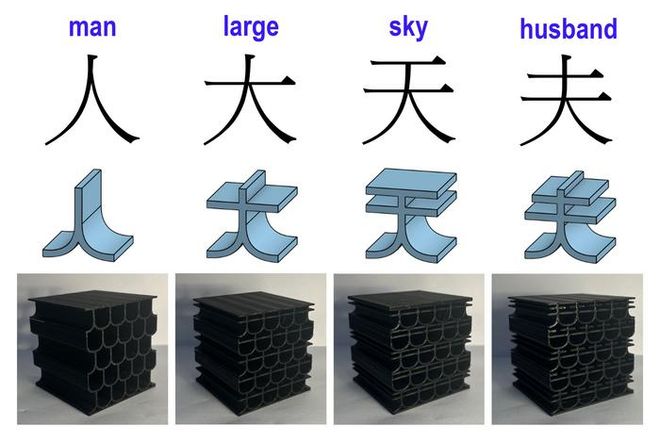
Chinese characters (top), unit cell designs (middle), and resulting 3D-printed metamaterials (bottom).
(Image Credit: Chloe Doey Leung and Parvez Alam)
What Makes Chinese Characters So Interesting for Engineers?
In the search for new and durable designs, engineers have increasingly turned to culturally rooted patterns. Beyond the success of applying origami principles to modern industrial design, the intricate geometric symmetry found in Islamic tile patterns has also inspired design software and structural engineering.
Now, scientists are hoping to build on this momentum by studying the durability of Chinese characters as structural patterns, potentially expanding their use beyond written language.
“Certain Chinese characters have strong, distinctive geometries, and these are shapes that ‘felt’ like they could exhibit unique mechanical properties and behaviors,” said study co-author Parvez Alam from the School of Engineering at the University of Edinburgh in a press release.
Chinese characters differ from the Latin alphabet in that they often consist of curves, crossbeams, and graduated features that fill square forms, shapes that are theoretically ideal for creating repetitive, functional units.
“These are architectural qualities that we see applied to metamaterials in general,” said Alam. “And a question that came to mind was whether these ancient characters might also serve as unconventional metamaterial architectures with specialized properties and behaviors.”
Some 3D-Printed Chinese Characters Perform Better Than Others
Metamaterials are materials that are defined more by their patterned structure than by their composition. To test whether Chinese characters could be used in functional designs, the researchers selected four simple characters, created rows of repeating units for each, 3D-printed them, and mechanically tested their performance.
The first character, ?, resembles an upside-down “V” and means “person.” The next, ?, adds a horizontal stroke and translates to “large.” The character for “sky,” ?, adds another horizontal stroke on top, while the final character, ?, meaning “husband,” differs from “sky” by a small protruding stroke above the top line.
Endurance tests, including compression under heavy loads, showed that some characters performed better than others from a metamaterial perspective. The “person” character failed first, likely due to its unsupported curvature. In contrast, the characters with horizontal strokes distributed the load more effectively, aligning with established principles in statics about the importance of crossbeams. Overall, the researchers found that the character for “sky” (?) exhibited the most favorable mechanical properties.
Connecting Engineering and History
The researchers see strong potential in their findings, not just for metamaterials, but also for making engineering more interdisciplinary and accessible. They suggest that symbol-based designs can help bridge engineering, materials science, and history.
According to Alam, they barely scratched the surface. There are thousands of Chinese characters to explore, not to mention other rich writing systems such as Bengali, Arabic, and broader traditions of calligraphy.
“The utility of symbols, while having value in engineering design, should also generate a different type of learning interest,” added Alam. “I hope we can encourage more interdisciplinary interactions through this. STEM is fun, but so is everything else.”
Article Sources
Our writers at Discovermagazine.com use peer-reviewed studies and high-quality sources for our articles, and our editors review for scientific accuracy and editorial standards. Review the sources used below for this article: