Mosquitoes Can Smell When Someone’s Had a Beer, and Even Prefer Beer-Drinkers’ Blood

https://www.discovermagazine.com/mosquitoes-can-smell-when-someone-s-had-a-beer-and-even-prefer-beer-drinkers-blood-48060

If you’re lounging outside on a muggy night enjoying a beer, you may start to notice wave after wave of mosquitoes pestering you. And it’s not just an unlucky coincidence — it’s because of that brew in your hand.

Mosquitoes don’t just pick people at random to get their fill of blood; they gravitate to certain targets based on a series of factors ranging from diet to the bacteria on our skin. A recent preprint paper uploaded to the bioRxiv server suggests that drinking beer is a surefire way to become a mosquito magnet.

Find out how beer consumption — and a medley of other factors — might make you more prone to mosquito bites.


Read More: This Medication Could Make Human Blood Deadly to Mosquitos, Combatting Malaria


Targeting the Blood of Beer-Drinkers

To see how beer consumption would influence mosquitoes’ attraction to people, the researchers behind the bioRxiv paper got the help of partiers at Lowlands, an annual music festival in the Netherlands. Here, researchers set up a pop-up laboratory inside four connected shipping containers, recruiting 465 volunteers to participate in tests.

The participants first filled out a questionnaire on their general health, diet, and hygiene during the festival. They then placed their arm inside of a cage designed so that the mosquitoes inside could smell, but not bite them. The mosquitoes in the cage could choose between a participant’s arm and a sugar feeder.

The researchers set up a video camera to record how often the mosquitoes chose to land on a participant’s arm, comparing the footage with the questionnaire answers.

They found that those who had been enjoying a few creature comforts at the festival were more likely to be targeted by mosquitoes. Participants who drank at least one beer before the tests were 1.35 times more attractive to mosquitoes compared to those who didn’t have any beer.

In addition, mosquitoes were notably attracted to those who reported smoking cannabis in the past 48 hours, as well as those who slept with someone the previous night.

A Mosquito’s Favorite Smells

So what makes beer-drinkers so attractive to mosquitoes anyway? The researchers note that measured blood alcohol concentration didn’t have an effect on mosquito attraction; they say that it could instead be the distinctive smell given off by those who drank beer.

Humans produce a lot of distinct chemical signals — called volatile organic compounds (VOCs) — that tend to attract mosquitoes, like carbon dioxide, lactic acid, and carboxylic acids.

The amount of these compounds that we release varies from person to person. For example, the rate of C02 release is associated with factors like metabolic rate, body mass, and respiratory activity. Pregnant women seem to be common targets for mosquitoes, which may be caused by an increased release of mosquito attractants (like C02) due to higher metabolic rate and heat production.

Consuming beer likely attracts mosquitoes due to alcohol metabolism changing someone’s body odor. Diet may even influence mosquito attraction in other ways, and while this idea has not been thoroughly explored with many foods and drinks, a 2018 study found that consumption of bananas could modify human odors and entice certain species of mosquitoes.

Keeping Mosquitoes at Bay

While mosquitoes may fancy certain smells, there are a few other factors that help to keep them away. One example is the microbiota living on our skin. Studies have shown that high diversity of skin microbiota correlates to reduced mosquito attractiveness; on the flip side, high abundance, but low diversity of bacteria is associated with increased attractiveness.

In the preprint paper, the researchers noticed that participants who had showered recently and applied sunscreen were less attractive to mosquitoes.

Mosquitoes are also drawn to darker colors, particularly black and red. If you can’t fathom giving up beer any time soon, it may be best to don a pair of clothing with lighter colors — and bring some repellent while you’re at it.


Read More: Mosquitos Carrying West Nile Virus Detected in Massachusetts, Putting Communities at Risk


Article Sources

Our writers at Discovermagazine.com use peer-reviewed studies and high-quality sources for our articles, and our editors review for scientific accuracy and editorial standards. Review the sources used below for this article:

via Discover Main Feed https://ift.tt/AiRzfCy

September 22, 2025 at 06:46PM
Hideo Kojima’s Next Announcement Is A Credit Card

https://www.gamespot.com/articles/hideo-kojimas-next-announcement-is-a-credit-card/1100-6534937/

As part of the "Beyond the Strand" event this week that celebrated the 10th anniversary of Kojima Productions, Hideo Kojima made a series of announcements, one of which was quite unexpected.

Kojima is parterning with Mitsubishi UFJ Financial Group to launch a new Kojima credit card. In the second half of 2026, MUFG will offer a credit card that will give users points based on spending that they can use to exchange for merchandise and other goods for Kojima-related items.

That’s all Kojima and the bank had to say about the credit card. Additional details will be forthcoming.

Presumably this card will only be available in Japan, but if you’re interested in a gaming credit card and live in the US, you have a few options to choose from. Microsoft offers an Xbox credit card and Sony offers a PlayStation credit card and each offer bonuses specific to their platforms.

Also during the Beyond the Strand event, Kojima Productions released new teasers for the Xbox-published game OD and the Sony-published game Physint. Kojima also announced a partnership with former Pokemon Go developer Niantic to create a new experience.

Here’s The Hideo Kojima Picture You’ve Been Waiting For

Got a news tip or want to contact us directly? Email news@gamespot.com

via GameSpot’s PC Reviews https://ift.tt/8vIGesa

September 23, 2025 at 07:48AM

This Electric Mercedes Just Went 749 Miles on a Single Charge

https://www.autoblog.com/news/this-electric-mercedes-just-went-749-miles-on-a-single-charge

Range anxiety is still a very real thing

Despite the federal government’s $7,500 purchase tax incentive expiring at the end of September 2025, electric vehicles are gaining major traction among American drivers due to some of the benefits they offer over a traditional gas-powered vehicle. However, some barriers, such as price parity and the robustness of public EV charging infrastructure, still prevent some from adopting the plug.

If there’s one phrase that has haunted the rise of electric cars, it’s “range anxiety,” a real fear where drivers worry about running out of juice before finding the next charger. This idea has become so prevalent that many skeptics are still left clinging to the gas pump instead of plugging in.

According to a June 2025 survey published by the American Automobile Association (AAA, or ‘triple-A’), 57% of drivers surveyed said their “perceived unsuitability of EVs for long-distance travel” prevented them from adopting an EV, 56% cited “a lack of convenient public charging stations,” and 55% said they had a “fear of running out of charge while driving.” Despite these real fears, a team of Mercedes-Benz’s EV-savvy engineers may have dealt it a one-two punch.

Mercedes-Benz


View the 2 images of this gallery on the
original article

749 miles, with more juice left in the “tank”

Today’s EVs are capable of long ranges. For instance, the 2025 Lucid Air Grand Touring has an advertised EPA-estimated range of 512 miles, whereas the 2025 Rivian R1S has an advertised EPA-estimated range of 410 miles under optimal conditions and in the right configuration. It’s impressive, but drivers still drive with the next charging stop in mind.

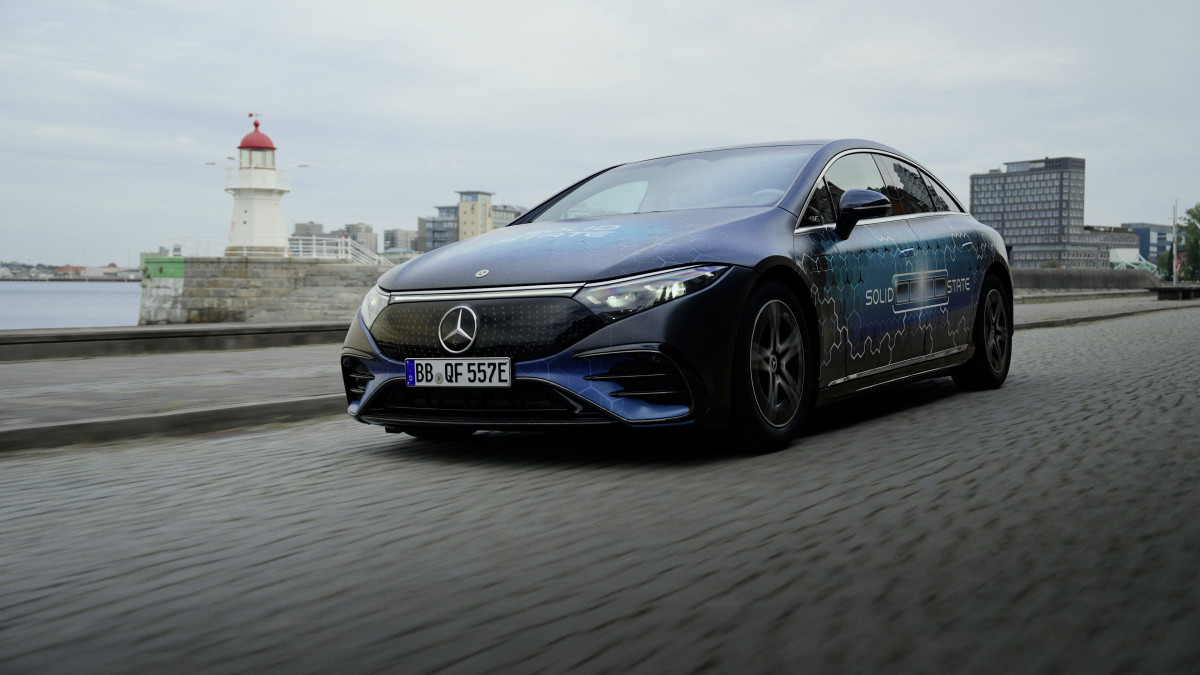
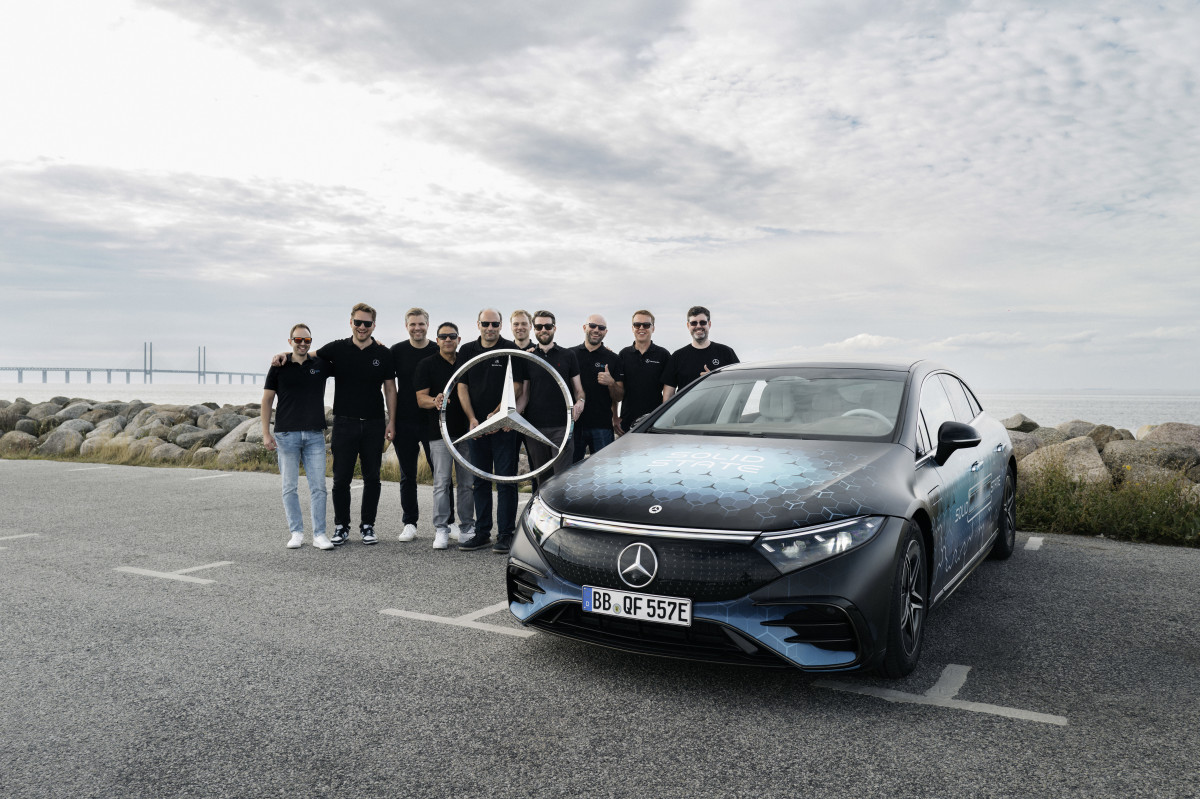
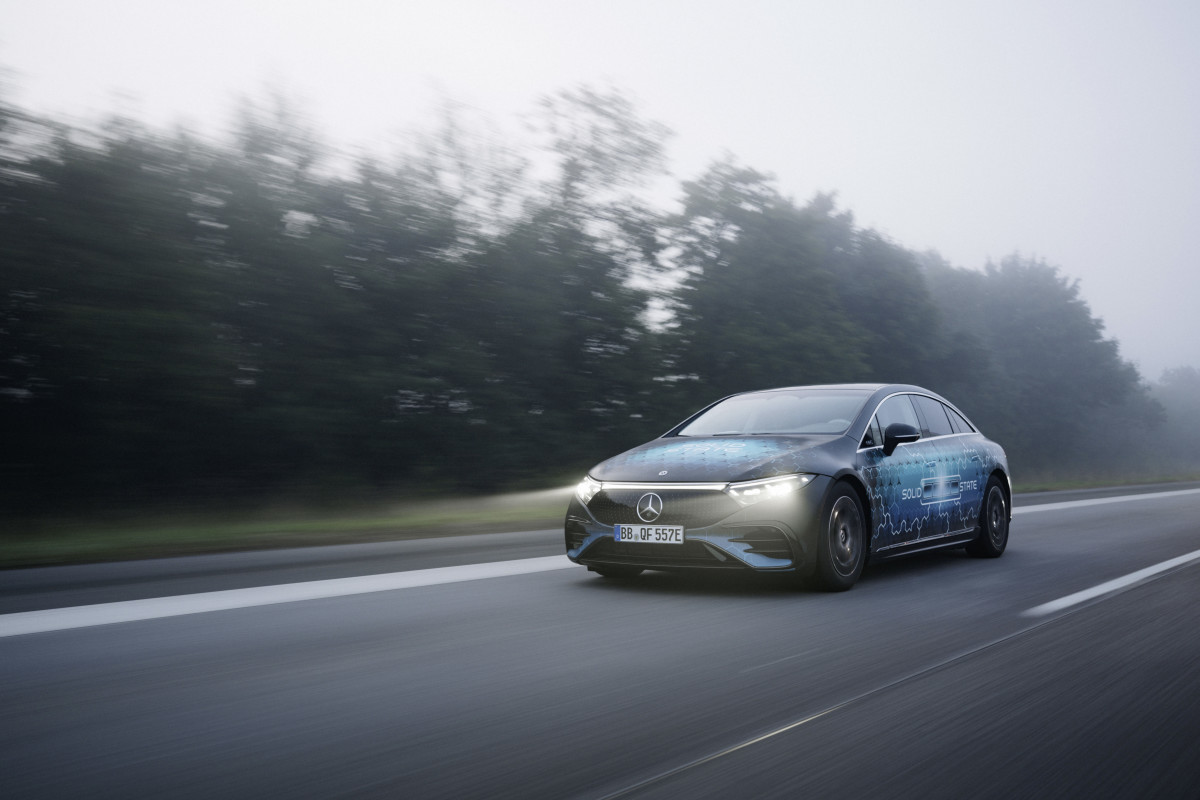
However, Mercedes-Benz engineers sought to change that. At the end of August, a team of engineers drove a prototype EQS sedan fitted with a special lithium-metal solid-state battery 1,205 kilometers (749 miles) across Europe. They traveled from Mercedes’s home in Stuttgart, Germany, through Denmark, and into Malmö, Sweden, all on a single charge, meaning there were no charging stops. To top it off, the car still had 137 km (85 miles) left in the “tank.” 

Mercedes-Benz


View the 2 images of this gallery on the
original article

According to Mercedes, their route was not a controlled environment or closed corridor, as they mentioned that the test cars went on highways A7 and E20 through Germany and Denmark to Malmö, Sweden. The engineers stated that this optimal route, which did not use ferries, was made using Electric Intelligence. This built-in Mercedes navigation technology factors in topography, traffic, ambient temperature, and energy needs for heating and cooling for maximum range.


The solid-state advantage

The secret behind this feat is the experimental solid-state battery technology used in the EV, which proves to be extremely energy-efficient and safe. Unlike traditional lithium-ion batteries that use liquid electrolytes, solid-state batteries utilize solid electrolytes, which allows for greater energy density and a lighter overall weight.

Developed in close collaboration with its Formula 1 arm, Mercedes-AMG High Performance Powertrains (HPP), and Factorial Energy, Mercedes has developed a battery that offers 25% more usable energy without increasing in size, an improvement for drivers looking for better range without added bulk.

Mercedes-Benz

To manage the changes in volume that happen during charging and discharging, Mercedes has incorporated pneumatic actuators into the battery design to keep everything together. These actuators help maintain stability and optimal contact pressure, ensuring the battery operates smoothly. Based on technology developed by Factorial Energy, the lithium-metal cells enhance efficiency, while passive airflow cooling helps keep everything running well. This setup gives Mercedes a competitive edge by providing a more powerful and efficient battery without sacrificing size.

“The solid-state battery is a true game-changer for electric mobility. Mercedes Chief Technology Officer Markus Schäfer said in a statement. With the successful long-distance drive of the EQS, we show that this technology delivers not only in the lab but also on the road."

Final thoughts

Despite all this progress and new electric vehicles on the showroom floor, don’t expect to see this type of technology in any new Mercedes EVs anytime soon. Per Schäfer, the team’s goal is to bring "innovations like this into series production by the end of the decade and offer our customers a new level of range and comfort.”

Still, this milestone proves that EVs don’t have to be defined by charging. For years, the EV conversation has been obsessed with range and infrastructure. Recently, new federal guidance gave gas stations a leg up in bolstering and expanding the EV charging grid with more chargers. However, Mercedes’s record-setting run doesn’t just showcase engineering; it also shows that some automakers have the potential to revolutionize electric driving.

via Autoblog https://ift.tt/OUlD1eP

September 22, 2025 at 08:19PM

New Study Finds Even More Evidence That Gaming Can Improve Overall Happiness

https://www.gamespot.com/articles/new-study-finds-even-more-evidence-that-gaming-can-improve-overall-happiness/1100-6534903/

A new scientific study has found significant effects of open-world gaming on people’s quality of life and emotional well-being. It also shows that playing games in tandem with watching nostalgia-inducing movies like Studio Ghibli’s films can have an even bigger effect, indicating that different types of media can interact with each other.

Writing in the journal JMIR Serious Games, which focuses on games studies research, a team of scientists presents evidence that playing The Legend of Zelda: Breath of the Wild can have a range of positive outcomes. Testing with a sample of postgraduate students–a community famous for its high levels of anxiety, dissatisfaction, and burnout–the authors show that playing Breath of the Wild on its own can help spark a sense of purpose and meaning. Further, this game helped people feel more calm, more adventurous, and more skillful in their lives outside of the game context.

Investigating potential interactions between games and watching film, the authors also instruct a subset of participants to play Breath of the Wild and watch a clip from Studio Ghibli’s My Neighbor Totoro or Kiki’s Delivery Service in close succession. Theorizing that the film clips spark a positive sense of nostalgia among participants, the authors find an even stronger effect on overall happiness and life purpose among this subset.

While this study only includes postgraduate students and can’t say much about the longevity of these positive impacts, it represents yet another piece of scientific evidence showing beneficial effects of gaming. For instance, scholars have found encouraging results for games as a tool to help mitigate substance abuse and improve mental health. Games have been shown to induce pro-social activity and improve community-building, and evidence suggests that they can even serve to reduce the effects of cognitive disorders.

This new study comes at a time of intense focus on the games industry and renewed calls from politicians to regulate games and game-adjacent spaces. Scientists have long studied the potential dark sides of gaming, from the potential risks from certain fringe gaming communities to the effects of certain types of multiplayer games on social psychology. However, recent proposals to investigate game companies have often rehashed old and unsupported allegations that violent video games directly cause violence.

via GameSpot’s PC Reviews https://ift.tt/i0sS4oO

September 22, 2025 at 09:46AM

Gizmodo Science Fair: A Giant ‘Kite’ That Generates Clean Energy Underwater

https://gizmodo.com/gizmodo-science-fair-a-giant-kite-that-generates-clean-energy-underwater-2000652149

Minesto, a marine energy technology developer based in Sweden, is a winner of the 2025 Gizmodo Science Fair for deploying the first operational, megawatt-scale tidal energy kite in the Faroe Islands.

The question

Can we use an underwater “kite” to turn ocean tides into renewable energy?

The results

In February 2024, Minesto’s Dragon 12 tidal energy kite delivered its first electricity to the national grid in the Faroe Islands. This 40-foot-wide (12-meter-wide), 28-ton subsea powerplant is the largest and latest of three tidal energy kites Minesto has installed in the Faroe Islands since 2020. This one generates far more electricity.

Dragon 12 is called a kite because it produces electricity by “flying” underwater while tethered to the ocean floor, but it looks more like a small plane. Its wing uses hydrodynamic lift to move the kite while an onboard control system steers it in a figure-8 pattern. As it flies, a turbine shaft located at the rear of the kite turns a generator. Clean energy then travels through a cable inside the tether to a seabed umbilical, which transmits power to the onshore grid.

The figure-8 path allows Dragon 12 to accelerate faster than the current flowing past it, reducing the size of the kite and rotor necessary to generate power. Indeed, Dragon 12 is up to 15 times lighter per megawatt than other similar technologies, according to Minesto. Its design also maximizes energy production, allowing the turbine to operate in flow conditions as low as 3.9 feet per second (1.2 meters per second).

A boat tows Minesto's Dragon 12 tidal energy kite in the Faroe Islands
A boat tows the Dragon 12 tidal energy kite in the Faroe Islands. © Minesto

Dragon 12 produces power automatically and autonomously, Minesto’s Chief Technology Officer Bernt Erik Westre explained. Once the kite’s onboard sensors detect that flow conditions are conducive to energy generation, it’s off to the races. “We just tell the system to fly, and then it will decide whether conditions are okay to fly in, and it will start,” Westre told Gizmodo. “If they’re not anymore, it will stop.”

In the Faroe Islands, Dragon 12 operates at a depth of 164 feet (50 meters). Minesto’s tidal energy kites “cannot ever get to the surface, unless we detach them with a special tool,” Westre said. Unlike fixed-bottom wind turbines, tidal energy kites are invisible from the shoreline, and ships can safely sail over them. This, coupled with the fact that these power plants can operate in low-flow conditions, opens up a much larger marine renewable energy market, Westre explained.

Within the first two weeks of testing in the Faroe Islands, Minesto verified Dragon 12’s functionality and power production performance. The kite has been delivering clean energy to the national grid ever since, with a 25% increase in power output after Minesto lengthened its tether in May.

“If you want lightweight, renewable energy that’s invisible, you know who to call,” Westre said.

Why they did it

Before joining Minesto in 2016, Westre was working as a naval architect for the oil industry. Ultimately though, the impact this industry was having on the global climate and wealth disparity became too stark to ignore. Westre wanted to be a part of the solution, not the problem.

“I guess I came to a point where I wanted to be able to look my children—and eventually grandchildren, if I ever get any—in the eye and say, ‘I made a shot at it,’” he said. Plus, “We were making the world’s richest companies even richer, and that didn’t feel right anymore.”

Minesto, founded in 2007, doesn’t just aim to reduce the world’s reliance on fossil fuels. The company’s offbeat approach to commercial marine power production aims to maximize the amount of electricity people can harness from the ocean. Its tidal energy kites do this by operating across a wider range of conditions than traditional technologies. This, Westre hopes, will open up a vast, untapped market for tidal energy extraction.

Why they’re a winner

Minesto is developing a new class of megawatt-scale renewable energy technology that produces predictable, clean power in untapped parts of the ocean. While it isn’t the only company working toward this goal, its technology comes with several advantages. The main selling point is its ability to efficiently generate power in low-flow conditions.

“The [design] principle has been the same since 2007, which is to fly or move the turbine rather than keep it stationary underwater,” Westre said. “By doing it that way, the market—or global potential—is so much larger.”

Minesto Gothenburg Team
The Miensto Gothenburg team © Minesto

Stationary systems—such as fixed-bottom tidal turbines—could theoretically operate in low-flow conditions too, but they would have to be huge, he explained. The fact that Minesto’s tidal energy kites move allows them to harness energy from slower currents while reducing cost and consumption of materials.

Another key advantage of this system is that it operates completely below the surface with minimal impact on marine wildlife. This avoids visual pollution that can negatively impact tourism and discourage public support for renewable energy projects.

What’s next

Minesto made big strides toward commercialization in 2024. As it continues building out its tidal energy provisions in the Faroe Islands, it’s working towards installing a first-of-its-kind tidal energy array with multiple Dragon 12 kites. The first phase will have a capacity of 10 megawatts—an initial step towards its eventual 200-megawatt capacity.

“10 megawatts on the Faroe Islands will make a difference,” Westre said. Once the array reaches its full capacity, it could meet 40% of the Faroe Islands’ expected electricity needs in 2030, according to Minesto partner Svenska Kullager Fabriken, a Swedish bearing company.

In June, the Swedish Energy Agency awarded Miensto and its partners $2.6 million to build a complete microgrid installation in the Faroe Islands. That project is expected to be complete by 2026.

The team

Minesto is led by CEO Martin Edlund, CTO Bernt Erik Westre, and COO Johannes Hüffmeier.

Click here to see all of the winners of the 2025 Gizmodo Science Fair.

via Gizmodo https://gizmodo.com/

September 22, 2025 at 06:12AM

Gizmodo Science Fair: A Physics Experiment Turned Lead Into Gold

https://gizmodo.com/gizmodo-science-fair-a-physics-experiment-turned-lead-into-gold-2000649706

The ALICE Collaboration is a winner of the 2025 Gizmodo Science Fair for transforming lead into gold for a fraction of a second and exposing the strange physics that goes on inside the Large Hadron Collider.

The question

What byproducts does ALICE—the Large Ion Collider Experiment at CERN—produce when it studies matter at extreme energy levels?

The result

Many different things, but perhaps most interesting of all—gold!

In a Physical Review C paper published earlier this year, the ALICE Collaboration announced that between 2015 and 2018, the Large Hadron Collider (LHC) created around 86 billion gold nuclei, each lasting for about a microsecond.

ALICE primarily studies high-energy collisions between lead nuclei, whose charge is 82 times that of a proton. These large nuclei travel nearly at the speed of light in the Large Hadron Collider, which slams these particles into the ALICE detector. These collisions produce a pulse of photon energy that chips away bits of the nuclei—usually neutrons, but sometimes protons. When a lead nucleus loses three protons, it transmutes into element number 79, or gold.

Science Fair Gold Cern Lead Collision
A visualization of lead-lead collisions at the Large Hadron Collider, recorded by ALICE. Credit: CERN/ALICE Collaboration

This transmutation occurs around 50,000 to 80,000 times per second. Indeed, the program’s “gold production is quite copious,” said John Jowett, an accelerator physicist at CERN. “However, on a human scale the gold production is very small. [Until] now we’ve only created about, I think, 90 picograms, which is one millionth of a gram of gold.”

Those 90 picograms of gold disappear almost immediately after emerging, he added. “So this just reminds us—I like to say to people—how small atoms are compared to the scales we’re used to,” he said.

Why they did it

The result didn’t surprise any CERN scientist familiar with these instruments, Jowett said. “We didn’t talk about it much before, but we knew it should happen.”

Scientists were also aware that this process had serious implications for ALICE in general, according to Daniel Tapia Takaki, a physicist at the University of Kansas who led the CERN working groups for this project. Any particle that transmutes at CERN typically travels very long distances, meaning some inevitably smash into different sections of the LHC tunnel.

“So they basically become kind of a safety hazard—I mean, they at least start switching off the alarms,” said Tapia Takaki. “You want to have a collider that’s very stable… So understanding exactly how to mitigate this transmutation is one of the big priorities for the next generation of colliders.”

Cern Alice Beam Pipes
The beam pipes inside ALICE. Credit: CERN/ALICE Collaboration

Uliana Dmitrieva is the ambitious young scientist who kicked off a project to officially record this process in a formal, scientific manner. The task proved so gargantuan that by the time the paper made headlines, Dmitrieva, who had proposed the project as a master’s student, had already finished her PhD and was preparing to become a staff scientist at Italy’s National Institute of Nuclear Physics.

“It took more time than my PhD thesis,” she laughed. “There were very few [formal] analyses of [these processes], and actually, I had to do everything from scratch, because it was difficult to model. There were a lot of bugs in [the calculations] because nobody had checked this before.”

Why they’re a winner

All that strain proved more than worth the effort—but in ways the team never imagined. The public attention for this project somewhat disguises the fact that gold production is “just a small part of the paper; the paper was mostly about proton emission and lead collisions due to these so-called ultra-peripheral interactions,” Jowett noted.

“It was…strange, because, okay, we just measured protons—nothing interesting—why is it everywhere?” Dmitrieva joked. “It sounds really funny that there’s some kind of alchemy at the LHC.”

But the team decided to lean into this angle, which clearly “caught the imagination of the public, and we thought it was a nice way to explain some of this physics,” Jowett added. Overall, they were pleasantly surprised to see their project become an entry point to the grand scientific enterprise at CERN.

“It made us happy but also humbled,” Tapia Takaki said. “We have a responsibility to share the knowledge and the excitement—and certainly, [creating gold] is very exciting.”

What’s next

Now that the public excitement has cooled down, the researchers are looking to build on this data to further improve the detectors. That said, and given the large size of the project, there isn’t a single, consolidated plan for the collaboration as a whole.

Tapia Takaki wants to boost the collaboration’s ability to make precise, systematic measurements of proton and neutron emission. With these results, he hopes ALICE’s quirky particle physics can help tackle the most pressing questions in quantum mechanics.

Jowett, who retired in 2019, now advises younger physicists, including at the ALICE Collaboration. “There’s a lot of research going on at the LHC,” he said. “It’s a very broadband machine that studies many things—ALICE is just one part of it. This has given a few surprises. And I think it will continue to do so.”

The team

To say that ALICE is a big collaboration would be a tremendous understatement. With 1,886 members across 163 institutions in 39 countries, it takes a veritable city of scientists to turn lead into gold. A full list of ALICE Collaboration members can be found here.

Click here to see all of the winners of the 2025 Gizmodo Science Fair.

via Gizmodo https://gizmodo.com/

September 22, 2025 at 06:12AM

As We Age, Nostalgia Rather Than Trends Controls the Music We Enjoy

https://www.discovermagazine.com/as-we-age-nostalgia-rather-than-trends-controls-the-music-we-enjoy-48030

Listening to music is a regular part of many people’s day, but what music you find yourself gravitating towards may have more to do with your age than you think. A new study, presented at the Association for Computing Machinery conference, revealed that our relationship with music shifts dramatically as we get older.

The study analyzed an enormous dataset from the music-sharing service Last.fm, which allows users to link popular streaming apps like Spotify and track their listening habits. Researchers looked at over 40,000 individuals’ listening history over a 15-year period and were able to map how musical tastes evolve across one’s lifetime.

“When you’re young, you want to experience everything. You don’t go to a music festival just to listen to one particular band, but when you become an adult, you’ve usually found a style of music that you identify with. The charts become less important,” said Alan Said, associate professor of computer science at the University of Gothenburg, in a press release.


Read More: How Does Music Impact Your Brain and Workflow?


How Does Our Music Taste Change With Age?

The findings confirm something many of us already suspect. When we’re young, our relationship to music is social and driven by trends. Teenagers and young adults consume a wide variety of genres, chase the latest hits, and bond with friends over shared playlists.

However, the transition into adulthood marks a turning point in listening habits. For those in their 20s and 30s, playlists diversified even further with many people experimenting across genres and artists. But as the years pass, that musical experimentation begins to dwindle.

By middle age, nostalgia begins to play a more important role in the music people listen to. Songs that remind us of our youth become the soundtrack of later stages of life and help ground us in those associated memories.

All of this doesn’t mean that older adults stop engaging with new music altogether. Instead, they develop a pattern of both returning to those youthful classics and occasionally branching out into new musical territory. As people age, their music taste becomes more uniquely theirs, and it becomes more difficult to find any overlap between people’s favorite songs and bands.

How Science Can Help Music Streaming

For streaming giants like Spotify and Apple Music, these findings could have implications for the way they recommend music in the future. Recommendation systems rely heavily on algorithms designed to anticipate user preferences. But if listening habits shift so dramatically over one’s lifetime, those algorithms may not be able to keep up.

“A service that recommends the same type of music in the same way to everyone risks missing what different groups actually want,” remarked Said in the press release. “Younger listeners may benefit from recommendations that mix the latest hits with suggestions for older music they have not yet discovered. Middle-aged listeners appreciate a balance between new and familiar, while older listeners want more tailored recommendations that reflect their personal tastes and nostalgic reminiscences.”

Overall, this study highlights how music isn’t just entertainment, but is a part of our shifting identity. Our playlists evolve as we do, reflecting the cultural trends we grew up with, the personal experiences that shaped us, and the nostalgia that comforts us later in life.


Read More: Nostalgia and Thinking About the Past Helps Us Hold Onto Our Friendships


Article Sources

Our writers at Discovermagazine.com use peer-reviewed studies and high-quality sources for our articles, and our editors review for scientific accuracy and editorial standards. Review the sources used below for this article:

via Discover Main Feed https://ift.tt/jSYLZ4E

September 15, 2025 at 05:54PM