A nerdy father of two, a husband of a beautiful and understanding wife, an engineer who loves anime and tinkering with PCs and games, but most of all, loves God.
Drivers in the state of Texas can no longer assume they know the roads well enough to stick with the speeds they’ve always done, as new variable speed limits are rolling out across the state. Digital speed limit signs are being installed to change the legal limit on certain roads after a deadly February 2021 crash, originally attributed to icy roads, raised safety concerns. A multi-car pileup took place on I-35W during an intense winter storm, and temperatures had fallen below freezing for over 36 hours with speed limits remaining at 75 mph, according to the National Transportation Safety Board’s report. Six died, and 36 were injured in an accident that spanned 1,100 feet on the North Tarrant Expressway.
Expect to See More Digital Signs Across the State
Naturally, a vehicle’s braking distance and handling change when the weather turns inclement and reduces traction, and these new variable limits aim to reduce the risks that drivers face when their vehicles become more difficult to control. The initiative began with a pilot program two years ago, after legislators approved the use of variable speed limits to change posted limits depending on road conditions. The idea is that people will be encouraged to drive more slowly when the weather turns bad, when there’s traffic up ahead, or when other hazards present themselves (roadworks, accidents, et cetera). Similar signs already exist in Colorado, Washington, Oregon, Minnesota, Florida, and several other states, using real-time data to adjust the limits in the hopes of improving safety and flow.
"If we’re not able to alter or modify the speed limit to reflect the current conditions, safety is in jeopardy," State Representative Terry Canales, author of the bill to authorize variable speed limits, told the Texas Tribune. The signs will start to appear on freeways already connected to the Intelligent Transportation System, which uses cameras and sensors to monitor conditions, readjusting the limits once conditions are deemed safe, reports Chron.
Meanwhile, in Arizona…
Getty Images
As Texas works to ensure speed limits suit the conditions, a new bill proposed by Arizona State Rep. Nick Kupper could remove them entirely — but only at certain times. The Reasonable and Prudent Interstate Driving (RAPID) Act endeavors to give the Arizona Department of Transportation the authority to create "derestricted speed zones" on certain rural interstates during daylight hours, with an 80-mph limit remaining in place after dark. The derestriction would also not apply to commercial vehicles, including semi trucks, and urban areas with populations over 50,000 people would remain restricted, too. A long list of requirements would need to be met, but like the implementation of variable limits in Texas, the idea is that this would help improve traffic flow and safety, though some argue that irresponsible individuals would abuse the Autobahn-like measure.
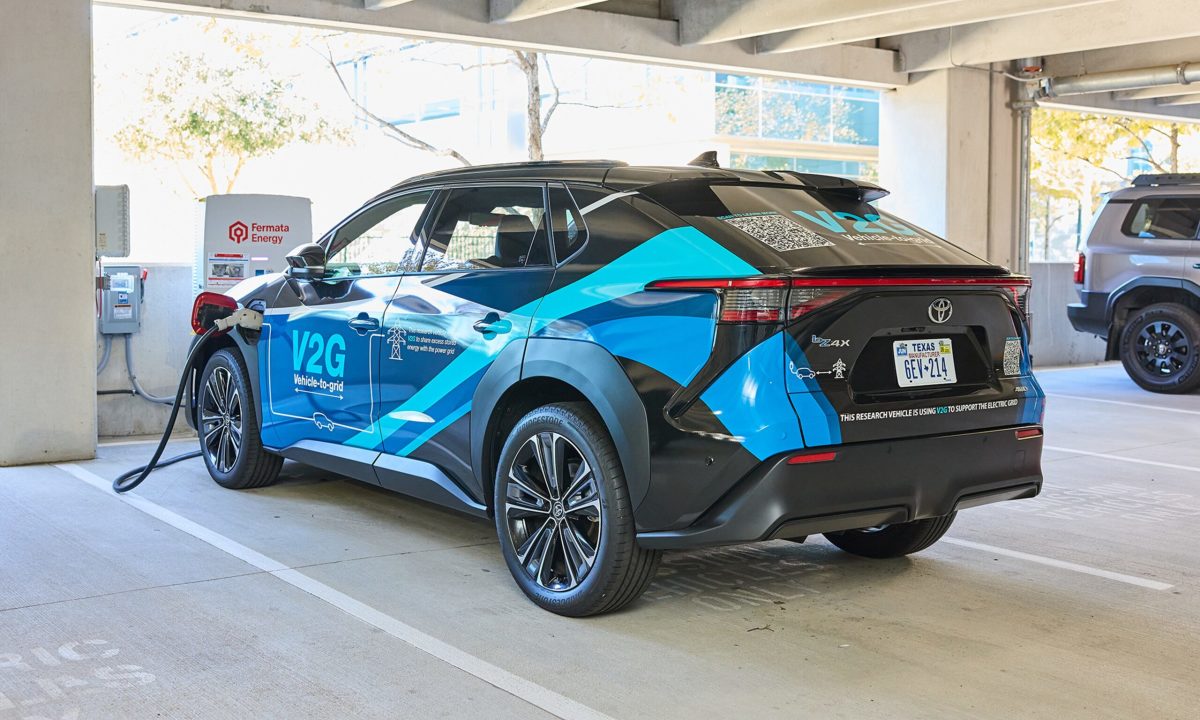
Toyota just dropped an eye-opening postulation about battery electric vehicles with vehicle-to-grid capabilities. The manufacturer says the roughly four million EVs currently on American roads could collectively pump approximately 40,000 megawatts back into the power grid, equalling what 40 nuclear reactors generate. Your idle EV could help stabilize grids by leveling spikes in demand, limit outages, and technically even reduce your energy costs.
The only issue with this is that Toyota is championing V2G technology without currently offering a single production vehicle in North America that supports bidirectional charging. A Japanese-spec bZ4X prototype equipped with V2G has been doing the rounds for the pilot, but American buyers can’t buy it. Toyota is essentially promoting technology they haven’t yet committed to selling.
Toyota
Why Bidirectional Charging Is a Big Deal
This is how it works in theory: EV owners charge batteries during cheap off-peak nighttime hours, then either power their homes directly or sell stored energy back to the grid during expensive peak periods. Think of it like the stock market: buy low and sell high, though that isn’t the prime goal here.
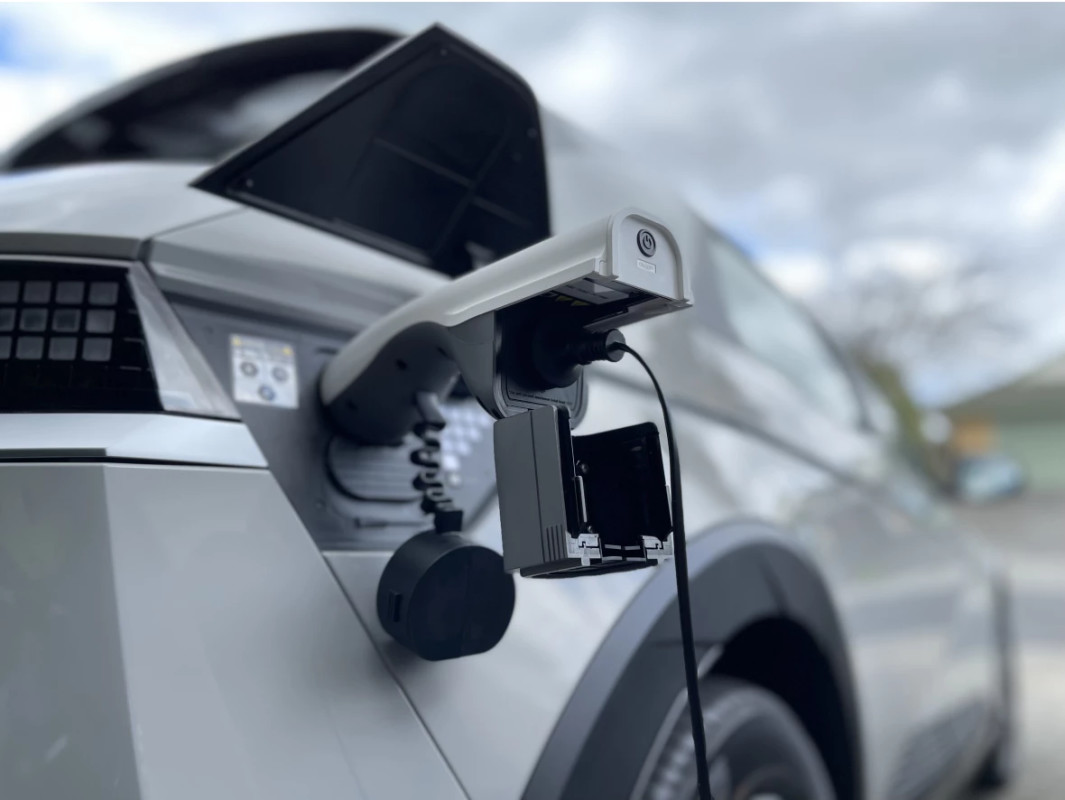
Bidirectional charging can stabilize the grid during extreme weather or outages. When thousands of vehicles act as distributed storage, utility companies can avoid firing up expensive backup generators during demand spikes. What’s more interesting is vehicle-to-home and vehicle-to-load technology, which allows drivers to directly give energy back to their homes or appliances.
Hyundai
Final Thoughts
While Toyota experiments, other manufacturers have already delivered. The Ford F-150 Lightning’s 9.6 kW of V2H power is enough to run an average house for three days during outages. Nissan pioneered this space in 2013 with the Leaf, theoretically letting owners earn money by feeding power back during peak demand. General Motors standardized V2H charging across its 2024 electric lineup, while Hyundai and Kia are running European pilot programs with the Ioniq 5. Tesla‘s Cybertruck now delivers 11.5 kW of home backup through its Powerwall system.
Despite Toyota’s grand projections, implementation faces obstacles. Most grids aren’t configured for bidirectional charging, and the home charging equipment costs thousands of dollars, turning off users who own vehicles with V2G capability. Then there’s battery degradation from working those extra cycles, and the fact that the regulatory framework governing electricity sales varies wildly from state to state. While the current costs associated with setting up bidirectional charging still skew the economics against it, the time when it all makes sense and Toyota’s vision comes to life isn’t so far off.
There are warning signs that your home network may have been compromised, such as unusual traffic patterns and slowdowns in system performance, but now there’s a simple tool to help determine if your router or connected devices are being used to conduct malicious activity. IP Check, from threat monitoring firm GreyNoise, will alert you if your IP address has been observed scanning the internet as part of a botnet or residential proxy network.
As GreyNoise outlines, residential IP compromise often isn’t obvious to the user because you’re still able to conduct business as usual, such as streaming, emailing, and web browsing. All the while, though, threat actors are routing malicious activity through your home IP address and can potentially exploit your network for everything from account takeovers to malware distribution.
Check your IP address for suspicious activity
To use IP Check, you simply need to open the tool in a browser window, and you’ll get one of several results. If your IP is clean, that means that your network hasn’t been caught scanning the internet (nor does it belong to any known business service infrastructure).
Credit: Emily Long
Your IP may also be flagged as being in the GreyNoise database, which is not a sign of compromise—this is likely because you’re using a VPN, corporate network, or cloud provider, and the tool can distinguish between an IP belonging to a data center and one that’s being exploited. (Note that Apple users browsing in Safari with Private Relay enabled will likely see "Possible Spoofed Traffic Detected," which also is not necessarily cause for alarm. Try checking your real IP in a different browser like Chrome or Firefox to confirm.)
Credit: Emily Long
If your IP is identified as malicious or suspicious, you should investigate further. If you toggle open the Observed Activity section of the scanner, you can see when the first and last instances of the scanning behavior occurred and what types were detected along with actionable next steps.
As BleepingComputer notes, you can get into the weeds with detecting malicious activity by reviewing device logs, network traffic, and activity patterns, but checking your IP address is the simplest place to start.
I have a drawer full of USB cables and every time I want to connect a device, I have to try them out. USB-C was supposed to simplify things: One cable for everything, that was the promise. In practice, it’s a different story: There are cables that can only charge. There are some that transfer data. Some also transmit image information, which can then be used as a monitor cable.
And then there is always the question of speed: 30 or 100 watts of charging power? USB 2.0 speed with 480 megabits or USB 3.2 or even Thunderbolt with up to 40 gigabits per second? Unfortunately, the cable labelling often doesn’t help to bring order to the cable chaos. And then devices run or charge unnecessarily slowly because the wrong cable has been used.
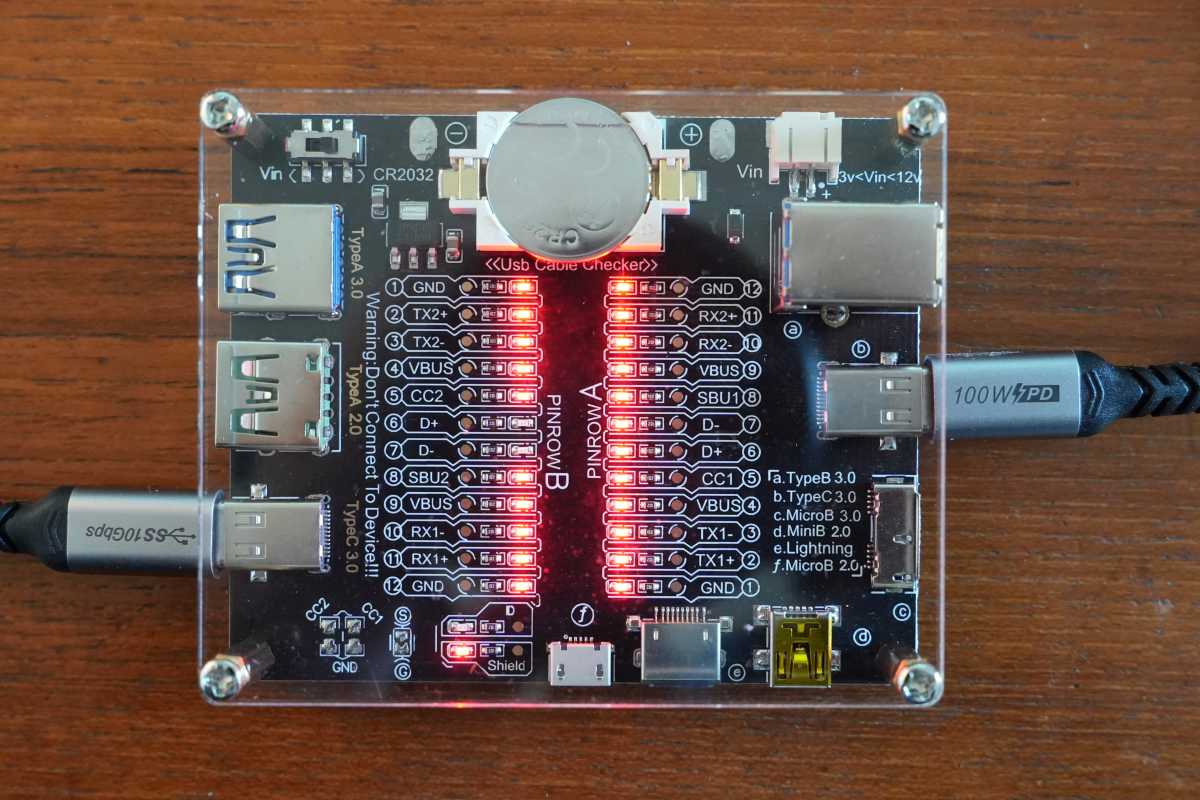
The more LEDs light up, the better the cable.
Inexpensive cable tester solves cable problems
Fortunately, this has now come to an end for me: An inexpensive cable tester from Treedix makes testing cables child’s play: Simply plug it in, check the LEDs, and I know whether my cable is “good” or whether I can stuff it in the other cable box in the basement. The one where I also keep SCART and jack cables.
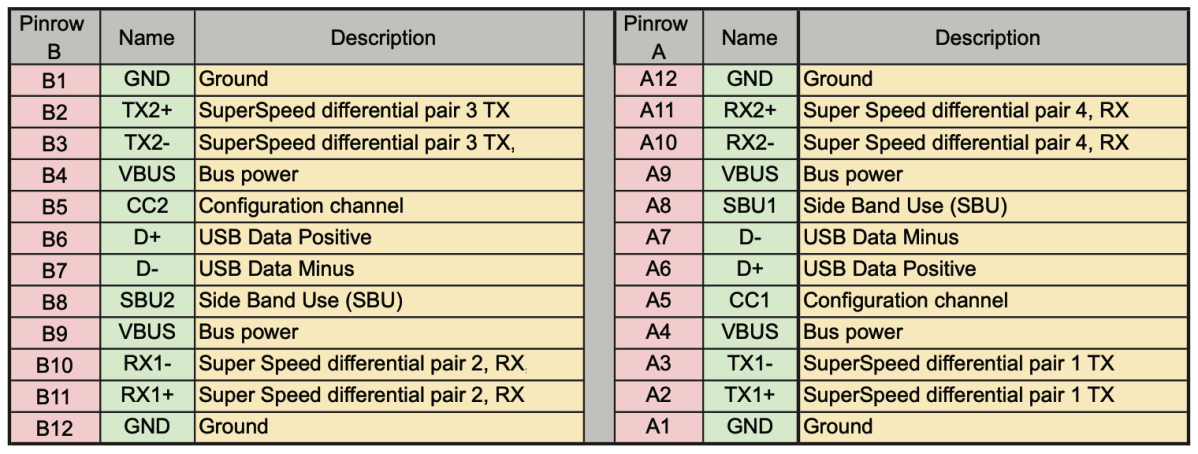
The tester’s small, clever circuit board is powered by an inexpensive CR2032 button battery and offers a number of USB ports. In addition to two USB-C 3.0 ports, there are two USB-A ports (USB 2.0 and USB 3.0) as well as mini-USB, micro-USB, Type-B, Lightning, and a hard drive connector (Micro-B 2.0).
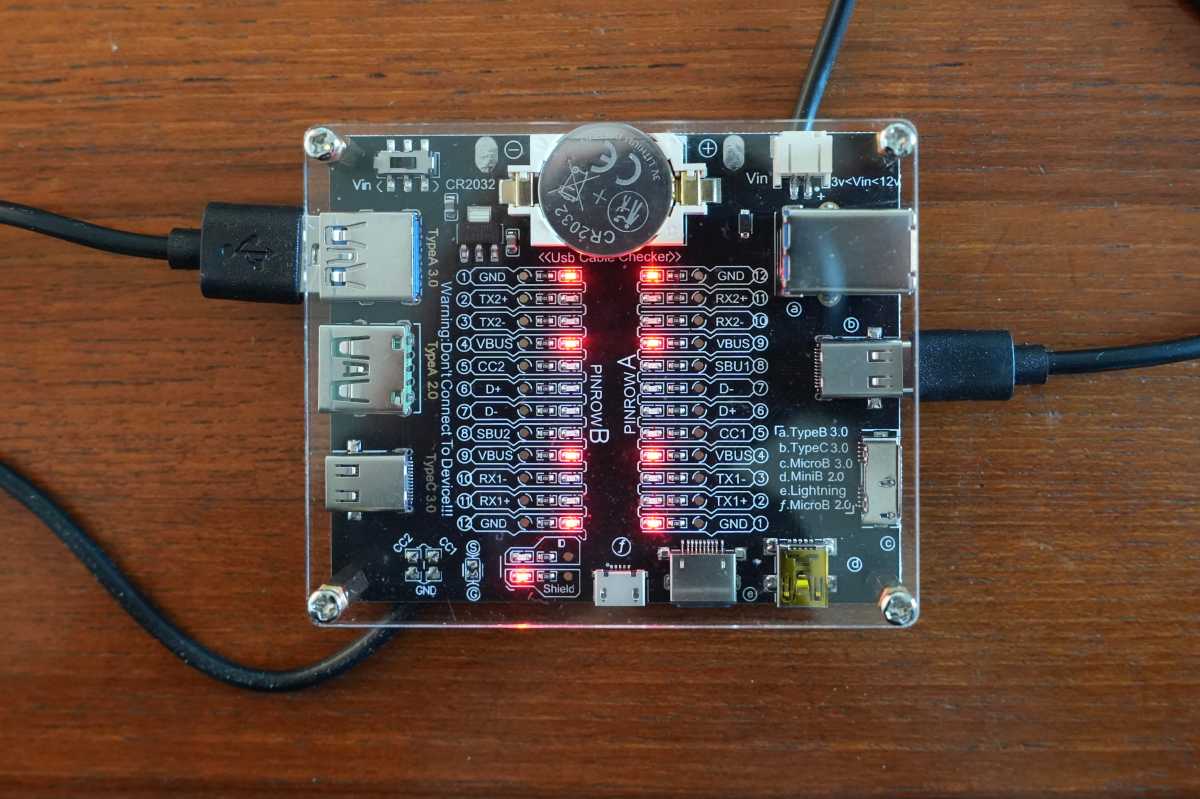
The functionality is as simple as it is efficient. Simply plug both ends of the cable to be tested into the device and the cable tester will display a series of LEDs. Basically, the more LEDs that light up, the better the cable.
This cable has significantly fewer functions than the upper cable: For example, the data lines are missing.
Meaning of the individual LEDs on the cable tester
Unfortunately, the cable tester does not currently support Thunderbolt or USB 4.0 — but this is not a problem, as both cable types have to be labelled as standard anyway. What’s more, these cables are relatively expensive and should therefore be easy to remember — at least that’s how it is for me.
The different LEDs light up depending on the cable standard.
No household should be without a USB cable tester
For me, the small cable tester is also more of an aid to sorting the countless other cables. Ragged USB-C charging cables can look just like the high-quality cables from the digital camera — with the difference that they don’t work in the same way. The cable tester helps me a lot here — and in my opinion, no household should be without one. Especially as it’s inexpensive and easy to use.
Sony is paying approximately $460 milliion to purchase Peanuts [PDF] and its characters, including Snoopy and Charlie Brown, created by Charles M. Schulz. That’s a 41 percent stake Sony is buying from Canadian firm WildBrain. Since Sony bought 39 percent of the franchise back in 2018, this will give the company an 80 percent stake. The deal is still subject to regulatory approvals, but Peanuts will become Sony’s consolidated subsidiary once it’s closed. Schulz’s family still owns the remaining 20 percent stake in the franchise.
Schulz launched the Peanuts universe in comic strips 75 years ago, back in 1950. The franchise has grown massively since then, spawning animated series, cartoon musicals and movies that made Snoopy a household name. The company said that it has focused on expanding the Peanuts IP since it bought 39 percent of the brand years ago. “With this additional ownership stake, we are thrilled to be able to further elevate the value of the ?PEANUTS? brand by drawing on the Sony Group?s extensive global network and collective expertise,” Sony Music Entertainment Japan CEO Shunsuke Muramatsu added.
This article originally appeared on Engadget at https://ift.tt/tQriSEx
In late September, a Spanish military plane carrying the country’s defense minister to a base in Lithuania was reportedly the subject of a kind of attack—not by a rocket or anti-aircraft rounds, but by radio transmissions that jammed its GPS system.
The flight landed safely, but it was one of thousands that have been affected by a far-reaching Russian campaign of GPS interference since the 2022 invasion of Ukraine. The growing inconvenience to air traffic and risk of a real disaster have highlighted the vulnerability of GPS and focused attention on more secure ways for planes to navigate the gauntlet of jamming and spoofing, the term for tricking a GPS receiver into thinking it’s somewhere else.
US military contractors are rolling out new GPS satellites that use stronger, cleverer signals, and engineers are working on providing better navigation information based on other sources, like cellular transmissions and visual data.
But another approach that’s emerging from labs is quantum navigation: exploiting the quantum nature of light and atoms to build ultra-sensitive sensors that can allow vehicles to navigate independently, without depending on satellites. As GPS interference becomes more of a problem, research on quantum navigation is leaping ahead, with many researchers and companies now rushing to test new devices and techniques. In recent months, the US’s Defense Advanced Research Projects Agency (DARPA) and its Defense Innovation Unit have announced new grants to test the technology on military vehicles and prepare for operational deployment.
Tracking changes
Perhaps the most obvious way to navigate is to know where you started and then track where you go by recording the speed, direction, and duration of travel. But while this approach, known in the field as inertial navigation, is conceptually simple, it’s difficult to do well; tiny uncertainties in any of those measurements compound over time and lead to big errors later on. Douglas Paul, the principal investigator of the UK’s Hub for Quantum Enabled Precision, Navigation & Timing (QEPNT), says that existing specialized inertial-navigation devices might be off by 20 kilometers after 100 hours of travel. Meanwhile, the cheap sensors commonly used in smartphones produce more than twice that level of uncertainty after just one hour.
“If you’re guiding a missile that flies for one minute, that might be good enough,” he says. “If you’re in an airliner, that’s definitely not good enough.”
A more accurate version of inertial navigation instead uses sensors that rely on the quantum behavior of subatomic particles to more accurately measure acceleration, direction, and time.
Several companies, like the US-based Infleqtion, are developing quantum gyroscopes, which track a vehicle’s bearing, and quantum accelerometers, which can reveal how far it’s traveled. Infleqtion’s sensors are based on a technique called atom interferometry: A beam of rubidium atoms is zapped with precise laser pulses, which split the atoms into two separate paths. Later, other laser pulses recombine the atoms, and they’re measured with a detector. If the vehicle has turned or accelerated while the atoms are in motion, the two paths will be slightly out of phase in a way the detector can interpret.
Last year the company trialed these inertial sensors on a customized plane flying at a British military testing site. In October of this year, Infleqtion ran its first real-world test of a new generation of inertial sensors that use a steady stream of atoms instead of pulses, allowing for continuous navigation and avoiding long dead times.
A view of Infleqtion’s atomic clock Tiqker.
COURTESY INFLEQTION
Infleqtion also has an atomic clock, called Tiqker, that can help determine how far a vehicle has traveled. It is a kind of optical clock that uses infrared lasers tuned to a specific frequency to excite electrons in rubidium, which then release photons at a consistent, known rate. The device “will lose one second every 2 million years or so,” says Max Perez, who oversees the project, and it fits in a standard electronics equipment rack. It has passed tests on flights in the UK, on US Army ground vehicles in New Mexico, and, in late October, on a drone submarine.
“Tiqker operated happily through these conditions, which is unheard-of for previous generations of optical clocks,” says Perez. Eventually the company hopes to make the unit smaller and more rugged by switching to lasers generated by microchips.
Magnetic fields
Vehicles deprived of satellite-based navigation are not entirely on their own; they can get useful clues from magnetic and gravitational fields that surround the planet. These fields vary slightly depending on the location, and the variations, or anomalies, are recorded in various maps. By precisely measuring the local magnetic or gravitational field and comparing those values with anomaly maps, quantum navigation systems can track the location of a vehicle.
Allison Kealy, a navigation researcher at Swinburne University in Australia, is working on the hardware needed for this approach. Her team uses a material called nitrogen-vacancy diamond. In NV diamonds, one carbon atom in the lattice is replaced with a nitrogen atom, and one neighboring carbon atom is removed entirely. The quantum state of the electrons at the NV defect is very sensitive to magnetic fields. Carefully stimulating the electrons and watching the light they emit offers a way to precisely measure the strength of the field at the diamond’s location, making it possible to infer where it’s situated on the globe.
Kealy says these quantum magnetometers have a few big advantages over traditional ones, including the fact that they measure the direction of the Earth’s magnetic field in addition to its strength. That additional information could make it easier to determine location.
The technology is far from commercial deployment, but Kealy and several colleagues successfully tested their magnetometer in a set of flights in Australia late last year, and they plan to run more trials this year and next. “This is where it gets exciting, as we transition from theoretical models and controlled experiments to on-the-ground, operational systems,” she says. “This is a major step forward.”
Delicate systems
Other teams, like Q-CTRL, an Australian quantum technology company, are focusing on using software to build robust systems from noisy quantum sensors. Quantum navigation involves taking those delicate sensors, honed in the placid conditions of a laboratory, and putting them in vehicles that make sharp turns, bounce with turbulence, and bob with waves, all of which interferes with the sensors’ functioning. Even the vehicles themselves present problems for magnetometers, especially “the fact that the airplane is made of metal, with all this wiring,” says Michael Biercuk, the CEO of Q-CTRL. “Usually there’s 100 to 1,000 times more noise than signal.”
After Q-CTRL engineers ran trials of their magnetic navigation system in a specially outfitted Cessna last year, they used machine learning to go through the data and try to sift out the signal from all the noise. Eventually they found they could track the plane’s location up to 94 times as accurately as a strategic-grade conventional inertial navigation system could, according to Biercuk. They announced their findings in a non-peer-reviewed paper last spring.
In August Q-CTRL received two contracts from DARPA to develop its “software-ruggedized” mag-nav product, named Ironstone Opal, for defense applications. The company is also testing the technology with commercial partners, including the defense contractors Northrop Grumman and Lockheed Martin and Airbus, an aerospace manufacturer.
An illustration showing the placement of Q-CTRL’s Ironstone Opal in a drone.
COURTESY Q-CTRL
“Northrop Grumman is working with Q-CTRL to develop a magnetic navigation system that can withstand the physical demands of the real world,” says Michael S. Larsen, a quantum systems architect at the company. “Technology like magnetic navigation and other quantum sensors will unlock capabilities to provide guidance even in GPS-denied or -degraded environments.”
Now Q-CTRL is working on putting Ironstone Opal into a smaller, more rugged container appropriate for deployment; “Ironstone Opal’s first deployment was, and looked like, a science experiment,” says Biercuk. He anticipates delivering the first commercial units next year.
Sensor fusion
Even as quantum navigation emerges as a legitimate alternative to satellite-based navigation, the satellites themselves are improving. Modern GPS III satellites include new civilian signals called L1C and L5, which should be more accurate and harder to jam and spoof than current signals. Both are scheduled to be fully operational later this decade.
US and allied military users are intended to have access to far hardier GPS tools, including M-code, a new form of GPS signal that is rolling out now, and Regional Military Protection, a focused GPS beam that will be restricted to small geographic areas. The latter will start to become available when the GPS IIIF generation of satellites is in orbit, with the first scheduled to go up in 2027. A Lockheed Martin spokesperson says new GPS satellites with M-code are eight times as powerful as previous ones, while the GPS IIIF model will be 60 times as strong.
Other plans involve using navigation satellites in low Earth orbit—the zone inhabited by SpaceX’s internet-providing Starlink constellation—rather than the medium Earth orbit used by GPS. Since objects in LEO are closer to Earth, their signals are stronger, which makes them harder to jam and spoof. LEO satellites also transit the sky more quickly, which makes them harder still to spoof and helps GPS receivers get a lock on their position faster. “This really helps for signal convergence,” says Lotfi Massarweh, a satellite navigation researcher at Delft University of Technology, in the Netherlands. “They can get a good position in just a few minutes. So that is a huge leap.”
Ultimately, says Massarweh, navigation will depend not only on satellites, quantum sensors, or any other single technology, but on the combination of all of them. “You need to think always in terms of sensor fusion,” he says.
The navigation resources that a vehicle draws on will change according to its environment—whether it’s an airliner, a submarine, or an autonomous car in an urban canyon. But quantum navigation will be one important resource. He says, “If quantum technology really delivers what we see in the literature—if it’s stable over one week rather than tens of minutes—at that point it is a complete game changer.”
This story was updated to better reflect the current status of Ironstone Opal.
via Technology Review Feed – Tech Review Top Stories https://ift.tt/6UiJWwj
While too much of the popular dairy product can spell tummy troubles and high cholesterol for some, new research suggests that eating more high-fat cheese and cream could be linked to a lower risk of developing dementia. While the findings published today in Neurology®, the medical journal of the American Academy of Neurology, do not prove that it lowers the total risk of the disease, it shows an association.
The high-fat debate
High-fat cheeses include cheddar, Brie, and Gouda, and contain more than 20 percent fat. High-fat creams such as whipping cream, double cream, and clotted cream typically contain 30 to 40 percent fat. These items are usually labeled as “full-fat” or “regular” versions in grocery stores.
“For decades, the debate over high-fat versus low-fat diets has shaped health advice, sometimes even categorizing cheese as an unhealthy food to limit,” said Emily Sonestedt, PhD, a study co-author and nutritional epidemiologist at Lund University in Sweden, said in a statement. “Our study found that some high-fat dairy products may actually lower the risk of dementia, challenging some long-held assumptions about fat and brain health.”
In this new study, the team analyzed data from 27,670 people in Sweden with an average age of 58 at the beginning of the study. The participants were followed for an average of 25 years. Over the course of the study, 3,208 people developed dementia.
For one week, the participants kept track of what they ate and answered questions about how often they ate certain foods. They also spoke with the researchers about how they prepared their food.
The researchers then compared people who ate 50 grams (about 1.7 ounces) or more of high-fat cheese every day with people who ate less than 15 grams (about half an ounce) daily. Fifty grams of cheese is about two slices of cheddar and a half a cup of shredded cheese and is roughly 15 grams. A serving of cheese is typically one ounce or 28 grams..
Of those who ate more high-fat cheese, 10 percent developed dementia by the end of the study. Of those who ate less, 13 percent developed dementia.
Risk factors
After adjusting for age, sex, education, and overall diet quality, the team found that people who ate more high-fat cheese had a 13 percent lower risk of developing dementia compared to those who ate less.
There are over 100 known forms of dementia, but the four main types are Alzheimer’s disease, vascular dementia, Lewy body dementia, and fronto-temporal dementia. When looking at specific types of dementia, the team found people who ate more high-fat cheese had a 29 percent lower risk of vascular dementia.
There was also a lower risk of Alzheimer’s disease among those who ate more high-fat cheese. However, that risk was only lower for those who do not have the APOE e4 gene variant—a genetic risk factor for Alzheimer’s disease.
Additionally, the team compared people who consumed 20 grams (roughly 0.7 ounces) or more of high-fat cream per day to people who consumed none. For example, 20 grams of high-fat cream is about 1.4 tablespoons of heavy whipping cream and a recommended serving is about 1 to 2 tablespoons. After similar adjustments, the researchers found that those who consumed high-fat cream daily had a 16 percent lower risk of dementia, compared to those who did not consume any.
They did not find any association between dementia risk and eating low-fat cheese, low-fat cream, high- or low-fat milk, butter, or fermented milk (yogurt, kefir, and buttermilk).
‘When it comes to brain health not all dairy is equal’
One important limitation of this study is that all of the participants were from Sweden, so results may not be the same for other populations. Sonestedt notes that in Sweden, cheese is often eaten uncooked, whereas in the United States it is often heated or eaten with meat. Sweden also has universal health coverage, which the U.S. lacks. Universal coverage typically leads to better health outcomes. Despite spending significantly more money than peer nations, Americans live shorter lives and face more barriers to basic care, so socioeconomics, pollution exposure, and other lifestyle factors can skew nutrition studies like this one.
“These findings suggest that when it comes to brain health not all dairy is equal,” said Sonestedt. “While eating more high-fat cheese and cream was linked to a reduced risk of dementia, other dairy products and low-fat alternatives did not show the same effect. More research is needed to confirm our study results and further explore whether consuming certain high-fat dairy truly offers some level of protection for the brain.”