
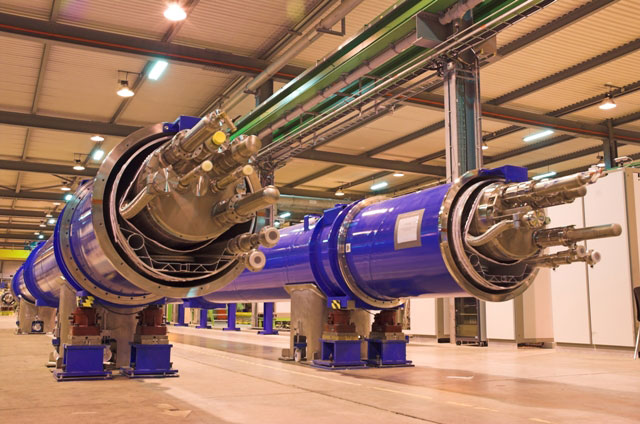
From Ars Technica: “We’ve observed a new particle”: leaked video reveals Higgs confirmation

“We’ve observed a new particle.” That’s the opening statement in a video featuring Joe Incandela, the spokesman for the Large Hadron Collider’s CMS detector, made in a video that is currently publicly accessible on the CERN website. The video, first spotted by ScienceNews and now apparently pulled, appears to preempt the big announcement scheduled for early tomorrow morning. It also implies that this year’s data was enough to push the evidence for the Higgs past the five standard deviations needed to declare discovery.

“When we say we’ve observed the particle, it means we’ve just got enough data to say it’s definitely there, and it’s very unlikely to go away,” Incandela says in the video. In addition, we know it’s a boson because it decays into two photons.
Its mass is roughly 130 times that of the proton, making it the heaviest boson we’ve discovered so far—and the heaviest particle other than the top quark.

The two-photon decay is one of the strongest bits of evidence, and provides a narrow peak that helps define its mass. Strong evidence is also available through decay into two Z particles; the signal is there in other decay channels as well, but those are less definitive because of the background noise present.


from Ars Technica

From Discover Magazine: Compressed Air Is Great for Powering Workshops. Can It Help Power the World? | 80beats

power grid

Despite increasing worry about what our energy consumption is doing to the planet, we’re also increasingly tied to power-hungry electronic devices. To keep reliable, renewable energy flowing, some suggest, we must give the power grid a makeover. And one method that could change it is a breath of fresh air. Danielle Fong and her company, LightSail Energy, want to store renewable energy in tanks of compressed air. Because wind and solar can be unpredictable energy sources, the ability to save any surplus for a windless or cloudy day makes them more reliable.

Caleb Garling has written about Fong’s unusual method of storing power for Wired’s World’s Most Wired feature.

In a way, Fong is going back to the future. Compressed air tanks have been used to store energy as far back as the late 19th century. They were installed in cities across the globe, from Paris to Birmingham, England to Buenos Aires. Germany has been using the technology for the past 30 years, and a power company in Alabama opened a facility in 1991. The idea is a simple one: If you have a power source — whether it’s gas or …

from Discover Magazine

From Popular Science – New Technology, Science News, The Future Now: Video: MIT Alumni Bring Spacesuit Tech to Temperature-Regulating Dress Shirts

Apollo Dress Shirt Ministry of Supply

It happens to the best of us: you slog through the summer heat on your morning commute and wind up a messy ball of sweat by the time you make it to the sweet comfort of your air-conditioned office. Now a team of MIT grads is trying to solve that problem by borrowing temperature-control technology from NASA.

The team, Ministry of Supply, is taking donations via Kickstarter for their Apollo line of dress shirts, which use phase-change materials to absorb heat from your body to cool you off when it’s hot, then release it when things cool down. It’s similar to technology used in NASA-approved spacesuits. The shirts keep sweat and moisture off of you, and use an anti-microbial coating to keep you smelling fresh.

The shirt has been a hit on Kickstarter so far, blowing past its initial goal of $30,000. To keep the funding rolling in, the team has been offering incentives, like new colors or patterns for reaching certain goals. At last count they were at more than $178,000.

[Kickstarter via Tech Crunch]


from Popular Science – New Technology, Science News, The Future Now