From Ars Technica: Kickstarter “Frankencar” combines solar panels with bike pedals

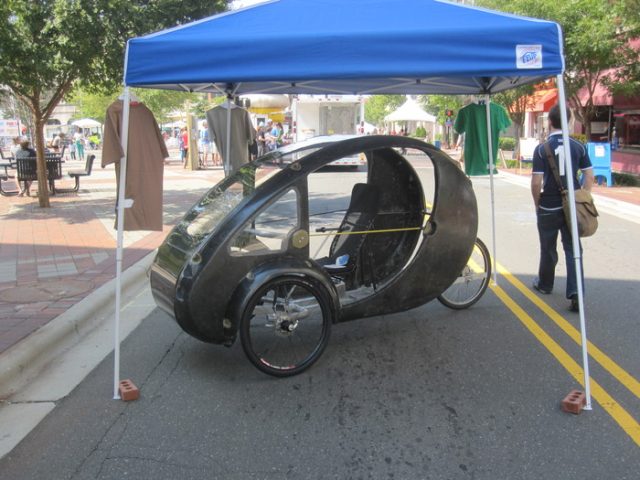
A new Kickstarter project proposes to fill in the missing link between bicycle and environmentally conscious car: a “three-wheeled electric assist velomobile” that runs off rooftop solar panels, a top-off from a wall outlet, or the power of your own two feet. The vehicle is still classified as a bike in all 50 states and can go 1,800 miles off the energy equivalent of one gallon of gas.

The ELF, created by Organic Transit of Durham, NC, claims to solve many of the problems that affect our choice about which vehicle to take out for short trips. Bikes are efficient and environmentally friendly, but they leave you sweaty and storageless. Cars are comfortable, effortless, and you can fill them up with groceries, backpacks, and gym bags… at the cost of your personal contribution to climate change. The ELF navigates neatly around these tradeoffs as a single-seat podlike vehicle with an electric motor that can both assist you when pedaling or take over powering the vehicle completely, with a range of up to 30 miles (Organic Transit doesn’t specify the motor’s top speed).

Behind the seat, the ELF has room in the back for “eight bags of groceries or 350lbs of cargo,” according to the Kickstarter page. A 60 watt solar panel on the roof comes standard to charge the 88.8-volt lithium battery, though that aspect of the vehicle can be upgraded. The ELF also comes with built-in headlights, brake lights, and turn signals, so riders don’t have to signal by waving their arms out the door.

Read 1 remaining paragraphs | Comments

from Ars Technica

From Ars Technica: Mozilla ships Firefox with H.264 support on Android

H.264 Big Buck Bunny in Firefox on Android 4.2.1.

The Firefox browser is now shipping with support for HTML5 videos compressed with the H.264 codec to users of Android 4.1 (Jelly Bean) and Samsung phones with Android 4.0 (Ice Cream Sandwich).

This is the first time the open source browser has supported the widely used video codec. Firefox’s developer, Mozilla, was reluctant to support H.264 because the open standard was not available on a royalty free basis; implementers of decoders have to pay for a license to use the various patents that cover H.264. Instead, the group hoped the Google-owned VP8 codec would suffice; a hope buoyed by Google’s announcement that Chrome would drop its support for H.264 and concentrate on VP8.

Google never did remove H.264 from Chrome—the browser supports it to this day—and a substantial fraction, possibly 80 percent or more, of HTML5 video on the Web uses the H.264 codec. The growth of mobile platforms made the demand for H.264 support even more acute: hardware acceleration of H.264 decompression is all but universal on mobile devices and taking advantage of this hardware support is essential for providing acceptable battery life.

Read 3 remaining paragraphs | Comments

from Ars Technica
From Ars Technica: How sensitive is the climate to added CO2?

As recent events have shown, even the World Bank is trying to understand the trajectory of future climate changes. Although there are a number of ways of doing this, many organizations rely on a measure called the climate sensitivity. It’s a bit rough, but it’s simple: it provides a value for the temperature increase we’d expect given a doubling of CO2.

Currently, the Intergovernmental Panel on Climate Change places this value between 2 and 4.5°C, with a most likely value of about 3°C. But a variety of studies have come up with measurements spread around that range, and nailing down the likely upper limit has been a challenge. Now, a large group of researchers has gone through millions of years of data on the Earth’s past, incorporating information from a number of past studies. In the end, the group decided that the IPCC estimates are more or less on target.

Adding more carbon dioxide to the atmosphere doesn’t drive temperatures in a linear manner. You can think of this in terms of the infrared photons they absorb: each one can only be absorbed once, and the more CO2 molecules you add, the more likely it is that an existing one would have absorbed that photon anyway. As a result, each doubling of carbon dioxide concentrations are expected to have roughly an equivalent impact.

Read 10 remaining paragraphs | Comments


from Ars Technica

From Wired Top Stories: Geeking Out on Materials: 3D-Print Circuits With Innovative Conductive Plastic

As we keep saying, for 3D printing to make its way into the mainstream, science needs to give us materials that can do more than just be hardened plastic. Researchers at the University of Warwick have just taken a huge step in the right direction with the introduction of a 3D-printable electrically conductive plastic. They’re calling it “carbomorph.”

from Wired Top Stories

From Popular Science – New Technology, Science News, The Future Now: Korean Government Will Intervene On Gadget Addiction, Starting With 3-Year-Olds

Korean Pro Gamers Wikimedia Commons

Gadgets and the Internet are big in South Korea. Really big, as this Associated Press story points out. Now “addiction” to the devices is enough of a problem that the government is stepping in. Officials plan to make mandatory classes for children as young as three (!) so the problem is dealt with early. This is the first line of the article: “Park Jung-in, an 11-year-old South Korean, sleeps with her Android smartphone instead of a teddy bear.” Yeah, that sounds like an issue. [PhysOrg]

from Popular Science – New Technology, Science News, The Future Now

From Geeks are Sexy Technology News: The Mine Kafon: A Wind-Powered Tumbleweed That Destroys Landmines [Video]

A beautiful, simple, cheap, and effective way to get rid of landmines in mine-infested territories. This guy is a genius.

THE MINE KAFON is a Semifinalist in the $200,000 FOCUS FORWARD Filmmaker Competition and is in the running to become the $100,000 Grand Prize Winner. It could also be named an Audience Favorite if it’s among the ten that receives the most votes. If you love it, vote for it. Click on the VOTE button in the top right corner of the video player. Note that voting may not be available on all mobile platforms, and browser cookies must be enabled to vote.

[Focus Forward Films]

No related posts.

from Geeks are Sexy Technology News