This Verizon Unlimited Plan Comparison Chart is Incredibly Helpful

https://www.droid-life.com/2023/04/14/this-verizon-unlimited-plan-comparison-chart-is-incredibly-helpful/

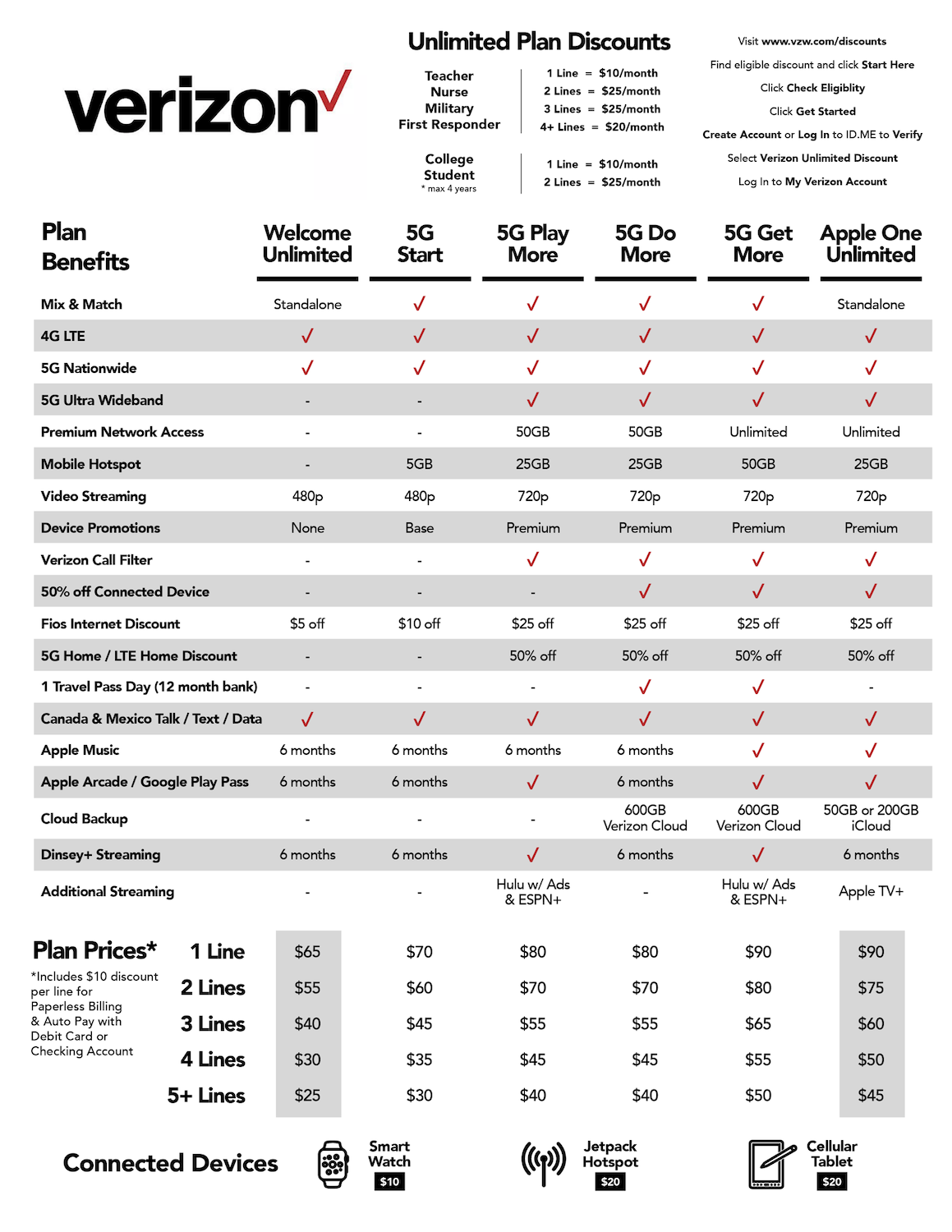
Verizon has a lot of Unlimited plans, and for many, it can be rather confusing to know what perks, benefits, and limitations each one has. Thankfully for us, there are people like reddit user maxypantsyo who go out of their way to make our lives a little easier. Props, maxypantsyo.

In a chart they published to reddit, we get a complete breakdown of each of the six Unlimited plans that Verizon currently offers, plus the various things that each plan gets and how much they cost. For example, the 5G Do More comes with 6 months of Apple Music, but the plan right above that, the 5G Get More plan, has no timed subscription – Apple Music is simply included with the plan. We can also see how the basic unlimited plans, like Welcome Unlimited and 5G Start, do not include access to 5G UWB, while all plans do include basic 5G access nationwide.

This chart is incredibly helpful to people like us who have to talk about these plans, but also to consumers who get lost in Verizon’s never ending remix of these plans and their names for marketing purposes. It’s a total pain to keep track of, so again, a big shoutout goes to maxypantsyo.

People are awesome.

// reddit

Read the original post: This Verizon Unlimited Plan Comparison Chart is Incredibly Helpful

via Droid Life: A Droid Community Blog https://ift.tt/r3GfxCO

April 14, 2023 at 01:04PM

Electric Car Production Will Accelerate after EPA’s Historic Tailpipe Emissions Rules

https://subscriber.politicopro.com/article/eenews/2023/04/13/epa-used-the-climate-law-on-cars-power-plants-are-next-00091811


CLIMATEWIRE | The tailpipe emissions rules EPA proposed Wednesday are the sticks to Congress’ carrots, providing the clearest view yet of how the agency plans to leverage the hundreds of billions of dollars lawmakers have pumped into clean energy and infrastructure.

EPA built its two market-transforming rules on top of generous incentives in last year’s Inflation Reduction Act, or IRA, and the 2021 bipartisan infrastructure law. That resulted in the agency proposing the most aggressive restrictions in U.S. history on the carbon, smog and soot emitted from compact cars all the way up to long-haul trucks.

It’s a pattern EPA will likely repeat when it releases its power plant carbon rules later this month.

On Wednesday, EPA Administrator Michael Regan said that the agency was “partnering very strategically” with the climate and infrastructure laws in its rules for light-duty and medium-duty vehicles. The proposal for light-duty vehicles — which aims to electrify two-thirds of new cars by model year 2032 — is feasible because EPA is “marrying regulation with historic incentives,” he said.

The rules are built upon newly enacted measures like the IRA’s $7,500 tax credit for EVs, the infrastructure law’s investments in charging stations and billions of dollars in last year’s CHIPS and Science Act for domestic semiconductor manufacturing.

“We’re rowing in the same direction,” Regan told an audience seated in the hot April sun in front of EPA headquarters.

The climate, infrastructure and science laws have reshaped the auto industry’s future, in turn changing the baseline EPA uses to determine the costs and benefits of its vehicle emissions rules. The laws have similarly changed how economic models predict the power sector’s future (Climatewire, April 4).

That’s important because the Clean Air Act demands that EPA consider cost and other factors when issuing a rule. Now, thanks to the new laws, the U.S. Treasury will shoulder a share of the cost for “manufacture, sale, and use of zero-emission vehicles by addressing elements critical to the advancement of clean transportation and clean electricity generation,” EPA states in the preamble to the light-duty vehicle proposal.

In short, federal incentives will prompt more automakers and consumers to turn to EVs. In the rule for cars and SUVs, EPA cites an analysis from the International Council on Clean Transportation that found electric vehicles will make up between 56 and 67 percent of new car sales by model year 2032 — before any new rules on tailpipe emissions.

The rule’s preamble includes a 3 ½ page section on the climate and infrastructure laws and — to a lesser degree — the CHIPS law. But the laws are also the backbone of EPA’s justification for the rule, with references sprinkled throughout its 758 pages.

The climate law’s $7,500 tax credit makes some EVs “more affordable to buy and operate today than comparable [internal combustion engine] vehicles,” EPA states in the rule. Hence, a tough rule that pushes manufacturers toward EVs won’t burden consumers, EPA asserts.

The agency also cites the climate law’s tax credits for battery cell and module manufacturers, which it says will help bring down the cost of production. Both credits phase out between 2030 and 2032, when the rule ends.

The rule also assumes the infrastructure law’s $7.5 billion investment in the nation’s charging network will make it easier for EVs to eat into gasoline-powered vehicles’ market share, bringing emissions down.

Market changes that were already in the pipeline can’t be attributed to new regulations. The climate and infrastructure laws have thus made EPA’s car and truck rules — which Regan called the strongest in history — look like part of the policy landscape rather than an outlier.

“EPA’s not setting these standards in a vacuum,” noted Chet France, a former EPA official who is now a consultant with the Environmental Defense Fund, during a Tuesday briefing. “It’s in the context of where the industry is headed, not only worldwide but specifically in this country.”

Right policy at right time?

This week’s tailpipe rules — and upcoming rules to limit carbon emissions from power plants — will be more heavily influenced by Congress’ recent influx of climate spending than most other EPA rules. That’s because the transportation and power sectors are top greenhouse gas emitters, making them targets of both climate legislation and agency regulation.

“These are the first rules where both what you do and what it costs would be affected by those incentives,” said David Doniger, senior strategic director for climate change at the Natural Resources Defense Council. “What EPA would do, what were the emission limits that EPA would impose for cars or for power plants, and what those emission limits would cost are very much affected by the IRA in the direction of bringing those costs down and making it possible for EPA to justify regulations under the Clean Air Act.”

The IRA also bolsters the tailpipe rules by affirming that EPA has the authority to regulate the six greenhouse gases under the Clean Air Act, and by showing Congress’ intention to decarbonize the power and transportation sectors, Doniger said. Both elements could help the administration defend rules in court, he said.

But the auto industry has expressed reservations about the draft rules, which would require auto manufacturers to cut the average emissions of their vehicles by more than 50 percent between model years 2026 and 2032.

John Bozzella, president and CEO of Alliance for Automotive Innovation, called the rules’ targets “very high” in a blog post Wednesday.

The Biden administration’s previous target for EVs — making 50 percent of car sales electric by 2030 — was already a “stretch goal and predicated on several conditions” that required the full force of the IRA to reach, he said.

Bozzella, whose group represents major U.S. car companies, said the rules’ feasibility would depend on factors outside of the industry’s control, including “charging infrastructure, supply chains, grid resiliency, the availability of low carbon fuels and critical minerals.”

He acknowledged baseline assumptions had changed because of new legislation.

“But it remains to be seen whether the refueling infrastructure incentives and supply-side provisions of the Inflation Reduction Act, the bipartisan infrastructure law, and the CHIPS and Science Act are sufficient to support electrification at the levels envisioned by the proposed standards over the coming years,” Bozzella wrote.

He also pointed to the Treasury Department’s recently released guidance for which vehicles qualify for the $7,500 EV tax credit. The guidance requires cars be made and sourced in the United States or its closest trading partners — which Bozzella said would mean “far fewer EV models” would qualify for the purchase incentive EPA’s light-duty vehicle rule counts upon.

But while major carmakers are cautious, the EV industry is anxious to line up behind EPA’s rules — or even push for stronger ones.

“This is the right policy at the right time because of the industrial policy put in place over the last two years,” said Albert Gore, executive director of the Zero Emissions Transportation Association.

The infrastructure law dedicated billions of dollars to building public charging stations for electric vehicles, Gore said. Most EV charging happens at home, but the network of chargers is expected to help quell drivers’ anxiety about long-distance driving. And the law has provisions to address other common complaints, like the slow charging speed and frequent outages (Energywire, March 29).

The IRA also not only expanded the tax incentives for car and truck buyers, but created financial incentives that will shore up the battery-making and car-manufacturing industries, as well. Even before the law passed last year, billions of dollars in new battery and vehicle plants were announced in the Midwest and Southeast.

“The IRA has really accelerated that,” Gore said.

 Reporter Mike Lee contributed.

This story also appears in Energywire.

Reprinted from E&E News with permission from POLITICO, LLC. Copyright 2023. E&E News provides essential news for energy and environment professionals.

via Scientific American https://ift.tt/MBJNE1x

April 13, 2023 at 11:36AM

Google Maps Now Contains All Info You Need Concerning US National Parks

https://www.droid-life.com/2023/04/11/google-maps-now-contains-all-info-you-need-concerning-us-national-parks/

Google announced four new features for the Maps app on Android and iOS this week, all centered on our national parks system here in the US. If you find yourself visiting these lovely locations, this update is for you.

In the update, users can now quickly identify the most popular places in a particular park, such as its attractions, campgrounds, visitor centers, and trailheads. This is made possible thanks to the work we the users have put in, as Google specifically calls out the Maps community. You’re welcome, I suppose. In addition, trails are now a serious feature of Maps, not just pins that display where a trail starts. Popular trails will now be shown in their entirety, allowing you to locate both the start and finish of that trail. When it comes to planning out a hike, this could be very useful.

Later this month, users will see park entrances highlighted on the map, as well as better directions to trailheads when you’re going on foot or by bicycle.

The last piece is for when cell reception out in the park is terrible. Users can download these maps and their information for offline use, just like you can on other areas. Again, that’s super helpful.

These changes are rolling out now.

// Google

Read the original post: Google Maps Now Contains All Info You Need Concerning US National Parks

via Droid Life: A Droid Community Blog https://ift.tt/8MTUPR4

April 11, 2023 at 02:32PM

Thieves are now stealing cars via a headlight ‘CAN injection’

https://www.autoblog.com/2023/04/12/vehicle-headlight-can-bus-injection-theft-method-update/


Car thieves have come up with yet another way to steal your car, and this one is rather creative. We’ll refer to it as “headlight hacking,” but as Dr. Ken Tindell of Canis Automotive Labs describes in his extensive and technical blog post, it’s a bit more complicated than that.

The method of theft begins at your car’s headlight module, but the only reason thieves have chosen this point of entry is because it offers them the easiest way to get hooked into a vehicle’s CAN bus system. For those unfamiliar, the CAN bus system of a vehicle is the method by which the numerous ECUs throughout a modern vehicle communicate with each other. Thieves are using this central nervous system to their advantage by executing an attack referred to as “CAN injection.”

Someone has developed a tool (disguised as a JBL Bluetooth speaker and sold on the dark web) that when wired into a vehicle’s control CAN bus, can impersonate the vehicle’s key fob. The vehicle used as an example is a current-generation Toyota RAV4, but it’s vital to note that this vulnerability is not specific to any particular OEM or model — this is an industry-wide problem at the moment. Thieves are pulling bumpers and trim pieces away from a vehicle, which allows them access to the CAN bus near the headlight connector. Much of a vehicle’s CAN bus systems will be found hidden deep inside a car, but since modern headlights are so smart these days, they require their own ECUs, which means they’re going to be wired into the whole car’s CAN bus system.

Once thieves find the correct wires to tap into, the theft device does the work for them. A simple “play” button on the fake JBL speaker injection tool is programmed to instruct the door ECU to unlock the doors, as though you have the actual key to the car in your hand. You turn the vehicle on in a similar fashion, and a thief can simply drive away with your car without ever coming into contact with the vehicle’s actual key fob.

What can a car owner do?

As of this article’s publishing, there isn’t a great defense against this sort of theft. On the good news front, a thief trying to steal a car this way will need to do some real work to get it. Ripping off body panels takes time, and so does wiring into the car. Basically, a thief would need to have uninterrupted access to your vehicle in a private area to make it work. Additionally, Lindell suggests that fixes for the problem are possible.

The initial fix he suggests automakers roll out would be a software update that recognizes the sort of activity on the CAN bus systems that this injection tool sends out. This could thwart the tool in the short term, but Lindell believes that thieves will find a way around it in the long term. As for a permanent fix, Lindell believes that a “Zero Trust” approach to CAN bus systems is the only way to go. Every message from one ECU to another would need to be encrypted and carry authentication codes that can’t be spoofed. Additionally, every ECU would need to be equipped with secret keys, and every car would need to carry its own secret keys to prevent a universal key extractor from being created. Developing such a security system would take considerable time and effort from a vehicle manufacturer. 

We talked with some security experts at VOXX Electronics, which is both an OEM supplier and aftermarket option for vehicle security systems, to get some perspective on this issue and what might work to defend against it. Both VP of marketing Jonathan Frank and security product manager Chris Libardi tells us that CAN bus-style attacks are hardly a new thing in the automotive space.

“Whatever they’re being referred to as they are out there, the hacks are not new,” Libardi tells us. “They’ve been going on for a dozen years. As long as there’s been CAN, there’s been ways to hack around it.”

The problem experts and the public is seeing today is that CAN bus hacking is getting easier because the CAN bus now stretches to more accessible parts of the car, such as the headlight modules used in this vulnerability. Years ago, it wasn’t so easy.

“In order to do CAN bus-style stuff, you had to gain access to the wires, which were interior, so you’d have to physically break into the vehicle gain access, get under the dash, get to a CAN network set of wires,” Libardi says. “It wasn’t as easy. It’s becoming more prevalent now because typically to do this you had to be very, very, very well educated and have a lot of expensive equipment, and have the actual CAN bus messaging and all that, that would be required to do something like this. It’s just becoming easier.”

Tindell at Canis Automotive Labs suggests that folks try and park their vehicle in places that don’t allow easy and uninterrupted access to its headlights. VOXX Electronics recommends one of its aftermarket systems (the Viper DS4) as a theft deterrent, though, as it says thieves won’t be able to start the car up with its system in place. The CAN injection allows thieves to bypass an OEM system, and VOXX says that a thief could still even unlock the car doors with its system installed, but they’d need to find a way to hack the Viper system on top of that for the vehicle to fire up.

Of course, installing an aftermarket security system on your brand new car isn’t something most folks want to do, but in terms of OE solutions, answers are short for the time being. We’ve reached out to a few different automakers for comment and to see what they might have to say about this new way of stealing cars, and will update this post upon hearing back.

But lastly, if you notice that someone has been tampering with the trim or body panels near/around your headlights, you may want to contact the police, because a thief could be readying their CAN bus injection theft.

via Autoblog https://ift.tt/BPD6t0a

April 12, 2023 at 10:15AM

Dashcam Footage Shows Driverless Cars Clogging San Francisco

https://www.wired.com/story/dashcam-footage-shows-driverless-cars-cruise-waymo-clogging-san-francisco/


The bus was stuck. San Francisco’s eastbound 54 Felton line was heading up a narrow residential street when a white SUV coming the other way stopped in the middle of the road. It was a rainy Sunday evening last month, and the bus driver leaned up to the windshield and peered through the haze at the SUV’s pulsing hazard lights before slumping back and exclaiming in surprise, “What the hell? No driver of the car?!”

The 54, brought to a halt by an autonomous vehicle belonging to Alphabet’s Waymo, isn’t the only bus that’s run into trouble with San Francisco’s growing crowd of driverless vehicles. Bus and train surveillance videos obtained by WIRED through public records requests show a litany of incidents since September in which anxiety and confusion stirred up by driverless cars has spilled onto the streets of the US city that has become the epicenter for testing them.

A San Francisco public transit bus encounters a Waymo autonomous vehicle in its path on March 5.

Courtesy of SFMTA

As the incidents stack up, the companies behind the autonomous vehicles, such as Waymo and General Motors’ Cruise, want to add more robotaxis to San Francisco’s streets, cover more territory, and run at all hours. Waymo and Cruise say they learn from every incident. Each has logged over 1 million driverless miles and say their cars are safe enough to keep powering forward. But expansions are subject to approval from California state regulators, which have been pressed by San Francisco officials for years to restrict autonomous vehicles until issues subside.

Driverless cars have completed thousands of journeys in San Francisco—taking people to work, to school, and to and from dates. They have also proven to be a glitchy nuisancesnarling traffic and creeping into hazardous terrain such as construction zones and downed power lines. Autonomous cars in San Francisco made 92 unplanned stops between May and December 2022—88 percent of them on streets with transit service, according to city transportation authorities, who collected the data from social media reports, 911 calls, and other sources, because companies aren’t required to report all the breakdowns.

The records obtained by WIRED are more focused. They follow a previously unreported directive to staff of the San Francisco Municipal Transportation Agency handed down last October to improve record keeping of incidents involving autonomous vehicles. Muni, as the agency is known, standardized the term “driverless car” when staff report “near-misses, collisions or other incidents resulting in transit delay,” according to the directive. Agency logs show 12 “driverless” reports from September 2022 through March 8, 2023, though Muni video was provided for only eight of these cases. Overall, the incidents resulted in at least 83 minutes of direct delays for Muni riders, records show. 

That data likely doesn’t reflect the true scale of the problem. Muni staff don’t follow every directive to the letter, and a single delay can slow other lines, worsening the blow. Buses and trains cannot weave around blockages as easily as pedestrians, other motorists, and cyclists, saddling transit-dependent travelers with some of the biggest headaches caused by errant driverless cars, according to transit advocates.

San Francisco officials say they want to be supportive of new technology, but they first want to be shown progress on addressing failures—like random stops in front of buses and trains. “What we’re seeing is a significant uptick in traffic and other kinds of chaos on our streets,” says Jeffrey Tumlin, Muni’s director of transportation. “We are very concerned that if autonomous vehicles are allowed limitless, driverless operations in San Francisco that the traffic impacts grow exponentially.”

For Muni’s 54 bus, which traverses San Francisco’s southern edge, the vehicle blocking its way early last month was a driverless Waymo that got stranded between rows of parked cars. A human driver would have reversed, clearing space for the bus, which isn’t allowed to back up without a supervisor. Instead, the Waymo Driver, as the company calls its technology, alerted a remote “fleet response specialist” to help. Waymo spokesperson Sandy Karp says that this worker provided guidance to the car that “was not ideal under the circumstances” and made it challenging to resume driving. 

That left the Muni driver in a bind. “I can’t move the bus,” the driver said to one of two riders on board. “The car is automatic driving.” The driver radioed managers and doffed their cap: “Whoosh … Half hour, one hour. I don’t know. Nothing to do.” Thirty-eight stops and about five miles remained ahead for the 54. The driver, looking out at the Waymo, expressed disappointment: “This one not smart yet. Not smart. Not good.”  

via Wired Top Stories https://www.wired.com

April 10, 2023 at 06:06AM

SpaceX stacks huge Starship vehicle ahead of orbital test flight (video)

https://www.space.com/spacex-starship-stacking-video-april-2023


This is quite the pretty picture for space fans.

SpaceX stacked its giant Starship vehicle on Wednesday (April 5), lifting the Ship 24 upper-stage prototype onto the Booster 7 first stage at the company’s Starbase facility in South Texas.

The lift and its aftermath were captured on video, which SpaceX founder and CEO Elon Musk shared via Twitter (opens in new tab) early Thursday morning (April 6). 

The footage, apparently captured by a drone, shows off gorgeous seaside scenery as well as the 394-foot-tall (120 meters) Starship, which will become the most powerful rocket ever to fly when it lifts off — and that should happen soon.

Related: SpaceX’s 1st orbital Starship looks supercool in these fueling test photos

SpaceX stacked its latest Starship vehicle on the orbital launch mount at Starbase in South Texas on April 5, 2023, as shown by this image, a screenshot from a SpaceX video. (Image credit: SpaceX/Elon Musk via Twitter)

Indeed, Wednesday’s stacking was prep work for the first-ever orbital flight test for Starship, as Musk noted in his tweet: “Starship preparing for launch,” he wrote as a sort of caption for the 47-second video.

Various reports have indicated that SpaceX may be targeting a try as early as Monday (April 10). There’s no firm target date, however; SpaceX has yet to announce one, and it’s apparently still waiting on an orbital launch license from the U.S. Federal Aviation Administration. So we’ll just have to wait and see.

Both of Starship’s stages are designed to be fully and rapidly reusable, a breakthrough that Musk thinks will make Mars colonization and a variety of other bold spaceflight feats economically feasible.

Though Starship has yet to go orbital, SpaceX has already booked a handful of deep-space missions with the stainless-steel vehicle. For example, NASA chose Starship to be the first crewed lander for its Artemis moon program, which aims to put boots down near the lunar south pole in 2025 and then go on to establish a base in the area.

In addition, Japanese billionaire Yusaku Maezawa bought a Starship flight around the moon, paying the way for himself and a group of eight artists. And Dennis Tito, who made history in 2001 as the first paying passenger to reach the International Space Station, plans to fly on another Starship circumlunar mission, along with his wife and other crewmembers who have yet to be named. The target dates for those private moon flights are still being worked out.

Mike Wall is the author of “Out There (opens in new tab)” (Grand Central Publishing, 2018; illustrated by Karl Tate), a book about the search for alien life. Follow him on Twitter @michaeldwall (opens in new tab). Follow us on Twitter @Spacedotcom (opens in new tab) or Facebook (opens in new tab).

Join our Space Forums to keep talking space on the latest missions, night sky and more! And if you have a news tip, correction or comment, let us know at: community@space.com.

via Space https://ift.tt/m6sKNeu

April 6, 2023 at 11:28AM

Dawn Aerospace’s space plane aces first rocket-powered flights (video)

https://www.space.com/dawn-aerospace-space-plane-first-rocket-powered-flights-video


Dawn Aerospace’s robotic space plane flew with a rocket engine for the first time last month, taking a major step toward the company’s goal of building a fully and rapidly reusable craft. 

Last week, the 15.7-foot-long (4.8 meters) Mk-II Aurora flew three times, and “all test objectives were achieved,” Dawn representatives said in a statement (opens in new tab) issued on Wednesday (April 5). The company also released a one-minute video showing the sleek space plane flying over New Zealand’s stunning South Island, close to the Glentanner Aerodrome where the tests were carried out.

In August 2021, the Mk-II Aurora debuted with five test flights using surrogate jet engines, but the plan was always to pivot to a rocket-powered engine. In the latest series of tests, which took place once each day from Wednesday (March 29) to Friday (March 31), the Mk-II Aurora flew to a height of 6,000 feet (1,830 m) at speeds of 196 mph (315 kph), which is similar to those the space plane had achieved during its 2021 test flights, Dawn team said in Wednesday’s update.

Related: Space planes: evolution of the winged spaceship (infographic)

Dawn Aerospace’s robotic Mk-II Aurora space plane flew with a rocket engine for the first time in March 2023. (Image credit: Dawn Aerospace)

“This is a phenomenal achievement for our small, but extremely capable, team in New Zealand and the Netherlands,” Stefan Powell, the CEO of Dawn Aerospace, said Wednesday in a different statement (opens in new tab). “To my knowledge, Dawn now operates the most rapidly reusable rocket-powered aircraft in the world.”

The latest test flights aimed mainly to validate the plane’s rocket engine. So the height reached by the plane was not a key factor, and future flights are expected to increase both speed and altitude. 

The Dawn team envisions its Mk-II Aurora, which can carry a small payload of 2.2 pounds (5 kilograms), not only to be able to fly more than 62 miles (100 kilometers) high, but to do so twice per day when it carries out commercial operations, such as sending satellites into space. When that manifests, Mk-II Aurora will become the first fully reusable satellite launcher.

Back in December 2020, Dawn Aerospace was approved to fly the Mk-II Aurora out of a conventional airport alongside civil airplanes. This approval, granted by the New Zealand Civil Aviation Authority, the agency responsible for the country’s aviation safety and security, was another major win for the company. 

Airports usually wait until launched rockets exit Earth’s atmosphere and sometimes even reroute commercial flights because rockets can leave debris in their wake that can impact passenger planes. Dawn’s team says the Mk-II Aurora stands out in this regard because it is designed to take off and land on a runway, just like an airplane. The space plane thus would not need any special restrictions or dedicated runways.

View from the engine bay of Dawn Aerospace’s Mk-II Aurora space plane during a test flight in March 2023. (Image credit: Dawn Aerospace)

All of these milestones, including the success of the latest test flights, advance Dawn’s goal to produce reusable space planes in a scalable and sustainable way, as the company looks toward achieving 100 to 1,000 flights per plane.

“Sustainability is important to us,” Powell said in his statement on Wednesday. “Beyond being the responsible thing to do, there is no point in building something if we aren’t going to be able to use it.”

As of late 2022, Dawn had raised $13 million to build a successor to Mk-II Aurora that would be able to carry a 550-pound (250 kg) payload to orbit.

Follow Sharmila Kuthunur on Twitter @Sharmilakg (opens in new tab). Follow us @Spacedotcom (opens in new tab), or on Facebook (opens in new tab) and Instagram (opens in new tab).

Join our Space Forums to keep talking space on the latest missions, night sky and more! And if you have a news tip, correction or comment, let us know at: community@space.com.

via Space https://ift.tt/m6sKNeu

April 6, 2023 at 04:27PM