From Ars Technica: Judge who threw out Apple/Moto case calls patent litigants “animals”

Judge Richard Posner, who recently threw out an entire patent lawsuit involving Apple and Motorola, has been nothing if not outspoken on the wildly busy US patent litigation system. In an interview published today by Reuters, he calls patent litigants animals struggling for survival and suggests that some industries—perhaps including software—shouldn’t have patent protection at all.

“It’s a constant struggle for survival,” Posner told Reuters in his chambers at the US Court of Appeals in Chicago. “As in any jungle, the animals will use all the means at their disposal, all their teeth and claws that are permitted by the ecosystem.”

While Posner said the pharmaceutical industry has a decent claim to patents because of the huge investment it takes to create drugs, he added that advances in software and other industries are less costly. The benefit companies get from being first to market would exist even if software patents didn’t. Smartphones are particularly problematic because they have thousands of patented components and features, he said.


from Ars Technica

From Engadget: Carnegie Mellon smart headlight prototype blacks out raindrops for clearer view of the road

DNP Carnegie Mellon headlight prototype blacks out raindrops for clearer view of the road

Researchers from Carnegie Mellon have developed a prototype smart headlight which blots out individual drops of rain or snow — improving vision by up to 90 percent. Made with an off-the-shelf Viewsonic DLP projector, a quad-core Intel Core-i7 PC and a GigE Point Grey Flea3 camera, the Rube Goldberg-esque process starts by first imaging raindrops arriving at the top of its view. After this, the signal goes to a processing unit, which uses a predictive theory developed by the team to guess the drops’ path to the road. Finally, the projector — found in the same place as the camera — uses a beamsplitter like modern digital 3D rigs. Used in tandem with calculations, it transmits a beam with light voids matching the predicted path. The result? It all stops light from hitting the falling particles, with the cumulative process resulting in the illusion of a nearly precipitation-free road view — at least in the lab. So far, the whole process takes about a hundredth of a second (13 ms) but scientists said that in an actual car and with many more drops, the speed would have to be about ten times quicker. That would allow 90 percent of the light located 13 feet in front of the headlights to pass through, but even at just triple the speed, it would give drivers a 70 percent better view. To see if this tech might have a snowflake’s chance of making it out of the lab, go past the break for all the videos.


from Engadget

From Engadget: Now NASA’s thinking with portals

Now NASA's thinking with portals (video)

Looks like playing games and watching sci-fi flicks didn’t do the University of Iowa’s Jack Scudder any harm. The NASA-funded researcher has been studying elusive magnetic portals connecting the Earth and Sun, and now he’s figured out how to find them. The portals, also known as X-points in Scudder-speak, are born from the mingling of Earth’s magnetic field with incoming solar winds. These astral connections create flux transfer events (we’ve got Doc Brown’s attention) — high-energy particle flows responsible for, among other things, the eerie twinkling of the polar auroras. Off the back of Scudder’s data wizardry, NASA‘s planning the 2014 Magnetospheric Multiscale Mission (MMS), sending four craft into the void to observe the portals. Each spacebot is capable of locating them, and when one is found, inviting the others ’round for a study date. Taking a leaf from Scudder’s book, Engadget researchers have tracked down a NASA video detailing the mission, located beyond the fold for your convenience.


from Engadget

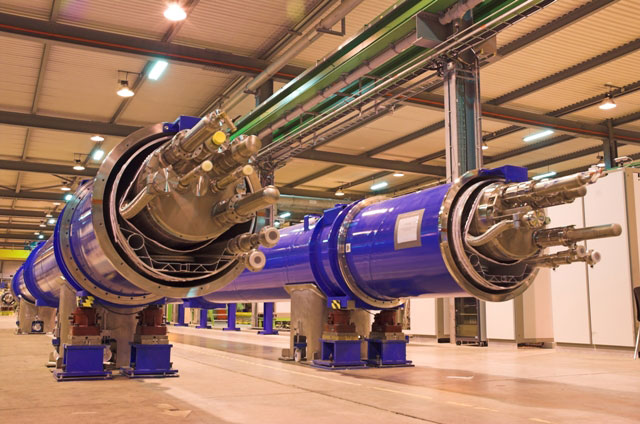
From Ars Technica: “We’ve observed a new particle”: leaked video reveals Higgs confirmation

“We’ve observed a new particle.” That’s the opening statement in a video featuring Joe Incandela, the spokesman for the Large Hadron Collider’s CMS detector, made in a video that is currently publicly accessible on the CERN website. The video, first spotted by ScienceNews and now apparently pulled, appears to preempt the big announcement scheduled for early tomorrow morning. It also implies that this year’s data was enough to push the evidence for the Higgs past the five standard deviations needed to declare discovery.

“When we say we’ve observed the particle, it means we’ve just got enough data to say it’s definitely there, and it’s very unlikely to go away,” Incandela says in the video. In addition, we know it’s a boson because it decays into two photons.
Its mass is roughly 130 times that of the proton, making it the heaviest boson we’ve discovered so far—and the heaviest particle other than the top quark.

The two-photon decay is one of the strongest bits of evidence, and provides a narrow peak that helps define its mass. Strong evidence is also available through decay into two Z particles; the signal is there in other decay channels as well, but those are less definitive because of the background noise present.


from Ars Technica