From Gizmodo: A Rocket Launcher and Flamethrower Fall in Love, and a Deadly Weapon Is Born

The M2 flamethrower utilized by Allied forces during WWII proved to be a devastatingly effective weapon against bunkers—and Axis psyches. However, walking around a firefight with a napalm-filled backpack and an effective range of 20m is a great way to become a crispy critter. So the US military developed the M202 FLASH rocket-propelled flamethrower. More »

from Gizmodo

From Engadget: Kinect Toolbox update turns hand gestures into mouse input, physical contact into distant memory

Kinect Toolbox update turns our frantic gestures into mouse input

Using Microsoft’s Kinect to replace a mouse is often considered the Holy Grail of developers; there have been hacks and other tricks to get it working well before Kinect for Windows was even an option. A lead Technical Evangelist for Microsoft in France, David Catuhe, has just provided a less makeshift approach. The 1.2 update to his Kinect Toolbox side project introduces hooks to control the mouse outright, including ‘magnetic’ control to draw the mouse from its original position. To help keep the newly fashioned input (among other gestures) under control, Catuhe has also taken advantage of the SDK 1.5 release to check that the would-be hand-waver is sitting and staring at the Kinect before accepting any input. The open-source Windows software is available to grab for experimentation today, so if you think hands-free belongs as much on the PC desktop as in a car, you now have a ready-made way to make the dream a reality… at least, until you have to type.


from Engadget

From Engadget: China’s new liquid oxygen and kerosene-fueled rocket engine lights up for testing

China's new liquid oxygen and kerosenefueld rocket engine lights up for testing

Liquid oxygen and kerosene, that’s what fuels China’s new — and freshly tested — rocket engine. When fired up on Sunday, it withstood temperatures as high as 5,432 degrees Fahrenheit (3,000 degrees Celsius) for 200 seconds and powered through almost 20,000 revolutions per minute in a rotational test. “The successful tests confirm the reliability of China’s LOX / kerosene engine,” test commander Lai Daichu told China Daily. According to China Central Television, the engine is non-toxic, pollution-free and the first of its kind for which China holds proprietary intellectual property rights — though similar engines have been used by other space agencies. The engine is on track to lend the upcoming Long March 5 rocket a total of 118 tons of thrust, giving it enough oomph to launch a 25-ton payload into low-earth orbit or 14-ton cargo into geostationary orbit. Its expected to haul additional portions of the country’s space station and aid lunar exploration, but the first voyage isn’t slated until 2014.

[Image Credit: China Aerospace Science and Technology Corporation]

from Engadget

From AnandTech: The 16GB Nexus 7: Storage Performance

For the first time, in our Nexus 7 review, I started seriously looking at integrated storage performance of tablets and smartphones. I’ve casually done this in the past, but users complaining of poor system responsiveness with background writes on ASUS’ Transformer Prime/Pad series demanded something a little more thorough.

As I mentioned in our Nexus 7 review, most tablet and smartphone makers integrate a single chip controller + NAND combo to save on cost and space. In the case of the 8GB Nexus 7, you get an 8GB eMMC package from Kingston. In this tiny package is an eMMC controller and NAND die. The component list should sound familiar to anyone who remembers the earliest affordable MLC SSDs for PCs, particularly in the absense of any on-board DRAM for caching duties. The lack of DRAM is only part of the issue, the fact of the matter is these cheap eMMC controllers just aren’t very fast – at least compared to high-end SSD controllers. Things will get better over time, but for now cost is still a major concern.

The Kingston controller in the 8GB Nexus 7 is much faster than what ASUS uses in the Transformer Prime/Pad series, but I had heard the controller in the 16GB models was even quicker. I just got my hands on a 16GB N7 and ran through the Android version of our standard four-corners SSD tests using Androbench. Just like last time I increased read/write sizes to 100MB in order to get consistent results out of the device.
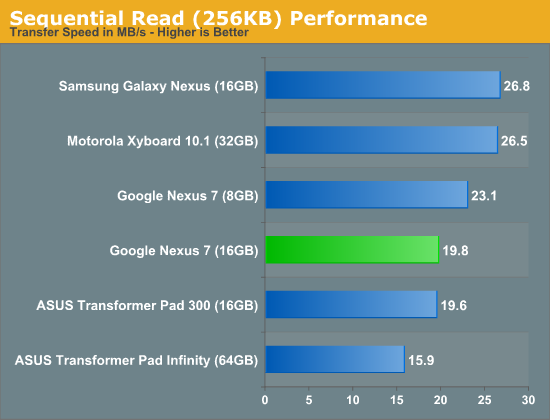
Sequential Read (256KB) Performance

Sequential read speed is around 14% slower on the 16GB part, but it’s still higher than what you’ll get out of a Transformer Pad Infinity. The drop here is unfortunate as sequential read performance does matter – that’s really the only downside to the 16GB model’s IO performance though. The drop is also not significant enough to cause any additional stuttering or otherwise undesirable behavior.
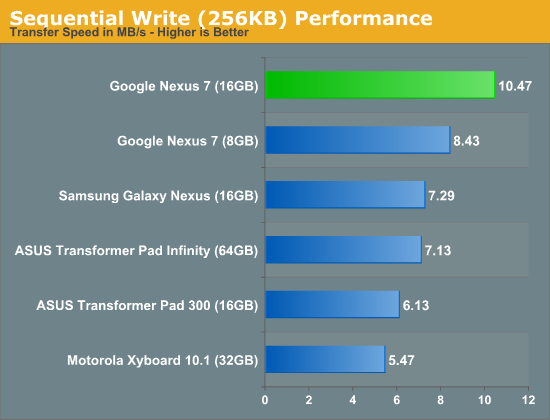
Sequential Write (256KB) Performance

Sequential write speed is up by 24%, putting the Nexus 7 further ahead of the other devices I tested here.
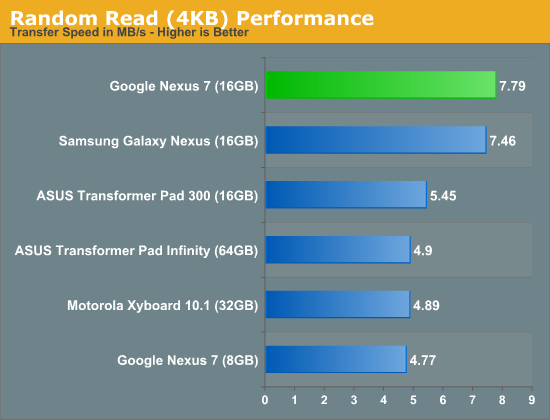
Random Read (4KB) Performance

Random read performance shoots up by over 60%, putting the 16GB Nexus 7 ahead of the Galaxy Nexus.
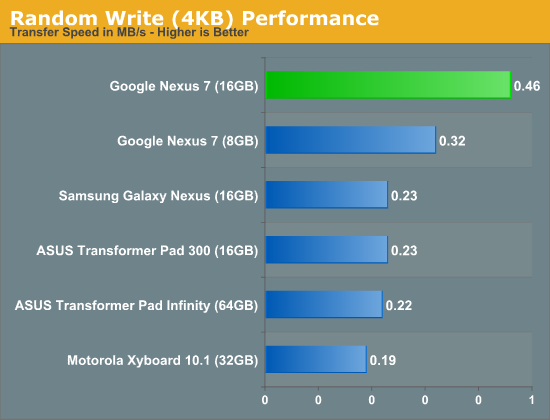
Random Write (4KB) Performance

Random write performance sees a 43% increase, putting good distance between the 16GB and 8GB N7s. None of these numbers are particularly good (we’re still talking about mechanical hard drive levels of performance here) but it’s definitely a step in the right direction.

It’s always possible that we’ll see multiple controllers used in the 8 and 16GB Nexus 7s, but for now all of the 16GB models use the same controller. The difference in IO performance isn’t significant enough to push you towards the $250 Nexus 7 if you don’t need the extra space, but consider it an added benefit if you do order the 16GB model.

from AnandTech

From Engadget: Verizon to stop blocking tethering apps, settles with FCC for $1.25 million

Verizon to stop blocking tethering apps, settles with FCC for $1.25

In May of last year, our free ride came to an end. US carriers started blocking third party tethering apps in the Android Market. Not long after, the built in feature was turned off on most phones. Our fortune may be reversing, however. The FCC has ruled that Verizon violated the rules governing the C Block of LTE spectrum by preventing consumers from using any application of their choice. The end result: Big Red will have to open up its airwaves and allow customers to circumvent its $20 a month tethering plan using apps from the Play store — so long as you’re on a “usage-based pricing plan.” Though it’s not explicitly stated, we assume that means those of you lucky enough to be grandfathered in to the unlimited data plans are left out. In addition to unblocking apps such as PdaNet and Barnacle, Verizon must pay a $1.25 million settlement to put an end to the investigation. For a few more details of the plan put in place to ensure compliance with the ruling, check out the PR after the break.


from Engadget

From Popular Science – New Technology, Science News, The Future Now: Video: Four-Ton Japanese Mega Bot Fires BBs At Smiling Humans

Kuratas via Plastic Pals

This boxy guy is called Kuratas, otherwise known as Vaudeville, and he stands 12 feet 5 inches tall. He weighs about 4.5 tons and is diesel-powered. Do not smile at him. He will shoot that grin right off your face.

Kuratas is a real-life mech from (where else?) Japan, and it’s an art project designed by Suidobashi Heavy Industry. Iron worker/artist Kogoro Kurata, at right in the photo above, built his namesake robot and debuted it at something called Wonder Fest 2012, which took place over the weekend.

It has a ride-in cockpit, a master-slave joystick and a touchscreen interface, and its arms can be controlled via Kinect, so it could be trained as a champion boxer. Its twin BB Gatling guns can fire up to 6,000 BBs per minute, according to Plastic Pals. And it fires when a small camera inside the robot detects when you smile. This is just for fun, however – Kurata says he would never want his creation to harm anyone. But it could be used for robot competitions, he said.

You could pretend-order one of your own, via a slick website Kurata and his colleagues at Suidobashi designed. The mecha come in various color schemes and customizable weapons. But the base model starts at $1,353,500, so better start saving.

[Plastic Pals]


from Popular Science – New Technology, Science News, The Future Now