
Driverless truck companies plan to ditch human co-pilots in Texas in 2024

https://www.autoblog.com/2024/01/07/driverless-truck-companies-plan-to-ditch-human-co-pilots-in-texas-in-2024/

A Peterbilt tractor equipped with Aurora Innovation’s self-driving system. (AP)


Driverless trucks with no humans on board will soon cruise Texas highways if three startup firms have their way, despite objections from critics who say financial pressures, not safety, is behind the timetable.

After years of testing, Aurora Innovation, Kodiak Robotics and Gatik AI expect to remove safety drivers from trucks that are being guided by software and an array of sensors including cameras, radar and lidar, which sends pulses of light that bounces off objects. The companies have already hauled cargo for big names such as Walmart Inc., Kroger Co., FedEx Corp. and Tyson Foods Inc.

“At the end of the year, we anticipate getting to the point where we begin operating those trucks without drivers on board,” Chris Urmson, co-founder and chief executive officer of Pittsburgh-based Aurora, said in an interview.

All of the companies say they’re ready to deploy the technology, though they know there’s little-to-no margin for error. The risk is worth it, they say, because the technology promises to improve highway safety and lower transportation costs.

Detractors say the companies have incentive to reduce the losses that investors have been financing during the development and testing phase.

“We are concerned about the lack of regulation, the lack of transparency, the lack of comprehensive data collection,” said Cathy Chase, president of Advocates for Highway and Auto Safety. The list of opponents also includes the International Brotherhood of Teamsters, the 1.3 million member union that represents drivers and warehouse workers.

And trucks pose severe dangers, opponents say, because they will be traveling at highway speeds and weigh as much as 80,000 pounds, or more than 15 times as much as General Motors Co.’s troubled Cruise driverless robotaxi.

The federal government for now has left regulation of driverless large trucks mostly up to states, creating a patchwork of rules. California suspended Cruise operations in October after several incidents in San Francisco. California’s lack of rules for allowing trucks to be tested on public roads encouraged the three driverless truck firms and others to turn to Texas for testing and deployment.

The difficulties that Cruise’s robotaxis faced on the streets of San Francisco — unpredictable pedestrians, sudden road closures and emergency vehicles — are less of a problem for driverless trucks, according to the companies. Trucks largely move cargo on fixed routes and mostly on highways that require much less interaction with passenger vehicles and pedestrians.

Besides saving on trucker pay, the trucks can travel longer than the 11-hour limit now on human drivers. The sensors scan in all directions several times a second to identify objects, speeding up reaction time. There are even estimated savings on emissions of 10% or more because the vehicles will stay just below the speed limit and travel at a steady cadence, the companies say.

And human drivers don’t guarantee safe operations. In 2021, 5,700 large trucks, which weigh 10,001 pounds or more, were involved in fatal crashes, according to statistics compiled by the Federal Motor Carrier Safety Administration. A majority of those incidents came from trucks with a gross weight of 33,001 pounds or more. These so-called Class 8 trucks are similar in size to those in Kodiak and Aurora fleets.

While driverless trucks haven’t had any at-fault incidents with other vehicles in testing with safety drivers, the FMCSA report suggests that they may not be immune to accidents. Nearly two-thirds of fatal accidents occur when a person, object, animal or other vehicle veers into a truck’s lane. Data collected by a self-driving truck’s computer system will be key to determining what caused an accident.

“They can’t just say we’re better than humans,” said Brian Ossenbeck, a transportation industry analyst with JPMorgan Chase, of the companies planning to go driverless this year. “They have to reach that superhuman level, at least initially, until there’s broader acceptance. And who knows how long that would take.”

Meeting the goal

At Aurora’s terminal just south of Dallas, a worker cleans sensors on top and at the side of a dark blue Peterbilt truck while a safety driver sits in the cab ready for the truck to pull out. If all goes as planned, the safety driver, whose hands now hover above the wheel without touching it while the truck is in transit, will soon no longer be needed for the 200-mile trek to Houston.

“Our intent is this is going to feel like just another day, except this day the truck’s going to head out on the road without anybody in it,” said Urmson.

Wall Street will be watching closely to see if Aurora meets its goal of going driverless by the end of 2024, said Jeff Osborne, an analyst with TD Cowen, who has a “market perform” rating on the stock. Otherwise, investors will raise cash-burn concerns, he said.

“If something is slightly delayed, you just end up getting punished,” Osborne said.

The startup raised $850 million this summer, giving it enough cash to operate through the second half of 2025. Aurora then aims to raise a similar amount to carry it through 2027, when it’s expected to turn a profit, Urmson said.
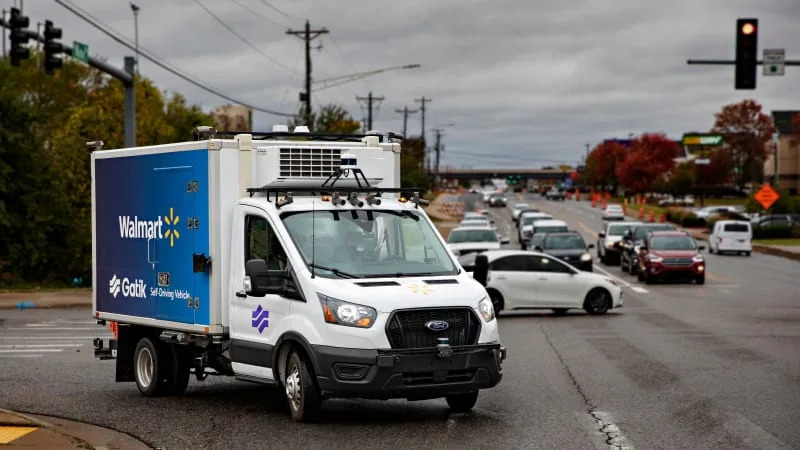
A Gatik-equipped box truck for Walmart in Bentonville, Ark. (AP)


Gatik AI, a Mountain View, California-based startup, has already driven trucks without a driver in Arkansas and Canada. The company uses smaller, box trucks and plans to deliver from distribution centers to stores. In 2024, the company expects to deploy driverless trucks in the Dallas area “at scale,” said Gautam Narang, Gatik’s co-founder and CEO, in an interview.

Kodiak plans to “start small in 2024 and gradually ramp it up as we build confidence in the system that we didn’t miss anything,” said Don Burnette, CEO of the closely held Mountain View, California-based company that he founded in 2018. “We’ve seen the damage that can be done,” as in the case of robotaxis in San Francisco, he said.

The first operations without a human aboard will be short runs near the company’s truck terminal just south of Dallas and extend from there, said Burnette.

The companies have truckport partners to help with refueling their diesel-powered fleets and roadside assistance in case of a flat tire.

Open road

For now, it’s mostly southern states – from Arizona to Florida – that allow self-driving trucks. Kodiak has been hauling cargo with a safety driver from Dallas to Atlanta and from Houston to Oklahoma City. Most companies plan to start in the south because there’s less inclement winter weather.

Texas first adopted legislation allowing driverless trucks in 2017. State authorities have worked with the startups to address issues such as inspections and how law enforcement will interact with a driverless truck.

“Autonomous vehicles are expected to help improve safety, spur economic growth and improve the transportation experience for all Texans,” the Texas Department of Transportation said in a statement.

Still, the self-driving startups realize that state and federal regulators “have the ability to force a recall and stop the operation of vehicles if they believe they’re creating unreasonable risk to the motoring public,” Urmson said. The potential transformation of the trucking industry will depend on whether the initial driverless runs are completed without a hitch.

via Autoblog https://ift.tt/6wSO2gL

January 7, 2024 at 09:12AM

Tesla Reverses on Bold Claims of Range and Full Self-Driving

https://gizmodo.com/tesla-elon-musk-model-y-range-autopilot-china-recall-1851143262

Photo: ODD ANDERSEN/AFP (Getty Images)

Teslas have always sounded a little too good to be true, and Elon Musk is in the dog house again for his latest expression of “free speech.” It seems Teslas can’t drive as far as once claimed and still don’t truly drive themselves.

Did Elon Musk Regret Buying Twitter? | Walter Isaacson Interview

Tesla slashed range estimates of its Model Y Long Range and Performance models by 6% on Thursday, according to Electrek. Musk’s electric car company also issued a software update to 1.6 million vehicles in China on Friday, reminding drivers they still have to pay attention while the Autopilot is enabled.

The Model Y’s new range estimates are not a reduction in performance, but rather a more realistic estimate of how far a Tesla’s charge will get you. The Model Y Long Range model is down to 310 miles from 330, while the Model Y Performance is down to 285 miles from 303, according to Electrek.

As for the Autopilot update, there was a similar over-the-air software update to over 2 million American Teslas in December after the National Highway Traffic Safety Administration determined Tesla wasn’t doing enough to ensure drivers used the system correctly. This week, the update expanded to Teslas in China, where a competitor, BYD, recently overtook Tesla as the top-selling electric car.

California’s DMV is currently in a legal battle with Musk over bold marketing claims about Tesla’s “full self-driving capability,” despite the cars requiring driver supervision in Autopilot mode. The DMV accuses Tesla of fraud whereas Musk calls the exaggerated claims “free speech.”

Independent testers have questioned the advertised ranges on Teslas for a long time. In 2021, Edmunds found the Tesla Model Y Performance drove 9.6% fewer miles than advertised. This updated range from Tesla is closer to its actual performance. But what does that make the old range? An exaggeration or another example of “free speech?”

The First Amendment argument is quickly becoming a core tenet of Musk’s businesses. Tesla, X, and xAI (the creator of the AI chatbot Grok) all seem poised to promote free speech at all costs. However, the line between freedom of speech and fraud at Tesla is up for debate amongst lawyers in California.

via Gizmodo https://gizmodo.com

January 5, 2024 at 09:39AM

NASA to unveil new X-59 ‘quiet’ supersonic jet on Jan. 12

https://www.space.com/nasa-x-59-quiet-supersonic-jet-rollout-livestream

NASA and Lockheed Martin are finally ready to unveil the new X-59 Quesst, a supersonic jet designed to break the sound barrier without creating a thunderous sonic boom.

The X-59 Quiet SuperSonic Technology (Quesst) jet has been under construction at Lockheed Martin’s "Skunk Works" facility in Palmdale, California since 2019. The experimental X-59 Quesst is designed to fly at supersonic speeds and reduce the typical sound of sonic booms, lowering the volume down to a "thump" similar to the sound of a car door slamming. NASA says the aircraft could help reshape regulations that currently prohibit supersonic flight over populated areas due to disruptions that sonic booms can cause.

On Friday, Jan. 12, beginning at 4 p.m. EST (2100 GMT), NASA will host a free livestream as it rolls the painted X-59 out of the hangar for the first time. You can watch it here at Space.com courtesy of NASA, or on NASA+ or NASA TV. NASA is even inviting the public to host watch parties for the rollout, complete with agency-provided printable invites and free STEM toolkits for educators.

Related: Watch NASA’s sci-fi-looking X-59 ‘quiet’ supersonic jet roll out of the hangar (video)

The X-59 in a hangar in Palmdale, California. (Image credit: Lockheed Martin)

The X-59 has been rolled out in front of cameras once before, in August 2023. But that was before the jet had gone into the paint barn for its final red, white and blue paint job, or livery.

During that rollout, the striking and unique geometry of the X-59 was on full display. The aircraft features a sharp, elongated beak-like nose section that measures 38 feet (11.5 meters) in length. The nose section will help shape the shock waves the aircraft produces during flight, NASA said in a 2021 statement.

A head-on view of the X-59 supersonic plane. (Image credit: Lockheed Martin)

That nose also means pilots flying the X-59 can’t see out of the forward windscreen  ?— because it doesn’t have one. Instead, pilots use what NASA calls the External Vision System, or XVS, to see in front of the aircraft. This system uses a forward-facing camera, a cockpit-mounted display screen and custom image processing software to "create an augmented reality view of the X-59 pilot’s forward line-of-sight along with graphical flight data overlays," according to a 2019 statement from the agency.

An illustration of the X-59 supersonic plane landing on a runway.  (Image credit: Lockheed Martin)

The 99.7-foot-long (30 m), 29.5-foot-wide (9 m) aircraft is designed to reach a speed of Mach 1.4, or 925 mph (1489 kph), while flying at an altitude of 55,000 feet (16,764 m). The X-59 is powered by a single engine built by General Electric Aviation.

Once it’s ready for flight, the X-59 will carry out a research campaign in which it will fly over select residential areas in order to collect data on how people below experience and react to the quieter sonic booms it creates.

NASA will then use that data to seek approval for commercial supersonic flights from regulatory agencies such as the Federal Aviation Administration.

Join our Space Forums to keep talking space on the latest missions, night sky and more! And if you have a news tip, correction or comment, let us know at: community@space.com.

via Space https://www.space.com

January 5, 2024 at 05:05AM

What Happens When You Deny Scientific Evidence? Look at Brazil’s Pesticide Problem

https://www.scientificamerican.com/article/brazils-pesticide-dilemma-illustrates-the-health-dangers-of-scientific-denialism/

In Brazil, the unabated use of dangerous pesticides reminds the world of the harm done by denying reality. Here, as with everywhere else, synthetic pesticides play a crucial role in agriculture by controlling pests and protecting crops. But because of their high biological activity and persistence in the environment, these substances can harm human health and the ecosystem. All too often, they do just that.

Brazil’s former president Jair Bolsonaro, who, many times, criticized COVID vaccines by claiming that they were too untested, set records in the approval of pesticides in the country, including substances banned in other countries because of safety concerns. The approvals ignored both the environmental impact of these pesticides, which themselves harmed farms, and their economic fallout, with possible export boycotts coming from other countries because of the risks of indiscriminate use.

The overuse of dangerous pesticides in Brazil both threatens public health there and serves as a worldwide warning about science denial. During the COVID pandemic, science denial threatened COVID treatments and vaccinations in Brazil while relegating important issues such as pesticide regulation to the background. Pesticides and pandemics may seem like separate issues, but warnings about the toxicity and risks of pesticides, just like calls for vaccinations, come from scientists. If there is no trust in science, warnings about both will be ignored.

Undoubtedly, the widespread introduction of pesticides after World War II increased food production on a large scale, but it also created environmental and public health problems, as well as dependencies on pesticide use in agriculture. Many developing countries, especially those in the tropical and equatorial zones, have become major food exporters crucial to global food security thanks to pesticides. Some of these substances lack secure regulations to monitor their precautionary use, however.

India best illustrates this paradox: the world’s most populous country faces the growing challenge of feeding its population and increasing food production. As one of the leading global agricultural societies, India’s farmers rely on chemical fertilizers, pesticides, seeds of high-yielding varieties and mechanization. Synthetic pesticides significantly increase agricultural productivity, but they also threaten Indians’ health and their country’s delicate and unique ecosystem.

It’s not only developing countries that face this challenge. California, with some of the world’s strictest pesticide laws, records hundreds of worker poisonings a year. Most poisonings are not known and recorded, demonstrating how difficult it is to control the use of these substances. Even Europe, rigorous in agricultural product import safety, faces growing problems with the use of pesticides and herbicides in urban and rural areas.

The intense use of pesticides is more pronounced in major producers of agricultural commodities. In recent years the consumption of pesticides in Brazil has surpassed 300 thousand tons annually, which represents a 700 percent increase in the last 40 years.

During the Bolsonaro years, pesticide registration dramatically increased, reaching 1,629 authorizations for new pesticides by February 2022. Bolsonaro’s government promoted flexibilization policies allowing for the accelerated approval of pesticides associated with diseases such as cancer. This approach resulted in the authorization of 550 new pesticides in 2021 and another 26 in 2022. This policy generated concerns about the risks to public health and the environment, especially considering that 37 of these new pesticides are banned in the U.S. and the European Union because of their toxicity. These statistics echo Brazil’s former minister of the environment, Ricardo Salles, who called for relaxing environmental laws amid the distraction caused by the pandemic.

Pioneering such indiscriminate practices is alarming for the entire world: the International Labor Organization (ILO) reports that  385 million acute poisonings and 11,000 deaths from pesticides occur annually in developing countries.

Brazil’s field workers were the first to be affected by these uncaring policies. The main dangers were acute and chronic poisoning, which can cause convulsions, fainting, coma and even death. In addition, workers can develop serious long-term problems such as paralysis, brain and liver damage, tumors and behavioral changes.

But, of course, the entire Brazilian population is affected, too. Foods with a high pesticide load present high health risks, which can result in chronic poisoning and lead to heart problems, neurological disorders, liver damage, carcinogenic effects, hormonal changes and damage to the immune system. Pregnant people face the additional risk of miscarriage and fetal congenital malformations.

Indiscriminate pesticide use contaminates soil, water, and air, compromising biodiversity and harming fauna and flora. In addition, pesticides can reduce water quality (negatively affecting agriculture itself), impacting aquatic ecosystems and harming aquatic life. Pesticides persist in the environment, causing lasting damage to ecosystems, and pose a threat to environmental sustainability.

The new Brazilian government, led by Luiz Inácio Lula da Silva, must reevaluate and reverse this situation. The start of da Silva’s administration raises concerns about the granting of authorizations for pesticides, however. In a period of slightly more than 11 months in 2023, da Silva’s government nearly matched the Bolsonaro’s government’s rate of authorization of these substances. During the 48 months of Bolsonaro’s administration, 2,030 pesticides were authorized, resulting in a monthly average of 42.29. In the first 11 months of the new government, however, 431 pesticides were authorized, with a monthly average of 39.18.

Consider the dangers faced by rural workers, especially the most vulnerable ones, such as farmhands and smallholders, who have limited resources and knowledge to protect themselves from the adverse effects of both mistaken policies regarding pesticides and lies about vaccines. Food safety and public health must be treated as national priorities that demand rigorous and careful measures, and it is essential to adopt more sustainable agricultural practices that reduce the use of pesticides and promote environmental preservation. The effects of the undermining of science are therefore evident in Brazil, where we see two major forms of poisoning: the use of unapproved drugs against SARS-CoV-2 and exposure to pesticides of dubious safety, some of which have been proven to be dangerous.

Globally, Brazil can be a positive or negative demonstration of the benefits of a more harmonious relationship between science, the environment and the growing demand for food. Everyone stands to gain from control of pesticides, and we need to change the perspective on pesticide use. The world’s food security cannot do without the health security of consumers and concern for the environment—nor can public health be assured amid the denial of science. All are intrinsic and aligned issues for the future of humanity.

via Scientific American https://ift.tt/lbas6zS

January 5, 2024 at 07:33AM

We’ll Get to See NASA’s Sonic Boom-Less Supersonic Plane Next Week

https://gizmodo.com/quiet-supersonic-plane-x59-nasa-reveal-watch-live-booms-1851139897

NASA’s supersonic experimental plane—the linchpin of the agency’s Quesst mission—is set to roll out of its warehouse in the California desert next week. We’re gassed for the big reveal: the X-59 has been in development for six years, and, if successful, it will demonstrate supersonic flight without sonic booms.

Let’s Eat a Chocolate Xbox Controller

The 99-foot-long (30-meter) plane is just 14 feet (4.27 meters) tall, making it look needle-like from the side. The single-engine jet will have a cruise altitude of 55,000 feet (16,764 meters) and will be capable of speeds up to 925 mph (1,489 kmph), or Mach 1.4. But here’s the kicker: The plane will only create a perceived sound of 75 PLdB, or about as loud as a car door closing, according to Lockheed Martin, whose Skunk Works team collaborated with NASA to develop the experimental aircraft.

Loud sonic booms occur when an object travels faster than the soundwaves it produces. While the booms cannot be heard by those aboard the speeding object—as they are traveling faster than sound—on the ground, the shock waves can damage buildings, panic animals, and generally be a nuisance for anyone within earshot.

With the X-59, NASA seeks to demonstrate supersonic flight with a muffled boom—a “sonic thump,” as they call it. The experimental plane was originally expected to make its first flight in 2023. But in aeronautics, nothing slips like a schedule, and more time was needed to integrate some of the aircraft’s systems and fix some recurring issues in its computers, according to a NASA release. The plane also underwent structural testing and ground tests.

Though the X-59 research aircraft is a bright mint green, the aircraft to be revealed next week will be red, white, and blue. Besides the patriotic aesthetic, the new paint job will protect the plane from moisture and corrosion. NASA has put out invitations, printable decorations, and some themed food ideas for anyone wanting to celebrate the roll-out, which you can watch on the agency’s website at 4 p.m. EST on Friday, January 12.

When we talk about supersonic aircraft, it is hard not to mention the Concorde, the supersonic commercial jet that made its final flight in 2003. Years before that—and indeed, before the fatal crash in 2000 that killed 113 people—the costs of supersonic travel were rising, according to the Museum of Flight. Their sonic booms meant the planes could only go supersonic over the ocean, as the powerful shockwaves could shatter glass on the ground. Cities issued noise complaints over (or rather, under) the Concorde’s earsplitting schlepps, and today we commercial travelers all fly slower than sound.

Now we’re inching very close to the aircraft’s first flight, slated for sometime this year. That will only mark the beginning of the X-59’s Phase 1. In Phase 2, the X-59’s quiet supersonic technology and the aircraft’s actual performance will be tested out in the air. Then, starting in 2026, the X-59’s third and final phase will involve flying the plane over several U.S. cities and surveying residents to determine the invasiveness of the aircraft’s supersonic presence. The entire mission is expected to run through 2027.

Currently, the Federal Aviation Administration does not allow civil aircraft to travel over speeds exceeding Mach 1. But in the next several years, the Quesst mission—vis-a-vis the elegant X-59—will test out the disruptiveness of sonic thumps. NASA will provide the data it collects to regulators, which could cause the rules around commercial supersonic flight over land to change.

More: 12 of the Weirdest X-Plane Designs

via Gizmodo https://gizmodo.com

January 4, 2024 at 11:24AM

CES 2024 Preview: Get Ready for a ‘Tsunami’ of AI

https://www.wired.com/story/ces-2024-preview-a-tsunami-of-ai/

If you’re waiting for the hubbub over generative AI to die down, maybe pull up a chair. The buzz around artificial intelligence shows no signs of quieting—a fact that will become all too obvious at this year’s CES.

CES, the consumer electronics industry’s largest annual gathering in the US, is returning to Las Vegas on January 9. It is a massive, four-day-long bustling bazaar of tech, with expo halls filled to the brim with new gadgets, hopeful startups, and prototypes that reach for the stars. CES is a trade show where sales and distribution deals are inked, where concept cars roll through crowded streets, and where tech journalists and showgoers alike wander the floors looking for the standout new products. And this year, many of the products debuting are going to be garnished with heaping globs of AI.

For years, generative AI technology bubbled beneath the surface of public consciousness. It finally burst into the limelight in November 2022, when OpenAI released the first iteration of ChaptGPT. The arrival of the shiny new chatbot kicked off an AI arms race. Since the reverberant waves of this eruption hadn’t yet fully saturated the tech industry by the time last year’s CES took place, there wasn’t really a whole lot of GenAI talk in Las Vegas last January. As a result, CES 2023 looks almost primitive in hindsight, arriving a scant six weeks behind the greatest technological revolution since the mobile phone.

That won’t be the case in 2024. “We didn’t get the full CES fire hose of AI announcements last year like we’re going to have,” says Anshel Sag, a principal analyst at Moor Insights & Strategy. “If you thought it was a wave last year, it’s going to be a tsunami this year.”

Expect to see AI everywhere at CES: in cars, scooters, headphones, cameras, speakers, and televisions. In some cases, these products will simply include another way to access a ChatGPT-style question-and-response service to handle spoken commands. But in other cases, the advances could feel more impactful. Companies like Intel, Qualcomm, and AMD are expected to announce chips that support AI services on the devices that carry them. These chips would process AI tasks locally, without having to send a request to a server in the cloud and then wait for a response, making things like computer vision, voice-to-text services, and generative computing feel snappier.

CES is where the narrative around industry trends is shaped. Sag says that’s what’s likely to happen with the abundance of AI this CES. “AI is just going to overwhelm everything,” Sag says. “It will be so prevalent and so dominant that some people will just be sick of it.”

via Wired Top Stories https://www.wired.com

December 29, 2023 at 07:09AM

Physicists Designed an Experiment to Turn Light Into Matter

https://gizmodo.com/physicists-designed-an-experiment-to-turn-light-into-ma-1851124505

Plasma could be wrangled to collide photons and yield matter, according to physicists who ran simulations to explore the practical applications of a world-famous equation.

Gizmodo’s Top Five Gadgets of 2023

The equation at work here is Einstein’s E = mc^2, which establishes a relationship between energy and mass; specifically, the equation holds that energy and mass are equivalent when the latter is multiplied by the speed of light, squared.

A team led by scientists at Osaka University and UC San Diego recently simulated the collisions of photons using lasers; their results suggest that the collisions would yield pairs of electrons and positrons. The positrons—the antiparticle of the electron—could then be accelerated by the laser’s electric field to produce a positron beam. Their results are published in Physical Review Letters.

“We feel that our proposal is experimentally feasible, and we look forward to real-world implementation,” said Alexey Arefiev, a physicist at UC San Diego and co-author of the paper, in a University of Osaka release.

The experimental set-up is possible, the release added, at laser intensities that currently exist. The researchers used simulations to test potential experimental set-ups and found a compelling one. The photon-photon collider uses the Breit-Wheeler process to produce matter, meaning it annihilates gamma-rays to produce electron-positron pairs.

Some extreme physics—places where stars are born and die, and where time stands still—exist in the distant reaches of the cosmos. In 2021, a different team of researchers suggested that the cores of neutron stars, extremely dense end-stages of stellar life, could be a venue for a similar dynamic, by which dark matter particles could convert into photons.

Spinning neutron stars are called pulsars, and their high-energy environment is where matter may be generated from light. Pulsars can spin thousands of times per second, emit gamma-rays, and have some of the strongest-known magnetic fields, according to NASA.

Pulsars are also useful tools for measuring gravitational waves in space. Earlier this year, five different pulsar timing array collaborations found what they suspect is the first look at the gravitational wave background—basically, the continuous murmurs of gravitational waves that ripple spacetime on a nearly imperceptible level.

Though it is difficult to observe the ins-and-outs of pulsars from afar, physicists can attempt to simulate them.

“This research shows a potential way to explore the mysteries of the universe in a laboratory setting,” said Vyacheslav Lukin, a program director at the National Science Foundation, which supported the recent research. “The future possibilities at today’s and tomorrow’s high-power laser facilities just became even more intriguing.”

The experiment could provide a way to peer into the universe’s composition, by bringing some far-out physics much closer to home. But for that to happen, an experiment will actually need to be built.

More: This Dark Matter Radio Could Tune Into New Physics

via Gizmodo https://gizmodo.com

December 26, 2023 at 02:57PM