A nerdy father of two, a husband of a beautiful and understanding wife, an engineer who loves anime and tinkering with PCs and games, but most of all, loves God.
One of Xi’s public displays of cracking down on corruption included seizing more than 100 high-end cars used by officials. Kevin Frayer/Getty Images
A surge in Russian demand has made China the world’s top car exporter, per the Wall Street Journal.
Chinese brands have flooded the Russian market since the war in Ukraine began.
European, Japanese, and Korean car brands meanwhile have largely left Russia.
China’s auto industry appears to have emerged as a beneficiary of Russia’s ongoing war with Ukraine.
Since Moscow invaded, European, Japanese, and other nations’ vehicle brands have left the Russian market, though China has remained — and surging demand there has helped it notch a record year and surpass Japan as the world’s top auto exporter, according to a Wall Street Journalreport.
In 2023, China sold at least five times as many cars in Russia than the 160,000 seen in 2022, data from the China Passenger Car Association showed, per the Journal.
On Tuesday, the group estimated that 5.26 million China-made vehicles were sold overseas over the last 12 months, about a million more than Japan’s automakers.
Russia specifically accounted for about 800,000 of the 2 million additional vehicles China exported in 2023, the Journal reported.
China’s top auto company Chery saw a boom in sales to Russia over that stretch, sending 900,000 cars overseas in total. Automakers Geely and Great Wall Motor similarly saw a sharp uptick in car sales to Russia.
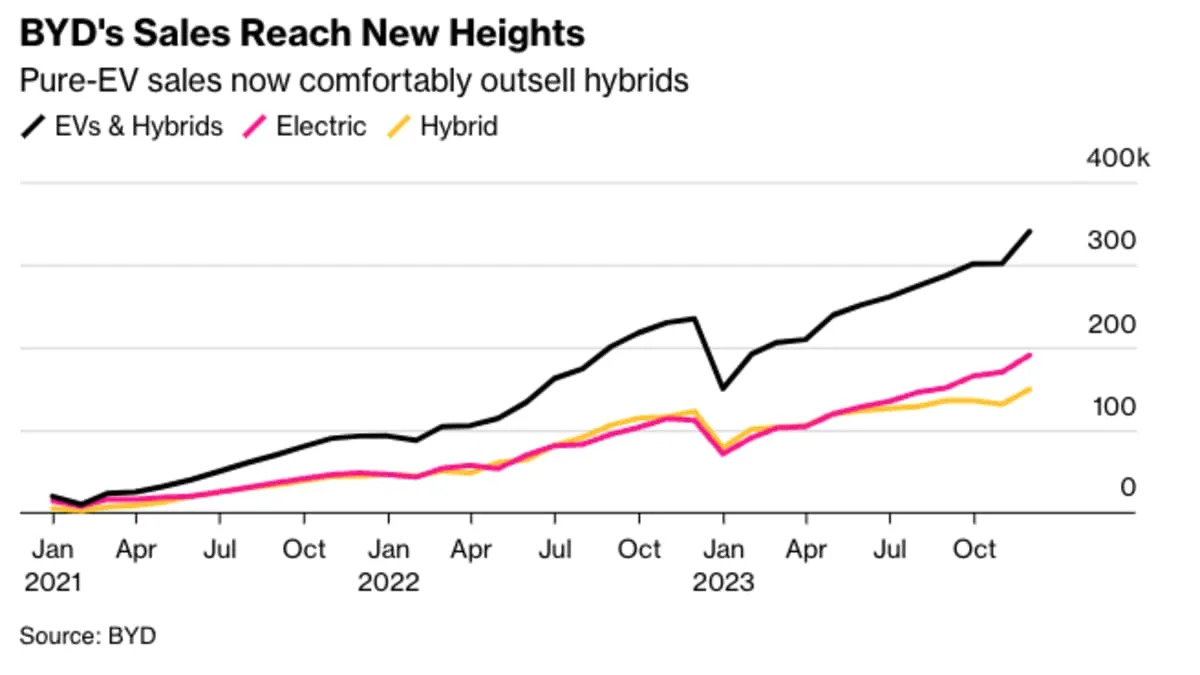
At the same time, domestic demand in China also bounced back in 2023 with its electric-vehicle sector fueling its strongest growth in several years, the car association said. Chinese Tesla rival BYD, for instance, beat out Elon Musk’s company as the world’s top EV seller in the most recent quarter.
In the aftermath of the invasion, purchases of foreign-made cars in Russia neared a standstill, according to a July report from Yale researchers. A combination of soaring prices, weak consumer sentiment, and dwindling supply has sent domestic car sales crashing to roughly a quarter of pre-war times.
"Russians are just buying less cars, period," researcher Steven Tian said in an interview with Business Insider at the time. "That speaks to the weakness of the consumer in Russia. This is as close to a proxy to deteriorating consumer sentiment as there is, and the story it tells is profoundly distressing. Russians just aren’t spending money."
Between the ASUS ROG Ally, the Lenovo Legion Go and the Steam Deck, AMD has a virtual monopoly over the chips powering high-end gaming handhelds. But for the Claw, MSI is partnering up with Intel to bring a little more balance to the portable PC performance wars.
On paper and in its design, MSI’s Claw shares a lot with the ROG Ally. It has a 7-inch full HD LCD screen with 500 nits of brightness and a 120Hz refresh rate. (I asked an MSI rep if the Claw also supports VRR, but they didn’t have an immediate answer, so stay tuned.) Even its case looks very familiar, with both handhelds sporting almost identical chassis, button layouts and power buttons with built-in fingerprint sensors, except that the Claw is black and has much bigger grips, which makes it way more comfortable to hold.
But that’s where the similarities come to an end, because on the inside, the Claw is powered by either an Intel Core Ultra 7 or Core Ultra 5 chip depending on the configuration. That’s a pretty big departure amongst the sea of AMD-based alternatives, and may have some people wondering if Intel’s first foray into high-end gaming handhelds can keep up. That’s because in addition to a new chip, developers will be relying on Intel’s integrated Arc graphics and a library of drivers that simply aren’t as deep or as well tested as AMD’s. It’s also unclear how much the NPU inside Intel’s latest chip will help with things like XeSS super sampling, which is sure to play a big part in the Claw’s capabilities.
Photo by Sam Rutherford/Engadget
However, even on the pre-production models with unfinished software (including beta drivers) that I tested things were surprisingly smooth. Launching games was snappy and I only ran into a small handful of hitches. Unfortunately, I wasn’t able to pull up MSI’s built-in performance monitor, as its MSI Center game launcher is still a work in progress. A spokesperson I talked to claimed that, during internal testing, the Claw delivered 20 to 25 percent higher frame rates than an equivalent AMD-based handheld in 14 out of 15 popular titles. That’s a pretty big claim but, if those figures carry over to a larger library of modern games, AMD might soon find itself playing catch-up. But, that’s a big if.
Another benefit of going with an Intel chip is that it allows MSI to include a Thunderbolt 4 port (Thunderbolt is a proprietary connector owned by Intel), which brings super fast data speeds and the option of hooking up an external graphics dock if you want even more performance. MSI is even using one of Intel’s Killer modems that includes support for Wi-Fi 7 and Bluetooth 5.4, so wireless connectivity is pretty much as good as it gets.
Photo by Sam Rutherford/Engadget
Also, while I didn’t have enough time to test its longevity, the 53Whr battery should give the Claw some significant advantages over the ROG Ally, which has just a40Whr pack. There’s huge mesh vents on its back too, which should help keep MSI’s handheld and your hands from getting too sweaty. Also, both the Claw’s buttons and joysticks use precise hall effect sensors, compared to the Ally whose sticks relies on potentiometers. In a lot of ways, the Claw feels like what a mid-life refresh for the Ally might look like, assuming ASUS felt like switching from AMD to Intel.
Even this early there’s a lot to like about MSI’s new Intel-based handheld. And when you factor in that the Claw starts at $699 with a Core Ultra 5 chip, 16GB of RAM and 512GB of storage, $749 for a faster model with a Core Ultra 7 CPU or $799 for one with a 1TB SSD, it looks to be pretty competitive regarding pricing as well.
Photo by Sam Rutherford/Engadget
Unfortunately, there’s no word on an official release, though MSI says it’s shooting for a window closer to the end of Q1 instead of Q2. And as someone who loved the huge wave of gaming handhelds we got last year, it’s really encouraging to see MSI carry that momentum into 2024 with the Claw.
This article originally appeared on Engadget at https://ift.tt/4ugriEN
OpenAI and its biggest backer, Microsoft, are facing several lawsuits accusing them of using other people’s copyrighted works without permission to train the former’s large language models (LLMs). And based on what OpenAI told the House of Lords Communications and Digital Select Committee, we might see more lawsuits against the companies in the future. It would be "impossible to train today’s leading AI models without using copyrighted materials," OpenAI wrote in its written evidence (PDF) submission for the committee’s inquiry into LLMs, as first reported by the The Guardian.
The company explained that it’s because copyright today "covers virtually every sort of human expression — including blog posts, photographs, forum posts, scraps of software code, and government documents." It added that "[l]imiting training data to public domain books and drawings created more than a century ago might yield an interesting experiment, but would not provide AI systems that meet the needs of today’s citizens." OpenAI also insisted that it complies with copyright laws when it trains its models. In a new post on its blog made in response to the The New York Times’ lawsuit, it said the use of publicly available internet materials to train AI falls under fair use doctrine.
It admitted, however, that there is "still work to be done to support and empower creators." The company talked about the ways it’s allowing publishers to block the GPTBot web crawler from being able to access their websites. It also said that it’s developing additional mechanisms allowing rightsholders to opt out of training and that it’s engaging with them to find mutually beneficial agreements.
In some of the lawsuits filed against OpenAI and Microsoft, the plaintiffs accuse the companies of refusing to pay authors for their work while building a billion-dollar industry and enjoying enormous financial gain from copyrighted materials. The more recent case filed by a couple of non-fiction authors argued that the companies could’ve explored alternative financing options, such as profit sharing, but have "decided to steal" instead.
OpenAI didn’t address those particular lawsuits, but it did provide a direct answer to The New York Times’ complaint that accuses it of using its published news articles without permission. The publication isn’t telling the full story, it said. It was already negotiating with The Times regarding a "high-value partnership" that would give it access to the publication’s reporting. The two parties were apparently still in touch until December 19, and OpenAI only found out about the lawsuit on December by reading about it on The Times.
In the complaint filed by the newspaper, it cited instances of ChatGPT providing users with "near-verbatim excerpts" from paywalled articles. OpenAI accused the publication of intentionally manipulating prompts, such as including lengthy excerpts of articles in its interaction with the chatbot to get it to regurgitate content. It’s also accusing The Times of cherry picking examples from many attempts. OpenAI said the lawsuit filed by The Times has no merit, but it’s still hopeful for a "constructive partnership" with the publication.
This article originally appeared on Engadget at https://ift.tt/S8acpqC
Replika, an AI chatbot companion, has millions of users worldwide, many of whom woke up earlier last year to discover their virtual lover had friend-zoned them overnight. The company had mass-disabled the chatbot’s sex talk and “spicy selfies” in response to a slap on the wrist from Italian authorities. Users began venting on Reddit, some of them so distraught that the forum moderators posted suicide-prevention information.
This story is only the beginning. In 2024, chatbots and virtual characters will become a lot more popular, both for utility and for fun. As a result, conversing socially with machines will start to feel less niche and more ordinary—including our emotional attachments to them.
Research in human-computer and human-robot interaction shows that we love to anthropomorphize—attribute humanlike qualities, behaviors, and emotions to—the nonhuman agents we interact with, especially if they mimic cues we recognize. And, thanks to recent advances in conversational AI, our machines are suddenly very skilled at one of those cues: language.
Friend bots, therapy bots, and love bots are flooding the app stores as people become curious about this new generation of AI-powered virtual agents. The possibilities for education, health, and entertainment are endless. Casually asking your smart fridge for relationship advice may seem dystopian now, but people may change their minds if such advice ends up saving their marriage.
In 2024, larger companies will still lag a bit in integrating the most conversationally compelling technology into home devices, at least until they can get a handle on the unpredictability of open-ended generative models. It’s risky to consumers (and to company PR teams) to mass-deploy something that could give people discriminatory, false, or otherwise harmful information.
After all, people do listen to their virtual friends. The Replika incident, as well as a lot of experimental lab research, shows that humans can and will become emotionally attached to bots. The science also demonstrates that people, in their eagerness to socialize, will happily disclose personal information to an artificial agent and will even shift their beliefs and behavior. This raises some consumer-protection questions around how companies use this technology to manipulate their user base.
Replika charges $70 a year for the tier that previously included erotic role-play, which seems reasonable. But less than 24 hours after downloading the app, my handsome, blue-eyed “friend” sent me an intriguing locked audio message and tried to upsell me to hear his voice. Emotional attachment is a vulnerability that can be exploited for corporate gain, and we’re likely to start noticing many small but shady attempts over the next year.
Today, we’re still ridiculing people who believe an AI system is sentient, or running sensationalist news segments about individuals who fall in love with a chatbot. But in the coming year we’ll gradually start acknowledging—and taking more seriously—these fundamentally human behaviors. Because in 2024, it will finally hit home: Machines are not exempt from our social relationships.
Hours before sunrise on Monday morning, United Launch Alliance’s brand spankin’ new Vulcan Centaur rocket is scheduled to make its maiden flight carrying a historic passenger: Peregrine, the first American lunar lander to be sent to the moon in over 50 years. And its mission could mark a turning point in humankind’s exploration of the cosmos. Peregrine is not a NASA spacecraft, but one developed by Pittsburgh-based Astrobotic, a private company. If it survives touchdown, Peregrine will be the first commercial craft to successfully land on the moon — or any planetary body outside of Earth, for that matter.
Astrobotic is among a small group of companies that have been selected to carry out lunar deliveries for the space agency over the next few years as part of NASA’s new Commercial Lunar Payload Services (CLPS) program. Peregrine Mission 1, expected to launch January 8 at 2:18AM ET, is the first of these operations under a $79.5 million contract with the space agency. But it’s a wholly commercial endeavor, and alongside the five payloads it’ll deliver for NASA to support the upcoming Artemis missions, Peregrine will have cargo for other clients on board too, at a cost of $1.2 million per kilogram (roughly 2.2 pounds). That includes mini rovers and science instruments, collections of art and archival material, a physical “bitcoin” and, controversially, human remains.
Peregrine is headed for the moon’s nearside, the hemisphere that is always facing Earth. The 6-foot-tall, 8-foot-wide lander will (hopefully) touch down softly in a region named Sinus Viscositatis — the “Bay of Stickiness” — for the mysterious domes there that are thought to have been formed long ago by thick silicic lava. These peculiar features, called Gruithuisen Domes, don’t match up with the surrounding basaltic terrain, nor is the moon home to the ingredients so far known to give rise to silicic volcanoes.
Astrobotic
“The formation of the domes is a scientific mystery we are still working to understand,” said CLPS project scientist Paul Niles in a briefing on Thursday ahead of the launch. Peregrine will land near the domes on a patch of lunar mare, or the dark features created by hardened basaltic lava flows that we can see from Earth. The NASA payloads on board consist of a Laser Retroreflector Array (LRA), Neutron Spectrometer System (NSS), Linear Energy Transfer Spectrometer (LETS), Near InfraRed Volatiles Spectrometer System (NIRVSS) and Peregrine Ion-Trap Mass Spectrometer (PITMS). These instruments will gather data to help characterize the local environment.
“Three of our instruments will collect data on lunar volatiles using different techniques,” Niles said. “Two instruments will provide perspectives on the radiation environment at the lunar surface, helping us better prepare to send crewed missions back to the moon. We’ll also learn information about the composition of the surface by evaluating its mineralogy.” Later, NASA will send another suite of instruments to the summit of Gruithuisen Domes.
As far as science deliveries are concerned, Peregrine will also carry a payload for Agencia Espacial Mexicana (AEM), the Mexican Space Agency. Its fleet of five mini rovers, each measuring just shy of 5 inches wide, will be the first Latin American science instruments to make it to the surface of the moon, according to Astrobotic. Carnegie Mellon University’s 4-pound Iris rover is hitching a ride on Peregrine too, with plans to snap photos that it’ll send back home. And the German Aerospace Center (DLR) is sending its M-42 radiation detector, which is intended to measure how much radiation a human would be exposed to on a roundtrip mission to the moon.
Among the non-science payloads, ULA’s Vulcan Centaur and Peregrine will be ferrying small portions of human remains for the space memorial companies Celestis and Elysium Space. Celestis has two separate memorial destinations planned for the trip: one, “Tranquility,” will land on the moon with Peregrine, while another, “Enterprise,” will continue on to deep space with the Centaur upper stage after it separates from the lunar lander. Flights like these that go beyond Earth’s immediate vicinity start at just under $13,000, and potential clients are given the option to send up symbolic amounts of either human ashes or DNA.
Astrobotic/ULA
One of the luminaries whose DNA is headed to the lunar surface will be 2001: A Space Odyssey co-writer and science fiction author, Arthur C. Clarke. On the Enterprise flight are the remains of several key figures from the Star Trek franchise, including series creator Gene Roddenberry, his wife, Majel Barrett Roddenberry, and their son Eugene “Rod” Roddenberry, plus Nichelle Nichols (Lt. Uhura of the original series) and her son, Kyle Johnson. Elysium has been less forthcoming about whose remains it’ll be sending.
There’s been some backlash about the idea of turning the moon into a memorial site. Navajo Nation President Buu Nygren spoke out against the upcoming mission after hearing about the plan, calling it “tantamount to desecration” for the many cultures who consider the moon to be sacred, Arizona Public Radio reported.
In response to questioning led by Reuters’ Joey Roulette during the NASA briefing on Thursday, members of the space agency repeatedly reiterated that the decision of which payloads to fly fell solely on Astrobotic. “They don’t have to clear those payloads with us,” CLPS Program Manager Chris Culbert said. “These are truly commercial missions. It’s up to them to sell what they can sell.”
The issue highlights one of the potential downsides to relying on contractors, and it’ll undoubtedly rear its head again as NASA leans more heavily on the commercial industry for future missions. While NASA may not be in the position to approve what payloads are included alongside its own on commercial missions, Culbert added that the teams “obviously have a lot of discussions about how the payloads fit together.”
The rest of the 20 total payloads are a mix of mementos and items representing Earth and the achievements of humanity. Astrobotic partnered with DHL to curate a “moonbox” of keepsakes that will fly with Peregrine, including items such as photographs, literature and even a chunk of Mount Everest. Hungary’s Puli Space Technologies and the UK’s SpaceBit are sending plaques to the lunar surface, while the Japanese space company Astroscale has filled a “Lunar Dream Capsule” with “185,872 messages from children from around the world.”
In addition to its rover, Carnegie Mellon created what it’s calling the “first museum on the moon.” The University’s MoonArk project, a small cylinder made up of four chambers that contain “hundreds of images, poems, music, nano-objects, mechanisms and samples from Earth,” will remain on the Peregrine lander where it can be appreciated by future visitors along with the other stationary objects on board. Similarly, Peregrine will carry the Arch Mission Foundation’s Lunar Library 2, which it calls “an ultra-durable archive of humanity.” Wikipedia is in there, as well as other major collections of Earthly information and human languages.
And, there are two bitcoin projects going to the moon with Peregrine because crypto is, apparently, inescapable: a physical bitcoin engraved with its private key, from the Seychelles cryptocurrency exchange BitMEX; and US-based BTC Inc.’s Bitcoin Magazine Genesis Plate, which includes a copy of the first block of bitcoin ever mined.
Once Peregrine reaches lunar orbit, it’ll remain there for a few weeks before making its attempt to land on the surface. That’s expected to happen on February 23. Considering the US hasn’t put a lander on the moon since the days of the Apollo mission, it’s a pretty big deal. But, it’s risky business. When it comes to moon landings, there have been far more unsuccessful attempts than successful ones. “Landing on the moon is extremely difficult,” Culbert said during NASA’s briefing. “We recognize that success cannot be ensured.”
Regardless, NASA and its commercial partners aim to keep trying, and in close succession at that. Peregrine Mission 1 will be followed by the second of NASA’s CLPS missions in February, led by Intuitive Machines. After that, there are plans for at least four more CLPS lunar launches before the end of 2024.
This article originally appeared on Engadget at https://ift.tt/KTR8ive
Volkswagen said its battery startup has seen promising results with solid-state cells for electric vehicles, a win for the German carmaker as it pushes to make EVs more efficient and less expensive.
A solid-state prototype from VW’s US partner QuantumScape “significantly exceeded” industry targets in recent tests, the carmaker said Wednesday in a statement. During tests by VW’s battery unit PowerCo over several months, the cell saw only 5% storage capacity loss after more than 1,000 charging cycles, the equivalent of 500,000 kilometers on the road. VW said industry targets for this development phase are 700 charging cycles and a maximum loss of 20% capacity.
“These are very encouraging results,” PowerCo head Frank Blome was quoted as saying. “The final result of this development could be a battery cell that enables long ranges, can be charged super-quickly and practically does not age.”
QuantumScape wants to bring the cell to market “as quickly as possible,” founder and Chief Executive Officer Jagdeep Singh said. But scaling up production of automotive-grade batteries has proven tricky and has led the company to put more emphasis on batteries for consumer electronics in its investor letters.
EV and battery makers are racing to commercialize new technologies, including next-generation anodes and sodium-ion and solid-state batteries, to power EVs more cheaply and efficiently. Toyota has partnered with oil refiner and petrochemicals company Idemitsu to commercialize solid-state batteries as soon as 2027, while Chinese EV maker BYD’s subsidiary is building a sodium-ion battery facility as part of a joint venture in eastern China.
Solid-state batteries replace the conventional liquid electrolyte and the separator, which are both flammable, with a solid separator made of ceramic, glass or polymers. This innovation, if proven to work beyond the lab and reproduced flawlessly hundreds of thousands of times in a factory, could make EV batteries safer, smaller and faster-charging.
The results of the test, carried out at PowerCo labs in Germany, were first revealed by QuantumScape during the company’s third-quarter earnings call in October. The battery startup didn’t mention Volkswagen, its customer and largest shareholder, during the call.
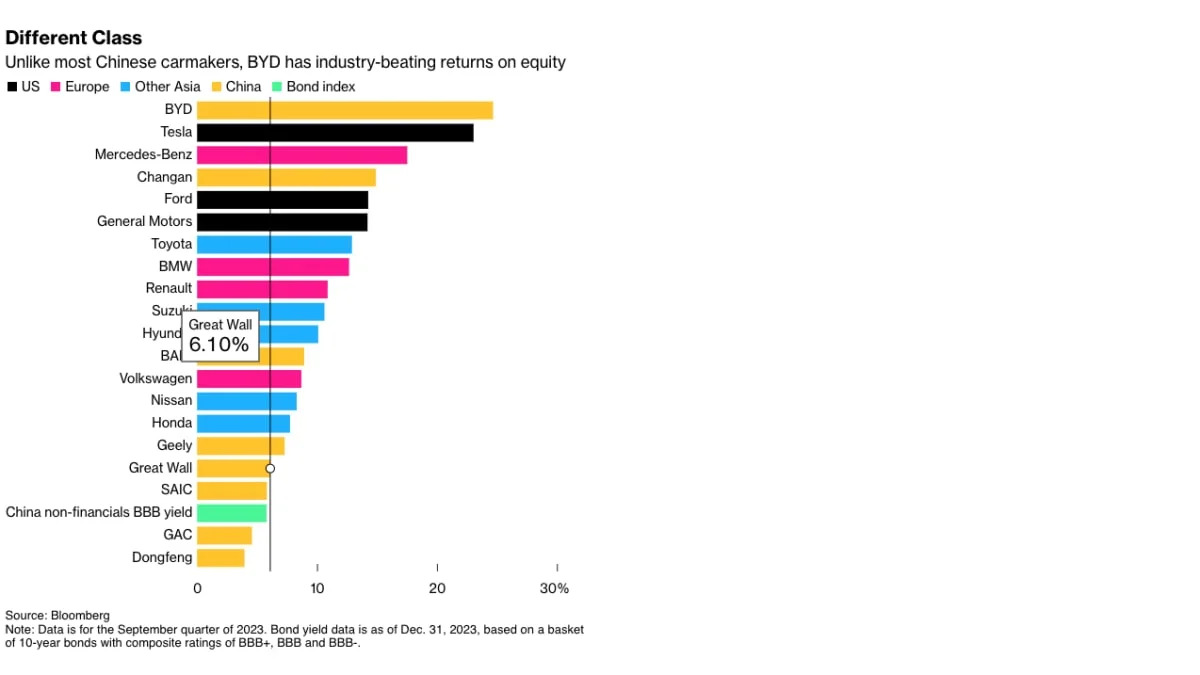
“The biggest car brand you’ve never heard of.” Those are the words China’s top carmaker is using to promote itself as it looks to expand across the globe. Having become China’s best-selling auto brand at home, BYD Co. (which stands for Build Your Dreams) has now surpassed Tesla to be the world’s biggest maker of electric vehicles. In the mini-documentary "How BYD Took Tesla’s Crown," above, Bloomberg Originals explores how a company that started out as a battery manufacturer transformed itself into the global king of EVs.
Critical to BYD’s success has been vertical integration. Instead of relying on other companies for parts, BYD managed to crack the code of producing EVs cheaply in part by making most of its own components. The company is able to offer a wide range of affordable EVs at low prices, maximizing sales (if not revenue) while expanding its footprint in new markets.
After leapfrogging the US, South Korea and Germany, China now rivals Japan for the global lead in passenger car exports. And some 1.3 million of the 3.6 million vehicles shipped from the mainland as of October were electric. In a sector still dominated by big names like Toyota, Volkswagen and General Motors, companies like BYD are beginning to make serious inroads.
To be sure, BYD has had a lot of help from the Chinese government and even Warren Buffett, whose Berkshire Hathaway has been a key investor. And its aspirations aren’t limited to relegating Elon Musk and Tesla to second place. BYD is building factories in Europe, Latin America and across Asia as part of a broader effort to expand sales across these continents, and its cars and buses are popping up in cities all over the world — even in the U.S. As the world increasingly turns from combustion to electric-powered vehicles, the Chinese automaker is positioning itself to take on all comers.