What do TSA bag scanners actually see?

https://www.popsci.com/technology/what-do-tsa-bag-scanners-see/

Despite the best of intentions, travelers aren’t always in the clearest headspace when making a mad dash to the airport. So although we theoretically know the rules, plenty of passengers have a story of a Transportation Security Administration (TSA) officer spotting something mortifying in their carry-on. The snafus range from embarrassing—a buzzing vibrator that sounds like a potential bomb threat—to stressful—cannabis products purchased legally, then accidentally carried into a state or country where they carry criminal charges.

Some of these prohibited items seem pretty obvious, but others beg the question, How the heck did they know that was in there?  If you’ve ever caught a glimpse of the squiggly, multicolored visual display on the X-ray scanner as you trudge to the body scanner, you may have found yourself wondering exactly how much information the Transportation Security Officers (TSOs) can decipher from it. 

A lot, as it turns out. If you have a pile of money or a container of pills in there, they’re gonna know. Ditto any electronics or, more importantly, any items sneakily hidden inside of them. 

That’s a good thing, since TSA agents pick up a whole lot of hazardous stuff, including knives, guns, and explosives.  “Prohibited items brought to checkpoints add up to hundreds of pounds a year at smaller airports to as much as 2,000 pounds or a ton per month at the largest airports,” says a TSA spokesperson. According to the administration, last year the government agency screened more than 2 billion carry-on bags and 494 million checked bags. Here’s how they did it.

Related Aviation Stories

How it works

Since 2002, when the TSA leveled up in the wake of September 11, virtually all agents have relied on Computed Tomography (CT) systems. “CT is a proven and highly effective screening technology that is widely used in the medical field,” says a TSA Spokesperson. 

Essentially, a TSA CT X-ray scanner sends low doses of X-rays through your luggage, which pass through the different materials at different rates. So the scanner can tell if there are metals, liquids, or even organic materials in there. 

“CT technology applies sophisticated algorithms and creates three-dimensional images by gathering hundreds of pictures with an X-ray camera spinning around the items,” says a TSA Spokesperson. “The images can be rotated 360 degrees on three axes, allowing for more detailed visual analysis by Transportation Security Officers and the detection of a broader range of threats without having to open the bag.”

Although the basic concept has remained the same, the tech is vastly more sophisticated these days. That’s a big part of why this year the TSA finally decided to let travelers keep their stinky feet shod while going through security. In fact, the newer models of CT scanners are so adept at reading your luggage that you can safely leave your laptops in your carry-on. Some can even tell if the liquids in your luggage contain explosives. While those aren’t widely available yet, there’s hope in the future that we might finally be able to fly with normal-sized shampoo again. 

Three knives, a camping axe, a knife hilt designed to look like a bat, and a BMW car key multitool are laid out on a blue surface.
The TSA at Miami International Airport displays confiscated carry-on items, including some very colorful knives. Image: Joe Raedle / Getty Images Joe Raedle

What they find in there

“TSA officers encounter everything from fireworks and replica grenades to snakes and literal kitchen sinks,” says a TSA Spokesperson. “Knives, martial arts items and large tools are among the most common items.”

Some of the finds are so outlandish that the TSA started pulling together an annual roundup on their official YouTube channel. For instance, last year, a passenger at Chicago Midway International Airport tried to hide a vape in a tube of toothpaste. In 2023, passengers tried to smuggle a knife in a loaf of bread and a DIY explosive in a soda can. And in 2022, drug mules got creative by putting narcotics in hair scrunchies and Fentanyl in candy.  

While ninja throwing stars (yes, really) and pipebombs are obviously out, it’s always a good idea to check the TSA’s guidelines if you’re not sure about a particular item. 

Even if you mess up and throw your full-sized skincare routine in your carry-on, don’t stress too much. Agents don’t actually confiscate most prohibited items, so unless you’re channeling Walter White or Tony Montana, you have a good chance of hanging onto them. You’re generally allowed to hand items to a friend or family member at the airport who isn’t boarding with you. Alternatively, you can usually go back to the ticket counter and ask to put it in your checked luggage.

Oh, and it’s an urban myth that TSA officers swipe the fancy bottle of Scotch you bought on the trip for themselves. The majority of the items surrendered (or just forgotten) at airport security actually wind up in a state-sponsored auction on GovDeals.com. Think about it this way: If you’re still mad about losing your favorite shampoo, you can score some terrific deals on everything from kitchen knives to Macbooks. It’s like the airport security circle of life. 

The post What do TSA bag scanners actually see? appeared first on Popular Science.

via Popular Science – New Technology, Science News, The Future Now https://www.popsci.com

August 1, 2025 at 08:00AM

The Kindle Colorsoft Will Make Your Books Look Worse

https://lifehacker.com/tech/kindle-colorsoft-makes-books-look-worse

Amazon’s Kindle Colorsoft is now the company’s most expensive e-reader (with the exception of the Kindle Scribe, although that’s more of an e-note than an e-reader), but that doesn’t automatically make it the best Kindle money can buy. Let’s say you have the cash to burn and want the best reading experience Amazon offers: If you only read novels, or even black-and-white comics like manga, you might actually be better off saving your money and getting the Kindle Paperwhite instead. Shelling out extra won’t give you an upgraded experience—it could actively make your books worse.

What is a color e-reader?

At its core, the Kindle Colorsoft is essentially a Kindle Paperwhite, but with one key difference. It’s got the same lighting options, weighs just about the same, looks exactly like a Paperwhite, and has the same size screen. The defining factor is that the Colorsoft has a color filter in its display, which allows content that passes through it to produce up to 4,096 colors.

Kindle Colorsoft library page

Credit: Michelle Ehrhardt

It can still display black-and-white content, but when you read something like a comic book on it, it cuts the resolution in half from 300 ppi to 150 ppi, then cleverly arranges the pixels so they shine through the exact right spots to produce the needed colors.

There’s a bit more to it than that—Amazon also has some proprietary materials in play that allows it to achieve better color accuracy and fewer artifacts than competing devices—but that’s the gist. It’s pretty clever, even if the core concept isn’t unique to the Kindle Colorsoft. It doesn’t just work on comics, either, but also on things like book covers or color-collated highlighting.

Sounds pretty cool. Even if you don’t use it all the time, it’s a nice bonus, right? You can get color when you need it, at the cost of some resolution, but you can also display black-and-white works at the same resolution as the Kindle Paperwhite. Unfortunately, the reality’s not so cut and dry.

The rainbow effect

While the Kindle’s software can recognize when it’s showing you black-and-white content and when it’s displaying color, the hardware can’t. Even in something like a novel, the physical color filter is still there. And while its individual color dots are too small to make out, your eyes can still notice the color layer as whole.

Enter the rainbow effect. At its best, it’ll put a light shimmer on your screen, giving it a somewhat grainy texture that can lower the contrast. At its worst, it’ll show full on spectrums of color on content that should be monochrome.

Take this page from Dune, which shows a fairly mild rainbow effect.

"Dune" on the Kindle Colorsoft (left) vs. Kindle Paperwhite (right).
Credit: Michelle Ehrhardt

And this page from Berserk, which shows a more aggressive rainbow pattern.

"Berserk" shown on the Kindle Colorsoft (left) vs. Kindle Paperwhite (right).
Credit: Michelle Ehrhardt

It’s unavoidable. No matter what you read on the device, it’ll show up to some degree. The question is how you’ll react to it.

Can you fix the rainbow effect?

Because the rainbow effect is a hardware issue, there’s no way to get rid of it completely. The competition has slight fixes for it, with the most notable being Kobo’s “reduce rainbow effect” toggle, which slightly blurs the image to try to line it up in a way that the color filter isn’t as noticeable. Amazon, unfortunately, has not opted to include such a solution on its device.

That said, the Kindle Colorsoft does ship with two color modes, standard and vivid. These won’t affect black-and-white content, but it’s worth noting that the way the color filter works in the Colorsoft can sometimes cause artifacting in color content as well. If you notice this, changing color modes could help you out. The Kindle is less prone to artifacting than I’ve seen on other devices, but its Vivid mode doesn’t use the full range of 4,096 colors, instead compressing it to boost saturation. Most of the fellow Colorsoft users I’ve spoken with prefer to swap over to Vivid and leave it on for everything, but the lower range of colors can cause pixelation, so if you notice that, it’s worth trying out Standard mode again. Sure, this isn’t exactly the same as the rainbow effect, but it’s a similar enough issue, and points out that even color users aren’t free from problems on this device.

Is dealing with the rainbow effect worth it?

How much the rainbow effect will bother you depends on what you read and how pristine you like your pages to look. To my husband, who reads all of his black-and-white books on a color e-reader, it doesn’t bother him much. He actually kind of likes the shimmering, saying it kind of looks like the grain you might get on real paper.

But to me, I can’t stand it. It’s bright and distracting, and if you spend most of your time on your Kindle reading traditional books, buying a Colorsoft will mean you’ll be paying extra just to have to deal with that. I suppose that might be worth it if you want to see your book covers in color when scrolling through your library, or if you highlight a lot. It does look nice, for the few seconds covers or highlights are on your screen. But for most of your time actually reading, you’re not going to be using the color, and you will be seeing the rainbow effect.

The news only gets worse if you read black-and-white illustrated works, like manga. To follow along with a book, all you have to do is make out the words— but with manga, the artwork will be actively worsened. Lines might look fuzzier, or facial expressions might give off an entirely different vibe underneath all the shimmering. But worst of all, you might get those unintended splotches of color, like I got in Berserk. To me, that’s not worth it.

The Kindle Colorsoft is only for people who read color content

It might sound obvious, but the Kindle Colorsoft is only for people who read color content regularly, like comic books—and even then, I don’t recommend it.

This isn’t like the ‘90s, when the Game Boy Color could play certain games in color, but could also play black-and-white games the same as an original Game Boy. The Kindle Colorsoft is not just a regular Kindle with optional color that readers with deep pockets can count on as an occasional added bonus, but as something they can otherwise ignore. Instead, using it is an entirely different experience.

via Lifehacker https://ift.tt/1oIF94p

July 31, 2025 at 04:25PM

Einstein was wrong (slightly) about quantum physics, new version of the famous double-slit experiment reveals

https://www.space.com/astronomy/einstein-was-wrong-slightly-about-quantum-physics-new-version-of-the-famous-double-slit-experiment-reveals

For over 100 years, quantum physics has taught us that light is both a wave and a particle. Now, researchers at the Massachusetts Institute of Technology (MIT) have performed a daring experiment using single atoms that confirms that, while light can behave as either a particle or a photon, it cannot be seen to behave as both at the same time.

The debate about the nature of light goes back centuries, to the 17th century and the time of Isaac Newton and Christiaan Huygens. Some, like Newton, believed that light had to be made from particles to explain why mirror images are sharp and our inability to see around corners. And yet, Huygens and others pointed out, light exhibits wave-like behavior, such as diffraction and refraction.

In 1801, the physicist Thomas Young devised the famous double-slit experiment, where he shone a coherent light source through two narrow slits and onto a wall. If light were a particle, we would expect two overlapping spots of light to appear on the wall as different photons pass through each of the two slits. Instead, what Young found was that the light was spread out on the wall in alternating interference patterns of light and dark. This could only be explained if light waves were spreading out from each slit and interacting with one another, resulting in constructive and destructive interference.

A century later, Max Planck showed that heat and light are emitted in tiny packets called quanta, and Albert Einstein showed that a quantum of light is a particle called a photon. What’s more, quantum physics showed that photons also display wave-like behavior. So Newton and Huygens had both been correct: light is both a wave and a particle. We call this bizarre phenomenon wave-particle duality.

Yet the uncertainty principle states that we can never observe a photon acting as both a wave and a particle at the same time. The father of quantum physics, Niels Bohr, called this "complementarity," in the sense that complementary properties of a quantum system, such as behaving like a wave and a particle, can never be simultaneously measured.

Einstein was never a lover of the randomness that complementarity and the uncertainty principle introduced into the laws of nature. So he looked for ways to disprove complementarity, and in doing so he went back to Young’s classic double-slit experiment. He argued that, as a photon passes through one of the slits, the sides of the slit should feel a small force as they are "rustled" by the passing photon. In this way, we could simultaneously measure the light acting as a photon particle as it moves through a slit, and as a wave when interacting with other photons.

Bohr disagreed. The uncertainty principle describes how, for example, we cannot know a photon’s momentum and its exact position — both complementary properties — at the same time. Therefore, said Bohr, measuring the "rustling" of the passing photon would only result in scrubbing out the wave-like behavior, and the interference pattern produced by the double-slit experiment would be replaced with just two bright spots.

Get the Space.com Newsletter

Breaking space news, the latest updates on rocket launches, skywatching events and more!

Experiments over the years have shown Bohr to be correct, but there’s always been the small, nagging doubt that bulky apparatus could introduce effects that mask seeing light as a wave and a particle simultaneously.

A basic depiction of the standard doubler-slit experiment that you might have performed in school science lessons. (Image credit: Future)

To address this, the MIT team, led by physicists Wolfgang Ketterle and Vitaly Fedoseev, pared the double-slit experiment down to the most basic apparatus possible, at the atomic scale. Using lasers, they arranged 10,000 individual atoms cooled to just fractions of a degree above absolute zero. Each atom acted like a slit, in the sense that photons could scatter off them in different directions and over many trials produce a pattern of light and dark areas, based on the likelihood that a photon will be scattered in certain directions more than others. In this way, the scattering produces the same diffraction pattern as the double-slit experiment.

"What we have done can be regarded as a new variant to the double-slit experiment," said Ketterle in a statement. "These single atoms are like the smallest slits you could possibly build."

The experiment showed that Bohr was definitely correct when he argued for complementarity, and that Einstein had got it wrong. The more atom-rustling that was measured, the weaker the diffraction pattern became, as those photons that were measured as particles no longer interfered with the photons that hadn’t been measured to be particles.

The experiments also showed that the apparatus — in this case the laser beams holding the atoms in place — did not affect the results. Ketterle and Fedoseev’s team were able to switch off the lasers and make a measurement within a millionth of a second of doing so, before the atoms had a chance to jiggle about or move under gravity. The result was always the same — light’s particle and wave nature could not be simultaneously discerned.

"What matters is only the fuzziness of the atoms," said Fedoseev. This fuzziness refers to the quantum fuzziness that surrounds an atom’s exact position, as per the uncertainty principle. This fuzziness can be tuned by how firmly the lasers hold the atoms in position, and, the more fuzzy and loosely held the atoms are, the more they feel the photons rustling them, therefore revealing light as a particle.

"Einstein and Bohr would have never thought that this is possible, to perform such an experiment with single atoms and single photons," said Ketterle.

The experiment further cements the weirdness of quantum physics, in which particles have a dual nature, and we can never simultaneously measure complementary properties such as whether light is a wave or a particle, or the position and momentum of that particle. The universe seems to operate on the basis of probability, and the emergent properties that we see coming from the quantum realm are only the manifestation of statistics involving very many particles, all of which, to Einstein’s chagrin, "play dice."

The research was published on July 22 in the journal Physical Review Letters.

via Latest from Space.com https://www.space.com

July 31, 2025 at 04:01PM

How the Potato Got Its Start Nine Million Years Ago—Thanks to a Tomato

https://www.scientificamerican.com/article/how-the-potato-got-its-start-nine-million-years-ago-thanks-to-a-tomato/

The Potato’s Mysterious Family Tree Revealed—And It Includes Tomatoes

About nine million years ago, a hybridization involving the lineage of another farmers market star gave rise to the modern-day cultivated potato

By Nora Bradford edited by Dean Visser

Whole tomatoes and potatoes

The new study reveals an interesting relationship between potatoes and tomatoes.

Nine million years ago, in the shadow of the rising Andes Mountains, a key ancestor of the beloved modern-day potato was born. And now new research shows this pivotal event—and the mashed, baked and fried bounty it routinely delivers today—only happened with crucial help from another treasured kitchen staple: the tomato.

According to a study published on Thursday in Cell, the prehistoric potato precursor was a hybrid of nearby-growing plants in the lineages of the tomato and Etuberosum, a section of species in the genus Solanum. The latter visually resembles the modern-day cultivated potato plant, which is part of the lineage of the Solanum section Petota. But it lacks the ability to produce the distinctive tubers that store all that useful nutrition in a convenient, fist-sized underground package,


On supporting science journalism

If you’re enjoying this article, consider supporting our award-winning journalism by subscribing. By purchasing a subscription you are helping to ensure the future of impactful stories about the discoveries and ideas shaping our world today.


“We have always thought that these three lineages were closely related,” says study co-author Sandra Knapp, a research botanist at the Natural History Museum in London. “But what the relationships between those three lineages were [was] not clear; different genes told us different stories. Our group came together to look into the why!”

The potato is one of the world’s most widely used staple crops (along with corn, wheat and rice). But until now, its genetic backstory had been elusive to scientists. Though potatoes resemble Etuberosum and were known to share some genes with tomatoes, scientists hadn’t managed to pin down the evolutionary story that somehow tied these plants together.

Knapp and her international team of researchers began by analyzing more than 100 genomes from modern-day potatoes and tomatoes, as well as the largest collection of Etuberosum genomes ever analyzed. The scientists found that each potato genome carried a balanced mosaic of genes from the tomato and Etuberosum lineages. Team members pieced together all the possible phylogenetic trees that could have related the three lineages—and they found strong evidence that the potato was likely not a sister of either the tomato or Etuberosum. The team could then conclude that the potato was a result of a hybridization between the two.

But another mystery remained: neither the tomato nor Etuberosum have tubers, thick parts of the stem that burrow underground and store nutrients for plants such as potatoes, yams and taros. So how did tubers develop in potato plants?

The researchers found that each ancestral parent contained one key gene that—when combined—allowed tubers to grow. Tomatoes contributed the SP6A gene, which acts like a master switch to begin tuber formation. And from the Etuberosum side, another gene called IT1 controls the growth of stems that become tubers.

“We are aware that hybridization generates new traits and new species,” says the study’s senior researcher Sanwen Huang, an agriculturist at the Chinese Academy of Agricultural Sciences. “However, this study is the first to show that hybridization generated a new type of organ, the tuber, which later became [a key part of] one of the staple foods of humanity.”

Tomatoes and Etuberosum likely hybridized during a period of rapid uplift in the Andes range. The resulting tubers enabled the potato’s ancestors to reproduce asexually and thus survive in new, higher-elevation habitats. Today tubers allow potatoes to grow resiliently in a range of environments and climates, supporting our ever growing assortment of potato-based foods.

“Now we have a story to tell about potato origins,” says Walter De Jong, a plant geneticist at Cornell University, who was not involved in the study, “another addition to our growing understanding of what makes a potato a potato."

via Scientific American https://ift.tt/n28oUxz

July 31, 2025 at 11:36AM

This startup wants to use the Earth as a massive battery

https://www.technologyreview.com/2025/07/29/1120765/earth-battery-quidnet/

The Texas-based startup Quidnet Energy just completed a test showing it can store energy for up to six months by pumping water underground.

Using water to store electricity is hardly a new concept—pumped hydropower storage has been around for over a century. But the company hopes its twist on the technology could help bring cheap, long-duration energy storage to new places.

In traditional pumped hydro storage facilities, electric pumps move water uphill, into a natural or manmade body of water. Then, when electricity is needed, that water is released and flows downhill past a turbine, generating electricity. Quidnet’s approach instead pumps water down into impermeable rock formations and keeps it under pressure so it flows up when released. “It’s like pumped hydro, upside down,” says CEO Joe Zhou.

Quidnet started a six-month test of its technology in late 2024, pressurizing the system. In June, the company was able to discharge 35 megawatt-hours of energy from the well. There was virtually no self-discharge, meaning no energy loss, Zhou says.

Inexpensive forms of energy storage that can store electricity for weeks or months could help inconsistent electricity sources like wind and solar go further for the grid. And Quidnet’s approach, which uses commercially available equipment, could be deployed quickly and qualify for federal tax credits to help make it even cheaper.

However, there’s still a big milestone ahead: turning the pressurized water back into electricity. The company is currently building a facility with the turbines and support equipment to do that—all the components are available to purchase from established companies. “We don’t need to invent new things based on what we’ve already developed today,” Zhou says. “We can now start just deploying at very, very substantial scales.”

That process will come with energy losses. Energy storage systems are typically measured by their round-trip efficiency: how much of the electricity that’s put into the system is returned at the end as electricity. Modeling suggests that Quidnet’s technology could reach a maximum efficiency of about 65%, Zhou says, though some design choices made to optimize for economics will likely cause the system to land at roughly 50%.

That’s less efficient than lithium-ion batteries, but long-duration systems, if they’re cheap enough, can operate at low efficiencies and still be useful for the grid, says Paul Denholm, a senior research fellow at the National Renewable Energy Laboratory.

“It’s got to be cost-competitive; it all comes down to that,” Denholm says.

Lithium-ion batteries, the fastest-growing technology in energy storage, are the target that new forms of energy storage, like Quidnet’s, must chase. Lithium-ion batteries are about 90% cheaper today than they were 15 years ago. They’ve become a price-competitive alternative to building new natural-gas plants, Denholm says.

When it comes to competing with batteries, one potential differentiator for Quidnet could be government subsidies. While the Trump administration has clawed back funding for clean energy technologies, there’s still an energy storage tax credit, though recently passed legislation added new supply chain restrictions.

Starting in 2026, new energy storage facilities hoping to qualify for tax credits will need to prove that at least 55% of the value of a project’s materials are not from foreign entities of concern. That rules out sourcing batteries from China, which dominates battery production today. Quidnet has a “high level of domestic content” and expects to qualify for tax credits under the new rules, Zhou says.

The facility Quidnet is building is a project with utility partner CPS Energy, and it should come online in early 2026. 

via Technology Review Feed – Tech Review Top Stories https://ift.tt/0OzDi3m

July 29, 2025 at 11:36AM

Research on Dungeons and Dragons is booming—and it seems like it’s great for your brain

https://www.popsci.com/science/dungeons-and-dragons-weirdest-thing-podcast/

What’s the weirdest thing you learned this week? Well, whatever it is, we promise you’ll have an even weirder answer if you listen to PopSci’s hit podcast. The Weirdest Thing I Learned This Week hits Apple, Spotify, YouTube, and everywhere else you listen to podcasts every-other Wednesday morning. It’s your new favorite source for the strangest science-adjacent facts, figures, and Wikipedia spirals the editors of Popular Science can muster. If you like the stories in this post, we guarantee you’ll love the show.

FACT: DnD is good for your brain

By Rachel Feltman

On this week’s episode of The Weirdest Thing I Learned This Week, I covered a couple mini-facts—one of which is that tabletop role-playing games like Dungeons and Dragons seem to be really good for players’ mental health. 

This story actually comes from my other podcast, Science Quickly. You can check out my video on the recent boom in DnD-related scientific research (featuring famous DM Brennan Lee Mulligan) here:

Dungeons and Dragons surged in popularity during COVID lockdowns, and the spike in interest has inspired several TTRPG-loving academics to bring their favorite game into the lab.There’s a lot of research left to do, but a growing body of evidence suggests that tabletop games can help players in all sorts of ways. Check out this week’s episode—and the video above—to learn more!

I also talked about why sharks play dead when they get flipped upside down. According to a recent study, the answer could be… just ’cause. 

FACT: Marathon swimmers have to get really good at peeing in the ocean

By Laura Baisis 

As a young swimmer in New Jersey, endless laps in a concrete box was just too boring for me. I longed to be on some kind of “ocean swim team,” so I became an open-water marathon swimmer in my early 20s. 

A marathon swim is any event over 6.2 miles or 10K in a river, lake, ocean, really any body of water that is not a pool. The sport has roots in Ancient Greece with the legend of Leander swimming across the Hellespont to his lover the goddess Hero. Inspired by Leander, the poet Lord Byron swam the water separating Europe and Asia, along with Lieutenant Ekenhead, on their second attempt in 1810. Modern marathon swimming was born in 1875, when Matthew Webb became the first person to successfully swim across the English Channel. In 1926, Gertrude Ederle became the first woman and sixth person to ever swim the channel. A 10K open-water swim was also added to the Olympics in 2008.

Now, the peeing thing. You have to drink a lot of water to stay hydrated and also consume calories when swimming for hours at a time. It varies person to person, but most swimmers will eat every 30 minutes. We call these “feeds” and they must be done in the water while treading or sometimes laying on your back like an otter, since you can’t hang on to the boat or kayak. With that, comes practice peeing while swimming in open water…not in the pool. Don’t pee in pools.

FACT: A biologist in NYC rediscovered a salamander after 60 years

By Ryan F. Mandelbaum

I’ve been super into salamanders lately. Even if you also love these little guys, you might be surprised to learn that a small population actually lives in Manhattan. 

Despite the city’s reputation as a concrete jungle, these dusky salamanders have managed to survive in some rocky, hidden corners of Highbridge Park for decades. Even when the park was full of garbage, these salamanders continued to hang on. 

On this week’s episode of Weirdest Thing, I talk about how fragile and isolated this little urban habitat really is—and how conservation even works in a place where nature and urban life have become intertwined. For more on urban wildlife, subscribe to my newsletter and check out my new book, Wild NYC.

The post Research on Dungeons and Dragons is booming—and it seems like it’s great for your brain  appeared first on Popular Science.

via Popular Science – New Technology, Science News, The Future Now https://www.popsci.com

July 30, 2025 at 08:11AM

Meet the 24-armed sea star, a kelp forest’s bodyguard

https://www.popsci.com/environment/sea-star-urchins-kelp/

While they have no backbone, sunflower sea stars (Pycnopodia helianthoides) mean business–especailly when faced with spiny sea urchins. These 24-armed, roughly 3-feet-wide sea stars can move 40 inches per minute when on the prowl for crabs, snails, sea urchins, and other ocean creatures to eat. 

Sea urchins appear to sense the sea star’s presence–desipte not having a brain–and avoid these predators, according to a study recently published in the journal Proceedings of the Royal Society B. Since multiple species of sea urchins can wreak havoc on ecologically important kelp forests, understanding how natural predator-prey relationships like this one between urchins and sea stars could be used to protect kelp. 

Why kelp rocks

Kelp forests are critical to the ocean–and planet’s–health. They live along most of North America’s western coast. These large, brown algae grow in cool, relatively shallow coastal waters. Kelp forests contribute roughly $500 billion to the global economy every year, as kelp is a key ingredient in everything from salad dressings to certain vitamins. 

Similar to forests on land, they grow in dense groups that provide food and shelter to numerous animal species, including fish (abalone, rockfish, and kelp bass), invertebrates (sea stars, urchins, and bristle worms), and marine mammal species (sea lions and otters). Many of these organisms can use the thick blades to shelter their young from predators or even storms.

About 10 years ago, sunflower sea stars went locally extinct in large parts of California and Oregon due an outbreak of wasting disease in 2013. The region’s kelp forests were lost right along with the sea stars. In the years since, neither the sea stars or kelp have fully recovered and the urchins that eat the kelp have pressed on. 

Natural kelp forest guardians

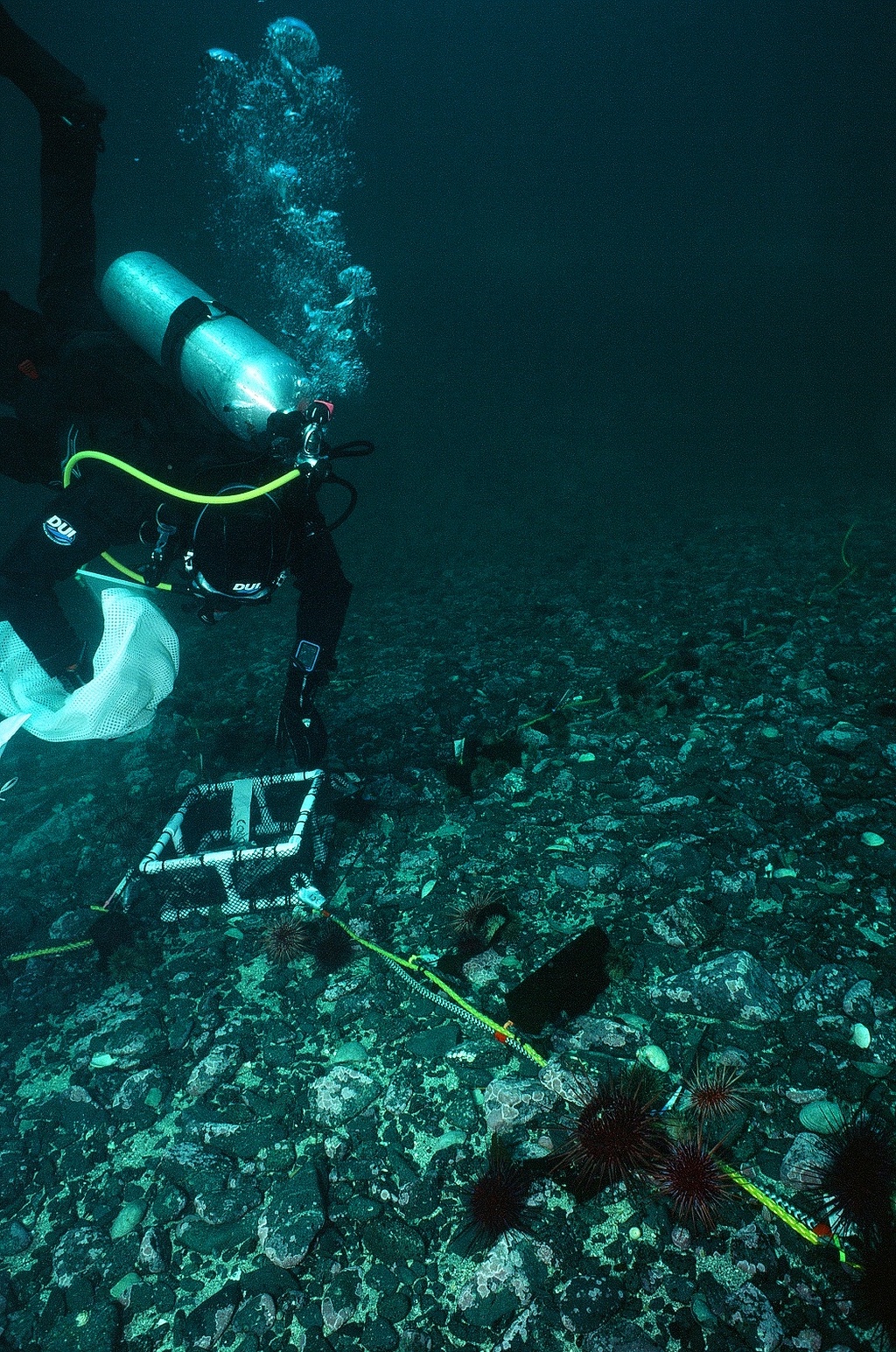
Previous research has found that increased sea otter populations have helped curb urchin populations around kelp forests. A group of ecologists and undergraduates at the University of California, Santa Cruz were curious to learn more about how sunflower sea stars could deter the urchins from eating kelp. To find out, they placed pairs of cages on the sea floor a few miles east of Sitka, Alaska, where resident urchins have turned once-thriving kelp beds into more barren zones. Both cages were made of plastic pipe and covered with fine mesh and kelp blades were tied to all of the cages as bait. A sunflower sea star was placed in one cage, while the other was sea star free. The two pairs of cages were about 60 to 100 feet apart.

A diver inspects an experimental cage along the sea floor in Alaska
A diver inspects one of the experimental arrays in Sitka, Alaska, in 2023 for the study. CREDIT: Photo by Rae Mancuso.

After one day, they observed that red urchins (Mesocentrotus franciscanus) remained an average of about six feet away from the kelp tethered to the cages with sea stars inside. However, the green urchins (Strongylocentrotus droebachiensis) were not so easily deterred. Even with the mixed results, they study found that the sea stars clearly deterred one type of urchin. According to the team, an increase in the presence of sunflower sea stars, either natural or artificial, may help kelp forests by deterring urchins, without requiring divers manually remove urchins.

“We show that the sea stars create a ‘landscape of fear’ among red sea urchins in degraded urchins barrens that reduces grazing on kelp,” study co-author and ecologist Kristy Kroeker, said in a statement. “These are very hungry urchins that are dissuaded enough by the scent of a sea star to deter grazing on kelp forests, which is promising for thinking about their role in kelp-forest recovery.”

[ Related: What’s killing sea stars? ]

Prowling for purple predators?

Additional research is needed to test whether the presence of the sea stars would have a similar effect on the most destructive kelp eater in the region–the purple sea urchin (Strongylocentrotus purpuratus). While a natural part of the ecosystem, if the population of purple sea urchins gets too high, the urchins can eat the kelp faster than they can reproduce

“My educated guess is that they will deter purple urchin grazing as well, but it’s a question of how much and for how long,” Kroeker said. “There are many unknowns that need to be addressed and many steps that need to be taken between our results and the reintroduction of Pycnopodia for kelp-forest recovery.”

The study also highlights how undergraduate students can be a real asset in scientific research at universities.

“I feel very grateful to have had the privilege of working on this study alongside my peers. Participating in the entire process, from diving to scientific writing, was exciting and impactful as an undergraduate student,” added study co-author Rae Mancuso. “I hope the findings from this field experiment contribute in some way to the restoration of our all-important kelp forests.”

The post Meet the 24-armed sea star, a kelp forest’s bodyguard appeared first on Popular Science.

via Popular Science – New Technology, Science News, The Future Now https://www.popsci.com

July 30, 2025 at 09:31AM