
Intel Goes Full XPU: Falcon Shores to Combine x86 and Xe For Supercomputers

https://www.anandtech.com/show/17268/intel-goes-full-xpu-falcon-shores-to-combine-x86-and-xe-for-supercomputers

One of Intel’s more interesting initiatives over the past few years has been XPU – the idea of using a variety of compute architectures in order to best meet the execution needs of a single workload. In practice, this has led to Intel developing everything from CPUs and GPUs to more specialty hardware like FPGAs and VPUs. All of this hardware, in turn, is overseen at the software level by Intel’s oneAPI software stack, which is designed to abstract away many of the hardware differences to allow easier multi-architecture development.

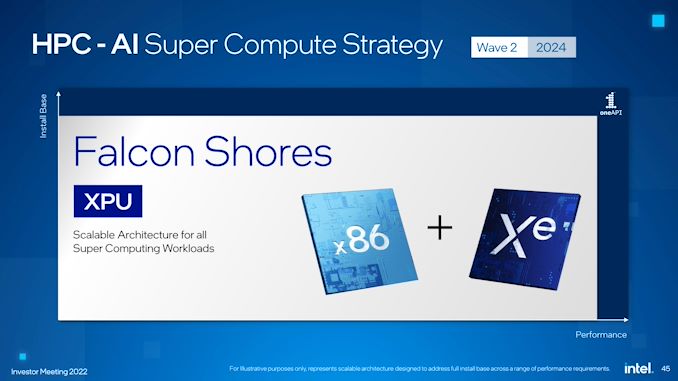
Intel has always indicated that their XPU initiative was just a beginning, and as part of today’s annual investor meeting, Intel is finally disclosing the next step in the evolution of the XPU concept with a new project codenamed Falcon Shores. Aimed at the supercomputing/HPC market, Falcon Shores is a new processor architecture that will combine x86 CPU and Xe GPU hardware into a single Xeon socket chip. And when it is released in 2024, Intel is expecting it to offer better than 5x the performance-per-watt and 5x the memory capacity of their current platforms.

At a very high level, Falcon Shores appears to be an HPC-grade APU/SoC/XPU for servers. While Intel is offering only the barest of details at this time, the company is being upfront in that they are combining x86 CPU and Xe GPU hardware into a single chip, with an eye on leveraging the synergy between the two. And, given the mention of advanced packaging technologies, it’s a safe bet that Intel has something more complex than a monolithic die planned, be it separate CPU/GPU tiles, HBM memory (e.g. Sapphire Rapids), or something else entirely.

Diving a bit deeper, while integrating discrete components often pays benefits over the long run, the nature of the announcement strongly indicates that there’s more to Intel’s plan here than just integrating a CPU and GPU into a single chip (something they already do today in consumer parts). Rather, the presentation from Raja Koduri, Intel’s SVP and GM of the Accelerated Computing Systems and Graphics (AXG) Group, makes it clear that Intel is looking to go after the market for HPC users with absolutely massive datasets – the kind that can’t easily fit into the relatively limited memory capacity of a discrete GPU.

A singular chip, in comparison, would be much better prepared to work from large pools of DDR memory without having to (relatively) slowly shuffle data in and out of VRAM, which remains a drawback of discrete GPUs today. In those cases, even with high speed interfaces like NVLink and AMD’s Infinity Fabric, the latency and bandwidth penalties of going between the CPU and GPU remain quite high compared to the speed at which HPC-class processors can actually manipulate data, so making that link as short as physically possible can potentially offer performance and energy savings.
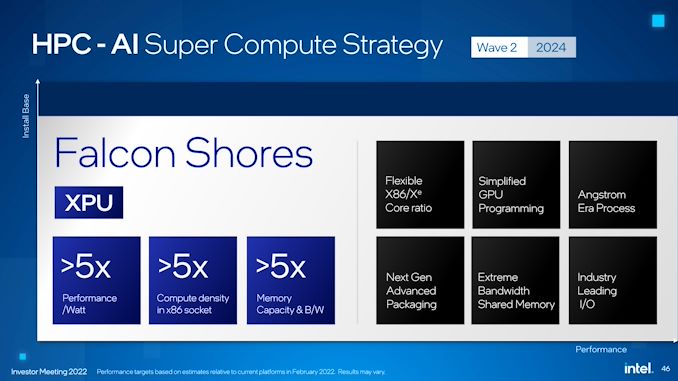
Meanwhile, Intel is also touting Falcon Shores as offering a flexible ratio between x86 and Xe cores. The devil is in the details here, but at a high level it sounds like the company is looking at offering multiple SKUs with different numbers of cores – likely enabled by varying the number of x86 and Xe titles.

From a hardware perspective then, Intel seems to be planning to throw most of their next-generation technologies at Falcon Shores, which is fitting for its supercomputing target market. The chip is slated to be built on an “angstrom era process”, which given the 2024 date is likely Intel’s 20A process. And along with future x86/Xe cores, will also incorporate what Intel is calling “extreme bandwidth shared memory”.

With all of that tech underpinning Falcon Shores, Intel is currently projecting a 5x increase over their current-generation products in several metrics. This includes a 5x increase in performance-per-watt, a 5x increase in compute density for a single (Xeon) socket, a 5x increase in memory capacity, and a 5x increase in memory bandwidth. In short, the company has high expectations for the performance of Falcon Shores, which is fitting given the highly competitive HPC market it’s slated for.

And perhaps most interestingly of all, to get that performance Intel isn’t just tackling things from the raw hardware throughput side of matters. The Falcon Shores announcement also mentions that developers will have access to a "vastly simplified GPU programming model" for the chip, indicating that Intel isn’t just slapping some Xe cores into the chip and calling it a day. Just what this entails remains to be seen, but simplifying GPU programming remains a major goal in the GPU computing industry, especially for heterogeneous processors that combine CPU and GPU processing. Making it easier to program these high throughput chips not only makes them more accessible to developers, but reducing/eliminating synchronization and data preparation requirements can also go a long way towards improving performance.

Like everything else being announced as part of today’s investor meeting, this announcement is more of a teaser for Intel. So expect to hear a lot more about Falcon Shores over the next couple of years as Intel continues their work to bringing it to market.

via AnandTech https://ift.tt/6SlrCkM

February 17, 2022 at 01:43PM
Windows 11 Gets 1,000 Android Apps in the US

https://www.droid-life.com/2022/02/16/windows-11-gets-1000-android-apps-in-the-us/

Microsoft has been talking about the arrival of Android apps on Windows 11 for some time now. We knew the situation involved the Amazon Appstore and Android apps from there running “naturally” on Windows through the Microsoft Store. Today, if you are in the US and running Windows 11, you can start to experience it all.

Microsoft announced via blog post that a bunch of the promised experiences for Windows 11 are now rolling out, from taskbar enhancements to clock placements on multi-monitor setups and a couple of revamped apps. But really, the big deal for us is this new Android app integration.

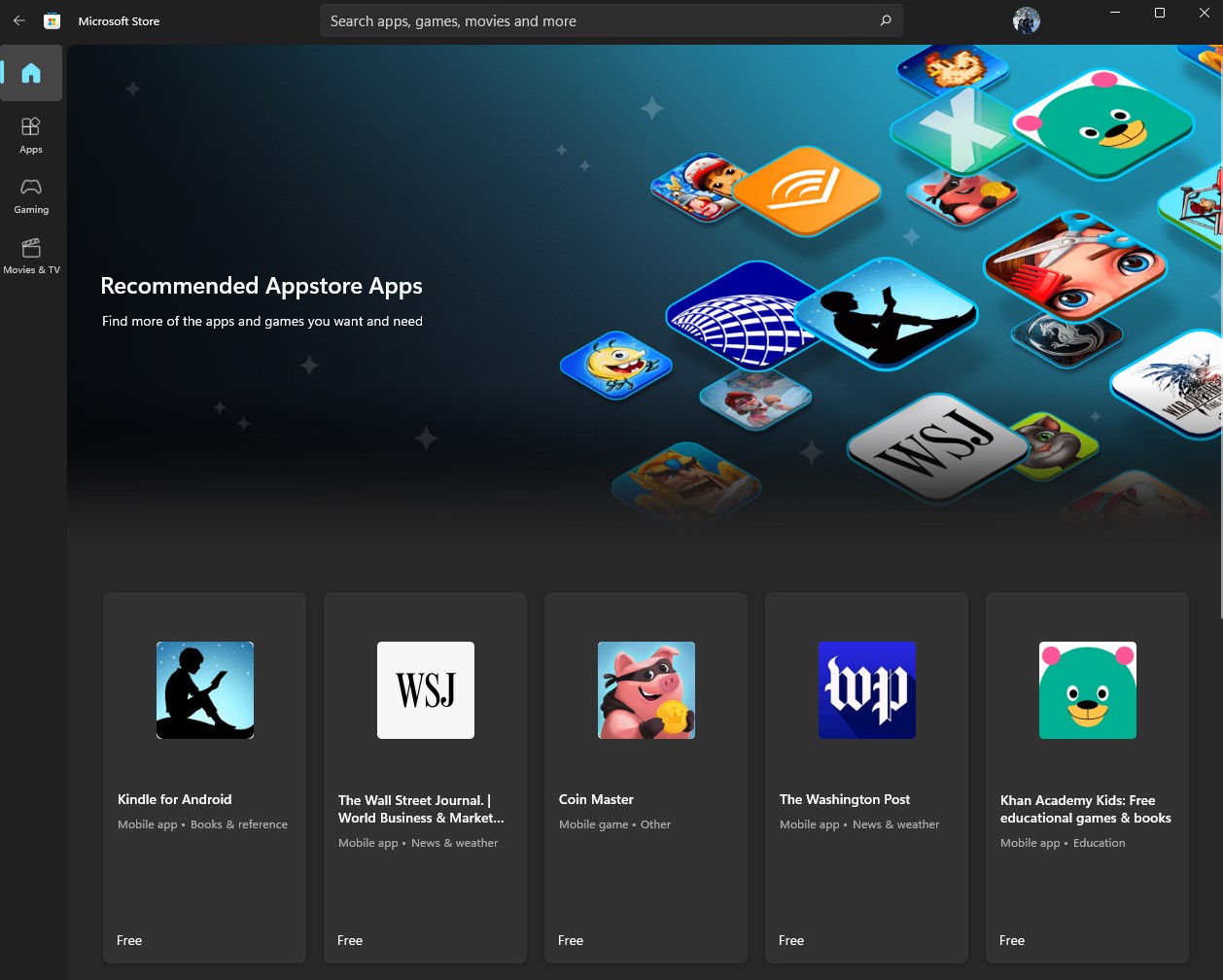
With the Amazon Appstore now on Windows 11, users can find over 1,000 apps and games that can be installed and run, almost like they were “a part of Windows.” Apps like Audible, Kindle, Subway Surfers, and Khan Academy are all there, just don’t expect a bunch of Google apps, since this is Amazon’s Appstore.

Amazon Apps Windows 11

To get Amazon’s Appstore up and running on your PC, you’ll open up the Microsoft Store, head into the Library tab, and then click the “Get Updates” button. This should initiate a bunch of updates to Microsoft services that bring in the Android app support, at least that’s how it looked when I just updated. Once done and the Microsoft Store re-opens, you should see a big splash screen at the top to showcase the Appstore’s arrival.

After updating, I can tell you that there are indeed Android apps there, as you can see above. However, finding more Android apps wasn’t easy. It seems like Microsoft is simply pushing them together with regular PC apps and so you really need to look for the “mobile app” tag under the title to know what you are getting.

Still, this could be cool, as long as Amazon’s selection of apps is decent. I can’t say I’ve looked at the Amazon Appstore in a solid 10 years.

If you’ve updated, tell us what you are finding.

Read the original post: Windows 11 Gets 1,000 Android Apps in the US

via Droid Life: A Droid Community Blog https://ift.tt/A5NunFb

February 16, 2022 at 12:14PM

The NYT Has Now Officially Changed The Wordle Solution List

https://www.gamespot.com/articles/the-nyt-has-now-officially-changed-the-wordle-solution-list/1100-6500735/


The New York Times’ acquisition of Wordle has already stirred up a few controversies, from players’ streaks being wiped to removing offensive words from the valid word list. Today we have confirmation that it’s not just the valid word list that the NYT has changed–it’s the solutions as well.

Wordle 241, which is the puzzle for February 15th, has a different answer depending on whether you’re playing on the live NYT site, or on a downloaded or cached version of the original powerlanguage.co.uk site. The NYT hasn’t fully changed the solution list, it’s just removed a few select answers, which means players who are sticking to the original version of Wordle will now be one day behind everyone else’s solutions.

The following will contain spoilers for the original, cached version of Wordle:

The word that was intended for Wordle 241 was “AGORA,” a word originating from Ancient Greek that refers to a city’s central public space. That word has been removed from the NYT version of the game, and instead the original solution for Wordle 242 has been moved up a day. Contrary to claims that the publication would make Wordle harder, the NYT has said in a statement that it has chosen to remove obscure words from the answer list, as well as “insensitive or offensive” words.

“AGORA” was removed from the solution list due to its obscurity, along with future solutions “PUPAL” and the British-spelled “FIBRE.” The NYT has also removed future answers “SLAVE,” “LYNCH,” and “WENCH” under its “insensitive or offensive” rule.

For players who continue to use the original version of Wordle, whether by having a browser tab open to the original site, or by having the webpage downloaded, the diverging solution list constitutes a problem.

Part of the appeal of Wordle has been that everyone around the world shares the same daily answer. The social appeal of the game starts to wane when people have different solutions to the same puzzles, which can lead to arguments and accusations of cheating, as NBA star Karl-Anthony Towns recently found out.

For what its worth, those with the old word list can update quite easily if they choose to do so. The word list will update automatically if players refresh their browser window, or they can move to a live version of the site rather than a downloaded one. This solution isn’t all that useful to those who are making the choice to play the pre-NYT version of the game, however.

GameSpot may get a commission from retail offers.

Got a news tip or want to contact us directly? Email news@gamespot.com

via GameSpot’s PC Reviews https://ift.tt/8OEcMPU

February 15, 2022 at 10:07PM

The CIA Has Secretly Run a ‘Bulk Collection’ Program

https://www.wired.com/story/cia-bulk-collection-surveillance-earn-it-security-news/


Cryptocurrency was everywhere this week, funding anti-Russian resistance groups and hacktivists in Ukraine and being seized by the US Department of Justice in a massive trove of laundered bitcoin worth $3.6 billion. If you’re just wading into crypto yourself and need a place to store your digital dough, we’ve got a guide for picking and setting up a cryptocurrency wallet.

Microsoft took a huge security step this week by announcing that it will disable its often-abused macros feature by default in Microsoft Excel and Word files downloaded from the internet. Health privacy researchers published findings about medical and genetic-testing companies that left details about their third-party ad tracking and lead generation methods out of their privacy policies. And pro-democracy activists, many of whom are in hiding after Myanmar’s 2021 coup, fear that their phone records—and by extension the identities of their loved ones and resistance networks—could be at risk of falling into the junta’s hands.

And if you’re getting freaked out about the possibility of being tracked using Apple AirTags, here’s our guide to scoping things out and protecting yourself.

And there’s more. We’ve rounded up all the news here that we didn’t break or cover in depth this week. Click on the headlines to read the full stories. And stay safe out there.

Partially redacted documents released on Thursday night by the US intelligence community reveal a secret CIA surveillance dragnet that has collected some Americans’ data under a program that did not have congressional approval or oversight. Senate Intelligence Committee members Ron Wyden (D-Oregon) and Martin Heinrich (D-New Mexico) sent a letter to the director of national intelligence and CIA director on April 13, 2021, demanding that information about the program be declassified. “Among the many details the public deserves to know are the nature of the CIA’s relationship with its sources and the legal framework for the collection,” the senators wrote in their letter.

The program was authorized under the 1981 presidential executive order “United States Intelligence Activities.” Referring to the Foreign Intelligence Surveillance Act, the senators said in a statement on Thursday that “FISA gets all the attention because of the periodic congressional reauthorizations and the release of DOJ, ODNI, and FISA Court documents” and the data-collection programs Congress authorizes under the law. “But what these documents demonstrate is that many of the same concerns that Americans have about their privacy and civil liberties also apply to how the CIA collects and handles information under executive order and outside the FISA law.”

The Senate Judiciary Committee advanced a familiar bill, the EARN IT Act, on Thursday. The legislation aims to increase tech company responsibility for child sexual abuse materials posted or distributed through their services. Technologists and privacy advocates have repeatedly and urgently warned that EARN IT would have significant cybersecurity and human rights implications by disincentivizing tech companies from implementing end-to-end encryption schemes. The legislation would force online services to “earn” some of the Section 230 protections that currently shield them from liability for material posted by their users. The bill was first introduced in 2020 and also advanced out of committee then, but it did not receive a floor vote before the end of the congressional session.

In a report this week, Google’s Project Zero bug hunting team said that companies are getting faster at patching after the group discloses a vulnerability to them. Project Zero is known for setting deadlines for developers to release fixes for their products, anywhere from seven to 90 days depending on the severity of the bug. Once the deadline expires, sometimes with an additional grace period of up to 14 days, the group publicly discloses the flaws. Project Zero said this week that it took companies an average of 52 days to fix vulnerabilities in 2021, down from an average of about 80 days in 2018. Additionally, it has become very rare for organizations to miss a Project Zero time limit. Only one bug exceeded its deadline in 2021, though the group noted that 14 percent of bugs do use the grace period. The group emphasized that the findings may not be generalizable across the industry, because Project Zero is well known and has a particular reputation for being strict and effective at getting bugs fixed. Companies may be more likely to take swift action when Project Zero shows up. Nonetheless, the trends are promising and show that there is more mainstream understanding of the vulnerability disclosure process.


More Great WIRED Stories

via Wired Top Stories https://ift.tt/UPcJTxd

February 12, 2022 at 08:12AM

DeepMind’s AI can control superheated plasma inside a fusion reactor 

https://www.technologyreview.com/2022/02/16/1045470/deepminds-ai-can-control-superheated-plasma-inside-a-fusion-reactor/

DeepMind’s streak of applying its world-class AI to hard science problems continues. In collaboration with the Swiss Plasma Center at EPFL—a university in Lausanne, Switzerland—the UK-based AI firm has now trained a deep reinforcement learning algorithm to control the superheated soup of matter inside a nuclear fusion reactor. The breakthrough, published in the journal Nature, could help physicists better understand how fusion works, and potentially speed up the arrival of an unlimited source of clean energy.

To support MIT Technology Review’s journalism, please consider becoming a subscriber.

“This is one of the most challenging applications of reinforcement learning to a real-world system,” says Martin Riedmiller, a researcher at DeepMind.

In nuclear fusion, the atomic nuclei of hydrogen atoms get forced together to form heavier atoms, like helium. This produces a lot of energy relative to a tiny amount of fuel, making it a very efficient source of power. It is far cleaner and safer than fossil fuels or conventional nuclear power, which is created by fission—forcing nuclei apart. It is also the process that powers stars.

Controlling nuclear fusion on Earth is hard, however. The problem is that atomic nuclei repel each other. Smashing them together inside a reactor can only be done at extremely high temperatures, often reaching hundreds of millions of degrees—hotter than the center of the sun. At these temperatures, matter is neither solid, liquid, nor gas. It enters a fourth state, known as plasma: a roiling, superheated soup of particles.

The task is to hold the plasma inside a reactor together long enough to extract energy from it. Inside stars, plasma is held together by gravity. On Earth, researchers use a variety of tricks, including lasers and magnets. In a magnet-based reactor, known as a tokamak, the plasma is trapped inside an electromagnetic cage, forcing it to hold its shape and stopping it from touching the reactor walls, which would cool the plasma and damage the reactor.  

Controlling the plasma requires constant monitoring and manipulation of the magnetic field. The team trained its reinforcement-learning algorithm to do this inside a simulation. Once it had learned how to control—and change—the shape of the plasma inside a virtual reactor, the researchers gave it control of the magnets in the Variable Configuration Tokamak (TCV), an experimental reactor in Lausanne. They found that the AI was able to control the real reactor without any additional fine-tuning. In total, the AI controlled the plasma for only two seconds—but this is as long as the TCV reactor can run before getting too hot.

Quick reactions

Ten thousand times a second, the trained neural network takes in 90 different measurements describing the shape and position of the plasma and adjusts the voltage in 19 magnets in response. This feedback loop is far faster than previous reinforcement-learning algorithms have had to deal with. To speed things up, the AI was split into two neural networks. A large network, called a critic, learned via trial and error how to control the reactor inside the simulation. The critic’s ability was then encoded in a smaller, faster network, called an actor, that runs on the reactor itself.

“It’s an incredibly powerful method,” says Jonathan Citrin at the Dutch Institute for Fundamental Energy Research, who was not involved in the work. “It’s an important first step in a very exciting direction.”

The researchers believe that using AI to control plasma will make it easier to experiment with different conditions inside reactors, helping them understand the process and potentially speeding up the development of commercial nuclear fusion. The AI also learned how to control the plasma by adjusting magnets in a way that humans had not tried before, which suggests that there may be new reactor configurations to explore.

“We can take risks with this kind of control system that we wouldn’t dare take otherwise,” says Ambrogio Fasoli, director of the Swiss Plasma Center and chair of the Eurofusion Consortium. Human operators are often unwilling to push the plasma beyond certain limits. “There are events that we absolutely have to avoid because they damage the device,” he says. “If we are sure that we have a control system that takes us close to the limits but not beyond them, then we can explore more possibilities. We can accelerate research.”

via Technology Review Feed – Tech Review Top Stories https://ift.tt/vRpoqXy

February 16, 2022 at 10:06AM

Historic sea level rise predicted by NASA and government task force

https://www.space.com/sea-level-rise-foot-2050-climate-change-report-nasa


As climate change continues to progress, so will its effects. In a new collaborative report, NASA and other U.S. government agencies have found that sea levels will rise up to a foot by 2050. 

The report, which comes from a sea level rise task force that includes a number of government agencies including NASA as well as the National Oceanic and Atmospheric Administration (NOAA), has concluded that sea levels along U.S. coastlines will, on average, rise between 10 and 12 inches (25 to 30 centimeters) above today’s levels by 2050. This means that, in just 30 years, ocean height could rise as much as it has risen in the past 100 years. 

This new report includes “the most up-to-date, long term sea level rise projections for all of the United States and Territories,” NOAA Administrator Rich Spinrad said during a news conference Tuesday (Feb. 15), adding that “what we’re reporting out today is historic.”

“The science is very clear,” NASA Administrator Bill Nelson said during the same news conference, “and that means it’s past time to take action to address this climate crisis.”

Nelson didn’t skirt around the problem and its source, specifying that “the science of the last 20 years has settled the question of human behavior that is driving this climate change.”

Related: Climate change is making Earth dimmer

“It’s important to underscore that this report supports previous studies and confirms what we’ve known all along,” Nelson said. “Sea levels are continuing to rise at a very alarming rate, and it’s endangering communities around the world.”

“Climate change is causing sea levels to rise, ocean surface temperatures to warm and moisture to build in the atmosphere. And all of these facts are leading to more intense and destructive storms,” Nelson added. 

This report is the update to a 2017 report and it forecasts sea levels all the way to 2150. However, this is the first time that the report has projected sea levels just 30 years into the future; earlier reports have only examined the effects over longer timescales. 

“Agencies at the federal, state and local levels use these reports to inform their plans on anticipating and coping with the effects of sea level rise,” a statement from NASA’s Jet Propulsion Laboratory in California reads.

Nelson shared how NASA is working on issues related to climate change.

“NASA is steadfast in our commitment to protecting our home planet by expanding our monitoring capabilities and continuing to ensure our climate data is not only accessible but understandable,” Nelson said in the statement.

“Over the next decade, NASA is going to put up five great observatories … to give us precision in our understanding of what’s happening to the atmosphere, to the ice, to the landmasses and to the waters,” Nelson said.

Nelson highlighted the agency’s Surface Water and Ocean Topography, or SWOT, mission that will “for the first time give us the elevation of our lakes, rivers and streams, in addition to what we know on the elevation of the seas.” NASA is currently planning to launch SWOT in November, using a SpaceX Falcon 9 rocket. 

He added that the other agencies on the task force, as well as the president’s administration, are serious about continuing to collect important data and working to combat the effects of climate change.

“This administration, the Biden-Harris administration’s response to climate change, it matches this threat,” Nelson said, adding that this moment requires “all hands on deck.”

Spinrad echoed Nelson’s “all hands on deck” sentiment, stating that “This report is a wake up call for the United States, but it’s a wake-up call that comes with a silver lining. It provides us with information needed to act now to best position ourselves for the future. It’s going to take all of us — government, businesses, academia, community citizens — to make a difference in the future.”

Email Chelsea Gohd at cgohd@space.com or follow her on Twitter @chelsea_gohd. Follow us on Twitter @Spacedotcom and on Facebook.

via Space.com https://ift.tt/4zUmp9W

February 16, 2022 at 06:09AM

11 ‘Successful’ People Who Were Actually Huge Frauds

https://lifehacker.com/11-successful-people-who-were-actually-huge-frauds-1848544767


Before he was outed as a criminal, few were seen as more respectable or smarter than Bernie Madoff. His is a quintessentially American rags-t0-riches story— except for the part with all the crimes.

The son of a plumber, Madoff founded an investment company at 22, partly with money he’d saved from working as a lifeguard, and climbed the ladder of Wall Street until he was named chairman of the NASDAQ. For decades, rich people begged to be included among the select few he counted as clients, because he was such a genius, he could make money even when the market took a crap!

Except Madoff never invested his clients’ money. He put their deposits in an account, sent falsified returns, and paid any withdrawals with newer investors’ dough. It was an unimaginative, dull-as-dirt Ponzi scheme, notable mainly for its scale: At Madoff’s sentencing, Judge Denny Chin remarked that the accused’s crimes were literally “off the charts,” as federal sentencing guidelines for fraud top out at $400 million in losses. Madoff’s scheme was worth about $64.8 billion. Not bad for a plumber’s son, eh?

via Lifehacker https://lifehacker.com

February 16, 2022 at 10:08AM