Meta reportedly disbands team creating a new OS for AR and VR

https://www.engadget.com/meta-dissolves-ar-vr-os-team-204708691.html

Meta might be rethinking plans to build a new operating system for its AR and VR devices. The Informationunderstands Meta recently disbanded a team of 300-plus people working on its long-in-the-making XROS. The team will reportedly share its experience with other parts of Meta. Some will move to the Project Aria AR glasses unit, while others will work on future Quest headsets and the "XR Tech" team responsible for eye tracking, hand tracking and other machine perception features.

Rumors surfaced in January that Meta had halted most or all work on XROS in favor of refining the Android-based VROS platform used in the Quest 2 headset. Meta appeared to deny the move in a statement to Engadget at the time, claiming that it was "not halting or scaling back" its reality OS development.

We’ve asked Meta for comment on this latest report. In a statement to The Information, spokesperson Sheeva Slovan didn’t confirm or deny the state of XROS but did reference the disbanding. Meta could "speed up" work on technology for each product line by placing OS engineers "directly" into its AR and VR teams, she said, adding that the company was still devoted to making "highly specialized systems."

A decision like this might produce mixed results. While it could help Meta launch new AR and VR products that much faster, it would also keep the company tied to Android despite attempts to drop Google’s software. If those are true, you might see more frequent but iterative headset releases than if Meta continued work on XROS.

via Engadget http://www.engadget.com

February 25, 2022 at 02:54PM

A True Story: The Crazy Tale of the First Sci-Fi Story Ever Written (2nd Century AD)

https://www.geeksaresexy.net/2022/02/25/a-true-story-the-crazy-tale-of-the-first-sci-fi-story-ever-written-2nd-century-ad/

Back in the second century AD, Greek author Lucian of Samosata wrote what is now considered the first sci-fi story of all time. “A True Story” was written to poke fun at some of the outlandish tales published by some of the author’s peers, particularly those reporting fantastical events as if they were true. Here is an entertaining summary of the book by Youtuber Austin McConnell.

Hey Hollywood! That tale would make for an awesome movie, so what are you guys waiting for? Chop chop!

[AustinMcConnell]

Click This Link for the Full Post > A True Story: The Crazy Tale of the First Sci-Fi Story Ever Written (2nd Century AD)

via [Geeks Are Sexy] Technology News https://ift.tt/Qx9Zkfw

February 25, 2022 at 01:06PM

Forget Wordle And Quordle, You Should Be Playing Octordle

https://kotaku.com/wordle-dordle-quordle-octordle-word-game-browser-puzzle-1848593721


Screenshot: Kenneth Crawford / Kotaku

As I continue to delight in the deranged conspiracy theories surrounding Wordle, following its purchase by the New York Times, I’m equally thrilled to discover those making increasingly difficult versions of the game. Quordle, a version where you solve four Wordles at once, has become pretty popular, in the wake of Dordle that offered but two. But throw that aside, because the real players are simultaneously solving eight puzzles, in Octordle.

It sounds impossible, and I think by Einsteinian law it should be impossible, but somehow it works. With 13 guesses, you simultaneously play across eight different Wordle grids, attempting to identify all eight words at the same time.

As you can imagine, this introduces a worldle of new tactics to Wordle. If you thought your starting word was important before, no consider it’s attempting to cover eight separate starts at once. And then what about go #2? Are you someone who puts in a whole other set of five letters (and thus revealing you aren’t playing Wordle on its rather hidden “Hard Mode”), or someone who immediately begins pursuing solutions? Is it time to add in a third starter word, to get as much of the alphabet in as you can? (Whisper it: what about four?)

Like Quordle, where you solve four puzzles at the same time (in that case with eight guesses), once you’ve got one puzzle’s word correct the grid locks off, and you can narrow your concentration. Of course, with eight times as many solutions to find, that dramatically increases your chance of also getting an awkward word in the mix, meaning you might want to adjust tactics to take that into account too. Might it be an idea to use some more obscure letters early on, to catch them as soon as possible? (Not according to these stats.)

Read More: A Wordle Math Clone Is Rapidly Becoming My Daily Favorite

I feel like I’m pretty bad at it. I get fixated on solving one of the grids, to the detriment of the other seven, abandoning any notion of tactics in a mad-brained pursuit of one stinking answer. And yet, even then, I’ve completed the game successfully. Which surprises me more than anyone else. (Not today though. Missed two whole words.)

Fortunately, as with Quordle, alongside the daily game that’s the same for everyone, there are “practice” games too, that let you play as much as you want with randomly selected groups of words. (I managed one of those just now, to make myself feel better.)

Now I’m just waiting for Sexdecordle. (And Untrigintordle.)


via Kotaku https://kotaku.com

February 25, 2022 at 12:50PM

Carbon removal factory

https://www.technologyreview.com/2022/02/23/1044972/carbon-removal-factory-climate-change/

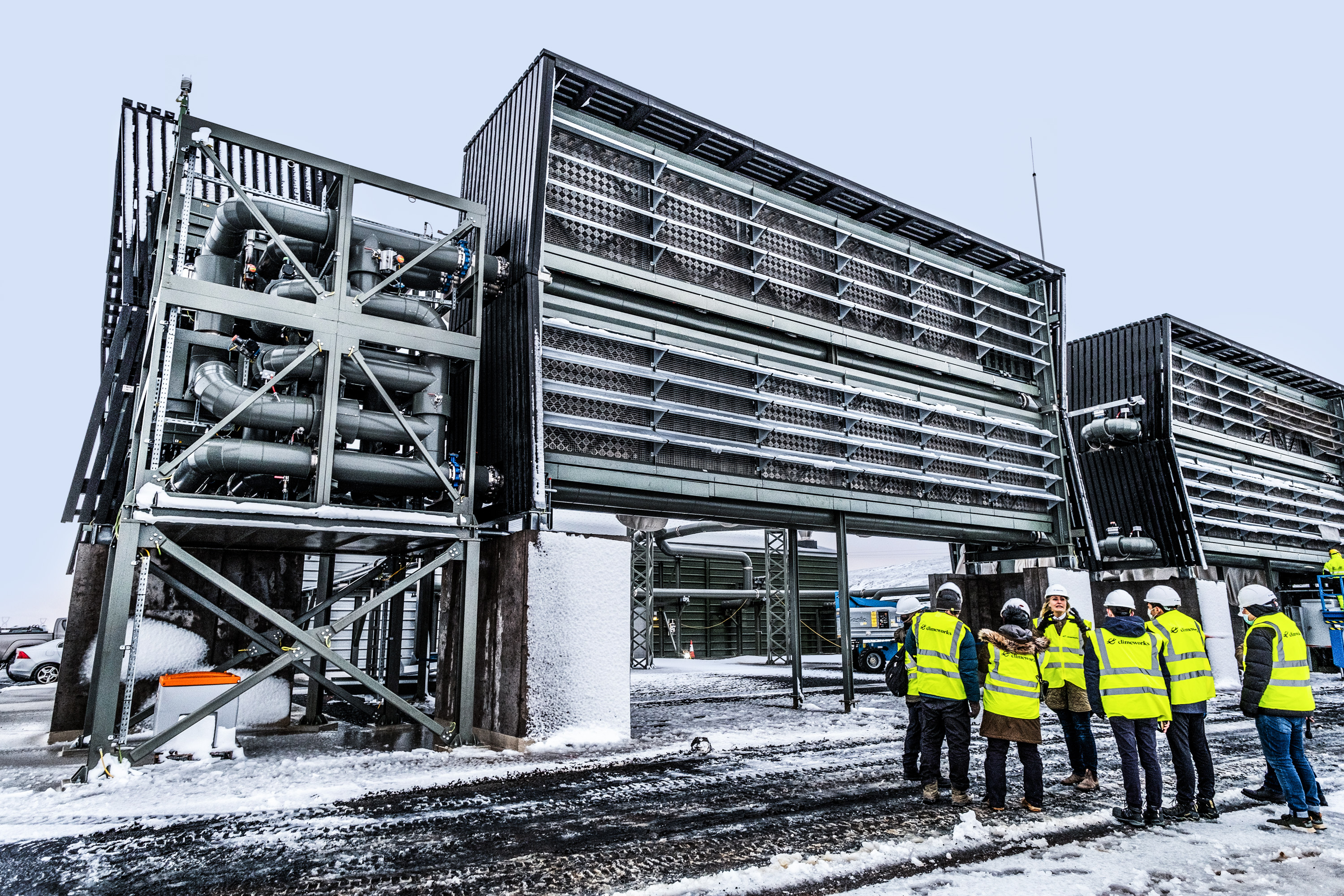
In September, Climeworks flipped the switch on Orca, the largest plant to date that is designed to remove carbon dioxide from the air. 

The facility, outside Reykjavik, Iceland, can capture 4,000 metric tons of carbon dioxide every year. Large fans suck air through a filter, where materials bind with CO2 molecules. The company’s partner, Carbfix, then mixes the carbon dioxide with water and pumps it underground, where it reacts with basalt rock and eventually turns into stone. The facility runs entirely on carbon-free electricity, mainly from a nearby geothermal power plant. 

workers at the orca plant
Each module at Orca is made up of a dozen carbon removal units. Air passes through grates and over a filter that traps carbon dioxide with adsorbent chemicals. When the filters are full, grates close across the front of the unit and pipes pump heat into the enclosed space, releasing CO2 from the filters.The carbon dioxide is then pumped to an area where it’s prepared for storage before the gates open again to restart the process.
KRISTJáN MAACK

To be sure, 4,000 tons isn’t that much. It’s less than the annual emissions of 900 cars. And it’s a tiny fraction of the billions of tons of carbon dioxide the world will likely need to pull out of the atmosphere to prevent global warming from soaring past 2 °C over preindustrial levels, according to a variety of studies.

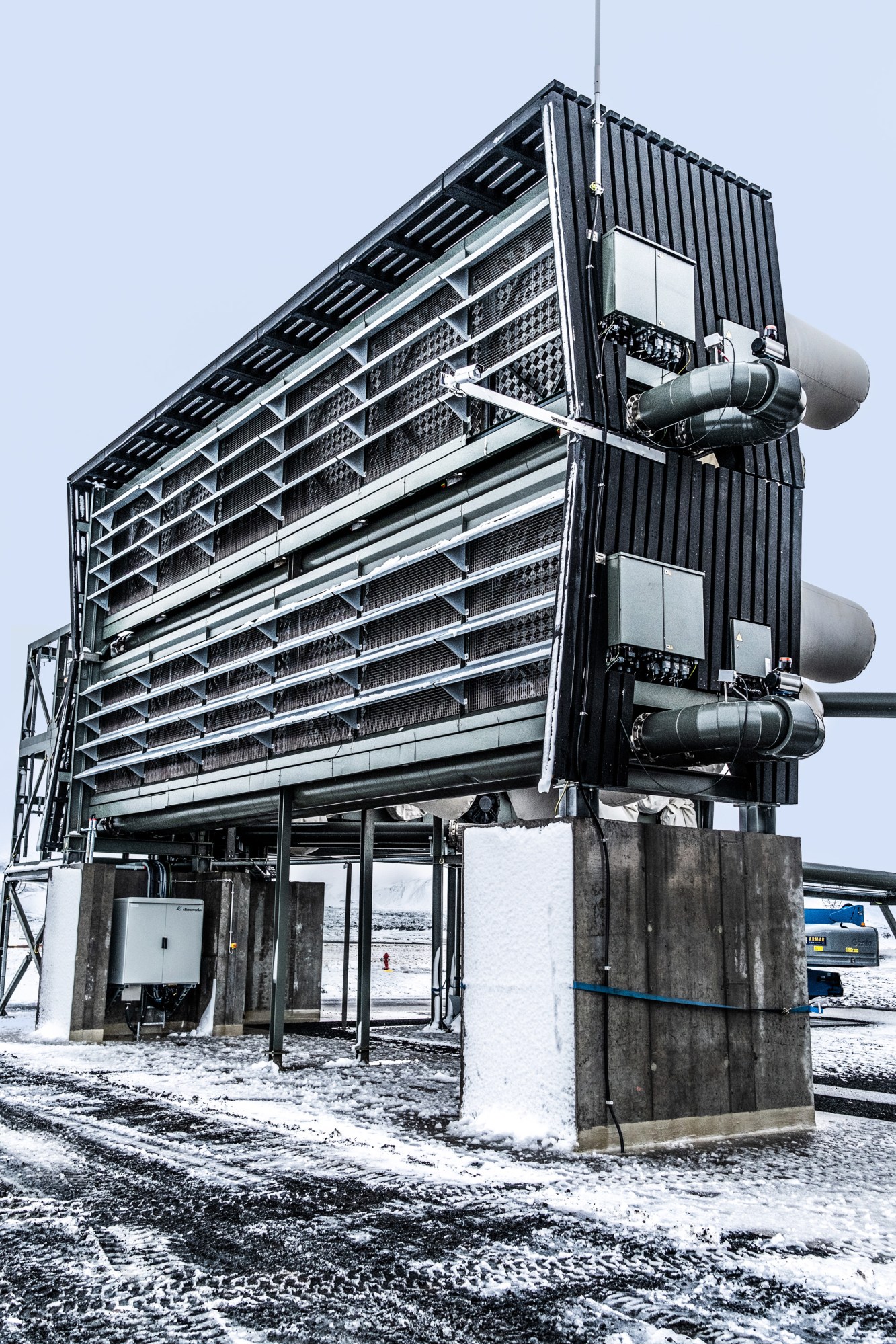
orca module
 Orca is made of modules that can be combined in different ways, making the plant easier to replicate around the world. Climeworks put its first plant in Iceland in part to take advantage of the country’s abundant geothermal power, so the facility can minimize the emissions it generates in the process of capturing carbon dioxide.
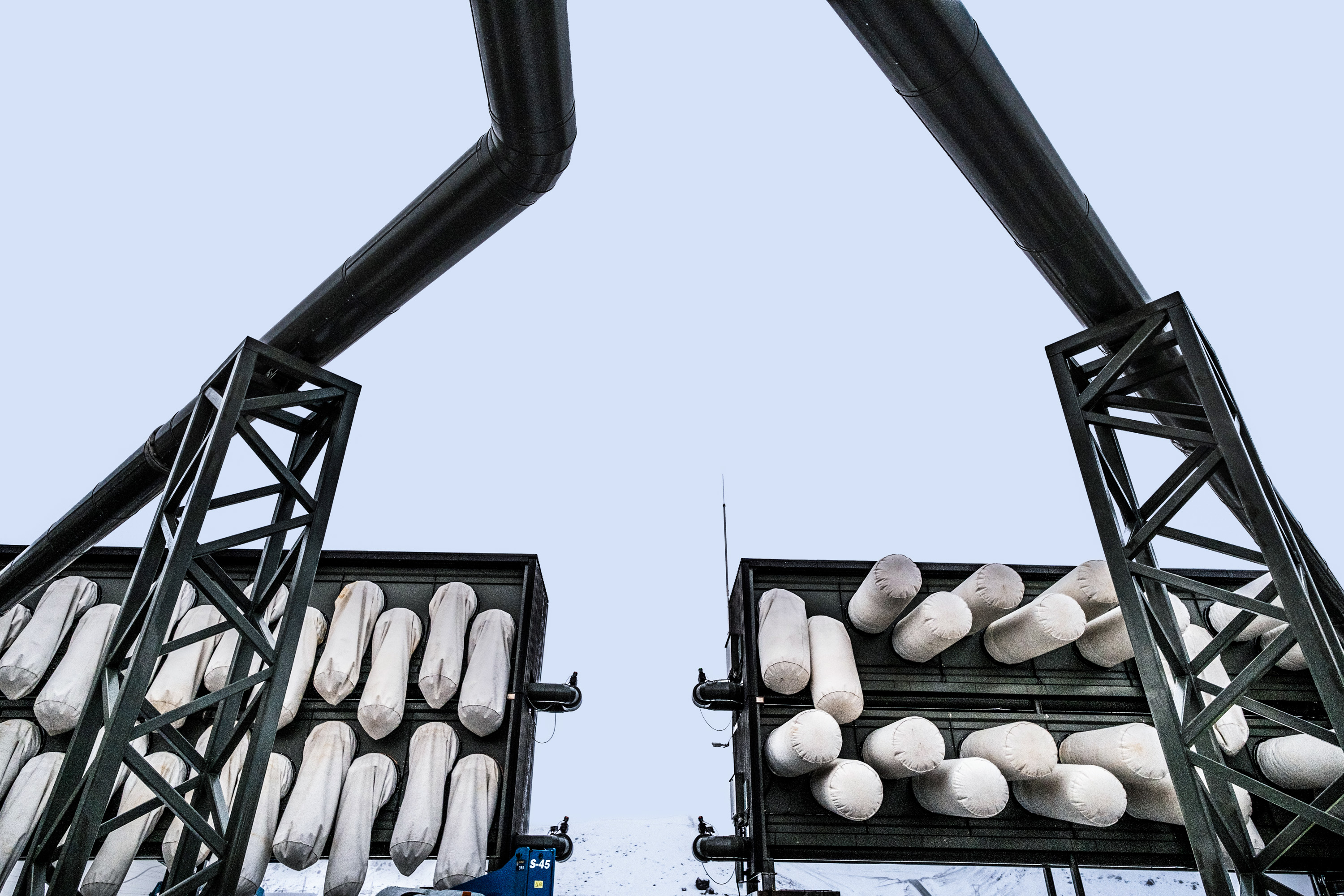
material covering fans at orca plant
On the back of each module, fans blow filtered air back into the atmosphere. Flexible covers on the fans ensure that loose bits from the filters aren’t blown away by the strong Icelandic winds. These covers will likely be needed just for the first year, while the units are tested.
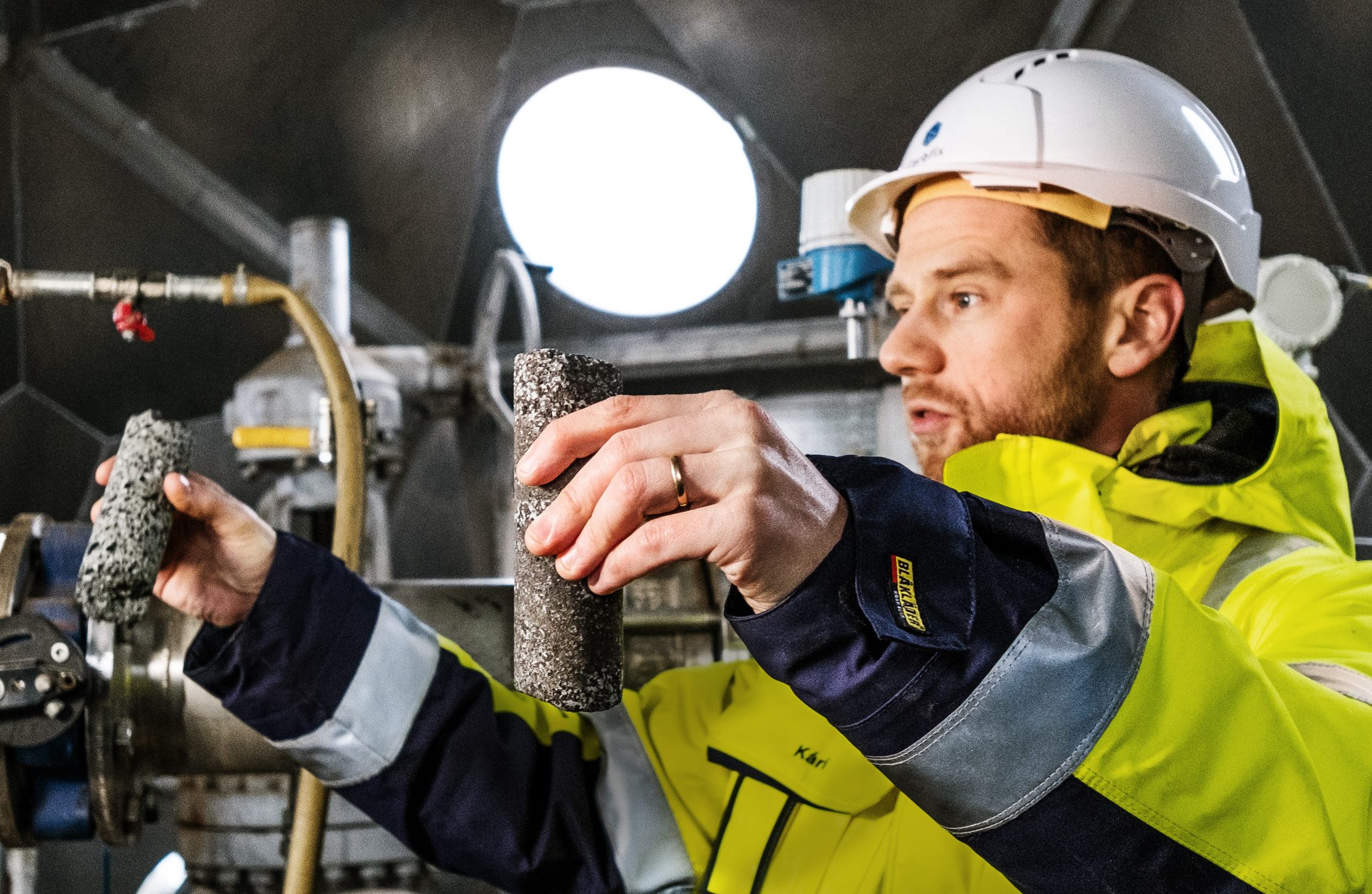
Carbfix employee holds basalt rock
After being captured, carbon dioxide is transformed into solid carbonate minerals, seen here as light spots in a matrix of dark basalt rock.

Far larger facilities are in the works as well. Carbon Engineering, based in Squamish, British Columbia, plans to start construction this year on a plant in the US Southwest with the capacity to remove 1 million tons of carbon dioxide a year. With various partners, it’s also begun engineering or design work on plants in Scotland and Norway that would capture 500,000 to 1 million tons per year.

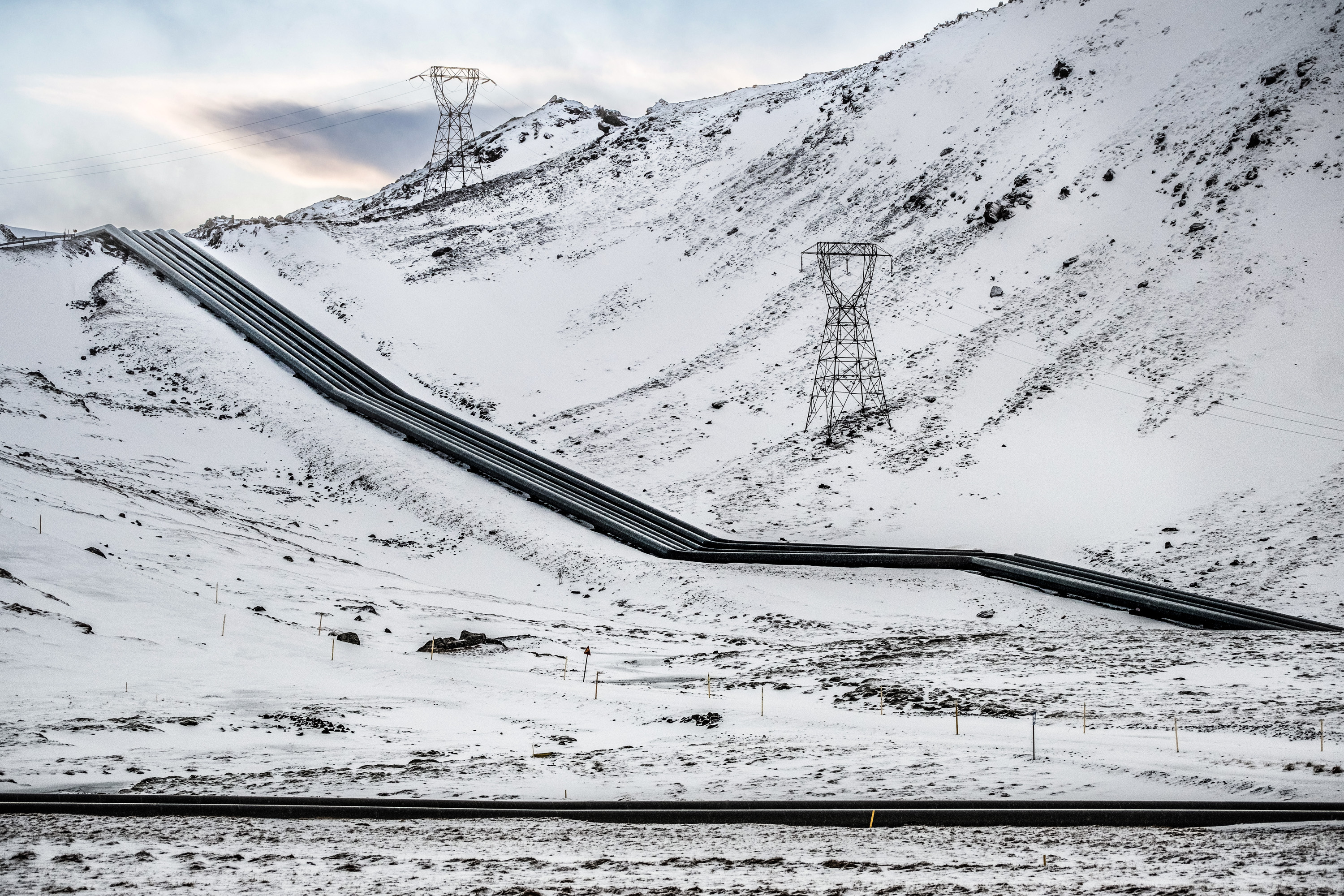
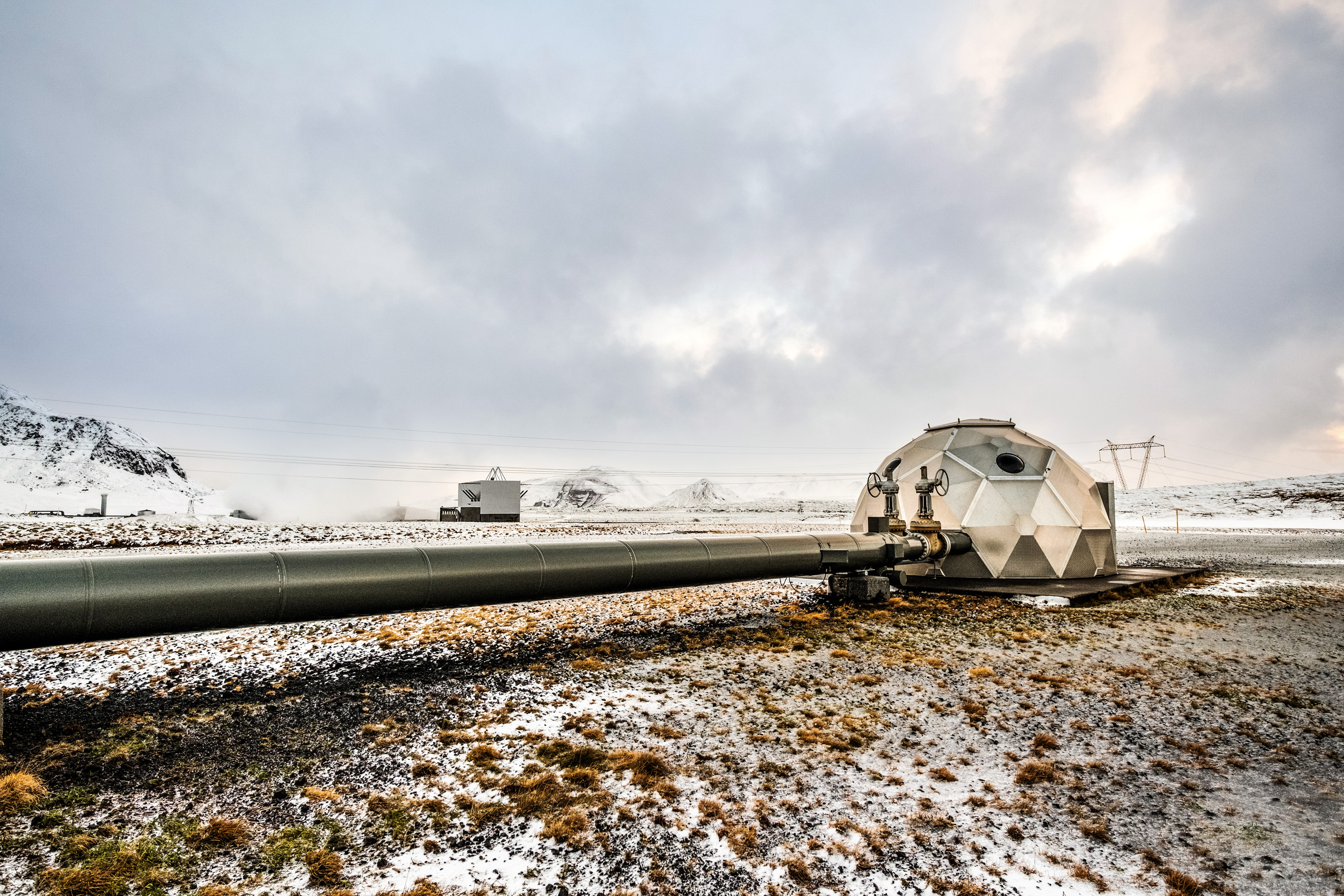
pipes across landscape in Iceland
Carbon dioxide is pressurized and mixed with water before being transferred through massive pipes to Carbfix, the company that pumps it underground to be stored.
KRISTJáN MAACK
Injection wells operated by Carbfix pump carbon dioxide 1,000 meters underground, where it reacts with basalt rock and is locked into mineral form within two years.
KRISTJáN MAACK

The hope is that building more and larger plants to capture carbon from the air will help companies figure out how to optimize operations, drive down the costs, and realize economies of scale. Climeworks estimates it will reduce costs between $600 and $800 per ton of carbon, to around $100 to $150, by the late 2030s. 

A growing number of individuals and companies, including Microsoft, Stripe, and Square, are already paying today’s high costs to suck carbon out of the air as they strive to cancel out their emissions. That’s providing crucial early revenue.

via Technology Review Feed – Tech Review Top Stories https://ift.tt/D8c4dti

February 23, 2022 at 04:05AM

Scientists create cube robots that can shapeshift in space

https://www.engadget.com/shapeshifting-robots-space-exploration-mit-csail-electrovoxels-140026431.html?src=rss

Scientists from MIT’s Computer Science and Artificial Intelligence Laboratory (CSAIL) and the University of Calgary have developed a modular robot system that can morph into different shapes. ElectroVoxels don’t have any motors or moving parts. Instead, they use electromagnets to shift around each other.

Each edge of an ElectroVoxel cube is an electromagnetic ferrite core wrapped with copper wire. The length of each ElectroVoxel side is around 60 millimeters. The total cost is just 60 cents.

When the polarity of a magnet is changed, the edges either attract or repel each other. That causes the cubes to shift into a different orientation. Printed circuit boards and electronics inside each cube control the direction of each electromagnet’s current.

The robots have two basic types of movement. They can pivot around the edge of another cube, or traverse from one ElectroVoxel to the next. A software planner can be used to program reconfigurations. A user can highlight specific magnets, control the speed of cube’s movements and ensure they won’t collide with each other.

The researchers say possible to control up to 1,000 ElectroVoxels with the software. Users can tell the blocks to shift into different shapes, such as turning from a chair into a couch. They can decide which cube should move in which direction, and the software will determine the electromagnetic assignments needed to carry out the task.

The scientists tested ElectroVoxels in microgravity on a parabolic flight. They found the robots can operate in low-gravity environments. As such, the researchers say ElectroVoxels could be used to alter and create structures in outer space.

ElectroVoxels on a parabolic flight.
MIT CSAIL

They suggest the robots could change the inertia properties of a spacecraft, which might mitigate the need for extra fuel for reconfiguration. That, the scientists say, remedies many challenges linked with launch mass and volume. They hope the system will eventually enable a range of space-related use cases, such as augmenting and replacing structures over a series of launches, and building temporary structures to assist astronauts and help with spacecraft inspections.

A future version of ElectroVoxels could allow the creation of self-sorting storage containers. However, to allow the robots to more easily reconfigure in Earth’s gravity, the researchers say more detailed modeling and optimization would be required.

"While the potential benefits in space are particularly great, the paradox is that the favorable dynamics provided by microgravity mean some of those problems are actually also easier to solve — in space, even tiny forces can make big things move," said Martin Nisser, a PhD student at CSAIL and lead author on a paper on ElectroVoxels. "By applying this technology to solve real near-term problems in space, we can hopefully incubate the technology for future use on Earth too."

via Engadget http://www.engadget.com

February 23, 2022 at 08:09AM

Bethesda Ditching Its Stupid Launcher, Returning To Steam

https://kotaku.com/bethesda-launcher-microsoft-pc-valve-steam-skyrim-doom-1848578696


Easily one of the worst trends to hit PC gaming in the last decade has been major publishers’ obsession with creating their own launchers and digital marketplaces. These are moves that have done little for the user, but make booting up a game fiddlier and more tedious.

You can see why they’ve done so from their points of view: the shopfronts give them a chance to sell things directly, rather than give a cut to Valve or Epic. The proprietary nature of the launcher means they get to have you log in to a specific account, and entangle yourself in all kinds of other locked-in stuff like digital rights management.

For us, though? It’s a huge pain in the ass. Especially when you buy and launch a game from Steam, and it then has to load a publisher’s launcher on top of that. In just the last few months I’ve been locked out of Madden 22 because EA’s Desktop App couldn’t verify my purchase, had Far Cry 6 launches held up because Ubisoft’s launcher wouldn’t let me login or sync properly, and wished for a quick death every time I’ve had to do anything with Rockstar’s launcher.

Mercifully, one publisher has now seen the light and will be ditching this approach entirely. Bethesda announced earlier today that they are “sunsetting” the Bethesda Launcher and marketplace in April, having launched them in 2016, and “migrating to Steam.”

Bethesda games have of course always been available on Steam, even when the launcher was active, but this move means that the publisher is now moving everything back to Steam. Even if you bought games directly from Bethesda, they’ll soon be transferred back to Valve’s service, in some cases (though not all) with your saved games included. There’s a FAQ under the blog if you need to know anything more.

Given Bethesda is now a Microsoft company, this is potentially exciting news for anyone who is also annoyed by the recently-purchased Activision Blizzard’s own Battle.net launcher.

via Kotaku https://kotaku.com

February 22, 2022 at 04:36PM

How Every Developer Knew All The Wordle Answers From Day One

https://makezine.com/2022/02/16/how-every-developer-knew-all-the-wordle-answers-from-day-one/


When you’re a developer, you get used to right-clicking on things. Whether it’s a design element you just need to know the css for or a tasty nugget of information that’s just south of a website’s subscription request, right clicking is the digital equivalent of popping open the hood to see what’s underneath. Once you’ve realized the power it adds to your internet browsing, it can become as transformative a tool as cutting and pasting.

My wife was in just this mindset when she first started playing Wordle. A seemingly simple word game that had taken the world by storm, but how exactly did it work? Luckily, she knew the answer was just a right click a way, although that wasn’t the only answer she found.

As it turns out, Wordle has one main javascript file, helpfully named main.js. Inside is the inner workings of the application for anybody who wants to see how it works, but smack dab in the middle, for any curious eyes to see, is the answers to all past and future puzzles laid out neatly in an array (not even minified!). This would be a huge security flaw, say if this was a government site storing teacher’s social security numbers, but in the case of a New York Times word puzzle, perhaps this is just the digital equivalent of printing the answers at the bottom of the page upside down, and trusting your readers not to peek.

Security was probably not high up on the list of concerns of Wordle’s programmer, Josh Wardle, who famously programmed the whole internet sensation as a gift to his significant other, but storing any kinds of data directly in javascript files is generally frowned upon. Still it just goes to show you that there are countless secrets hidden in “plain site” all over the internet for those who are savvy enough to know where to look. The answers you’re looking for could be a mere right-click away!

(Just don’t look at our code, I swear we’re clean)

[Feature photo by Josh Wardle (website/game), Berrely (vectorizing) – Screenshot of https://www.powerlanguage.co.uk/wordle/ — wikipedia/public domain]

via MAKE https://makezine.com

February 16, 2022 at 03:03PM