Ozempic Pill Flops in Major Trials for Alzheimer’s

https://gizmodo.com/ozempic-pill-flops-in-major-trials-for-alzheimers-2000690714

Two of the most anticipated studies this year—large-scale, randomized, controlled, and double-blinded trials of the popular obesity and diabetes drug semaglutide for Alzheimer’s disease—have unfortunately ended in a dud.

Novo Nordisk, the makers of semaglutide, announced the disappointing trial results early Monday morning. The drug did not meaningfully slow down the disease’s progression compared to placebo, the trials showed. The company will now shut down the extension of these trials, though some experts and advocacy groups are still hopeful about the potential future of GLP-1 therapy for Alzheimer’s.

“While these results are not what we had hoped for, they will contribute to our understanding of this devastating and fatal disease,” said Joanne Pike, president and chief executive officer of the Alzheimer’s Association, in a statement sent to Gizmodo.

Early but unfulfilled promise

Semaglutide is the active ingredient in the diabetes drug Ozempic and the obesity medication Wegovy; it’s also currently available as an oral diabetes medication under the brand name Rybelsus. It mimics the naturally occurring GLP-1 hormone, which helps regulate our hunger and insulin production, among other things. Though not the first approved GLP-1 drug, semaglutide’s improved duration and potency have greatly changed the field of obesity medicine. The drug is significantly more effective at helping obese people lose weight than diet and exercise alone.

For years, various studies have suggested that GLP-1 medications like semaglutide may also be able to prevent or slow down the progression of dementia. On the basis of this promising research, Novo Nordisk commissioned the evoke and evoke+ phase 3 trials four years ago. These trials collectively involved 3,808 older adults (over age 55) with mild cognitive impairment or early Alzheimer’s disease. The participants were randomized to receive a weekly dose of oral semaglutide or a placebo.

As with past trials, semaglutide was generally safe and tolerable (common side effects tend to be gastrointestinal, such as nausea or vomiting). People on semaglutide did appear to have some noticeable improvements in biomarkers related to Alzheimer’s, according to Novo Nordisk. Ultimately, however, these improvements did not translate to real-world results. There was no significant difference in the progression of people’s dementia between the two groups, the company reported.

“Based on the significant unmet need in Alzheimer’s disease as well as a number of indicative data points, we felt we had a responsibility to explore semaglutide’s potential, despite a low likelihood of success. We are proud to have conducted two well-controlled phase 3 trials in Alzheimer’s disease that meet the highest standards of research and rigorous methodology,” said Martin Holst Lange, chief scientific officer and executive vice president of research and development at Novo Nordisk, in a statement.

The future of GLP-1s for dementia

Alzheimer’s disease is one of the most complex and devastating conditions we can develop. Even today, researchers still aren’t in agreement about the exact causes of Alzheimer’s, nor about the best approach to treating it. And this is far from the first time that a promising drug candidate for Alzheimer’s has failed to cross the finish line in late-stage clinical trials. So in many respects, these results aren’t too much of a surprise.

But there may yet be a silver lining to this flop. Given the biomarker findings, it’s still possible that a GLP-1 medication can slow the progression of Alzheimer’s, just not this particular one or in this particular way. There are newer GLP-1-based drugs, including many in development, that are generally more effective at treating obesity and diabetes than semaglutide. So perhaps that greater effectiveness can apply to Alzheimer’s as well. And there is precedent for this happening with other drug classes. After years of failure (and one controversial approval), there are now several anti-amyloid drugs available that can modestly slow Alzheimer’s progression.

Another consideration is timing. It’s possible that giving anti-Alzheimer’s medications to people at high risk of the disease—but years before they show any symptoms—can significantly slow its emergence, a hypothesis that trials of other drugs are currently testing.

Advocates like the Alzheimer’s Association are not fully abandoning their hopes that GLP-1 therapy for Alzheimer’s can help, at least not yet.

“Though this semaglutide pill did not help against Alzheimer’s, the field will continue to investigate this class of drugs, as they may act differently. And, the Alzheimer’s Association remains a fierce leader for this type of innovative research, and we believe it’s critical to continue investigating diverse approaches to treatment and prevention,” said Maria C. Carrillo, Alzheimer’s Association chief science officer and medical affairs lead, in a statement to Gizmodo.

Novo Nordisk’s announcement comes roughly a week before the company is expected to present the primary results of the two evoke trials at the Clinical Trials in Alzheimer’s Disease (CTAD) meeting in early December. These results may provide a better sense of where the drug came up short.

For now, though, these findings should also illustrate why clinical trial research is so important. Many lab or observational studies will tease the potential of an experimental or repurposed drug, only for later, more definitive trials to come up short. These preliminary studies are key to finding the drugs or interventions that can work, but we should always be mindful that they won’t pan out most of the time.

This is an especially relevant reminder with GLP-1 therapy, which has shown promise for treating conditions beyond obesity, such as alcohol addiction. Other studies have validated the benefits of GLP-1s for some health problems, such as heart disease. But this may not be the first and only flop we see with this drug class.

via Gizmodo https://gizmodo.com/

November 24, 2025 at 10:38AM

Genesis Magma GT Concept Offers a Striking New Take on the Porsche 911 Formula

https://www.autoblog.com/news/genesis-magma-gt-concept-offers-a-striking-new-take-on-the-porsche-911-formula

A Surprise Reveal

Audi has RS, BMW has M, and Mercedes has AMG. Heck, even Hyundai has N for its range of hotter performance models. Now, it’s Genesis’ turn to get an in-house tuning division. It’s called Magma, and the first model to get that treatment is the GV60 Magma, which just made its world premiere in France.

But towards the end of the GV60 Magma’s debut program, Genesis pulled out two more surprises. One of them was the Magma GT Concept, which aims to make a bold statement about Genesis’ new performance division.

Genesis Magma GT Concept

"More Than a Design Study"

Genesis called the Magma GT Concept "the brand’s clearest expression yet of its commitment to its future high-performance capabilities." On top of that, the company is also committed to turning the concept car into a production vehicle and even aims to enter it in GT racing categories down the line.

There are no full specs just yet, though. However, Genesis did say that it will have a mid-engined layout. Emphasis on the engine bit suggests that there will be internal combustion power, should this model reach production. It’s still too early to tell if there will also be hybrid assist for this low-slung sports car.

Genesis Magma GT Concept

Possible Expansion

Genesis has even bigger ambitions for the Magma GT. Speaking to The Drive, Hyundai Motor Group’s Chief Creative Officer Luc Donckerwolke made it clear that it won’t be a direct rival to the Porsche 911. Instead, it will adopt a model strategy similar to that of an evergreen sports car.

That means we could expect a variety of body styles and higher-performance trims for the Magma GT. "There could be a Magma GT base, Magma GT S, GT R, GT Roadster, GT Clubsport—30 cars would need to be made for the GT3 racing homologation," Donckerwolke told The Drive. The executive even admitted that he owns "more 911s than anyone should have."

Think of this then as more of an alternative to the Porsche Boxster and Cayman (likely with ICE options in the future) and, to some extent, the Chevrolet Corvette C8. There aren’t a lot of mid-engined sports cars out that with true daily-driver capabilities, so it will be interesting to see how Genesis approaches that niche.

Of course, the model expansion will depend on the success of the road-going Magma GT, and Genesis has to build it in the first place. The South Korean automaker hasn’t mentioned when that will come out, but it’s a safe bet that it could reach showrooms before the end of the decade.

Genesis Magma GT Concept

via Autoblog https://ift.tt/qiNeXA5

November 22, 2025 at 12:39PM

Porsche Is Keeping Combustion Alive With a New Water-Injection System

https://www.autoblog.com/news/porsche-is-keeping-combustion-alive-with-a-new-water-injection-system

Spray Water Into Your Engine For More Power

While Oldsmobile, Saab, and even BMW have dabbled in water-injection systems for production cars over the years, Porsche has been quietly filing patents that indicate a strong interest in refining this technology at Stuttgart. For the uninitiated, water injection is a method of cooling the intake charge and combustion chamber by introducing a fine mist of water (or a water-methanol mix) into the intake tract. As the water vaporises and turns to steam, it absorbs heat from its surroundings, thus cooling intake and combustion temperatures. Cooler air is denser and nets more power, and a cooler combustion chamber is less prone to knocking — allowing for higher boost pressures and aggressive ignition timing without the risk of detonation. 

Porsche

This technology has been around for a while, first seen in mid-20th-century high-boost piston aircraft engines, but its use in land vehicles has been limited and mostly confined to motorsports applications and the performance tuning world. Oldsmobile tried it out in their 1962 Jetfire, the world’s first turbocharged production car, Saab tried it in the late ‘70s and early ’80s, while the system was most recently seen on the short-lived 2015 BMW M4 GTS. While other manufacturers seem to have moved on, it looks like Porsche is intent on making the tech truly production-ready.

Porsche Still Focused on Internal Combustion

Now, at a time when most manufacturers are turning the attention of their R&D departments towards battery and charging technology, Porsche engineers are still working behind the scenes to drive innovation in the internal combustion space. Earlier this year, the German manufacturer filed a patent for a new water injection system, and now another patent has emerged, this one describing a method to diagnose and test the system. 

Porsche

The Problem With Water Injection  

Porsche’s latest patent focuses on a method to monitor pressure in the system and ensure that the appropriate amount of water is introduced into each cylinder at any given point. Being able to precisely meter the correct amount of water into each cylinder is extremely important; too little leads to higher engine temperatures, a tendency to knock, and reduced power, while too much water can damage engine or intake components due to the water hammer effect, or worse, result in excess liquid entering a cylinder, leading to hydrolock and catastrophic engine failure

Porsche

All water-injection systems so far can only correctly meter flow when the engine is at high rpm and under heavy loads. This means that a reliable diagnosis can only be carried out under these conditions, with the car being driven and accelerating hard. Porsche, on the other hand, is working on simulating these conditions on a stationary vehicle to enable on-demand diagnostics of the water injection system and its components. 

How Porsche’s System Works

The patent documents detail a rear-engined car with a hybrid powertrain equipped with all the necessary hardware for a water-injection cooling system. This includes a water tank with a pump unit leading to a pressurised rail and injectors meant to spray a fine mist of water into each combustion chamber. The patent drawings also feature a diagnostic device and an external workshop tester. 

WIPO

The on-board diagnostic device uses the hybrid powertrain’s electric motors to momentarily increase engine speed and manage the load on the engine against the torque from the motors. This artificially simulates the conditions necessary to accurately diagnose issues or spot inconsistencies within the water-injection system, all with the car stationary in the workshop or service bay. 

The patent also highlights that the increase in engine speed required to carry out this test can be achieved automatically by the diagnostic device, or manually by a technician depressing the accelerator pedal. The system can then accurately diagnose the water-injection system by shifting the load point as necessary, and spraying water through the injectors at the right time to mimic real-world driving conditions. The results of the diagnosis and errors, if any, are then stored and displayed in the external workshop tester. 

Porsche

The Bottom Line

Despite the challenges of incorporating water-injection systems today, chief among them the need for a refillable water tank that still requires manual intervention and complicates emissions compliance, Porsche’s persistence shows the brand isn’t ready to let combustion fade quietly into history. Instead, Stuttgart is pushing the boundaries of what a modern ICE can do, using clever diagnostics and hybrid assistance to make technologies like water injection genuinely viable. In an era dominated by electrification, Porsche’s latest patents prove there’s still meaningful innovation left in the world of pistons and boost.

via Autoblog https://ift.tt/qiNeXA5

November 23, 2025 at 03:55PM

This Hacker Conference Installed a Literal Anti-Virus Monitoring System

https://www.wired.com/story/this-hacker-conference-installed-a-literal-anti-virus-monitoring-system/

Hacker conferences—like all conventions—are notorious for giving attendees a parting gift of mystery illness. To combat “con crud,” New Zealand’s premier hacker conference, Kawaiicon, quietly launched a real-time, room-by-room carbon dioxide monitoring system for attendees.

via Wired Top Stories https://www.wired.com

November 21, 2025 at 05:05AM

Moss Survives 9 Months Outside ISS, Somehow Keeps Growing Once Back on Earth

https://gizmodo.com/moss-survives-9-months-outside-iss-somehow-keeps-growing-once-back-on-earth-2000688200

Plants can be quite tough—they’ll survive forgetful caretakers, aggressive pets, and other potentially life-threatening events. Apparently, these threats don’t compare to what some plants are capable of surviving: the extreme conditions of outer space.

According to a new study published today in iScience, Physcomitrium patens—an extremely common moss species—can survive for 9 months outside of the International Space Station. What’s more, 80% of the moss spores came back to Earth intact and healthy enough to continue growing, breaking new ground in astrobiological research at the onset of humanity’s missions to the moon, Mars, and beyond.

Space Moss Spores After Germination
Moss spores seen growing after spending 9 months in space. © Fujita et al., 2025

“Space imposes multiple extreme stresses simultaneously, and we expected that nearly all the spores could die,” Tomomichi Fujita, study senior author and a biologist at Hokkaido University in Japan, told Gizmodo in an email. “Instead, many remained viable and apparently grew into perfectly normal plants. It also contributes to discussions about the resilience of life beyond Earth.”

Life beyond Earth

This is not the first time that researchers have tested how the extreme conditions of outer space affect Earth-born creatures. In fact, astrobiologists often recruit particularly sturdy creatures—typically microbes or other microorganisms like tardigrades—known to withstand harsh conditions on Earth. One experiment in 2005 sent lichen to space for around two weeks, whereas in 2022 researchers found cyanobacteria and fungi could withstand extraterrestrial conditions for months.

Moss, on the other hand, was already known for its remarkable survivability, being “among the earliest plants to colonize land,” and has been known to thrive in Antarctica, volcanic fields, mountain peaks, and more, Fujita explained.

“We wondered: If mosses could pioneer barren lands on early Earth, could their spores also withstand the environment of space and even contribute to future efforts to green the Moon or Mars?” Fujita mused. Physcomitrium patens was also genetically well-understood among researchers, making it the ideal species for analyzing the effects of outer space on the plant’s genetic material.

Moss Spore Space Exposure Unit
The moss spores were contained in specially designed exposure panels, pictured here. © Fujita et al., 2025

The moss, a dry, mature sporophyte—moss structures containing thousands of spores—launched to space aboard Cygnus NG-17 in early 2022 and returned to Earth in 2023, riding SpaceX’s CRS-16. Excluding brief storage periods, the moss lay exposed to space on a specially designed panel for 283 days (fun fact: that is three days less than the famous “stranded” Starliner crew from earlier this year, although these human astronauts were inside the ISS, not outside).

Moss life in space

While in space, the moss “endured vacuum, cosmic radiation, extreme temperature fluctuations, and microgravity,” Fujita explained. To put this into perspective, just the temperatures alone ranged from anywhere between -320.8 and 131 degrees Fahrenheit (-196 and 55 degrees Celsius). And so, Fujita’s team expected that “survival rates could be close to zero.”

“The biggest challenge was uncertainty,” he said. “We had no way of knowing how much damage the combined stresses of space would cause because such conditions cannot be replicated on the ground.”

To their—pleasant—surprise, they were totally wrong. Upon the moss’s return to Earth, Fujita’s team assessed the combined effects of such elements on the moss’s germination rates, growth patterns, photosynthetic activity, and cellular integrity.

Germinated Moss Spores After Space Exposure
Moss spores seen growing after their intergalactic journey. © Fujita et al., 2025

They found that a shocking 80% of the spores survived the intergalactic journey, whereas nearly 90% of those remaining spores were able to germinate, or grow. The chlorophyll levels in the moss were generally consistent as well, according to the paper.

That said, the study focused on a single type of moss, meaning it may not capture the full extent of how mosses—or plants, for that matter—respond to similar conditions, the paper noted. Space experiments are generally difficult to conduct, but Fujita is determined to continue building on the latest findings.

“This is not just a story about ‘moss in space,’” Fujita said. “It is part of a larger scientific effort to understand how life adapts to extreme environments, how ecosystems might be built in closed systems […] It is also a powerful reminder that life is far more resilient than we often imagine.”

via Gizmodo https://gizmodo.com/

November 20, 2025 at 10:09AM

Glowing Bacteria Pills Could Replace Colonoscopies and Detect Gut Disease

https://www.discovermagazine.com/glowing-bacteria-pills-could-replace-colonoscopies-and-detect-gut-disease-48280

There are many things people would rather endure than a colonoscopy. But when it comes to gut health, taking this physical approach by literally looking inside the intestines is still the established method. How great would it be if we could instead swallow a tiny pill that travels through our bowels, collects the information doctors need, and exits our bodies without us even noticing?

That’s exactly what a team of Chinese researchers has developed: a small sensor-in-a-pill that combines the power of bacteria and magnetism to create a less invasive but highly sensitive diagnostic tool for colitis. By reacting to gastrointestinal bleeding and producing a glow detectable later, bacteria once again show how surprisingly resourceful they can be in medical diagnostics.

The study, published in ACS Sensors, describes the bacteria-infused pill as safe and effective in mouse models, and the team hopes the platform can eventually expand to humans and to detect other gastrointestinal diseases.

Diagnosing Gut Disease Without a Colonoscopy

Gastrointestinal diseases like colorectal cancer or inflammatory bowel disease affect millions of people, often causing intestinal bleeding and chronic discomfort. Early diagnosis is crucial for improving treatment. Right now, the gold standard is still an endoscopy of the colon — better known as a colonoscopy — which uses a camera to examine the intestine from the inside.

Unfortunately, this procedure isn’t exactly known for being patient-friendly. It requires uncomfortable preparation, it’s time-consuming, and it’s rather invasive. To boost patient compliance and make screening more accessible, researchers are searching for a gentler way to pick up the medical clues hidden in our guts.

This is where bacterial biosensors come in. Some bacteria can chemically respond to their surroundings in measurable ways, offering a kind of built-in reporting system about the environment they’re in. The only challenge: transporting them safely through the body to where they’re needed.


Read More: How Light-Controlled Bacteria Could Tackle the Problem of Antibiotic Resistance


Bacteria Detect Blood and Start Glowing

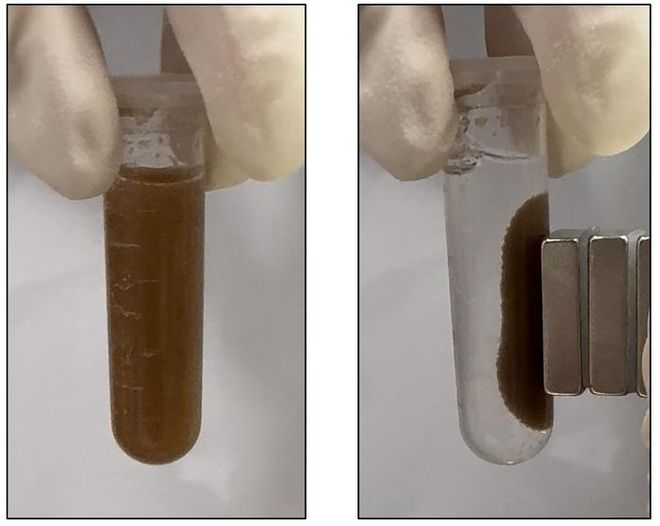
The first step for the research team was engineering heme-sensing bacteria that respond to heme (a component of blood) by producing light. Then, they encapsulated the bacteria using sodium alginate, a thickening agent that forms a protective hydrogel. This shield helps the bacteria survive digestive fluids without interfering with their ability to detect heme. The researchers also added magnetic particles to the microspheres so the sensors could be easily retrieved from stool samples.

Microspheres that sense gastrointestinal disease are suspended in solution (left), then attracted to the side of a test tube by a magnet (right) so researchers can easily retrieve them from biological samples.

Microspheres that sense gastrointestinal disease are suspended in solution (left), then attracted to the side of a test tube by a magnet (right) so researchers can easily retrieve them from biological samples.

(Image Credit: Adapted from ACS Sensors 2025, DOI 10.1021/acssensors.5c01813)

To test the novel system, the team administered the bacterial sensors to mice showing different stages of colon inflammation (colitis). After the pill traveled through the gut and was excreted, it took only about 25 minutes to retrieve the microspheres from feces and measure their glowing signal, a huge improvement over the several hours it would take without encapsulation.

The results were striking: the light intensity increased in line with disease severity. In other words, the stronger the glow, the more blood was present, and the more advanced the colitis. Healthy mice showed no adverse effects, suggesting the microspheres were safe and well-tolerated.

Bacteria Could Support Diagnosis, Treatment, and Monitoring

Based on these early observations, the researchers believe the technology could be expanded to detect additional biomarkers and eventually diagnose a range of gut diseases.

“This technology provides a new paradigm for rapid and non-invasive detection of gastrointestinal diseases,” said the study’s co-author Ying Zhou from East China University of Science and Technology, Shanghai, in a press statement.

Human trials will be the next essential step, but the initial findings are promising. Beyond early diagnosis, the system could one day help guide treatment and track disease progression with a tool that’s fast, noninvasive, and unexpectedly powered by glowing bacteria.

This article is not offering medical advice and should be used for informational purposes only.


Read More: Electricity-Conducting Bacteria Could Help Advance Environmental Cleanup


Article Sources

Our writers at Discovermagazine.com use peer-reviewed studies and high-quality sources for our articles, and our editors review for scientific accuracy and editorial standards. Review the sources used below for this article:

via Discover Main Feed https://ift.tt/tWdwiIM

November 19, 2025 at 07:24PM