Zozofit’s capture suit takes the guesswork out of body measuring

https://www.engadget.com/zozofits-capture-suit-takes-the-guesswork-out-of-body-measuring-140006295.html?src=rss

I’ve developed an odd fascination with body-measuring technology, especially as it relates to the fashion world. Many companies are working on infrastructure that will hopefully one day let us buy clothes custom-tailored for the exact contours of our bodies. That should make people like me, who feel very under-served by the traditional fashion industry, a lot happier. It should also help to reduce the waste generated by the overproduction of clothes nobody wants to buy, which is a problem both for businesses and the planet. So, when Zozofit, makers of the Zozosuit, asked if I wanted to try its skin-tight body-measuring outfit, which has now been repurposed as a fitness tool, I agreed, albeit with my usual degree of trepidation.

The Zozosuit isn’t new, but its makers are using this year as a form of soft relaunch, with a new focus on breaking into the US. It was actually set up back in 2018 by Japanese high-end fashion retailer Zozo as a way of launching a custom-clothing line. Users bought the suit, scanned their bodies and then could order clothes that, on paper, were tailored to better suit their bodies. And while the clothes weren’t custom-made, the idea was that the outfits would be a better fit for them than the usual mass-produced stuff. But that idea, great in theory, didn’t necessarily shake out that well in practice.

Fashion Network said that the cost and complexity involved in launching the suit ate away at the company’s otherwise healthy profits. QZ reported that while people bought the suits, which were sold at a deep discount, few went on to purchase the custom threads as Zozo had planned. It got worse, as many reporters who tested the system found the clothes they had ordered, like Gizmodo’s Ryan F. Mandelbaum and the Economist’s Charlie Wells, didn’t actually fit. A better suit with higher-resolution dots for imaging was developed, but the project was subsequently put on ice.

Since then, Zozo has tried to open up its technology to third parties, but has now pivoted the technology toward something more fitness-focused. Since it already had the tech to make a body-measuring suit, it might as well be put to good use, or so the thinking goes. A number of health and fitness professionals advocate that, for people looking to get fitter, measure their bodies instead of stepping on the scale. So it makes sense for this to be offered as an elegant alternative to wrestling with a tape measure on a weekly basis.

Buying a Zozosuit is easy enough, just give it your weight in pounds, as well as your height in feet and inches, and cough up $98 plus tax. Not long after, you’ll get a slender package which contains a skinsuit made out of polyester and spandex. It looks very much like a motion capture suit commonly used in the production of visual effects, and functionally does the same job. Coming in two parts, the app will give you guidance on how to wear it, making sure that the waistband is pulled up high and covered by the top. You’ll need to try and keep everything as flat as you can, since visible creases will prevent you from taking an accurate scan.

Picture of two people with different body shapes wearing the Zozofit Zozosuit, used for making quick 3D scans of your body.
Zozofit

As a 5’11”, 231-pound man, I did wonder if Zozo would have a suit large enough to cater for my body shape. The website has images of much more athletically-adept models wearing its clothing and you may be concerned there’s no option for bigger-sized folks. The suit I tried on was tight, as intended, but didn’t feel restrictive, and I don’t think you should be nervous that the company can’t accommodate your needs. Other users in a similar situation have documented a similar experience, including YouTuber The Fabric Ninja, who produced a “Plus-Size Review” in 2020. That said, I don’t think I could pull this off as some form of athleisure fashion statement, for all of the reasons you can probably presume.

Inside the package is a cardboard phone stand, which you’ll need to pop out and fold into place to prop your smartphone onto. The Zozofit uses your handset’s primary camera, and so you’ll need to stand it on a table and then stand six feet or so away from it. Once activated, you’ll get voice guidance talking you through the setup and measurement process, and you’ll be asked to hold your arms slightly away from your body. The coach will then ask you to turn to every position on the clock, taking 12 images as you shuffle around in a circle. Once completed, you’ll be notified that you can pick up your phone and then wait 30 seconds-or-so for the model to process.

And you’ll get a headless 3D-mesh model of your body with various measurements labeled off the sides. These include measurements for your upper arms, chest, waist and hips, upper thigh and your calves. After you’ve pawed at your vital statistics, you’ll be invited to set some fitness goals based on those initial measurements. Interestingly, these are capped, I suspect to keep you picking smaller, more sustainable goals and avoid becoming disappointed. It measured my waist at 46.6-inches, and you can only set the goal at inch-wide increments down to 41.6-inches or up to 51.6-inches. This will change in a later update, but I appreciated the more realistic form of goal-setting it promises.

You’ll also get the app’s rough calculation of your body fat percentage, which it clocked at 35.6 percent. Not long after, I jumped on my smart scale and it registered me as having 31.6 percent, and I suspect, too, the imaging might struggle to be as accurate when you’re dealing with such big figures. I’d wager, too, that body fat percentages might not be so easily calculated by sight alone, and perhaps Zozo could look to remove those measurements which aren’t as reliable. It may also dent the PR braggadocio the company is putting out, claiming that this setup is the “world’s most accurate at-home 3D body scanner.” (It says it has compared its results to several rivals on the market, as well as professional hand-measurements.)

Screenshots of measurements taken of Daniel Cooper inside the Zozofit app showing a 3D-wire mesh of his body with measurements overlaid.
Zozofit / Daniel Cooper

Now, the company says that its body fat measurements use the US Navy Body Fat system, which calculates your body fat based on a series of body measurements. That method was developed to create a quick-and-dirty measurement to determine if someone was fit for service. (In the process of researching this, I learned that personnel describe it as the “rope and choke,” which isn’t relevant, but thought you’d appreciate the slang.) The company’s representatives added, to me, that it has found that curvier bodies are more likely to see less accurate results than thinner ones, and that it is working on its algorithms to improve this situation.

With any health-and-fitness technology, there’s a question of how much you can rely upon the accuracy of its measurements. Few consumer-level devices offer the same level of data quality you can get from a much more expensive clinical tool. Straight after my first scan, I ran a second, to see the sort of variation you can expect from an imaging-based measurement. The margin is fairly small, only a few tenths of an inch difference between each scan, which seems fair to me. I’d say, too, that what matters more with these sorts of tools is the trend and direction of travel, rather than obsessing over the pinpoint accuracy of each individual measurement.

And, to test that, as soon as I’d run my second scan (and changed back into normal clothes), I asked a friend to help measure me with a tailor’s tape. And there was a wider delta than I think some people might expect, especially if they’re in need of millimeter-perfect measurements. For instance, the app measured my chest at 43.4-inches, while the tape clocked it in at 44. My upper arms measured 14.5-inches, compared to 14.2 and 14.3-inches inside the app. With my waist and hips, the app said they were 44.6 and 45.3-inches, respectively, while the tape measure clocked them in at 44.5-inches and 47-inches.

Partially, I think these divergences are because computer imaging, even with help, isn’t going to hit as perfectly as a tape measure. Not to mention that the suit pulls you in a little compared to normal clothes, which are far baggier by comparison. I’m sure, too, that the garb sits less well on a larger body compared to a smaller one, where there are fewer issues with terrain. Maybe I’m grading on a curve, but it’ll depend on what exactly users want to get out of this system.

The other question, and a likely more relevant one, is if squeezing into a Zozosuit is easier and less time-consuming than using a tape measure. It’s nice to have an automated process, and to have that data tracked over time, but nothing the app does could qualify as essential. That’s a fairly neat way to sum this up – if you’re a dedicated gym-goer looking for a more elegant way to monitor your vital statistics, then you may find some value here. I’m not sure how compelling this would be, however, if you’re expecting this to be the sum total of your fitness universe.

This article originally appeared on Engadget at https://ift.tt/WkQu1q2

via Engadget http://www.engadget.com

April 27, 2023 at 09:20AM
OpenAI improves ChatGPT privacy with new data controls

https://www.engadget.com/openai-improves-chatgpt-privacy-with-new-data-controls-174851274.html?src=rss

OpenAI is tightening up ChatGPT’s privacy controls. The company announced today that the AI chatbot’s users can now turn off their chat histories, preventing their input from being used for training data.

The controls, which roll out “starting today,” can be found under ChatGPT user settings under a new section labeled Data Controls. After toggling the switch off for “Chat History & Training,” you’ll no longer see your recent chats in the sidebar.

Even with the history and training turned off, OpenAI says it will still store your chats for 30 days. It does this to prevent abuse, with the company saying it will only review them if it needs to monitor them. After 30 days, the company says it permanently deletes them.

Screenshot of ChatGPT's Chat History & Training toggle. A Settings window shows various controls, including that, export data and delete account.
OpenAI

OpenAI also announced an upcoming ChatGPT Business subscription in addition to its $20 / month ChatGPT Plus plan. The Business variant targets “professionals who need more control over their data as well as enterprises seeking to manage their end users.” The new plan will follow the same data-usage policies as its API, meaning it won’t use your data for training by default. The plan will become available “in the coming months.”

Finally, the startup announced a new export option, letting you email yourself a copy of the data it stores. OpenAI says this will not only allow you to move your data elsewhere, but it can also help users understand what information it keeps.

Earlier this month, three Samsung employees were in the spotlight for leaking sensitive data to the chatbot, including recorded meeting notes. By default, OpenAI uses its customers’ prompts to train its models. The company urges its users not to share sensitive information with the bot, adding that it’s “not able to delete specific prompts from your history.” Given how quickly ChatGPT and other AI writing assistants blew up in recent months, it’s a welcome change for OpenAI to strengthen its privacy transparency and controls.

This article originally appeared on Engadget at https://ift.tt/xviR93p

via Engadget http://www.engadget.com

April 25, 2023 at 01:13PM

This Nigerian EV entrepreneur hopes to go head to head with Tesla

https://www.technologyreview.com/2023/04/21/1071359/mustapha-gajibo-nigeria-electric-vehicle-motorized-tricycles/

Nigerians have become accustomed to long lines for gasoline and wild fluctuations in bus fares. Though the country is Africa’s largest producer of oil, its residents don’t benefit from a steady supply.

Mustapha Gajibo, 30, is doing what he can to alleviate the problem: his startup, Phoenix Renewables Limited, is launching a homegrown electric-­vehicle industry in the northeastern city of Maiduguri. 

Gajibo dropped out of university in his third year to run it. His first project was converting the internal-combustion engines of commonly used vehicles in the city to electric versions. He focused on two types of vehicles that residents often pay to ride: seven-seat minibuses and the motorized tricycles known as kekes.

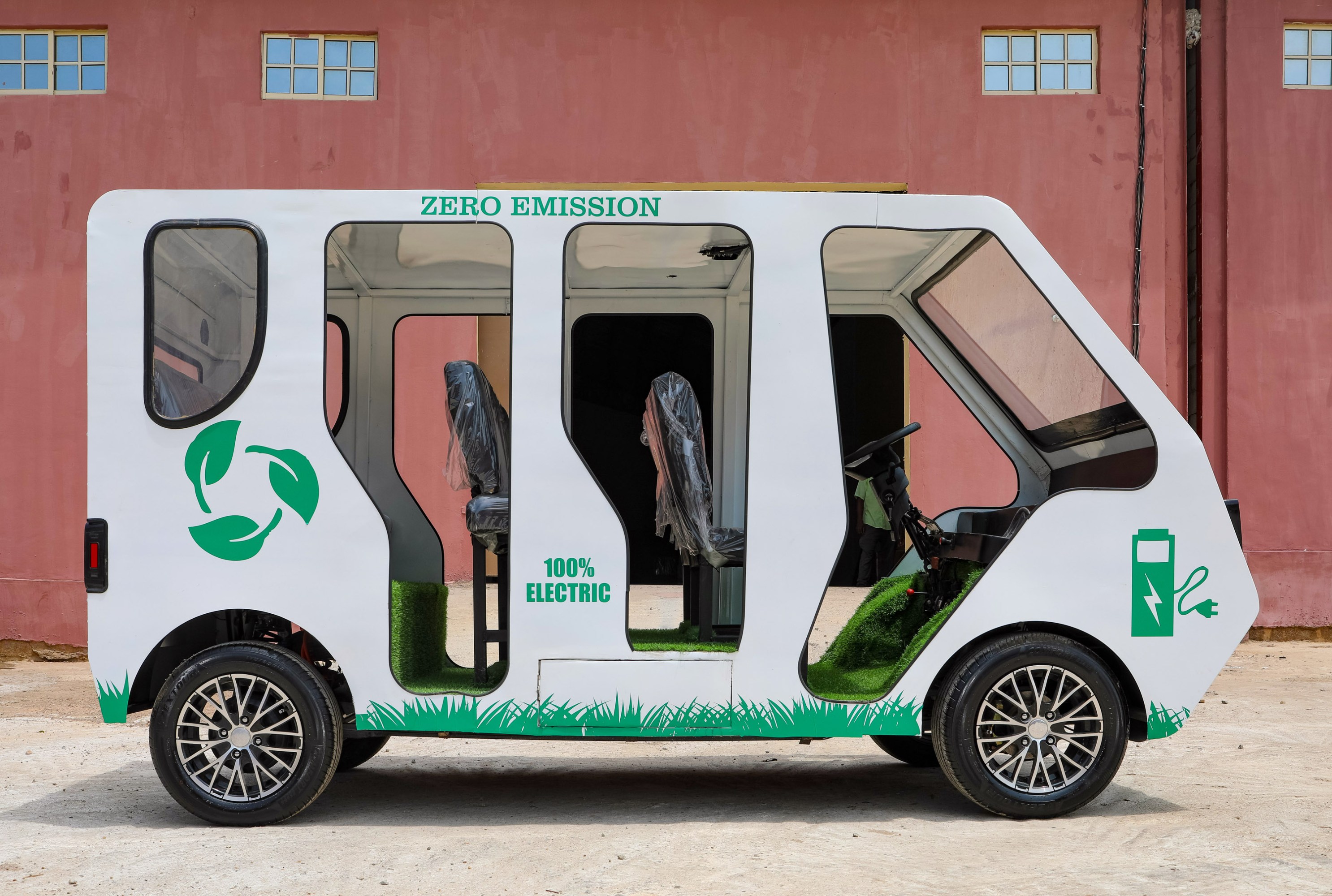
A "zero emission" vehicle with fake grass floor carpeting outside the warehouse of Phoenix Renewables
Phoenix Renewables maintains a fleet of a dozen retrofitted electric
minibuses capable of covering a distance of 150 kilometers on a charge.
FATI ABUBAKAR

He faced skepticism at first: limited power charging infrastructure has constrained the adoption of electric vehicles in the region. “Many people don’t believe that electric mobility is possible and commercially viable in the city of Maiduguri,” Gajibo says. But his electrification scheme has been gaining traction. The company now maintains a fleet of a dozen electric minibuses that can cover a distance of 150 kilometers on a charge and cost about $1.50 to power to full capacity. 

Building the necessary infrastructure is crucial to the success of the project. Gajibo and his cofounder Sadiq Abubakar Issa designed a 60-kilowatt-hour solar-powered charging station in the city and are looking at creating more.

Now, Gajibo has moved on from retrofitting internal-combustion vehicles to building electric vehicles from scratch. 

The first, introduced in 2021, is a 12-seat bus constructed from a number of locally sourced materials. It has a range of 212 kilometers and can be charged in 35 minutes via a solar-powered system integrated into the back. In a recent test run funded by the company, the buses transported 35,000 passengers in Maiduguri in just one month. 

Deborah Maidawa, an electrical building services engineer who lives in Maiduguri, believes Gajibo’s EVs are a good way to meet local needs. “Incorporating solar gives the vehicles an edge over other EVs that are springing up, and I believe they will flood the Nigerian market,” she says.

A brand-new gas-powered passenger minibus with automatic transmission can cost nearly 5 million naira (about $10,000). Gajibo says it will cost around the same to buy one of his solar-powered 12-seaters. He plans to roll out 500 units across eight Nigerian cities in the coming months and hopes this time he’ll be able to sell them. 

“Our products are quite affordable, and the cost of the vehicle is one of the major things we put into consideration,” he says. “The only way to achieve that is by fully designing and building these vehicles locally.”

State and local governments are now taking notice. In early 2022, for example, the governor of Borno State, where Maiduguri is situated, commended Gajibo’s work and awarded him 20 million naira (about $45,000) for research and development, as well as 15,000 square meters of land for a factory. The Nigerian government has expressed interest in having his company build electric patrol vehicles for the police and armed forces.

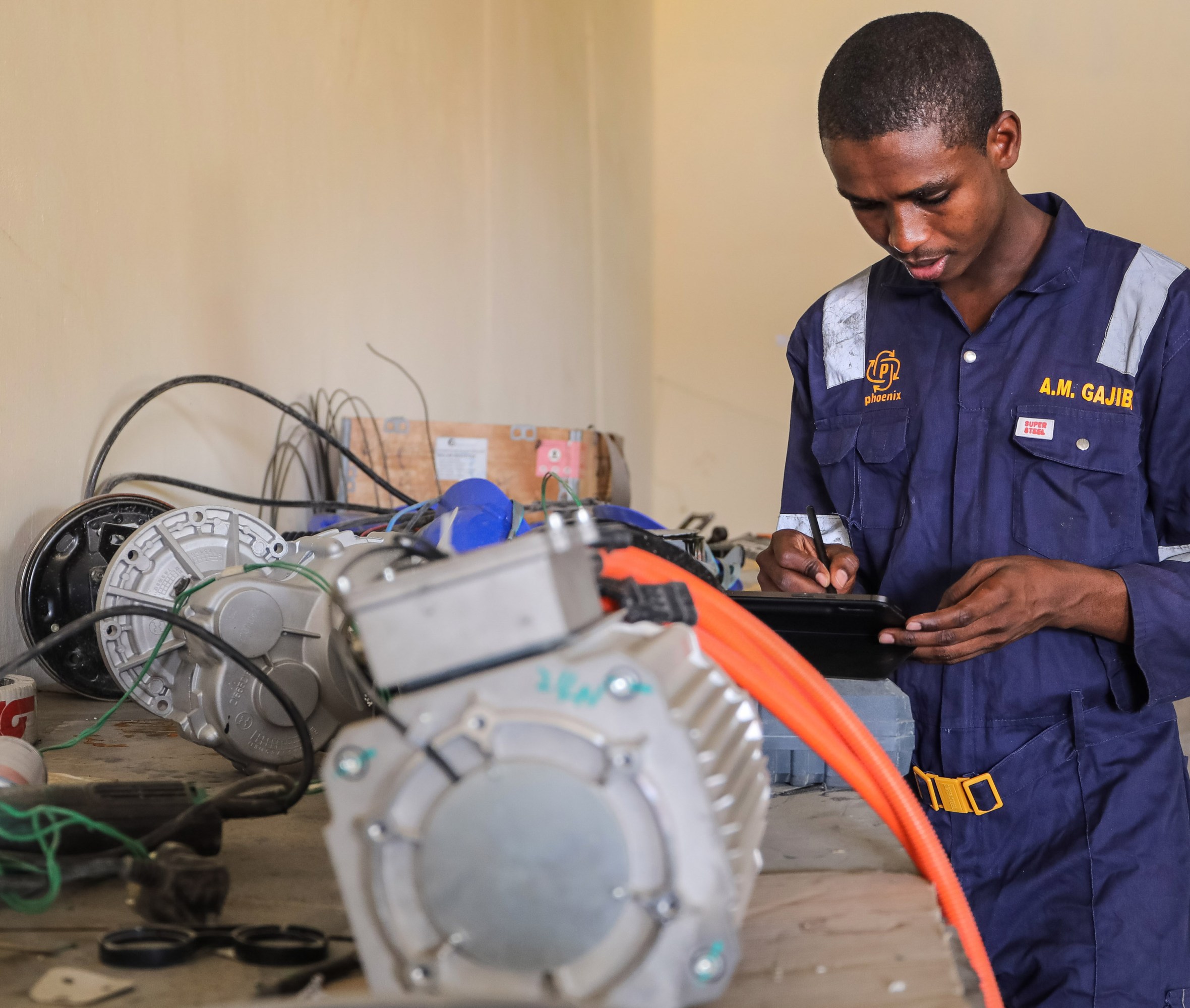
Mustapha Gajibo at a workbench with motor parts in the foreground

FATI ABUBAKAR

Gajibo’s ultimate goal is to compete with Tesla and other bigger brands. “We want to have our vehicles driven in New York, London, Munich, and other big cities across the world,” he says.

Valentine Benjamin is a Nigerian travel journalist and photographer who reports on global health, social justice, politics, and development in Nigeria and sub-Saharan Africa.

via Technology Review Feed – Tech Review Top Stories https://ift.tt/mYi9z3h

April 21, 2023 at 04:30AM

AI Image Generator Is Making Wild And Horrifying Game Controllers

https://kotaku.com/midjourney-ai-art-ps5-nintendo-xbox-controller-1850363530

When it’s not stealing or plagiarizing, generative AI is improving quickly. Images that used to look uncanny now appear more natural and humanly imperfect. But it still struggles with plenty of things. Apparently video game controllers are one of them. Someone asked Midjourney for simple pictures of a person having fun playing video games, and got back some beautiful abominations.

This New Series Completes Studio MAPPA’s Dark Trilogy

A generative AI enthusiast asked the Midjourney community for help this week when a simple prompt returned some nightmares. “Mj has a real tough time with ‘playing video games’ apparently,” they posted on the project’s subreddit. “Any ideas how I could improve this? Prompt: female influencer relaxing playing PlayStation 5 having a blast”

While Midjourney managed to render a human with the right number of fingers, the controllers in her hands and how she was holding them looked like something out of a Cronenberg movie. The gamepads are overflowing with random buttons, triggers, and sticks, and not in a cool way. Microsoft’s adaptiver controller looks sleek. Midjourney’s version hurts just looking at it.

As many commenters suggested, one reason could be the overly broad prompt. While “playing” is intuitive to the average person, it’s vague when compared to what a search for it might reveal. The bigger culprit, though, is probably that there just aren’t many images of the backs of controllers compared to all the front-facing promotional shots companies release to sell them.

In that regard, the failed experiment potentially reinforces one of generative AI’s biggest weaknesses: It’s great at giving you variations on what already exists, but struggles to bridge the gaps in what’s missing. Or it borrows from existing sources in the wrong ways. Some of you might remember the infamous grip meme, and it certainly looks like that’s what Midjourney is recreating in the fourth image. Turns out the fake AI gamer girl is actually an extremely hardcore Armored Core fan.

via Kotaku https://kotaku.com

April 21, 2023 at 03:23PM

SpaceX veterans create startup to power spacecraft with moon water

https://www.space.com/spacex-veterans-water-power-spacecraft-argo-space


Water may power the next generation of spacecraft, if a trio of SpaceX veterans has their way.

Brothers Kirby, Robert and Ryan Carlisle plan to harvest water from the moon and use it to fuel future vehicles. They recently closed a $2 million funding round, led by Type One Ventures, to kickstart water propulsion with their company Argos Space. While still a five-person startup, they have big plans for the near future.

They plan a demonstration flight in Earth orbit in 2024, to start commercial service around 2025 if all goes to plan, and to expand to the moon later in the decade. The moon has ample water ice on its surface that could be harvested for future missions. Where exactly Argos will land on the moon will depend on what water resources future spacecraft confirm, whether it be at the poles or in other locations.

Space.com caught up with the three brothers, who worked in a variety of roles at SpaceX before Argos Space, to learn more about their plans for water-powered spacecraft in Earth orbit and on the moon.

Related: Water on the moon is more common than we thought, studies reveal

Space.com: How did the company get start?

Robert Carlisle, CEO: The three of us have wanted to start a space company together since we were children. But then, specifically, after SpaceX, we wanted to do something that would help really expand humanity’s presence in space, with in-space resources. We also wanted to make sure we were making a commercial business, not just a sort of purely future lunar-focused business. I did commercial sales for a while at SpaceX, and one of the things I saw there was how hard it is for really small satellites to get access to orbits beyond LEO [low Earth orbit.]

A SpaceX Starship at sunrise. The three founders of Argo Space all previously worked at SpaceX in different roles. (Image credit: SpaceX via Twitter)

(opens in new tab)

Space.com: Tell me about your first vehicle.

Robert Carlisle: The Argonaut is what we’re calling our initial transportation vehicle. It’s named after the sailors on the Greek mythical ship, the Argo. It’s a water propellant vehicle and it’s planned on being fully reusable from day one. It offers high delta [high-altitude] orbits, and on-orbit pickup of payloads.

Space.com: How does the water system work?

Ryan Carlisle, chief technology officer: Basically, you take steam, and in this diffuse vapor form you hit it with RF [radiofrequency] energy or other forms of electric fields. It turns the water into a plasma, which is extremely hot. And from there, it works similarly to any other rocket engine. You have a very, very hot gas heated by this electrical energy and it exits the back of the engine at high velocity. The prototype we made was based on years of research. There are a bunch of published papers going back to the 1970s or 1980s on similar styles of plasma propulsion, including with NASA.

Space.com: Why use water as a propellant?

Kirby Carlisle, chief operations officer: Water has a lot of great properties about it. It’s easy to store in space, It can be used efficiently as propellant. It’s of course necessary for human life. It’s super delicious; my favorite thing to drink. And it is serendipitously available in large quantities on the lunar surface, the closest celestial body to Earth, as well as many other places throughout the solar system.

Related: Hidden water source on the moon found locked in glass beads, Chinese probe reveals

This image shows the distribution of surface ice at the moon’s south pole (left) and north pole (right), as detected by NASA’s Moon Mineralogy Mapper instrument, which flew aboard India’s Chandrayaan-1 spacecraft.  (Image credit: NASA)

(opens in new tab)

Space.com: Before you go to the moon, what do you want to do first?

Kirby Carlisle: Our initial target market is this niche of high-energy orbits for small satellites, which is not really well served right now, even with other vehicles and solutions that people call tugs. So our vehicle can actually pick something up in LEO, and then take it out to geostationary [orbit] or cislunar space.

Space.com: So if I’m understanding you correctly, what you’re saying is that you’re going to be launching your tug to a convenient orbit, and then as spacecraft come by, you can snag them and then go up to another orbit, and down again. How would you be refueling them?

Robert Carlisle:  We plan to launch water tanks, initially from Earth, and have them in that same base orbit waiting to meet with the Argonaut after it finishes a mission. Imagine the SpaceX Transporter launches, the big rideshare launches [for satellites]. We would launch an Argonaut and water tank on one of those. 

We don’t want to put too much detail yet into how we’ll catch the satellites, but the key thing is we’re trying to do it without requiring the customer to put any additional hardware on their spacecraft. Our demonstration flight won’t go quite that high, however. We’ll demonstrate the propulsion system and we’ll do some level of of the RPO — the rendezvous and proximity operations — with the payload.

Related: Low Earth orbit: Definition, theory and facts

Artists’ depictions of lunar lander designs from commercial companies Astrobotic, Intuitive Machines and Orbit Beyond. Argo Space plans to partner with lunar companies like these to bring water extraction technology to the surface. (Image credit: Astrobotic; Intuitive Machines; Orbit Beyond)

(opens in new tab)

Space.com: What’s the plan for your lunar operations?

Kirby Carlisle: Commercial access to the moon and use of limited resources. We’ve always had a bit of a chicken and egg problem: for companies to plan on using whatever resources, someone needs to be producing those resources. But for someone to produce the resources, there needs to be a clear demand. So at Argos, we are creating that demand by turning these resources into transportation, using lunar water as propellant. 

Robert Carlisle: We want to start generating revenue with the [Earth] orbital service. But in parallel, we’re working towards this water extraction. In the late 2020s, we want to be actually using water we harvest from the lunar surface. Then we want to scale up to a larger vehicle, sort of like a 10,000 kilogram [22,000 pounds] payload class. Think of something that could pick up a SpaceX Starship sort of payload in LEO, and then take it out to lunar orbit or to geo[synchronous].

We do intend to partner with lunar lander companies. If we can just build up the harvesting and the extraction technology and put it on someone else’s lunar transport systems, that’s fine for us. We’ll take care of the LEO to lunar orbit part, and back to Earth.

This interview has been edited and condensed.

Elizabeth Howell is the co-author of “Why Am I Taller (opens in new tab)?” (ECW Press, 2022; with Canadian astronaut Dave Williams), a book about space medicine. Follow her on Twitter @howellspace (opens in new tab). Follow us on Twitter @Spacedotcom (opens in new tab) or Facebook (opens in new tab).

via Space https://ift.tt/pD69YEk

April 20, 2023 at 03:13PM

Google Plans to Use Generative AI to Pump Out ‘Remixed’ Ads

https://gizmodo.com/google-plans-to-use-generative-ai-for-remixed-ads-1850356632


Google has found yet another place it can cram in generative AI. The company is bringing artificial intelligence into its marketing business, adding the tech to the services and content it offers to advertisers, according to a report from the Financial Times. “Generative AI is unlocking a world of creativity,” the company wrote in a presentation to advertisers titled “AI-powered ads 2023.”

Google’s Antitrust Case Is the Best Thing That Ever Happened to AI

In the burgeoning age of AI, Google will start generating ads on its platforms using the same sort of large language model tech that powers its Bard chatbot and has already been integrated into aspects of Gmail and Google Workspace. What this means in practice is that ads you see on search pages, YouTube, Maps, Gmail, and other Alphabet-owned platforms going forward may not have been created by a human.

Instead, Google’s clients can supply “creative” chunks of disparate content like images, video clips, and written copy for an ad campaign. Google’s AI will then “remix” what it’s given to produce algorithmically advertisements, the internal presentation reportedly explained, presumably to maximize ad efficacy and reach.

The new generative AI offering will be incorporated into Performance Max, according to FT, which uses a rather opaque system of programmed automation to dictate where/when/how ads appear. Already this set of Performance Max algorithms was capable of spitting out basic ad copy. Now, with the addition of Google’s newest AI, that capacity will likely be much greater.

But these ads are undoubtedly set to come with the same problems as other AI-generated content, namely: inaccuracies and manipulative untruths. AI loves to lie, or “hallucinate” as tech companies and researchers have branded it. One anonymous source expressed concerns about misinformation sneaking its way into advertisements with the new AI push. “It is optimized to convert new customers and has no idea what the truth is,” the unnamed person told FT .

Gizmodo reached out to Google with questions about its AI advertisements, and filters or protections to limit the spread of false info. The company did not respond as of publication time. However, Google told FT it has plans and safeties in place to prevent misinformation.

Google isn’t the first company to bring generative AI into its marketing business. Earlier this month, Meta announced similar plans to integrate AI into its advertising by the end of 2023. And previously, smaller companies have used generative AI tools like DALLE-2 and ChatGPT to produce ad campaigns.

via Gizmodo https://gizmodo.com

April 20, 2023 at 10:50AM

SpaceX’s Starship Rocket Finally Flies—but Blows Up Minutes Later

https://gizmodo.com/spacex-starship-rocket-explodes-first-launch-1850356794


A still from SpaceX’s livestream of the debut launch
Screenshot: Gizmodo

It finally happened—and it was as spectacular as we hoped. SpaceX’s Starship megarocket blasted off from the Boca Chica, Texas, launch pad just after 9:30 a.m. ET this morning, lifted upwards by a record-breaking 16.5 million pounds of thrust.

Astronomers Could Soon Get Warnings When SpaceX Satellites Threaten Their View

The rocket managed to survive MaxQ, the moment when a rocket experiences the greatest aerodynamic pressure, and continued upwards toward space. Things turned sour shortly before the four-minute mark, however, when the rocket began to exhibit erratic flight behavior. The rocket blew up, presumably the result of a self-destruct command issued by SpaceX ground control.

Still, it’s an amazing result. SpaceX was simply hoping to see the rocket leave the Boca Chica launch tower, so everything that happened afterwards would be considered a bonus.

This article is part of a developing story. Our writers and editors will be updating this page as new information is available. Please check back again in a few minutes to see the latest updates. Meanwhile, if you want more news coverage, check out our tech, science, or io9 front pages. And you can always see the most recent Gizmodo news stories at gizmodo.com/latest.

via Gizmodo https://gizmodo.com

April 20, 2023 at 09:02AM