
Rocket Lab launches US Space Force mission with less than 17 hours’ notice — a new record

https://www.space.com/space-exploration/launches-spacecraft/rocket-lab-launches-us-space-force-mission-with-less-than-17-hours-notice-a-new-record

Rocket Lab has successfully launched the second spacecraft for the U.S. Space Force’s Victus Haze Tactically Responsive Space (TacRS) mission, setting a new readiness record in the process.

Only 16 hours and 42 minutes passed between Rocket Lab receiving the Notice To Launch from the Space Force’s Space Safari Program Office and liftoff of the company’s Electron launch vehicle, beating the previous TacRS record set by Firefly Aerospace on the September 2023 Victus Nox mission by more than 10 hours.

Liftoff occurred on Friday (June 19) at 6:19 a.m. EDT (1019 GMT, 10:19 p.m., local time), from Rocket Lab’s Launch Complex-1, in New Zealand, beginning a rapid-response demonstration designed to simulate a real-world orbital threat scenario.
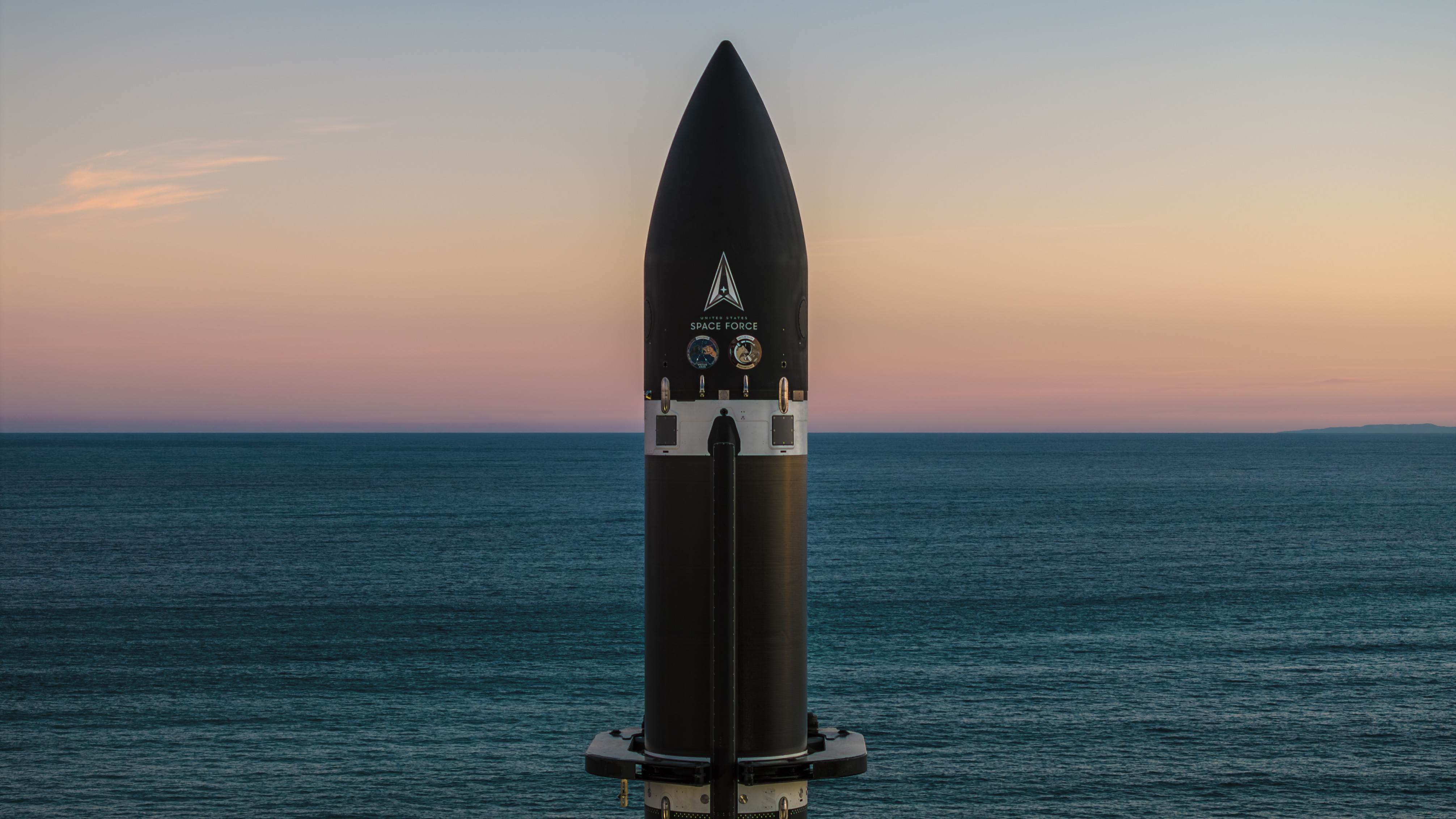
The top of a black rocket stands against a background of rich sea parted in the center by the horizon, and a cool, orange-hued sky.

Rocket Lab’s Electron rocket launched on Friday (June 19) at 6:19 a.m. EDT (1019 GMT, 10:19 p.m., local time), from Rocket Lab’s Launch Complex-1, in New Zealand. (Image credit: Rocket Lab)

Electron delivered a Rocket Lab-built Pioneer spacecraft to low Earth orbit (LEO), where it has begun pursuit of another Victus Haze spacecraft that was launched by SpaceX in May and serves as the target vehicle for the demonstration — True Anomaly’s Jackal satellite. According to a June 22 Rocket Lab statement, "[Pioneer] is now fully commissioned and conducting complex orbital maneuvers to chase down another spacecraft on orbit and conduct Rendezvous and Proximity Operations (RPO)."

Victus Haze is a TacRS mission managed by Space Systems Command’s Space Safari Program Office, with the objective of demonstrating the rapid acquisition, launch and operation of spacecraft in response to orbital threats and "non-compliant satellites," the Rocket Lab release said.

"Rendezvous and Proximity Operations on such short timelines are certainly not trivial, especially in a crisis or conflict scenario, but this demonstration of our ability to commission a complex and capable space vehicle within less than 72 hours, and immediately begin an RPO scenario thereafter, shows that we can field capability to deny adversaries first-mover advantage into novel orbits,” said Lt. Col. Lincoln Miller, Space Safari system program manager, in the statement.

Rocket Lab and True Anomaly teams are now managing their respective spacecraft in orbit. They will soon enter the RPO phase of Victus Haze, conducting space domain awareness (SDA) threat-response scenarios and "dynamic engagements with the other," according to a separate statement from the U.S. Space Force (USSF).

Space Force officials have increasingly looked to commercial providers to develop new capabilities and technologies to address potential conflicts in space. “Victus Haze is primed to further demonstrate our readiness to lean on our commercial partners to deny, disrupt, and counter any adversarial advantage — no matter where they try to operate in space,” acting Space Force portfolio acquisition executive Col. Bryon McClain said in the USSF statement.

With its Electron rocket and Pioneer spacecraft both vertically integrated into Rocket Lab’s manufacturing processes, this Victus Haze launch marks the first TacRS mission to be carried out by a single prime contractor, providing the spacecraft, launch vehicle and on-orbit operations.

"This is what modern space power looks like: the ability to reinforce and reimagine national security space architecture at will," said Rocket Lab CEO Peter Beck. "We’re proud to be providing the nation with those next-generation space capabilities, today.”

via Latest from Space.com https://ift.tt/5URm7TS

June 23, 2026 at 01:06PM

Valve Says The Companies Making RAM Give Them A Price And If They Say No, They ‘Never Talk To Us Again’

https://kotaku.com/valve-says-the-companies-making-ram-give-them-a-price-and-if-they-say-no-they-never-talk-to-us-again-2000709575

In a recent interview, Valve says that when buying PC memory from the few big companies that produce the stuff globally, it basically has no choice but to take the price offered each month because to try to negotiate would likely lead to the DRAM makers cutting them off completely.

Valve’s Steam Machine is in the process of launching. But while the mini-PC running SteamOS seems like a cool evolution of the Steam Deck idea, the $1,000+ price tag is hard for many to swallow. A big reason why Valve has to charge $1,050 for the base version of the Steam Machine is that the small collection of companies that produce DRAM, which is an important part of most computers, phones, and consoles, are greatly limiting what folks who aren’t affiliated with AI hyperscalers can even purchase and are changing prices monthly. Valve can’t even get a contract with any of the DRAM makers, the company claimed during a recent interview with Gamers Nexus.

“Look, there’s no contracts,” said a Valve employee. “There’s nothing. Like, those guys…they are…they give us a price every month or something and they say ‘You can buy that many’ and it’s yes or no. And if we say no, then they never talk to us again.”

Because of the limited supply and pricing options, some Steam Machines will ship with one stick of 16GB RAM while others will ship with two sticks of 8GB RAM, which isn’t ideal, though Valve explained that in their testing, it didn’t cause any noticeable differences in performance.

This situation, which some online suggest sounds a lot like an organized crime ring extorting victims, makes it hard for Valve and other tech companies to build up stock or accurately budget months or even years in advance. But DRAM makers like Micron and Samsung seemingly don’t care, because all of these companies have become laser-focused on producing and providing PC memory to AI hyperscalers and datacenters, as those clients are buying massive amounts, months in advance, and that’s just a much more profitable business plan. Some of the DRAM makers are just straight-up done making consumer memory products entirely.

Keep in mind, many of these same DRAM makers were once caught up in one of the largest illegal business cartels ever discovered by the U.S. government over 25 years ago. Just a fun fact to store in your brain.

As pointed out by Gamers Nexus, even a company like Gskill, which is focused almost entirely on making RAM for consumers, is struggling to buy the parts it needs because it’s not a big enough player in the space anymore compared to OpenAI. So it’s not shocking that Valve can’t negotiate for better rates or more DRAM.

And this situation shows no signs of getting better as companies continue to invest heavily in AI and datacenters. So be prepared to pay more and more for computers and consoles for the foreseeable future. And don’t count on DRAM makers in China saving us all from this horrible situation.

via Kotaku https://kotaku.com/

June 23, 2026 at 01:30PM

Polymarket Allegedly Faked Videos Of People Winning Up To $100,000 Because Everything Is Now Fraud Or Gambling And Sometimes Both

https://kotaku.com/polymarket-videos-fake-bets-winners-creators-2000709467

Polymarket, the crypto-fueled prediction market that lets users bet on everything from Hollow Knight: Silksong’s chances of winning Game of the Year to Iran’s chances of getting nuked by the United States, has been paying “mostly college-age creators” to create fake videos of themselves winning huge, six-figure sums on the platform and artificially making said videos go viral by using a “social-media army” to advertise them, according to a new report.

As detailed in the Wall Street Journal’s report, more than 1,100 fake videos, alongside “instructional materials and interviews with creators” who have worked with Polymarket, were reviewed during its investigation.

The videos featuring creators winning massive sums on ridiculous bets were reportedly fabricated using a dummy version of Polymarket’s website, allowing the platform to fake the winnings without having to actually pay out any money. WSJ also notes that the creators Polymarket used to promote said fake bets on platforms such as X updated their bios on social media to include the phrase “@polymarket partner” after being contacted by its journalists.

According to the report, 118 of the faked videos reviewed featured creators winning. The combined winnings faked by said creators totaled almost $900,000. WSJ notes that those who legitimately bet on the same outcomes as the ones featured in Polymarket’s videos would have actually been denied their winnings, and that real-world bets on the outcomes featured in the 118 videos would have resulted not in massive winnings but in losses of “more than $166,000.” (One such video showed a creator winning $100,000 on a bet that President Trump would say the word “McDonald’s” in public that month.) Creators of the faked videos were apparently paid somewhere around “$2,000 to $3,000 a month” for their work.

In a statement provided to Ars Technica, Polymarket did not address the Wall Street Journal’s findings, but stated it was conducting a “comprehensive audit” of its promotional material: “We are part of a rapidly growing industry and are constantly evaluating ways to improve how we’re engaging and earning the trust of our audience. As part of that commitment, we are conducting a comprehensive audit of active promotional content to ensure it complies with our standards, as well as applicable regulatory and legal disclosure requirements.”

via Kotaku https://kotaku.com/

June 23, 2026 at 09:22AM

China unveils man-portable anti-drone laser that can burn through a drone 1,600 feet away in four seconds — backpack-sized 2-kilowatt weapon uses AI for targeting, weighs 55 pounds, and can be carried by a single soldier

https://www.tomshardware.com/tech-industry/china-shows-off-a-backpack-sized-anti-drone-laser-that-one-soldier-can-carry

Chinese defense supplier Harbin Xinguang Optic-Electronics Technology demo’d two man-portable anti-drone lasers at a Beijing arms expo this week, putting backpack-scale directed-energy hardware alongside the mounted platforms that have so far dominated the space. The Lijian II and Lijian III, shown at the Defence Information Equipment & Technology Exhibition 2026 that opened Tuesday, weigh 30kg (66 pounds) and 25kg (55 pounds), draw around 2 kW, and cost about 2 million yuan (US$295,000) each, according to the South China Morning Post. It also uses AI for targeting.

Each portable unit splits into a laser emitter, an air cooler, and a handheld control terminal, light enough for one or two soldiers to carry. The emitter accounts for about 15kg, and the cooling system for roughly 10kg. Both models have a pitch angle above 90 degrees and reach about 500 meters (1,640 feet). The Lijian III burns through a drone in 4 seconds and needs under 5 seconds to cool before firing again, the company said.

The same line includes a fixed-position model, the Lijian-10G, that draws around 10 kW and reaches 1,200 meters (3,900 feet), but requires a large liquid-cooled box rather than a backpack. Harbin Xinguang said the portable units are "easier to operate and can be quickly deployed and recovered," in comments from a product promoter as reported by SCMP.

Those weight savings, of course, come out of the overall power budget of the laser. At roughly 2 kW, the portable Lijian models sit below the 3 kW-class NI-L3K counter-drone lasers that China showed at DSA 21026 in Malaysia, and far below the heavier directed-energy systems built elsewhere. The U.S. Army is currently testing a vehicle-mounted 20kW LOCUST system on the Oshkosh JLTV platform, and Israel’s 100kW Iron Beam became the first high-power laser to enter service late last year. Obviously, those trade portability for the wattage needed to engage longer-range targets.

A 2 kW suits small, low, and slow targets at close range, with a much more favorable cost per shot. Burning down a quadcopter or FPV drone using a laser consumes energy rather than shoulder-fired munitions, which can cost tens of thousands of dollars per round. Zhao said the core technology reached maturity in 2023, as the war in Ukraine reshaped thinking around drone warfare.

Rather troubling is the fact that the Lijian series uses AI to identify targets and engage drones that enter its range, cued by external sensors such as radar. Harbin Xinguang said the weapons have already been placed at some Chinese facilities, including military airfields, and that it’s seeking further orders through the exhibition.

All the specifications come from the manufacturer’s exhibition materials and a company representative and haven’t been independently tested.

via Tom’s Hardware https://ift.tt/YERPxaV

June 20, 2026 at 05:33AM

The Rise and Fall of Humanity’s Favorite Languages, Animated Across 4,500 Years

https://www.geeksaresexy.net/2026/06/23/the-rise-and-fall-of-humanitys-favorite-languages-animated-across-4500-years/

What language would you have been speaking 4,500 years ago? Ancient Egyptian? Sumerian? Old Chinese? And when exactly did English become the global heavyweight we know today?

This animated graph from Data Is Beautiful takes viewers on a journey from 2500 BC to 2026, tracking the world’s most spoken languages across more than four millennia of human history.

The project reconstructs the evolution of global languages by estimating the total number of speakers over time, combining both native speakers and fluent second-language speakers. That distinction is important because it helps explain why languages such as Aramaic, Latin, and English became so dominant. They were not always the languages people were born speaking, but they became the languages people needed to know for trade, government, religion, education, and international communication.

At the beginning of the timeline, Old and Middle Chinese dominate with an estimated two million speakers, followed closely by Ancient Egyptian and several languages that have long since vanished from everyday life. By 1 AD, the world looks dramatically different. Latin, Aramaic, Greek, Sanskrit, and Persian have surged as powerful empires spread their influence across vast regions. Watching the chart evolve feels like watching a condensed version of human history, with every rise and fall representing migrations, conquests, cultural exchanges, and demographic booms.

As the centuries pass, familiar modern languages begin climbing the ranks. Arabic expands alongside the great Islamic Caliphates. Mandarin grows with China’s population. Spanish and Portuguese spread across continents. English eventually emerges as the world’s dominant language, not because it has the most native speakers, but because hundreds of millions of people learn it as a second language. In the final 2026 snapshot, English sits comfortably at the top with more than 1.6 billion total speakers, ahead of Mandarin Chinese, Hindustani, Spanish, and Arabic.

The methodology behind the project is surprisingly thorough. Speaker populations for extinct languages such as Sumerian, Akkadian, and Latin were reconstructed using historical demographic sources, including the Maddison Project Database and Colin McEvedy’s Atlas of World Population History. The growth of languages such as Arabic, Mandarin, and Hindustani was estimated using historical population databases and sociolinguistic research. Modern language totals were mapped using sources including Ethnologue, the CIA World Factbook, regional census data, and UN population models.

One of the most entertaining aspects of the animation is seeing linguistic empires rise and fall.. Ancient Egyptian enjoys a spectacular multi-millennia run before disappearing entirely. Latin climbs to greatness, only to fragment into the Romance languages. Aramaic spends centuries as the language of commerce and administration before fading from the spotlight. Meanwhile, English shows up relatively late to the party and somehow ends up owning the venue.

More than anything, this animation is a reminder that languages are living things. They grow, spread, evolve, split apart, and sometimes disappear entirely. Behind every surge on the chart lies a story of migration, trade, conquest, innovation, and human connection.

Enjoying the content? Please consider supporting Geeks are Sexy!

Click This Link for the Full Post > The Rise and Fall of Humanity’s Favorite Languages, Animated Across 4,500 Years

via [Geeks Are Sexy] Technology News https://ift.tt/R1KQXoY

June 23, 2026 at 07:21AM

Retro pirate gets two-year suspended jail sentence for being stuck in the past, burning and selling remix CDs of famous artists — four-year investigation into copyright infringement on 40-year-old medium began in 2018

https://www.tomshardware.com/pc-components/storage/retro-pirate-gets-two-year-suspended-jail-sentence-for-being-stuck-in-the-past-burning-and-selling-remix-cds-of-famous-artists-four-year-investigation-into-copyright-infringement-on-40-year-old-medium-began-in-2018

A UK man has been sentenced after pleading guilty to the unauthorized mixing and selling of music CDs, and thus breaking copyright laws. It is 2026.

via Tom’s Hardware https://ift.tt/Cei1cPb

June 18, 2026 at 07:44AM

Geoengineering still faces major practical challenges

https://www.technologyreview.com/2026/06/18/1139227/geoengineering-engineering-challenges/

Solar geoengineering is often portrayed as a sort of emergency brake. Something along the lines of Pull in case of climate emergency to scatter light-reflecting particles to bounce sunlight out of the atmosphere and cool the planet.

But it might be less like a simple brake and more like a complicated, entirely unsolved puzzle.

Some researchers are starting to look into how nations or companies would go about trying to cool the planet—and there’s a lot to figure out. My colleague James Temple dug into these engineering challenges in his latest feature story. My biggest takeaway? This all might be a lot harder than I thought.

I’ll admit, I’ve always thought of geoengineering as a relatively low-tech solution. That’s partly because over the years we’ve seen some companies do their own low-cost guerrilla “experiments,” tossing balloons up into the atmosphere and claiming to have made some small dent in climate change.

But to actually actively cool the planet in a significant way, and to make sure we understand exactly what effect we’re having, there’s a lot that researchers still need to learn. 

First, there’s the problem of getting up into the atmosphere. Generally, the target for solar geoengineering efforts is the stratosphere, since the air there is drier and more stable, so particles deposited there would stay aloft and move around the planet, lowering temperatures over a wider area and for a longer time.

You can release the particles in balloons, but balloons may not go where you want them to. And at a large scale, you’d be leaving a lot of litter all over the planet. That leaves aircraft, but conventional planes aren’t suited to fly around in the stratosphere. (Commercial aircraft generally fly at around 12 kilometers above the Earth’s surface, while geoengineering would require reaching roughly 20 kilometers.) The air is thinner higher up, so aircraft with massive wings would probably fare better than more conventional designs.

One design, from a startup called Iris Aero, shows just how much rethinking of our current flight technologies might be needed—the plane is almost unsettling in its proportions. Its wings are so long, on a stubby little body. It reminds me of a water strider, those bugs that have super-long legs to scurry around on a pond’s surface.

And that’s just the beginning. There’s also the question of what, exactly, would be best to scatter up in the stratosphere. The idea behind geoengineering comes from volcanoes—after an eruption, sulfuric acid ends up floating around in the atmosphere, and it can temporarily cool the planet. But that chemical is sticky and would be heavy to carry, so scattering some sort of precursor to sulfuric acid would probably be better. Researchers, including some at the University of Chicago, one of the leading institutions in this field, are working to figure out the best formula. 

I’m struck by how complicated this turns out to be, and I’m also left with a big question: As research turns from modeling and simulations to the practical aspects of this incredibly controversial technology, what does it mean to be doing this work?

There are major concerns about what effects might come from large-scale attempts to cool the planet. The effects could be positive for some parts of the globe and negative for others. Established weather patterns, like the monsoon season in South Asia, could shift. There are major questions about what the governance for the use of geoengineering should look like, and who gets to decide whether to go ahead. 

Experts who champion research in geoengineering often draw a line between a desire to support learning more about the technology and a call to deploy it. Many would argue that we should understand it better, so we can make informed decisions.

But to me, there’s a clear difference between atmospheric modeling and detailed engineering work on an aircraft. If there’s public research that essentially amounts to a set of practical instructions, I can’t help but feel like it could enable any number of individual actors or nations to take geoengineering into their own hands. It also might normalize the idea of using the technology. 

Some experts shared concerns along these lines with James, arguing that the shift to practical engineering work requires more oversight. Some called research in this area dangerous.

One alternative perspective I found interesting came from Shuchi Talati, executive director of the nonprofit Alliance for Just Deliberation on Solar Geoengineering.

Rather than further practical research making a slippery slope slipperier, it could have the opposite effect, she told James. “The actual practice of R&D will be a sticky slope, because there will be more real-world problems that come up that we haven’t even thought of yet,” she says. Engineering research could challenge the “idealized notions” of how easy the technology would actually be, she adds.

It’s hard to argue against better understanding potential tools to address climate change. But if we draw a map towards a potential future, it might become difficult to control who follows it. 

This article is from The Spark, MIT Technology Review’s weekly climate newsletter. To receive it in your inbox every Wednesday, sign up here

via Technology Review Feed – Tech Review Top Stories https://ift.tt/PQrH5Xm

June 18, 2026 at 05:24AM