From Engadget: NVIDIA scores $12.4 million contract from the DOE to help FastForward exascale computing

Image

Sick and tired of waiting around for some exascale computing? So’s the Department of Energy. The agency has offered up a $12.4 million contract to NVIDIA as part of its FastForward program, an attempt help speed up exascale development. The chipmaker will be using the two-year contract to help develop architecture for an exascale computer that operates at a “reasonable power level,” in order to “advance the frontiers of science.” Possible implications for exascale computing include the study of climate change, development of efficient engines, the search for disease cures, according to NVIDIA — not to mention “reasons of national security and economic competitiveness.”


from Engadget

From Engadget: XBMC for Android app revealed; source code available now, beta APKs soon

Surprise surprise, after popping up on the iPad last year, XBMC developers revealed tonight that they’ve created a version of the media center that runs as an Android app. Currently the team has it stable on the Pivos XIOS DS set-top box, and posted a video (embedded after the break) showing it running on a phone and a tablet. Of course, the different varieties of Android hardware audio and video decoding is mostly a software only affair, but universal hardware decoding is in the plan. The truly dedicated can dig up the source code right now, but APKs for beta testers are promised “in the coming weeks.” According to the blog post, it currently includes a community member created touch oriented skin and hopes to have more available before any version of this hits Google Play officially.

[Thanks, Bharath]


from Engadget

From Autoblog: Official: Aspid unveils menacing new GT-21 Invictus hammerhead

Filed under: , , , ,

Aspid GT-21 Invictus

Aspid has finally gotten around to revealing the production version of the GT-21 Invictus. This funky-looking sports car delivers 450 horsepower to the rear wheels thanks to a BMW-sourced 4.4-liter V8 engine paired with a seven-speed dual-clutch gearbox or six-speed manual. That’s a far cry from the supercharged 2.0-liter four-cylinder found in the Spanish company’s first offering. Aspid says the GT-21 Invictus can lay waste to 60 mph from a standstill in under three seconds on its way to a top speed of 189 mph. Even better, the creation’s suspension can serve up 1.6 g on the skidpad.

The company has managed to keep weight to a mere 2,182 pounds thanks to composite body panels and a spaceframe chassis. Interestingly enough, the GT-21 Invictus is also available with a slew of on-road safety equipment, including adaptive airbags, stability control and anti-lock brakes.

Inside, there’s a 2+2 seating configuration, which suggests there’s actually room for two adults and their luggage for a weekend trip. Aspid is currently aiming to start building its newest model in 2014, but there’s no word on pricing yet. Scroll downto watch a dramatic – dare we say Batman-esque – official video below.


from Autoblog

From Engadget: Researchers use off-the-shelf parts to let you write emails with your eyes

Researchers use offtheshelf parts to let you write emails with your eye movements, play Pong

There’s a lot of research to help the spinal cord or stroke-injured become more self-sufficient, but it often takes some exotic paraphernalia. To buck that trend, scientists from Imperial College London showed that subjects could perform relatively hard tasks like writing messages and playing Pong using eye movement — with a mere $35-worth of parts. They even showed how well the system worked, with subjects scoring within 20 percent of an able-bodied person after a scant 10 minutes of practice. The tracker works with two video console cameras and a pair of eyeglasses that, after calibration, can precisely track the pupils — allowing them to control a cursor or move a paddle. The researchers also figured out how to “click” the eye-mouse by winking, and can even use more precise adjustments to calculate gaze depth — meaning subjects will be able to perform more complex tasks in the future, like guide a motorized wheelchair. While by no means the first eye-tracking system we’ve seen, it’s by far the most economical. Check the video after the break to see how it works.


from Engadget

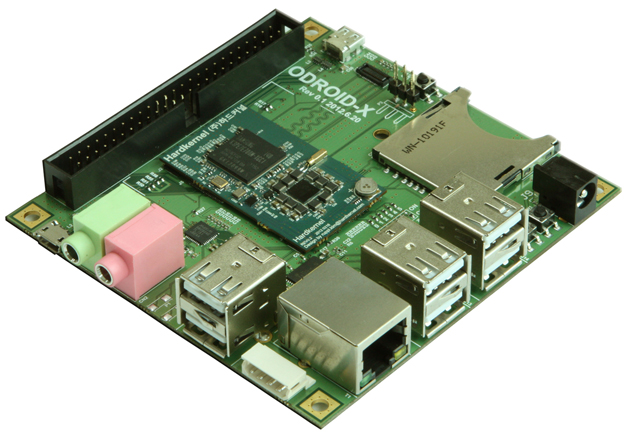
From Ars Technica: Korean company’s tiny quad-core ARM Linux computer packs a punch at $129

Hardkernel’s little Linux computer, with a quad-core Samsung Exynos CPU

Little Linux computers have attracted a lot of interest from hobbyists this year. The $35 Raspberry Pi ARM board, which met with huge demand when it launched in February, is a compelling solution for affordable embedded projects. But what if you need more power than the 700MHz ARM11 board can offer?

A Korean hardware manufacturer called Hardkernel is launching a high-end alternative. The company’s new ODROID-X board comes with a Samsung Exynos 4 processor, a quad-core CPU clocked at 1.4GHz. The board also has a quad-core Mali 400 GPU, 1GB of RAM, six USB host ports, an ethernet adapter, headphone and microphone jacks, and an SDHC card slot for storage.

With four times as much RAM as the Raspberry Pi and a much more powerful processor, the Hardkernel board seems like a nice option for more computationally-intensive usage scenarios. The system is still highly compact, measuring at about 3.5 x 3.7 inches.


from Ars Technica