
A curious trend has developed in recent quarters: When iPhone sales fall, business improves for AT&T and Verizon.
From Ars Technica: NTP to get patent cash from “pretty much” entire cell phone industry
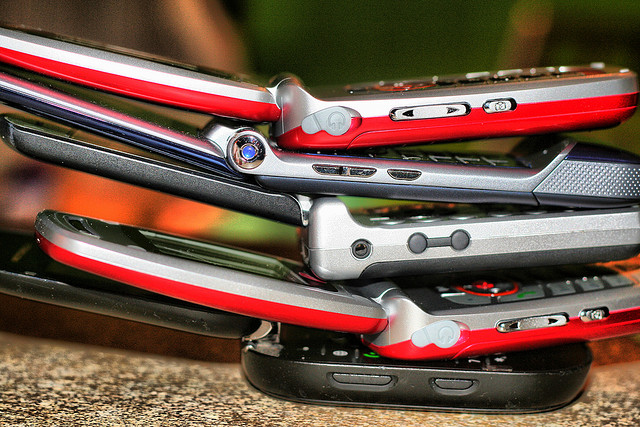
Cell phone makers are paying dearly for the right to patents covering “wireless e-mail” technology.
NTP Inc., a patent-holding company that won a $612.5 million settlement from RIM in 2006, has struck again with a settlement involving 13 of the biggest companies in the tech industry.
NTP, noting that it holds eight US patents “relating to the delivery of electronic mail over wireless systems,” today said it reached a settlement with 13 companies representing just about everyone involved in building and selling smartphones or delivering e-mail to them. The 13 companies are AT&T, Verizon Wireless, Sprint Nextel, T-Mobile, Apple, HTC, Motorola Mobility, Palm, LG, Samsung, Google, Microsoft, and Yahoo.
“The signed agreement provides broad coverage under NTP’s patent portfolio to all of the companies,” NTP said. Consequently, “all pending litigation between NTP and these companies will be dismissed.”
from Ars Technica
From Morning Edition: Penn State’s Wins Since 1998 Vacated, Hit With $60M Fine
The NCAA today handed down a series of penalties against Penn State University that include a ban from post-season football bowl games for four years, a $60 million fine, the loss of Joe Paterno’s victories from 1998-2011, and the loss of football scholarships, over its handling of a sex abuse scandal involving Jerry Sandusky, former assistant football coach. For more on this development, Steve Inskeep talks to NPR’s Joel Rose.
from Morning Edition
From Popular Science – New Technology, Science News, The Future Now: Researchers Trying to Give First Supersonic Biplane Some Lift

Return of the Biplane Shigeru Obayashi/Tohoku University
In the 1930s engineer Adolf Busemann conceived of a supersonic biplane that produced no sonic boom-the shock waves would bounce off the plane’s two wings at opposing angles, nullifying each other. But the design created so much drag that the plane wouldn’t have been able to fly. Now two groups are trying to improve the concept with computer simulations. Engineers at Japan’s Tohoku University devised wings with shifting flaps that adjust for drag at different speeds. And researchers from MIT and Stanford University widened the air channel between the wings and tilted their leading and trailing edges. If either design gets built, it could be the first supersonic biplane to take off.
See the supersonic Concorde jet breaking the sound barrier below.

from Popular Science – New Technology, Science News, The Future Now
From Ars Technica: DoJ on Apple e-book pricing: two wrongs don’t make a right
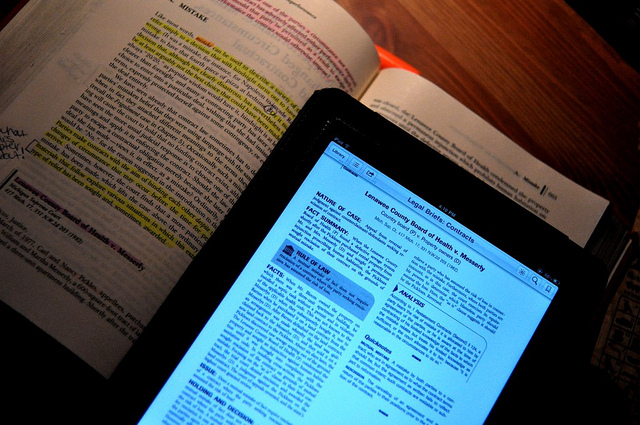
The US Department of Justice says it plans to move forward with its proposed settlement with some e-book publishers, despite the “self-serving” comments submitted by Apple. In a 64-page response (PDF) to the comments it received on the settlement, the DoJ reiterated its reasons for suing Apple and publishers, accusing Apple of continuing to offer solutions that are “contrary to the public interest.” That’s a no-no, even if the old system pushed by Amazon was a “monopoly.”
When the DoJ first sued Apple, Hachette, Harper Collins, Macmillan, Penguin, Pearson, and Simon & Schuster in April of 2012, it said the companies had actively conspired to raise e-book prices. This allegedly forced consumers to “pay tens of millions of dollars more for e-books than they otherwise would have paid” since the iPad’s launch in 2010, both as a result of the iBookstore’s prices and Amazon’s eventual decision to adopt the same “agency model” pricing scheme that same year.
Three of the publishers—Hatchette, HarperCollins, and Simon & Schuster—immediately agreed to settle with the DoJ, leading to a slew of commentary being submitted from the public, publishers, and even Apple. And now that the comment period is over, the DoJ appears to feel even more strongly about its original complaint. In its response, the DoJ reiterated that it conducted a “lengthy investigation” into the e-book price increases of 2010 that “uncovered significant evidence that the seismic shift in e-book prices was not the result of market forces, but rather came about through the collusive efforts of Apple and five of the six largest publishers in the country.”
from Ars Technica
From Ars Technica: Tri-band WiFi chips for 7Gbps speed coming from Marvell, Wilocity
One of the biggest changes ever made to WiFi is coming in the next year with a new standard supporting the 60GHz band, powering much faster transmissions than are possible in the existing 2.4GHz and 5GHz bands. All that’s needed are some chips, and products to put them in.
Slowly but surely, the chipmakers embracing 60GHz technology are making their plans known. The latest is Marvell, which today announced a partnership with startup Wilocity to make tri-band chips that will use all three bands. That will allow consumer devices to connect to existing WiFi networks while also taking advantage of the super-fast 60GHz band for high-speed data transfer and high-quality media streaming. Under the developing 802.11ad standard, 60GHz transmissions can hit 7Gbps.
Wilocity already has a partnership with Qualcomm Atheros, Qualcomm’s networking subsidiary, to build tri-band chips. Those are expected to come out by the end of this year and focus on the PC notebook market—for example a laptop bundled with a remote docking station. The partnership with Marvell won’t result in shipping products until 2013, but Wilocity’s VP of Marketing, Mark Grodzinsky, told us that the Marvell/Wilocity chips will focus on a broader range of products including tablets, Ultrabooks, and phones. The two companies are also targeting access points, residential gateways, and media center devices.
from Ars Technica
From Engadget: Galaxy S III sales breach 10 million, satisfy Samsung executives

Wondering if Samsung’s new flagship has hit its sales goal yet? Breathe out — it did. According to Yonhap, Shin Jong-kyun, head of Samsung’s information technology and mobile communication division, told reporters the firm has moved more than 10 million Samsung Galaxy S IIIs since its unveiling. Jong-kyun wasn’t able to give specific numbers, but we know from history that the handset is outpacing its predecessor, which took five months to make eight digits in sales. As for the goal, Sammy previously pegged the 10 millionth unit for early July, noting that it was fighting component shortages along the way — all in all, mid-month isn’t too far off. Thinking of helping the firm bolster its numbers further? We’ve got a whole series of reviews you may want to take a look at.
from Engadget