From Ars Technica: Want to fix traffic? Pay people to get up and go earlier

STANFORD, CALIFORNIA—Everyone hates commuting. (Disclaimer: I work at home, my commute is only about five seconds between my bedroom and my home office. Thanks Ars!) For most driving commuters, the biggest problem is that there are often hundreds of other cars that want to drive the same stretch of highway at the same time. Cars performing below optimal speed is not only inefficient; it pollutes, too.

So, Balaji Prabhakar, a Stanford professor of electrical engineering and computer science with a background in computer networks, had an idea. He found that there may be a new way to alleviate congestion: rather than imposing a penalty on drivers, why not pay them to simply alter their behavior slightly? That is, what if drivers were given a financial incentive to drive slightly earlier or slightly later than the prime 8 to 9 am window?

“The most important thing about congestion that’s worth knowing is that it’s a 10 percent phenomenon,” he told Ars this month. “That means if you shift 10 percent of the load from peak to off-peak, congestion will come down significantly for everyone. The reason is that as load approaches capacity, the rise in congestion is very severe at the high end. You don’t have to shift everybody. In fact, it’s not worthwhile to shift everybody.”


from Ars Technica

From Ars Technica: Berkeley Earth project is back to re-re-confirm Earth is warming

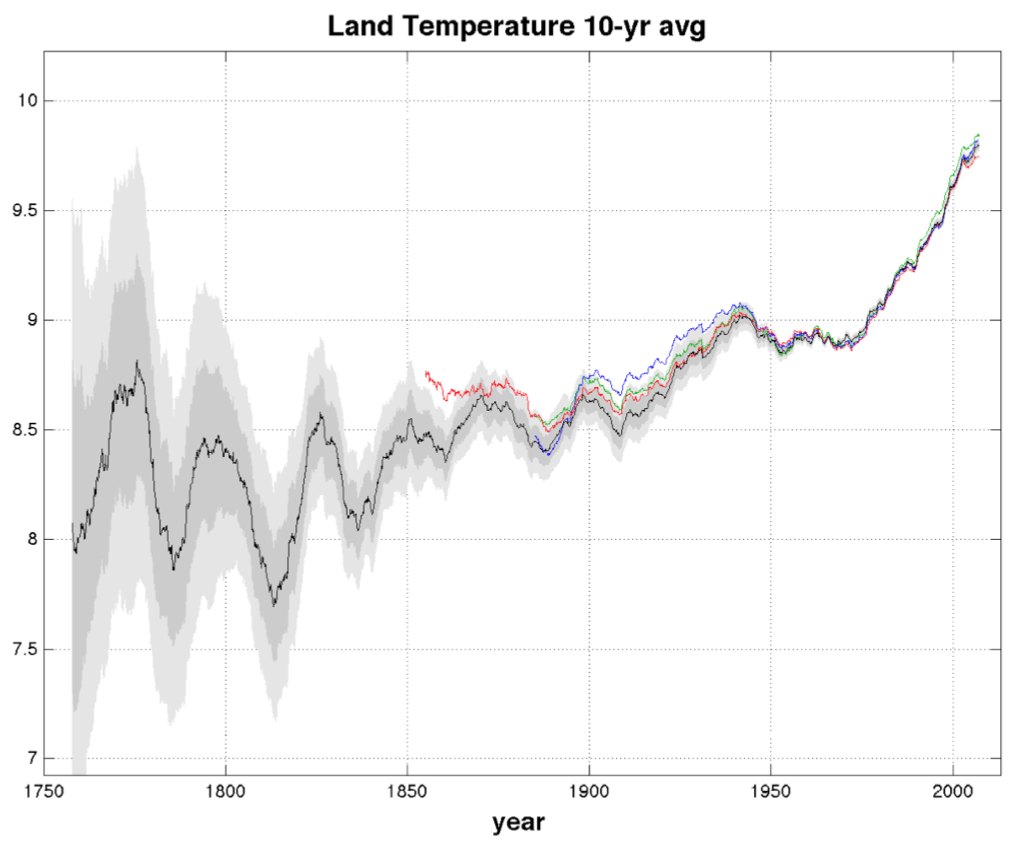
Enlarge / The gray areas are one and two standard deviations from the calculated temperature (black line). The other surface temperature records are colored red, green, and blue.
Berkeley Earth

Despite plenty of indications that the Earth has gotten warmer—like melting glaciers and ecosystems that are shifting toward the poles—there are a number of climate skeptics who simply don’t accept the temperature records produced by three different organizations (NASA, NOAA, and the CRU). Many of them pinned their hopes on physicist Richard Muller, who was also not convinced the professionals had gotten it right. But Muller did something about it, forming the Berkeley Earth project, and building a huge database of land temperature records.

Back in October, Muller dropped his findings in a rather unconventional location: an editorial in The Wall Street Journal. Despite the hype, the results were rather bland. He produced a temperature record that was nearly identical to that of the other organizations. But now, Muller is back for round two, and this time he has chosen the New York Times as an outlet for his climate musings.

As before, his team uses a different statistical method of reconstructing temperatures that works well with short records, taken at sites that were shut or moved. NASA, NOAA, and the CRU use methods that require long records, so they have to make adjustments to the data from sites that have shifted or gotten new equipment. This compensates for the fact that these changes will lead to discontinuities in the record. Since Berkeley Earth doesn’t need the same length, it can just skip adjustments entirely: any record with a discontinuity is just split there, and treated as two records. The team has now also pushed its analysis back to almost 1750, adding a century to the land temperature records produced elsewhere.


from Ars Technica

From Engadget: Kuratas, the 13-foot mech: unleashes your inner Ripley, costs $1.35 million

Kuratas, the 13foot mech unleashes your inner Ripley, costs $135 million video

Suidobashi Heavy Industries has put the finishing touches to its latest project, the 4.4-ton Kuratas. Mobile suit obsessives around the world can thank artist Kogoro Kurata and robotics expert Wataru Yoshizaki for the robot frame, which has space to house a pilot inside. The mech’s touchscreen UI even includes a Kinect-based movement interface and the shudder-inducing “smile-activated” twin BB gatling guns. You can customize your own diesel-powered beast in the dystopian gang colors of your choosing, but be advised: the $1.35 million price tag doesn’t include further customization options like a faux leather interior, cup holder or phone cubby. The Kuratas does, however, come with the ability to make phone calls direct from the cockpit, so you can tell your enemies that you’re coming for them.


from Engadget

From Legit Reviews Hardware Articles: Google Nexus 7 Tablet Review – The $200 Jelly Bean Tablet

Google Nexus 7 Tablet Review - The $200 Jelly Bean Tablet

The Nexus 7 is a no compromise Android tablet that just happens to be the first tablet designed by Google. With a stunning 7″ IPS display, a powerful NVIDIA Tegra 3 1.3GHz quad-core processor and up to 8 hours of battery life during active use, Nexus 7 was built to bring you the best everything. Read on to see the features of this tablet and to take a look at how it performs in some benchmarks!

from Legit Reviews Hardware Articles