From Engadget: SK Telecom deploys HD Voice over LTE, claims title of world’s first

SK Telecom deploys HD Voice over LTE, claims title of world's first

The little blue marble we call Earth is no stranger to HD Voice — it’s been around commercially since Orange debuted the service over its 3G network in Moldova nearly three years ago — but the technology still hasn’t been officially deployed over an LTE network. That is, until SK Telecom launches the service later today. Doing so will allow the South Korean carrier to snag the crown for world’s first before Sprint, which recently announced that its network won’t have it until later this year. It’s a win-win scenario for the company: HD Voice over LTE is meant to vastly improve call quality and reduce latency for the customers, while lessening network strain and offering new revenue-making opportunities for SK Telecom. What about devices? It hasn’t announced any brand new smartphones that can take advantage of the service, but the company’s ready to pre-load the Samsung Galaxy S III with software that enables HD Voice capability, and is planning to push an update to current owners of the flagship device. If you’re the type of person that still makes the occasional call, this kind of progress should come as pleasant news.


from Engadget

From Engadget: OUYA, XBMC sitting in a tree, media s-h-a-r-i-n-g (update: TuneIn, new pics)

OUYA and XBMC sitting in a tree, media sharing

OUYA’s slew of collaborations isn’t letting up, even with less than two days to go before its fundraising round is over. The XBMC team has just pledged that its upcoming Android app will be tailored to work with the upcoming console. While the exact customizations aren’t part of the initial details, the media center app developers will have early access to prototypes of the OUYA hardware. There’s suggestions that there won’t be much of a wait for the Android port of XBMC, whether or not you’re buying the cuboid system — XBMC’s developers note that Android work should be merged into the master path once “final sign-offs” are underway. All told, though, the OUYA is quickly shaping up into as much of a go-to media hub as it is a game system.

Update: OUYA itself has also posted word that TuneIn’s radio streaming is also on its way. And just to top off its efforts, the company has posted rendered images that better show the scale of the console: our Joystiq compatriots note that it’s really a “baby GameCube” in size, and its gamepad looks gigantic by comparison.


from Engadget

From Droid Life: Google Maps Adds Live Traffic Support for Additional 130 Cities Across America

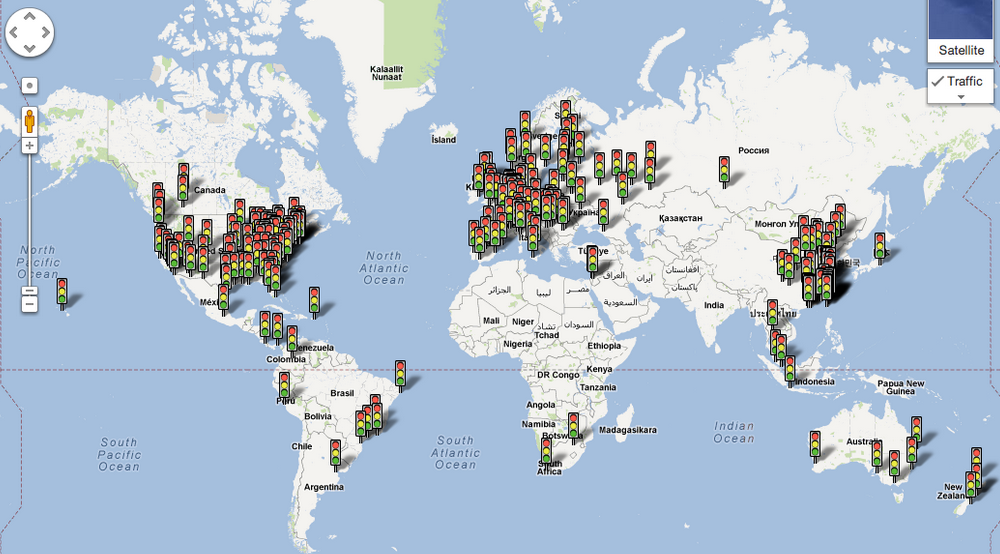
Google announced that it is to bring live and typical traffic support to roughly 130 smaller cities across America through Google Maps. In addition, they are also including even further support for areas in China, Brazil, Canada, and many other countries. Google didn’t post a list of every supported area, but did give this chart that shows traffic lights at every area that allows for the coverage. Thanks, Google.

Click here to view the embedded video.

Via: Google Lat Long Blog

from Droid Life

From Engadget: Amazon launches its own game studio, goes social with Living Classics on Facebook

Amazon launches its own game studio, goes social with Living Classics on Facebook

Amazon is committing itself to gaming much more seriously than providing a storefront: it just launched its own game development house. The simply titled Amazon Game Studios is starting out gently by producing a Facebook hidden object game, Living Classics, that lets the socially inclined dig around through scenes from well-known literature — what else would you expect from the Kindle’s creator? While the free, me-too game isn’t going to give Microsoft or Sony any frights just yet, the company has the ambition of making “innovative, fun and well-crafted” titles. Amazon is actively recruiting more help for the studio as we write, so we’d expect more grandiose work before too long.


from Engadget

From Ars Technica: Report says 15 percent of Mitt Romney Twitter followers are paid fakes

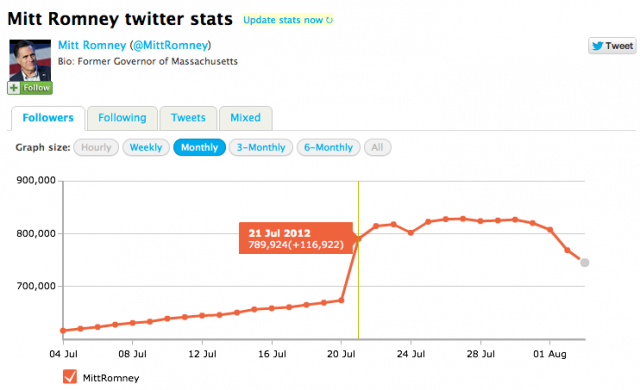
More than 15 percent of Mitt Romney’s Twitter followers may be generated by paid services that use fake accounts to artificially inflate the number of people subscribed to the presumptive Republican nominee for US president, according to a new report.

The report comes from researchers at security firm Barracuda Labs, and it cites the addition last month of 116,922 followers to @MittRomney in a span of just 24 hours. The infusion on July 21 represented a 17-percent spike in accounts following Romney. A quarter of those new accounts were less than four days old, and 23 percent of them had never issued a single tweet. Ten percent have since been suspended by Twitter for unspecified reasons.

“Based on the above distinguishable features, we believe most of these recent followers of Romney are not from a general Twitter population but most likely from a paid Twitter follower service,” Barracuda Labs Research Scientist Jason Ding wrote in the report. Such services allow customers to buy followers for any Twitter account, he stressed, so it’s not clear if the fakes were purchased by Romney, his supporters, or his political foes.


from Ars Technica

From AnandTech: ARM Announces 8-core 2nd Gen Mali-T600 GPUs

In our discrete GPU reviews for the desktop we’ve often noticed the tradeoff between graphics and compute performance in GPU architectures. Generally speaking, when a GPU is designed for compute it tends to sacrifice graphics performance or vice versa. You can pursue both at the same time, but within a given die size the goals of good graphics and compute performance are usually at odds with one another.

Mobile GPUs aren’t immune to making this tradeoff. As mobile devices become the computing platform of choice for many, the same difficult decisions about balancing GPU compute and graphics performance must be made.

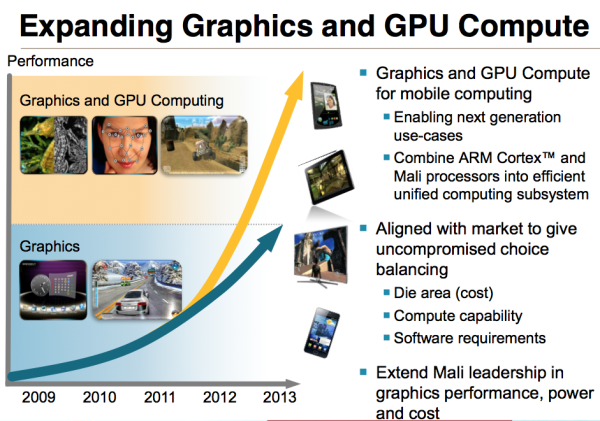
ARM announced its strategy to dealing with the graphics/compute split earlier this year. In short, create two separate GPU lines: one in pursuit of great graphics performance, and one optimized for graphics and compute.

Today all of ARM’s shipping GPUs fall on the blue, graphics trend line in the image above. The Mali-400 is the well known example, but the forthcoming Mali-450 (8-core Mali-400 with slight improvements to IPC) is also a graphics focused part.

The next-generation ARM GPU architecture, codenamed Midgard but productized as the Mali-T600 series will have members optimized for graphics performance as well as high-end graphics/GPU compute performance.

The split looks like this:

The Mali-T600 series is ARM’s first unified shader architecture. The parts on the left fall under the graphics roadmap, while the parts on the right are optimized for graphics and GPU compute. To make things even more confusing, the top part in each is actually a second generation T600 GPU, announced today.

What does the second generation of T600 give you? Higher IPC and higher clock speeds in the same die area thanks to some reworking of the architecture and support for ASTC (an optional OpenGL ES texture compression spec we talked about earlier today).

Both the T628 and T678 are eight-core parts, the primary difference between the two (and between graphics/GPU compute optimized ARM GPUs in general) is the composition of each shader core. The T628 features two ALUs, a LSU and texture unit per shader, while the T658 doubles up the ALUs per core.

Long term you can expect high end smartphones to integrate cores from the graphics & compute optimized roadmap, while the mainstream and lower end smartphones wll pick from the graphics-only roadmap. All of this sounds good on paper, however there’s still the fact that we’re talking about the second generation of Mali-T600 GPUs before the first generation has even shipped. We will see the first gen Mali-T600 parts before the end of the year, but there’s still a lot of room for improvement in the way mobile GPUs and SoCs are launched…

from AnandTech