
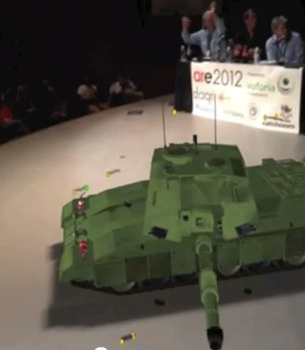
From Ars Technica: Augmented reality tank can blast holes in real surfaces

Wow, even the shadow is right.

An augmented-reality military tank that we can control from our iPhones to blast holes in real-world walls? Don’t mind if we do. This demo shown at the Agumented Reality Event 2012 (created by Ogmento, a game development company) lets users blow through surfaces in the augmented-reality environment with the tank’s cannon.

The application uses a system called Simultaneous Localization and Mapping (SLAM) in real time to project and render the tank from all perspectives in new and unknown environments. The demo video below shows how the demonstrator is able to walk around the tank and see it from different angles without using a special environment or background for the app to work with. According to Ogment, SLAM “is typically used by robots and autonomous vehicles to build up a map within an unknown environment… while at the same time keeping track of their current location.” Applying the system to AR games allows users to drop digital environment elements into any space.

Ogment is billing the tank as having “x-ray vision”—that is, when the tank spins its cannon and fires a shot at a detected surface, the AR application will display a “hole” showing “what’s behind” that surface. In the demo video, a hole blasted in the tablecloth where Will Wright and Bruce Sterling are sitting shows bottles of booze and pantless legs (though if this were real and serious AR, it would show two bloody stumps instead). Oriel Bergig, vice president of research and development at Ogment, told Ars that other pre-loaded X-ray vision themes will include “scenery” and “urban.”


from Ars Technica

From Engadget: NVIDIA CEO Jen-Hsun Huang announces cloud-based, virtualized Kepler GPU technology

NVIDIA CEO Jen-Hsun Huang announces cloud-based, virtualized Kepler GPU technology

We’re here at NVIDIA’s GPU technology conference here in San Jose, California and CEO Jen-Hsun Huang just let loose that his company plans to put Kepler in the cloud. To make it happen, the company has created a virtualized Kepler GPU tech, called VGX, so that no physical connections are needed to render and stream graphics to remote locations. So, as Citrix brought CPU virtualization to put your work desktop on the device of your choosing, NVIDIA has put the power of Kepler into everything from iPads to netbooks and mobile phones.


from Engadget

From Autoblog: Report: Why you should call 911 if you get pulled over in Mississippi

Filed under: , , ,

Police officer

It sounds like an urban legend: A serial killer posing as a police officer pulling over motorists and then murdering them in their vehicles on the side of the highway. But this is no hoax, as the Mississippi Bureau of Investigation is on the hunt for a suspect after discovering two such victims, according to CNN.

The shootings both took place last week, on two separate roadways some 55 miles apart, according to the report. Police say the victims were not acquainted.

Authorities in Mississippi are advising motorists to be cautious if they’re pulled over, and to call 911 to verify that the police officer is legitimate. Pulling over into a well-lit, well-populated area is also advised. Scroll downto watch CNN’s report on the Mississippi killings.


from Autoblog

From Popular Science – New Technology, Science News, The Future Now: NASA is Training Up an Astronaut Crew for a Potential Manned Asteroid Mission

Asteroid Eros This spud-shaped rock is asteroid 433 Eros. Gregory W. Nemitz claimed to own it and aims to develop it. In 2003, he sued NASA in search of parking fees after the NEAR spacecraft alighted on it. NEAR Project/NLR/JHUAPL/NASA

We haven’t heard much about if from NASA yet, but the Telegraph is reporting that the space agency will soon begin training up an international crew of astronauts for a potential manned mission to an asteroid slated for later in the next decade. Starting next month, six astronauts are headed to the NASA Extreme Environment Mission Operation (NEEMO), the underwater habitat off the Florida coast that will serve as a simulator for the long duration mission to an asteroid, the UK outlet reports.

The multinational team of asteroid astronauts, which includes Britain’s first official astronaut with the European Space Agency, will spend its time living in tight quarters 65 feet beneath the ocean surface for 12 days, during which time crew members will undertake simulated spacewalks on the seafloor and learn to pilot vehicles in much the same way they would if they were working in proximity to an asteroid.

A manned asteroid mission would of course be unprecedented (if the private sector doesn’t get there first), operating far beyond mankind’s furthest point of exploration on the moon’s surface. A trip to an asteroid could take astronauts up to three million miles away. It would likely take a year to make the round trip, and astronauts might remain there for up to a month.

Details of NASA’s vision for such a mission are to be presented to the international community at the Japan Geoscience Union meeting later this month. The agency will also present details underlying a robotic asteroid rendezvous mission that it hopes will return samples from an asteroid by 2016 as a precursor to any manned mission.

[Telegraph]

from Popular Science – New Technology, Science News, The Future Now