A new episode of Mario Warfare is out! If you haven’t watched episode #1 yet, you can do so right here.
No related posts.

For everything from family to computers…
A new episode of Mario Warfare is out! If you haven’t watched episode #1 yet, you can do so right here.
No related posts.
Last Friday, we nominated our favorite webcomics and asked you to recommend yours. Boy, did Ars readers deliver. Approximately 123 unique recommendations later, we’re culling the best and most recommended comics into a handy list for your perusal. There’s a lot our original list missed, and because we can’t list all 123 recommendations here, we’ll inevitably miss a lot more in this follow up. But here are some overwhelmingly reader-approved webcomics that you’ll want to check out (if you haven’t done so already.)
If ever there was an exercise in dedication, it appears to be embodied by the creator of Schlock Mercenary. Cervus got into the comments early to tell us “No Schlock Mercenary? I am disappoint. Hard scifi webcomic, updated without missing a day since June of 2000. Nominated for the Hugo several times (lost to Girl Genius on all of them).” abj21 agreed with, “This. Schlock is by far my favorite webcomic. I have been reading it daily for over a decade.”
“[N]ot only is it hard scifi with strong story arcs, it manages to bring the funny nearly every day,” wrote swilhelm. And reader davolfman gives us the reason behind his respect for the comic: “I think Schlock Mercenary should be on any list. It is probably by far the most professional webcomic out there with an artist who supports a family now and does what it takes to have a daily comic for more than a decade straight without interruption. He didn’t start with any talent just a plan to do it right and has stuck with it while the art improved.”
Read 23 remaining paragraphs | Comments
from Ars Technica
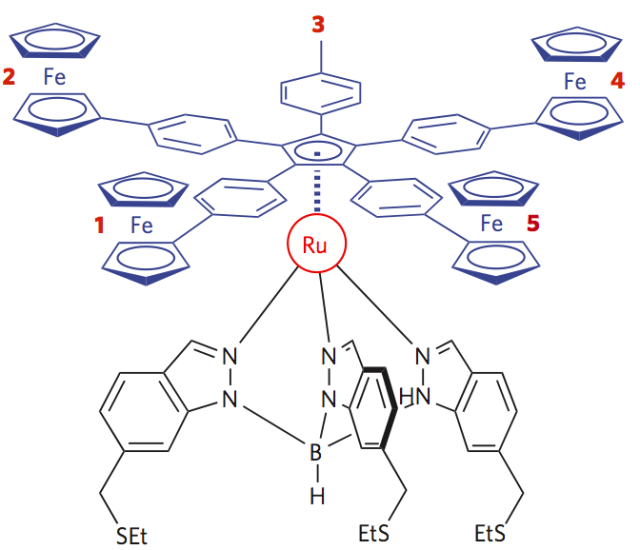
For some time now, researchers have been managing to craft ever-smaller devices, though they’re approaching the problem from two directions. Some researchers are etching small features into chips to carve out nanoscale versions of familiar devices. But others are taking advantage of our ability to synthesize and interact with individual molecules to create systems that are only a few dozen atoms across. And, in many cases, these single-molecule devices look disturbingly like their full-scale counterparts.
When last we left single-molecule motors, they were four wheeling across a sheet of copper, powered by electrons fed in by an atomic force microscope. In the latest iteration, researchers have managed to create a reversible rotor that sits atop a ball bearing—but in this case, the bearing is a single ruthenium atom.
Again, the tricky part comes in building the molecules required. The base of the system involves a boron atoms that coordinates three ringed structures that are chemically similar to the bases of DNA. Nitrogens at a corner of these ringed structures coordinate the ruthenium atom, placing it at the peak of a three-sided pyramid. (This compound has the succinct name [n5-1-(4- tolyl )-2,3,4,5-tetra(4-ferrocenylphenyl) cyclopentadienyl hydrotris [6-((ethylsulphanyl)methyl)indazol-1-yl] borate ruthenium(II)], which should provide some sense of its complexity.)
Read 5 remaining paragraphs | Comments
from Ars Technica
NASA researchers focusing on the difficulties of traveling into deep space have identified an unusual source for fuel that astronauts will be carrying with them anyway: trash. Scientists say there is a good chance that food wrappers, used clothing, scraps, tape, packaging and other garbage accumulated by a crew of four astronauts flying beyond low Earth orbit can be turned into valuable methane gas, oxygen and even water using processes and much smaller versions of devices that are already doing the same thing on Earth.

If you’re a science hobbyist you probably don’t have access to actual liquid nitrogen (-320 degrees Fahrenheit) but you can make your own cryo-fluid from dry ice and rubbing alcohol that goes down to -110 degrees Fahrenheit, enough to instantly freeze flowers, cherries, and other popular liquid nitrogen demonstrations. More » 
from Lifehacker
 Now here is a novel idea – since “there is an app for everythingâ€, why not expand that horizon with the Hyundai Connectivity Concept? Imagine your smartphone doubling up as your vehicle’s key, now what would make one less thing to remember to bring with you wherever you go, don’t you think so? After all, vehicle manufacturers have been moving in a direction where content from your smartphone is being sent to your vehicle, and with a smartphone, you are able to access navigation, music, text messaging and other phone functions from the driver and/or passenger seat. With the Hyundai Connectivity Concept, the South Korean vehicle manufacturer intends to bring things up by another level, allowing you to transfer all of the phone’s content to the car’s touchscreen display wirelessly and throwing in other wireless functions to boot.
Hyundai has named it the Connectivity Concept, being a “technology study†and has a dream of it reaching production within the next three years. In fact, Hyundai has already equipped the conceptual system on a New Generation i30 as part of its demonstration purposes. The Connectivity Concept hardware will kick off before you even enter the car. Instead of a hard or electronic key, the Hyundai Connectivity Concept will rely on near-field communications (NFC) to pop the locks of the vehicle open, all you need to do is place the smartphone over an NFC tag on the door, and be prepared to enter.
When you have planted your rear end on the comfortable seat, the smartphone can then slide into a wireless dock that is located in the center console, where the entire slew of its content, ranging from music to phone contacts, and profile settings among others are then streamed to the car’s 7-inch touchscreen. The car’s infotainment system will resemble the look and function of the phone’s touchscreen, and a wireless charger is also thrown into the mix. This technology is expected to be commercialized in 2015.
[ Hyundai Connectivity Concept turns smartphones into car keys copyright by Coolest Gadgets ]
from Coolest Gadgets

It was inevitable. Drones are in ever-wider use by the military, and some day they might deliver you food, but it looks like they’ll also be the private, flying-camera spies for private companies too. That’s what Japanese security company Secom is banking on with its new private security quadrotor. More » 
from Gizmodo