
From Ars Technica: Unlocking new cell phones to become illegal on Saturday

An edict from the Library of Congress is about to make phone unlocking illegal for the first time in 6 years. The decision, issued in October, is part of a triennial process whereby the Librarian of Congress hands out exemptions from the Digital Millennium Copyright Act.

The two previous batches of regulations, issued in 2006 and 2010, respectively, granted users permission to unlock their phones in order to switch wireless carriers. But in the wake of a 2010 decision holding that software is licensed rather than sold, the Library reversed itself and declared phone unlocking illegal once again. The Librarian was also influenced by claims that there are more unlocked phones on the market than there were three years ago.

The new ruling comes with a grandfather clause. It will continue to be legal to unlock phones purchased before Saturday, January 26. But if you unlock a phone purchased after that date you could be liable under the Digital Millennium Copyright Act, which prohibits the “circumvention” of copy protection schemes.

Read 2 remaining paragraphs | Comments

from Ars Technica
From Ars Technica: New lab could unlock vast potential of seabed methane ice

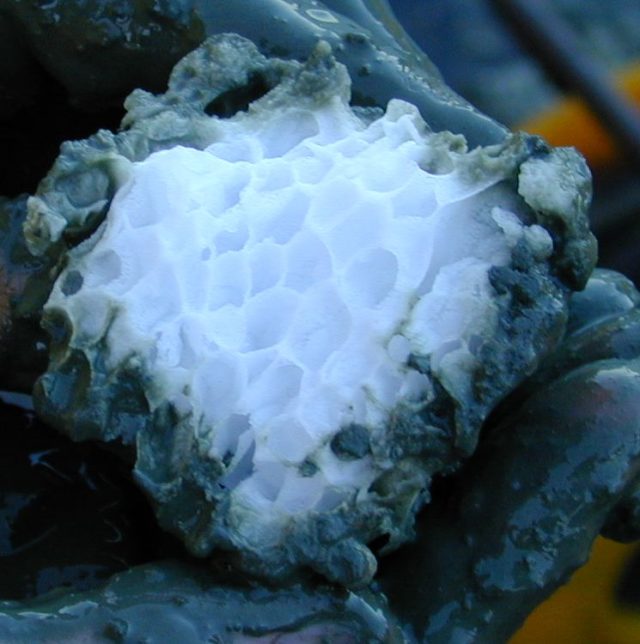
This sample of methane hydrate, which resembles ice, was retrieved by a German research vessel of the coast of Oregon.

The University of California, Irvine has been granted $1 million to develop a unique laboratory for the research of clean energy obtained from methane hydrates, an as-yet untapped source of methane gas that exists in huge quantities in some ocean-floor environments.

Methane hydrates are clathrate compounds, where the methane molecules are trapped in a lattice of water ice—hence their alternate names, methane clathrate and methane ice. They occur where methane and water are present at favorable combinations of low temperatures and high pressure. These conditions restrict clathrates to undersea locations at polar latitudes and along continental shelves, where they are distributed within the sedimentary bed.

Such environments are plentiful, of course, and so it’s unsurprising that methane hydrate is thought to be abundant on planet Earth. However, as our understanding of methane hydrate formation has grown, our best guess as to the extent of the reserves has become smaller. Currently, the most conservative estimate is that there are between 500 and 2,500 gigatonnes of carbon in submarine gas hydrate deposits, the majority of which are in the form of methane.

Read 9 remaining paragraphs | Comments

from Ars Technica
From Ars Technica: Laser cooling of semiconductors by annihilating excitations

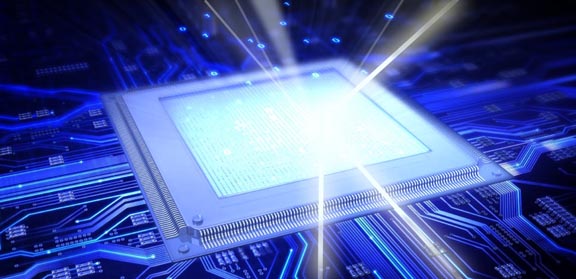
We’re not at the point where we can cool chips with lasers yet, but we may be a step closer.
MIT

The process of cooling materials to cryogenic temperatures is often expensive and messy. One successful method is laser cooling, where photons interact with the atoms in some way to dampen their motion. While laser cooling of gases has been standard procedure for many years, solids are another issue entirely. Success has only come with a few specially prepared materials.

Having a laser annihilate something isn’t usually associated with chilling anything down. But a new experiment reduced the temperature of a semiconductor by about 40°C using a laser. Jun Zhang, Dehui Li, Renjie Chen, and Qihua Xiong exploited a particular type of electronic excitation: when the photons interacted with this excitation, they canceled it out, damping the thermal fluctuations in the material.

Laser cooling of gases transfers some of the kinetic energy of the atoms into photons they interact with. Successful laser cooling was achieved in glasses—solids without an ordered, coherent crystal structure—by embedding rare-earth atoms in the matrix. As with gases, the excitation of the rare-earth atoms produced the cooling. However, that method won’t work for every solid.

Read 6 remaining paragraphs | Comments

from Ars Technica

From Ars Technica: A magnetic quantum ratchet made of graphene turns AC to DC

A ratcheting socket wrench happily turns one way, but resists rotation in the opposite direction. A magnetic quantum ratchet allows flow of electrons one way, but not the other.

In a common type of mechanical ratchet, back and forth motion provided by a human arm gets converted to rotating motion that acts to tighten a screw or bolt. The role of the ratchet is to convert a force that changes direction into a torque acting in one direction only. That principle is generalized in many other systems that convert fluctuations (some of which may be random) into usable work. Many types of ratchets exist, in mechanical, quantum, and biological systems.

Researchers have now fabricated a magnetic quantum ratchet out of graphene, a two-dimensional hexagonal lattice of carbon atoms. C. Drexler and colleagues introduced asymmetries in the electronic structure by disrupting graphene’s structure with hydrogen and modifying the substrate on which the carbon sat. When they exposed the modified graphene to an alternating electric current and a strong magnetic field, its electrons preferentially moved in one direction, setting up a directed current. So the modified graphene acted as an AC/DC converter. Although it’s not practically useful, the behavior may tell us more about the rules that govern graphene-like materials.

Under ordinary circumstances, graphene is a symmetrical hexagonal lattice of carbon atoms. When exposed to an alternating electric current, the electrons oscillate, producing no direct current on average. Similarly, imposing a steady magnetic field in the presence of the alternating current alters the electronic properties of the graphene slightly, but doesn’t tend to make the electrons move preferentially in one direction.

Read 7 remaining paragraphs | Comments

from Ars Technica
From Ars Technica: Wires smaller in diameter than light waves boost solar cell efficiency

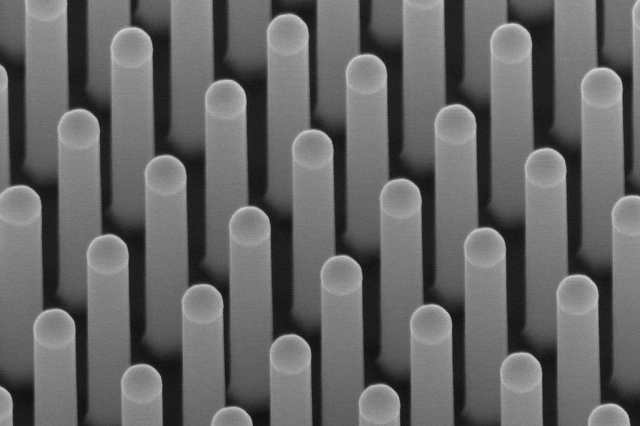
Electron micrograph of indium phosphide (InP) nanowires. Each is 180 nanometers in diameter; this diameter allows them to capture more light, making them effective in a photovoltaic solar cell.
Wallentin et al.

In the continuing quest to create solar cells, researchers seek new materials, use clever techniques, and look for novel physical phenomena to extract the maximum electricity out of sunlight for the lowest cost. One method of extracting more power at a lower cost relies on creating arrays of nanowires that stand vertically on inexpensive substrates. In contrast to the material in ordinary solar cells, nanowires use less material, can potentially be built with less costly materials, and in principle trap more light thanks to the geometry of the arrays. However, most nanowire solar cells are currently outperformed by their conventional counterparts.

A new effort used indium phosphide (InP) nanowires with diameters smaller than the wavelength of the light they were trapping. That trick enabled Jesper Wallentin and colleagues to reach comparable efficiencies and slightly higher voltage than a conventional InP solar cell. While the wires only covered 12 percent of the surface area, they exploited a principle known as resonant trapping to extract over half as much current as a full planar cell of InP. This approach could lead to even greater efficiency at lower cost for solar cells.

Many candidates for the next generation of photovoltaic (PV) solar cells are being investigated. Research in this area has two goals that don’t always overlap: maximizing the efficiency of converting sunlight into electric current, and reducing cost per unit of electricity. The advantage of nanowire-based cells lies in using a lot less material, since the entire surface need not be covered in PV material. Additionally, the wires themselves can be fabricated from relatively inexpensive semiconductor materials.

Read 7 remaining paragraphs | Comments

from Ars Technica

From Ars Technica: Boeing’s Dreamliner batteries “inherently unsafe”—and yours may be too

A battery incident on an ANA 787 Dreamliner was the last straw for the FAA.

The Boeing 787 Dreamliner was supposed to be the company’s bold entry into the future of air travel—an environmentally friendly, fuel-efficient world traveler. Using 20 percent less fuel than Boeing’s similarly sized 767, it was the most heavily pre-ordered widebody aircraft ever.

But now, the entire fleet of 787s has been grounded because of a series of mishaps involving the plane’s batteries. On January 7, a Japan Airlines 787 just in from Tokyo caught fire at Boston’s Logan International Airport when the batteries in the aircraft’s auxiliary power unit ignited; eight days later, a battery scare forced an All Nippon Airways 787 flying from Yamaguchi, Japan to make an emergency landing and evacuate.

The batteries at the heart of the problem, manufactured by the Japanese firm GS Yuasa Corporation, are essentially giant versions of the lithium-ion batteries used in cell phones and laptops. Like those batteries, the Dreamliner’s use a lithium-cobalt oxide cathode, which is “an inherently unsafe cathode,” said Mark Allen, assistant professor of chemistry and biochemistry at the University of Maryland, Baltimore County. And in the larger form used by Boeing, they pose an even larger risk. When overcharged or damaged, they can become essentially a firebomb inside the airplane—one that burns without air and can’t be put out by usual aircraft fire suppression systems.

Read 14 remaining paragraphs | Comments

from Ars Technica