From New on MIT Technology Review: The Scientific Case for Outlawing Guns

A new study suggests that U.S. laws should go further to limit gun ownership and improve enforcement.

Efforts to pass new federal gun control laws in the aftermath of the Newtown massacre are making progress, while the NRA has argued that arming more citizens, even teachers in schools, is the answer to stopping gun deaths.

Two researchers, an evolutionary biologist and a mathematician at University of California, Irvine, have now stepped back from the emotional debate and taken a dispassionate look at which kind of gun policies would save more lives, both in a one-on-one attack (as in a homicide) and in a shooting in a crowd (as in a movie theater or mall). 

Their findings suggest that President Obama, who has said he supports the right for private individuals to own a gun, is not going far enough if he wants to prevent the greatest number of gun-related deaths.

The study starts by showing that the optimal survival strategies could be either of the extreme approaches: a total ban on private gun ownership, or a policy allowing anyone in the general population to get a gun.

Which of the two save the most lives in practice depends on a few key parameters that are at the center of the gun debate: how effectively illegal gun purchases are stopped; the fraction of people who purchase guns legally and also carry them around; and, finally, the extent to which a gun is effective at stopping an attacker. In mass shooting scenario, this also depends on the “efficiency” of the shooter’s weapon compared to any weapons in the crowd.
from New on MIT Technology Review

From Geeks are Sexy Technology News: Must Watch Sci-Fi Short: NOON [Video]

Wow. Just wow. Here is just one of the many, yet to be filmed, scenes of Noon, a science fiction story about a soul-deadened coyote who reluctantly guides a band of rebels on journey to take control of water and energy on a future Earth where the Sun has stopped moving in the sky. I’m not sure if one day they’ll complete the movie, but I certainly hope they do!

[NOON]

No related posts.

from Geeks are Sexy Technology News

From Droid Life: Before Apple Took Interest, Verizon Was To Install Siri On Every Droid Device

siri ios 6

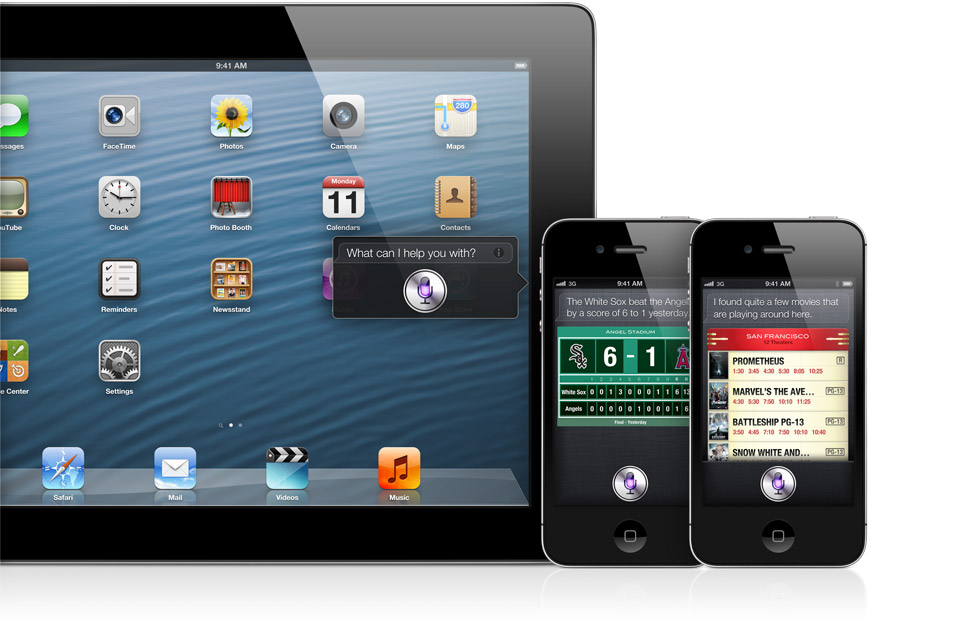
Making the rounds today is an interesting story, given that it could have greatly affected the way we think about our smartphones and the competitors in the smartphone race. In 2009, before the Siri startup was purchased by  Apple, Verizon made their own bid in an effort to have the software installed on every DROID-branded device they sold. Verizon was so far into the deal that even commercials were filmed to tout DROID’s newest halo feature. 

Sometime soon after this, Steve Jobs had a meeting with the co-founder of Siri and shortly thereafter, Siri was Apple’s. Siri now ships on every new iPhone, still being marketed as one of the main selling features. Plus, she can even tell you jokes after failing to do simple web searches. It’s a win-win.

Now, I wanted to go back to how I said it would have changed the way we think about the smartphone race. For example, if Siri was in fact bought by Verizon instead and installed on all of their Android devices, we as Android users would be the ones defending this software. Down the road, and say Apple created Google Now Apple Now, we would be the frustrated Siri users who would dream of something like that coming our way. If you ask me, we all dodged a bullet. Shout out to Steve Jobs for sparing all of us.

Via: The Verge

from Droid Life

From Ars Technica: Review: Who needs Windows RT? Acer’s Iconia W510 runs the real thing

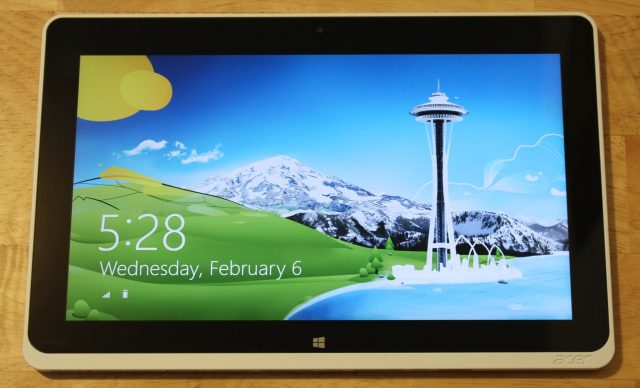
The W510’s 10.1-inch 1366×768 display, surrounded by a black bezel. A capacitive Windows button is located below the screen.

When Microsoft announced Windows on ARM way back in early 2011, it definitely made some sense—ARM-based processors were, then, the best way to build a tablet that would have the size, weight, and battery life it needed to succeed against the iPad and the rising tide of Android tablets.

Fast forward to late 2012, and we finally know all there is to know about the operating system that came to be known as Windows RT. It looks like Windows 8, it feels like Windows 8, but in one especially crucial aspect it is not Windows 8: despite including a desktop environment, a port of the desktop version of Microsoft Office, and the common suite of first-party desktop applications you might expect in a Windows PC, Microsoft rendered it completely incapable of running desktop applications by third parties. Thus, one of Windows 8’s biggest theoretical selling points—the ability to get a good tablet experience and a good laptop experience from the same device—was almost completely excised from Windows RT.

Something else happened in that two-year gap, too: Intel started getting serious about fitting its processors into tablets. Intel processors bring the full Windows 8 experience (and all of your legacy apps) to a tablet, but tablets based on Ivy Bridge processors have their own drawbacks, namely size; heat; and reduced battery life compared to their ARM-based counterparts (see both our Acer Iconia W700 and Microsoft Surface Pro reviews for concrete evidence).

Read 30 remaining paragraphs | Comments

from Ars Technica

From Ars Technica: Robohand: How cheap 3D printers built a replacement hand for a five-year old boy

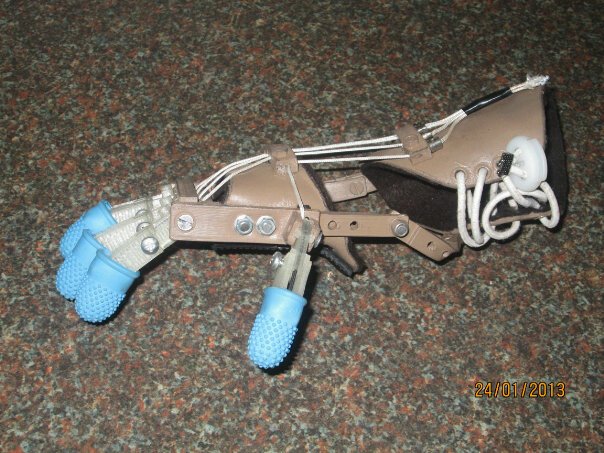
Liam’s Robohand, the product of a collaboration between Ivan Owen in Bellingham, Washington and Richard Van As in South Africa—and produced on a MakerBot 3D printer.

Not too long ago, Liam had no fingers on his right hand. The South African five-year old was born with Amniotic Band Syndrome, which causes amputation of digits before birth. But since November, Liam has been using a series of prosthetic hands designed by two men living on opposite sides of the planet, using open source software and 3D-printing technology.

Now, those two men—Ivan Owen in Bellingham, Washington and Richard Van As in South Africa—have published the design for Robohand, the mechanical hand prosthesis, on MakerBot’s Thingiverse site as a digital file that can be used to produce its parts in a 3D printer. They’ve intentionally made the design public domain in the hopes that others around the world who don’t have access to expensive commercial prosthetics (which can cost tens of thousands of dollars) can benefit from it.

Liam, on his third day with his completed Robohand.

The project began with a mechanical hand Owen made for a science fiction convention in 2011. He works for a school supply business during the day, but he also works from home creating special effects. When a video of Owen demonstrating the oversized hand went viral, it got the attention of Van As, who had lost most of four fingers on his right hand in a woodworking accident. Van As had been told that prosthetic fingers, such as the X-Finger, would cost him at least $10,000 per finger replaced, so he set about in his workshop trying to design his own.

Read 8 remaining paragraphs | Comments

from Ars Technica

From Ars Technica: How to use a million-core supercomputer—without it blowing up in your face

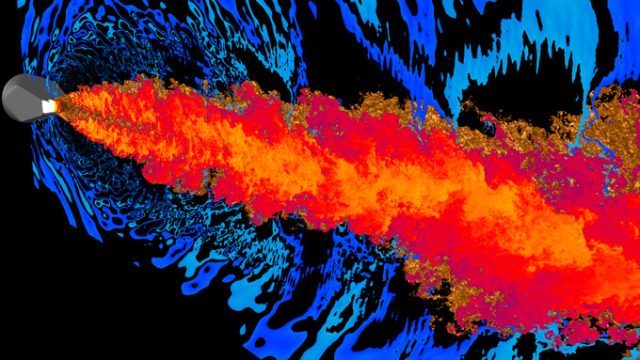
Jet noise simulation. An engine nozzle is on the left in gray; exhaust temperatures are in red and orange; sound is represented in blue and cyan.

At the Lawrence Livermore National Laboratory in California, a supercomputer named “Sequoia” puts nearly every other computer on the planet to shame. With 1.6 million processor cores (16 per CPU) across 96 racks, Sequoia can perform 16 thousand trillion calculations per second, or 16.32 petaflops.

Who would need such horsepower? The IBM Blue Gene/Q-based system was built for the Department of Energy for simulations designed to extend the lifespan of nuclear weapons. But for a limited time, the machine is being made available to outside researchers to perform all sorts of tests, a few hours at a time.

One of the first to take advantage of this opportunity was Stanford University’s Center for Turbulence Research—and it wasn’t hesitant about seeing what this machine is really capable of. For three hours on Tuesday of last week, researchers from the center remotely logged in to Sequoia to run a computational fluid dynamics (CFD) simulation on a million cores at once—1,048,576 cores, to be exact.

Read 27 remaining paragraphs | Comments

from Ars Technica