From Droid Life: Samsung Introduces the Galaxy Beam – It’s a Phone with a Built in Projector, That’s Actually Pretty Cool

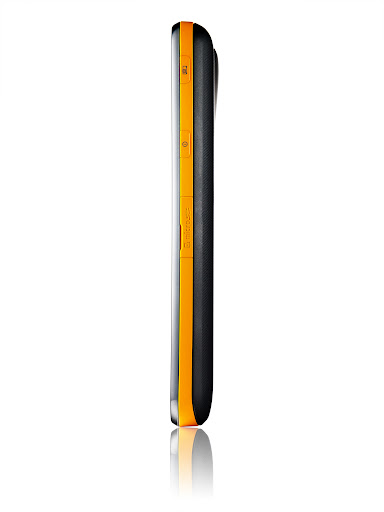
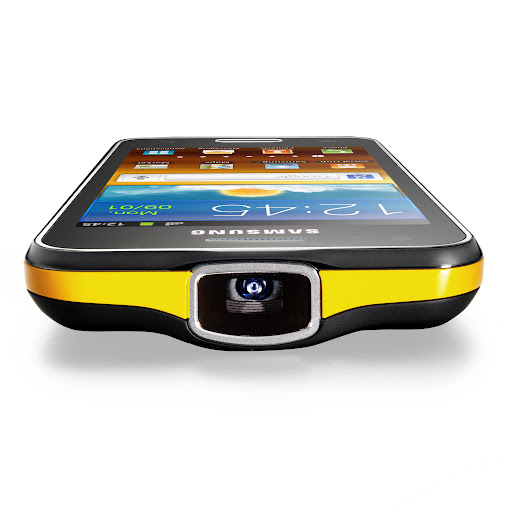
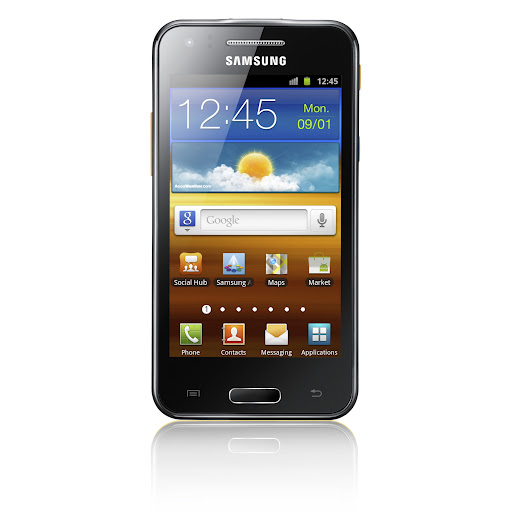
The other announcement from Samsung so far at MWC - aside from the disappointment Galaxy Tab 2 (10.1) – is an interesting phone, to say the least. It’s called the Galaxy Beam and includes everything that you have come to expect from a smartphone now a days, but Sammie then packed a projector inside. That’s not a type-o. This phone actually has a real projector inside that can project video, pictures, or other media onto just about any wall or flat surface. Think about that for a second. Wherever you are with this phone, you can essentially beam a 50″ representation of your screen onto a wall. It’s tough to tell how locked up the feature is, but I’m just imagining what devs could potentially do with this.

Other than the projector, the Beam sports a dual-core processor, 6GB of RAM (that’s what the spec list says and has to be an error), 5MP camera, front camera, 4″ WVGA display, 2000mAh battery, and Gingerbread. It’s no HTC One X, but it’s not bad.

Is anyone even slightly interested? Projector, baby?
Share the Fun with Samsung GALAXY Beam

February 26, 2012

Samsung’s projector smartphone offers unforgettable shared experience for playing multimedia content anytime, anywhere

Barcelona – February 26, 2012 – Samsung Electronics Co., Ltd, a global leader in digital media and digital convergence technologies, today introduced Samsung GALAXY Beam, the projector smartphone that allows users to display and share multimedia content anywhere on a large luminous projector screen.

GALAXY Beam lets users spontaneously share photos, videos or other digital media with family or friends by beaming content stored on the device directly onto walls, ceilings or improvised flat surfaces, so that everyone can share the fun without the need to huddle around smartphone or pad-sized screens. GALAXY Beam’s ultra-bright 15 lumens projector allows users to freely share life’s memorable moments instantly and in crisp clarity, even in outdoor environments.

“GALAXY Beam provides mobile freedom, enabling a unique shared experience around digital content for everyone—anywhere and instantly—from a smartphone as slim and portable as any on the market,” said JK Shin, President of IT & Mobile Communications Division at Samsung Electronics.

“GALAXY Beam is a device borne out of Samsung’s insight and innovation, demonstrating Samsung’s commitment to providing extraordinary experiences for consumers with products that let them express and fulfill themselves.”

Video clips, maps, business information, games – a whole range of multimedia content can be beamed instantly by GALAXY Beam on a crisp, high-definition projection up to 50’’ wide. The device features a projector-dedicated application which makes it easy to select content and activate projection in a few simple steps.

Add a dose of ambience or entertainment to a friends’ gathering by transforming any household room or outdoor deck into an instant mini home-theater, projecting full-screen video clips on a ceiling or wall for common sharing, at the touch of a button. Or capture your favorite holiday moments using the GALAXY Beam’s 5MP camera, then display a full photo slideshow to family members on a dining room wall while playing accompanying music straight from the device, so that everyone shares the experience.

For young users who depend on constant, immediate socializing of digital content and entertainment, GALAXY Beam introduces a new way of sharing. It becomes much more than a phone—a handy digital tool, deployable anywhere, which can add visual entertainment to a simple street gathering, set the mood for a small party, or simply turn life’s moments into something personally and immediately sharable. With GALAXY Beam, a birthday or anniversary party can be enlivened in seconds by sharing YouTube or Hulu music videos straight onto a ceiling or door. Likewise, students can collectively share videos or study-work in any dormitory room or student lounge, turning group study into a whole new interactive experience right from a desk table or from the palm of their hands. GALAXY Beam is also ideal for action-packed interactive gaming: Users can upload their own games or choose from over 1,000 games available via Game Hub, Samsung’s dedicated virtual gaming store, then project games to co-players or observers to turn gaming into an unbeatably interactive, shared experience. Additionally, GALAXY Beam is convenient tool for mid-sized business workers. An estate agent can beam images of candidate properties to customers as they tour them; or an architect can display draft concepts or designs to co-workers on the spot at a building site or public location.

Despite featuring a full built-in projector, the GALAXY Beam does not compromise on style or portability, measuring just 12.5mm thick and featuring an elegant, ergonomic design. It runs on Android 2.3 Gingerbread which is powered by an impressive 1.0GHz dual-core processor, ensuring great versatility and a highly responsive user interface. An impressive 8GB of internal memory allows ample multimedia storage without compromises, and a powerful 2000 mAh battery ensures greater display power and content freedom.

The GALAXY Beam is exhibited at Samsung stand (Hall 8), Mobile World Congress 2012. For multimedia content and more detailed information, please visitwww.samsungmobilepress.com.

from Droid Life

From Popular Science – New Technology, Science News, The Future Now: The Best Science Podcasts for the Enjoyment of Your Ears and Brain

PopSci Loves Science Podcasts Dan Nosowitz
Science, technology, comedy, and the confluence of all three, in downloadable audio formPodcasts are undergoing a minor renaissance lately–every comedian has one, and every news publication has at least one–and, luckily for us, the explosion in quantity has also meant a ton of really amazing, high-quality stuff. In the last few years, writers, scientists, journalists, and all kinds of other interesting folks have taken to the microphone in new record numbers. Podcasts now have sold-out live tapings in front of rapturous audiences. They play at festivals like South by Southwest and Bonnaroo. They’re downloaded millions upon millions of times. And there are hundreds of science podcasts out there, each with their own loyal audiences. But some are, of course, better than others. Here are the best of the best.

RADIOLAB

Radiolab is shockingly good. Smart, hip, funny, and arty, it’s recorded in seasons, rather than on a typical weekly basis; we’re currently in the 10th season of five episodes each, with episodes generally being around 60 minutes. Radiolab episodes are based around a broad theme rather than a topical news peg, with frequent trips “into the field” to find interesting stories. Primary host Jad Abumrad has a background in experimental music composition, which can be heard in the various bleeps and bloops and overlapping audio from different interviews. Radiolab ends up being interesting not just in content, but also in structure.
Sample topics of discussion: Our weird desire to be near to dangerous animals but not in danger, how much information the human mind can reliably handle at once.
Recommended starting point: “Memory and Forgetting”

STAR TALK

Star Talk is Neil deGrasse Tyson’s astrophysics podcast. It’s around 45-60 minutes long, with new episodes popping up around three times per month. Tyson will often talk about topical issues in astrophysics, and his guests are usually from the entertainment field (actors and comedians mostly), which is a smart choice. We’re big fans of Tyson, his vests, and his show; he sometimes hosts Star Talk Live, a taping of the podcast that’s open to the public, at Brooklyn’s Bell House, which we enthusiastically attend whenever possible.
Sample topics of discussion: The existence of free will, whether Stephen Hawking is only as smart as an alien baby, a Tyson rant on faraway galaxies.
Typical guest: Astronaut Mike Massimino, actor Morgan Freeman.
Recommended starting point: “Live at the Bell House: The Astronaut Session”

PROFESSOR BLASTOFF

Professor Blastoff, hosted by comedians Tig Notaro, Kyle Dunnigan, and David Huntsberger, is part of the Earwolf family of comedy podcasts, one of the major forces in that world (its flagship podcast is Comedy Bang Bang). Probably half of the episodes feature no actual, professional scientist, but the hosts are smart and interested, and the show has this calm rhythm (helped along by Notaro’s this-close-to-monotone voice) that makes it ideal for long trips. Episodes are around an hour long, focusing on one very broad theme, like robots, immortality, and taste. It’s like listening to your smartest, funniest friends bounce ideas off each other based on what they read over the past week.
Sample topics of discussion: The craveability of kale chips, the importance of compassion in human evolution, and how to harness the ocean’s energy.
Typical guest: Comedian Paul F. Tompkins, professor of anthropology Dr. Martin Cohen.
Recommended starting point: “Sexual Attraction”

PROBABLY SCIENCE

Another mostly-comedy podcast like Professor Blastoff, Probably Science finds hosts Matt Kirshen, Brooks Wheelan, and Andy Wood meandering through a discussion of the week’s top science stories with a guest list that is, so far, entirely comedian-based. It’s a brand-new podcast, only eight episodes in, but last week’s episode, which features the very funny Kyle Kinane, showed some real potential. It’s early, but this is one to keep an eye on.
Sample topics of discussion: Injecting snakes with estrogen, embarrassing moments from high-school science class, and whether atheists are hypocritical for thinking aliens exist.
Typical guest: Comedian Kyle Kinane.
Recommended starting point: “Episode 7”

SCIENCE FRIDAY/SCIENCE IN ACTION

Science Friday is the science and tech section of NPR’s “Talk of the Nation” programming block, and it has the production values and pleasantly pedantic tone of most of NPR’s shows. Hosted by Ira Flatow, Science Friday is heavily topical, discussing four or five items of science news from the past week. It’s a long show, almost two hours long, and split into two parts for easy consumption. It’s not always fabulously entertaining, but its topics are wide-ranging and it’s consistently smart and informative. Very similar is the BBC’s Science in Action podcast, which also examine’s the week’s stories with various experts.

There are actually lots of science podcasts like these, and they’re mostly boring and lacking personality. It’s about the easiest way to do a science podcast–you just pick a few interesting stories from the week and talk about ’em for a few minutes each, then sign off and go have a beer. There’s a place for these news-recap podcasts but you certainly don’t need to listen to more than one of them. These are two of the best of their type.
Sample topics of discussion: Commercial and military applications for new drones, the effects of bigger solar flares on us, and the psychology of the winter season.
Recommended starting point: This week’s episode. Neither of these podcasts have the peaks and valleys of a less structured podcast, so there’s not a ton of variation in quality week to week.

TED TALKS

The podcast component of the famous TED Talks (“dedicated to ideas worth spreading”) is kind of hard to pin down. It comes out often but not on any reliable schedule, topics range from traditional hard science ideas to architecture, philosophy, history, and art, segments can last between three and 20 minutes long, and individual episodes can range from fascinating and mind-expanding to infuriatingly smug and dull. All that said, TED Talks are often fantastic, and the relatively short length with a single focus and single speaker make it the perfect short-form timewaster.
Examples of guests: Chef Homaro Cantu, actress Jane Fonda, flying man Yves Rossy, writer Malcolm Gladwell.
Recommended starting point: Whatever interests you! Pick and choose a topic that strikes your fancy, and know that whoever’s speaking will be an interesting authority on that subject. The segment above, with Homaro Cantu of Chicago’s Moto restaurant, is a favorite for us food nerds here at PopSci.

THE INFINITE MONKEY CAGE

A live BBC podcast from Brian Cox and Robin Ince, The Infinite Monkey Cage toes the line between science and (extremely British) comedy. It’s fast-talking, likably geeky discussion on usually topical subjects between the two old friends and an array of expert guests. The live setting gives it a nice energy, with the hosts feeding off the crowd, and at only 30 minutes, the show never wears out its welcome.
Sample topics of discussion: The intersection and conflict between science and cosmology, the future of manned space flight, the latest neutrino updates, and physics vs. chemistry.
Typical guests: Richard Dawkins, Billy Bragg, and an assortment of physicists, chemists, neuroscientists, and other experts.
Recommended starting point: “Physics v. Chemistry”

60-SECOND SCIENCE

Bite-sized daily podcast episodes from Scientific American. It is, true to its name, only a minute long, and new episodes come out every weekday, focusing on some interesting news story from that day. There’s obviously not much time to explore a topic or host interesting guests, but I’ve found myself listening to this podcast most days. I almost always have a bored minute, and 60-Second Science fills that gap nicely.
Sample topics of discussion: Drunk fruit flies, underground nuclear silos, and parasite-sensing body hairs.
Recommended starting point: Today’s news.

from Popular Science – New Technology, Science News, The Future Now

From Popular Science – New Technology, Science News, The Future Now: Thermoelectric “Power Felt” Fabric Lets You Sit on Your Phone to Power It

Power Felt Wake Forest University

A team from Wake Forest University’s Center for Nanotechnology and Molecular Materials has created a new thermoelectric fabric they call Power Felt. It’s constructed of “tiny carbon nanotubes locked up in flexible plastic fibers,” though the final product looks and feels like fabric, and creates and electrical charge from changes in temperature–like, say, touching it with your hot finger, or sitting on it with your hot butt (hot in this case referring to temperature and thus wholly inoffensive science).

Thermoelectrics isn’t a new field, but it’s mostly been hampered by expensive materials that can cost up to $1,000 per kilogram. But Corey Hewitt, a graduate student at Wake Forest and member of the Power Felt team, says the new design could drastically bring down the price. For something small, like a cellphone case, the addition of Power Felt could cost as little as a dollar extra. And there are all kinds of possible applications, from apparel to car seats.

from Popular Science – New Technology, Science News, The Future Now

From Popular Science – New Technology, Science News, The Future Now: The Yamaha Moegi Demonstrates The Future of Fuel Efficiency

Yamaha Y125 Moegi Concept Courtesy Yamaha

Since the days of $4 gas began, the single-cylinder motorcycles and scooters that dominate international megacities have become increasingly common on American streets. Engineers at Yamaha created the Y125 Moegi concept to capitalize on that trend. They based it on the company’s first motorcycle, the 1955 125-cc YA-1, but they also included some modern touches, in particular an ultralight frame and a new cylinder design that could help make the Moegi one of the lightest and most fuel-efficient motorcycles ever.

The Y125 Moegi, which is 90 percent aluminum, weighs just 176 pounds (50 pounds less than an entry-level Vespa). Engineers molded the aluminum frame using Yamaha’s proprietary “controlled-filling” die-casting process. Controlled filling reduces air bubbles in the finished parts by 20 percent, making it possible to build strong, thin components that are 30 percent lighter.

Like the original YA-1, the Moegi runs on an air-cooled, 125-cc engine, which connects to the bike’s 20-inch rear wheel with a simple belt drive. But engineers replaced the YA-1’s lawnmower-like two-stroke with a low-friction four-stroke. They also incorporated another Yamaha invention: the DiASil cylinder, the world’s first mass-produced all-aluminum, die-cast motorcycle cylinder. The DiASil’s abrasion-resistant aluminum alloy dissipates heat at three times the rate of steel. When the engine isn’t being adequately cooled by the wind (for example, when riding uphill or stuck in traffic), there’s less power loss resulting from increased engine heat.

Yamaha hasn’t announced a horse-power rating for the Moegi engine, but 10 to 15 horsepower would be enough to propel a bike this light to 50 mph. Yamaha engineers have said, however, that the Moegi could achieve 188 mpg, which would make it nearly four times as efficient as a typical motorcycle.

Mileage: Up to 188 mpg
Weight: 176 pounds

from Popular Science – New Technology, Science News, The Future Now

From MAKE: In the Maker Shed: Big Bad Beetlebot Kit

Are you looking for a great kit to introduce your children to the joys of making and robotics? The Big Bad BeetleBot, available in the Maker Shed, is a simple kit to make a quick and basic obstacle-avoiding robot – no soldering required! Use only a screwdriver to put it together, then watch it zoom and smartly bounce off anything in its path! No microcontrollers, ICs, or transistors are used – just two switches wired cleverly together form the brains of this robot. We recommend this popular kit to all our new makers. It’s a Maker Shed favorite!

Features

  • Simple screw-together mechanical construction (we even included the screwdriver!)
  • Plug-in wiring
  • Sturdy, preformed wire sensors
  • Laser-cut acrylic shell
  • Detailed construction manual with large, clear graphics
  • 4 AAA Needed but not included
  • Body measures a big 4″ x 4.5″ x 1.25″


from MAKE