From Technology Review RSS Feeds: Engine Could Boost Fuel Economy by Half

Delphi says its diesel-like engine runs cleanly on gasoline.

Delphi, a major parts supplier to automakers, is developing an engine technology that could improve the fuel economy of gas-powered cars by 50 percent, potentially rivaling the performance of hybrid vehicles while costing less. A test engine based on the technology is similar in some ways to a highly efficient diesel engine, but runs on gasoline.


from Technology Review RSS Feeds

From Engadget: Laser-toting MAV can find its way in tight spaces, might eventually hunt you down

Image

A perpetual weakness of MAVs (micro air vehicles) is their frequent need for hand-holding in anything other than a wide-open or very controlled space. If they’re not using GPS or motion sensors to find their locations, they can’t turn on a dime the way a human pilot would. Adam Bry, Abraham Bachrash and Nicholas Roy from MIT’s CSAIL group haven’t overcome every problem just yet, but they may have taken combat drones and other pilotless aircraft a big step forward by giving them the tools needed to fly quickly when positioning isn’t an option. Uniting a laser rangefinder with an existing 3D map of the environment — still ‘cheating,’ but less dependent — lets the prototype flyer find the distance to nearby obstacles and steer clear even at speeds that would scare any mere mortal MAV. Ideally, future designs that can create their own maps will be completely independent of humans, making us think that MIT’s references to “aggressive” autonomous flight are really cues to start hiding under the bed.


from Engadget

From Ars Technica: Terahertz frequencies bring Japanese researchers 3Gbps in a WiFi prototype

The terahertz wireless radio is small enough to fit in portable devices.

A team of researchers at the Tokyo Institute of Technology have transmitted data on the terahertz range of spectrum using a wireless radio no bigger than a 10-yen coin (roughly the size of a penny). The tiny contraption can access spectrum between 300GHz and 3THz (otherwise known as T-Rays for terahertz), and was able to transfer data at a speed of 3Gbps. But this was only a test run—researchers suspect that using terahertz spectrum could get data transfer up to rates of 100 Gbps.

The newest WiFi standard available to consumers (but not yet ratified by the IEEE), 802.11 ac, transmits on a 5GHz band and can theoretically achieve 1.3Gbps. There’s an even-further-out standard in the works as well; 802.11ad (otherwise known as WiGig) will transmit on the 60 GHz rage for a theoretical 10 Gbps—although this will generally only be within a line-of-sight range.

A T-ray based WiFi is certainly far off, and the greatly increased frequency of the transmission will undoubtedly require devices using terahertz spectrum to be quite close to each other. As Extreme Tech points out, the short distance of transmission for this technology would be better for server farms than anything else, permitting servers to share data between each other wirelessly rather than through a web of wiring.


from Ars Technica

From Ars Technica: Augmented reality tank can blast holes in real surfaces

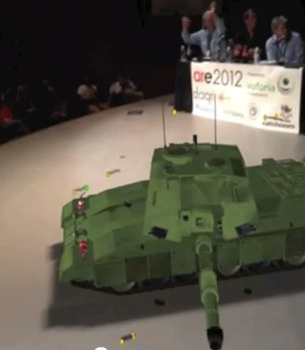
Wow, even the shadow is right.

An augmented-reality military tank that we can control from our iPhones to blast holes in real-world walls? Don’t mind if we do. This demo shown at the Agumented Reality Event 2012 (created by Ogmento, a game development company) lets users blow through surfaces in the augmented-reality environment with the tank’s cannon.

The application uses a system called Simultaneous Localization and Mapping (SLAM) in real time to project and render the tank from all perspectives in new and unknown environments. The demo video below shows how the demonstrator is able to walk around the tank and see it from different angles without using a special environment or background for the app to work with. According to Ogment, SLAM “is typically used by robots and autonomous vehicles to build up a map within an unknown environment… while at the same time keeping track of their current location.” Applying the system to AR games allows users to drop digital environment elements into any space.

Ogment is billing the tank as having “x-ray vision”—that is, when the tank spins its cannon and fires a shot at a detected surface, the AR application will display a “hole” showing “what’s behind” that surface. In the demo video, a hole blasted in the tablecloth where Will Wright and Bruce Sterling are sitting shows bottles of booze and pantless legs (though if this were real and serious AR, it would show two bloody stumps instead). Oriel Bergig, vice president of research and development at Ogment, told Ars that other pre-loaded X-ray vision themes will include “scenery” and “urban.”


from Ars Technica

From Engadget: NVIDIA CEO Jen-Hsun Huang announces cloud-based, virtualized Kepler GPU technology

NVIDIA CEO Jen-Hsun Huang announces cloud-based, virtualized Kepler GPU technology

We’re here at NVIDIA’s GPU technology conference here in San Jose, California and CEO Jen-Hsun Huang just let loose that his company plans to put Kepler in the cloud. To make it happen, the company has created a virtualized Kepler GPU tech, called VGX, so that no physical connections are needed to render and stream graphics to remote locations. So, as Citrix brought CPU virtualization to put your work desktop on the device of your choosing, NVIDIA has put the power of Kepler into everything from iPads to netbooks and mobile phones.


from Engadget

From Technology Review RSS Feeds: Antimatter Propulsion Engine Redesigned Using CERN’s Particle Physics Simulation Toolkit

Latest simulation shows that the magnetic nozzles required for antimatter propulsion could be vastly more efficient than previously thought–and built with today’s technologies

Smash a lump of matter into antimatter and it will release a thousand times more energy than the same mass of fuel in a nuclear fission reactor and some 2 billion times more than burning the equivalent in hydrocarbons.


from Technology Review RSS Feeds