Visa and MasterCard agreed to pay retailers more than $6 billion to settle a lawsuit in an agreement that also permits merchants to charge higher prices to customers who pay for purchases with credit cards.
For everything from family to computers…
Visa and MasterCard agreed to pay retailers more than $6 billion to settle a lawsuit in an agreement that also permits merchants to charge higher prices to customers who pay for purchases with credit cards.
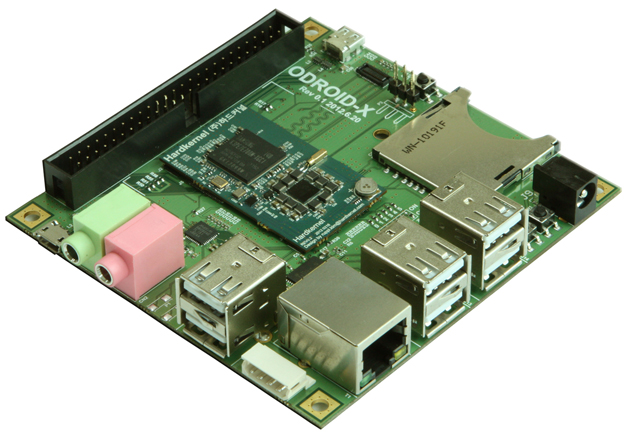
Little Linux computers have attracted a lot of interest from hobbyists this year. The $35 Raspberry Pi ARM board, which met with huge demand when it launched in February, is a compelling solution for affordable embedded projects. But what if you need more power than the 700MHz ARM11 board can offer?
A Korean hardware manufacturer called Hardkernel is launching a high-end alternative. The company’s new ODROID-X board comes with a Samsung Exynos 4 processor, a quad-core CPU clocked at 1.4GHz. The board also has a quad-core Mali 400 GPU, 1GB of RAM, six USB host ports, an ethernet adapter, headphone and microphone jacks, and an SDHC card slot for storage.
With four times as much RAM as the Raspberry Pi and a much more powerful processor, the Hardkernel board seems like a nice option for more computationally-intensive usage scenarios. The system is still highly compact, measuring at about 3.5 x 3.7 inches.
from Ars Technica

If there was doubt as to whether or not Android would soon become the majority smartphone platform in the US, that’s just been erased by Nielsen. Google crossed the tipping point in the second quarter after getting close in the winter, with 51.8 percent of current smartphone users running some variant on the green robot’s OS. As we’ve seen in the past, though, the increase is coming mostly at the expenses of platforms already being squeezed to within an inch of their lives, such as the BlackBerry (8.1 percent) and Windows (4.3 percent combined). Apple still isn’t in a position to fret: it kept climbing to 34.3 percent and swung the attention of recent buyers just slightly back in its direction. The real question for many of us might center on what happens in a summer where Samsung has thrown a Galaxy S III-sized curveball at Americans and any new iPhone is likely still a few months away.
from Engadget
German authorities are investigating thousands of Credit Suisse customers who are suspected of evading taxes with the help of insurance products sold by the Swiss bank.

Apple has withdrawn all its laptop and desktop computers from the EPEAT environmental rating system, including older MacBook Pro and MacBook Air models. According to iFixit, who recently tore down a MacBook Pro and its retina screen, that’s likely related to a design direction favoring smaller, lighter notebooks and longer battery life. Doing so required them to glue the cells to the aluminum shell, making it impossible to recycle the case and other parts — iFixit couldn’t pull the batteries out without spilling the (highly toxic) battery guts all over. Cupertino’s decision means that many federal agencies might not be able to buy those products, since 95 percent of its electronics purchasing must conform to the EPEAT standard. On top of that, many educational institutions that require the certification would also need to opt out of Mac purchases, as well as large corporations like HSBC and Ford. Currently, iPhones and iPads are exempt from that certification, but considering recent ads from Apple specifically touting its conformance to EPEAT, the company might have some ‘splaining to do.
[Image credit: iFixit]
from Engadget
Veteran Judge Posner says “animals” like Apple are just exploiting the weapons an ineffectual gov’t has created
