
These 8 Raspberry Pi attachments radically expand its powers

https://www.pcworld.com/article/2204701/the-best-extensions-for-the-raspberry-pi.html

The Raspberry Pi is already versatile out of the box. But with hardware extensions that are plugged directly onto the board, you can significantly increase the possibilities. We introduce you to some remarkable components.

With the “Hardware Attached on Top” (HAT) concept, the Raspberry has an easy way to expand its capabilities. The add-ons are simply plugged onto the GPIO pins on the board. The expansion kits usually also include plastic spacers to protect against short circuits if the main board and expansion board come too close together. The range of such extensions has grown considerably in recent years. In addition to the official HATs, the manufacturer Pimoroni stands out in particular.

In this article, we present a series of particularly interesting HAT boards. The focus is on model 4, but the boards presented here can also fit older models or the brand new Pi 5, although they do not have to. You should therefore find out about compatibility before you buy (see last point “Check before you buy!”).

Rich sound with DAC
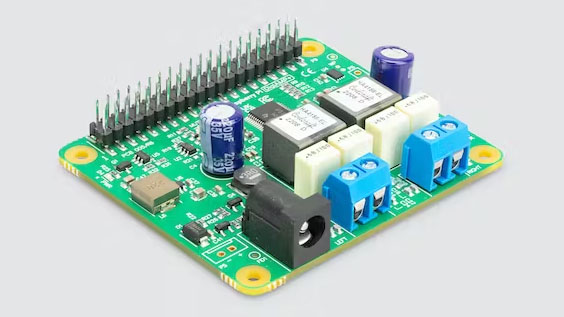
Mit einem DAC schließen Sie die Platine an passive oder aktive Lautsprecher oder an die Stereoanlage an. Damit verwandeln Sie den Raspberry in eine Streamingbox.

With a DAC, you can connect the board to passive or active speakers or to the stereo system. This turns the Raspberry into a streaming box.

Raspberry Pi Foundation

An extension that works immediately, i.e. “out of the box,” improves the sound characteristics of the board. The Raspberry Foundation has various models of such “Digital Audio Controllers” (DAC) on offer.

Which board is right for you depends on your environment. The Digi AMP+ is the right choice if you want to connect passive speakers to the computer. The board offers the usual clamp connections for the cables and delivers an output of up to 35 watts per channel. That’s definitely enough for the living room at home.

The Raspberry Pi DAC or its Plus version, on the other hand, are intended for active speakers. They offer the classic connection via banana plugs. In such a system, the speaker with the integrated amplifier is connected to the signal source. The HATs convert digital signals into analog signals so that you can connect the Raspberry either directly to loudspeakers or the stereo system (AUX input). In combination with the right software, you can turn the Raspberry Pi into a streaming box for the WLAN or use it to play music stored on data storage media.

For all Lego fans
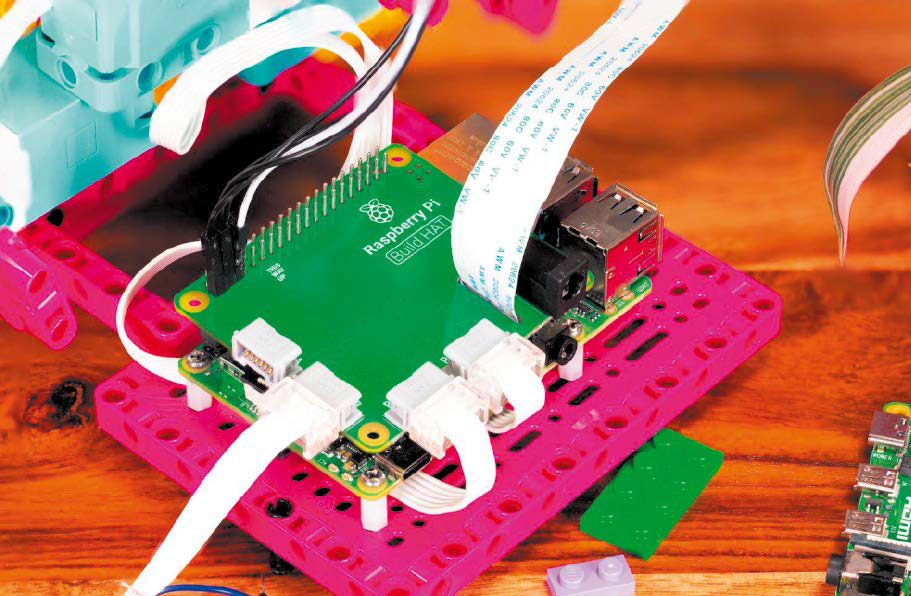
Mit dem HAT für Lego-Bastler eröffnen sich neue Möglichkeiten, um Sensoren und Motoren aus dem Lego-Kosmos per Raspberry zu steuern.

The HAT for Lego hobbyists opens up new possibilities for controlling sensors and motors from the Lego cosmos via Raspberry.

IDG

The Raspberry Pi Build HAT expansion board, which can control up to four motors and sensors — including components from the Mindstorm cosmos — is available for all ambitious Lego hobbyists who are intensively involved with Lego Technics. You can even find a Lego board in specialized shops, which you can use to integrate the board directly into your Lego creations. You can connect most components that use an LPF2 connection. Details on compatibility can be found on the board’s official product page.

But beware: The integrated power supply is not sufficient to operate a motor on the board.

An external power supply unit is offered as a supplement to the HAT board, which is only suitable for this component. You cannot use this power supply unit to operate the Pi 400, for example. There is an extensive library for Python projects to control distance, motion, or color sensors, which is explained in detail.

The extension costs just under $30. The matching power supply then costs a little less than $20.

Raspbee II: For home automation
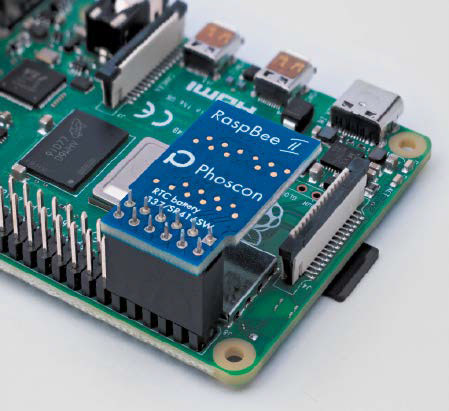
Diese kleine Platine wirkt unscheinbar, bewirkt aber viel: Damit erlauben Sie dem Raspberry die Kommunikation mit Smarthome-Geräten, die den Zigbee- Standard verwenden.

This small circuit board looks inconspicuous, but does a lot: it allows the Raspberry to communicate with smart home devices that use the Zigbee standard.

Raspbee

Are you looking for a way to control your smart home centrally via the Raspberry Pi? Then you should definitely take a look at the Raspbee II board. As the name suggests, it is an extension that communicates with devices that use the Zigbee standard. The tiny board even has a slot for a battery so that devices can be controlled via a real-time clock (RTC).

The basic idea is to get rid of the various gateways from other manufacturers. This also works as long as the components are recognized by the manufacturer’s software. It is therefore worth looking through the documentation before making a purchase decision. After all, Zigbee is just a communication protocol. The “magic” of the control system must then be performed by software.

This useful addition to the smart home costs less than $30.

Game Hat: The Raspberry becomes a console
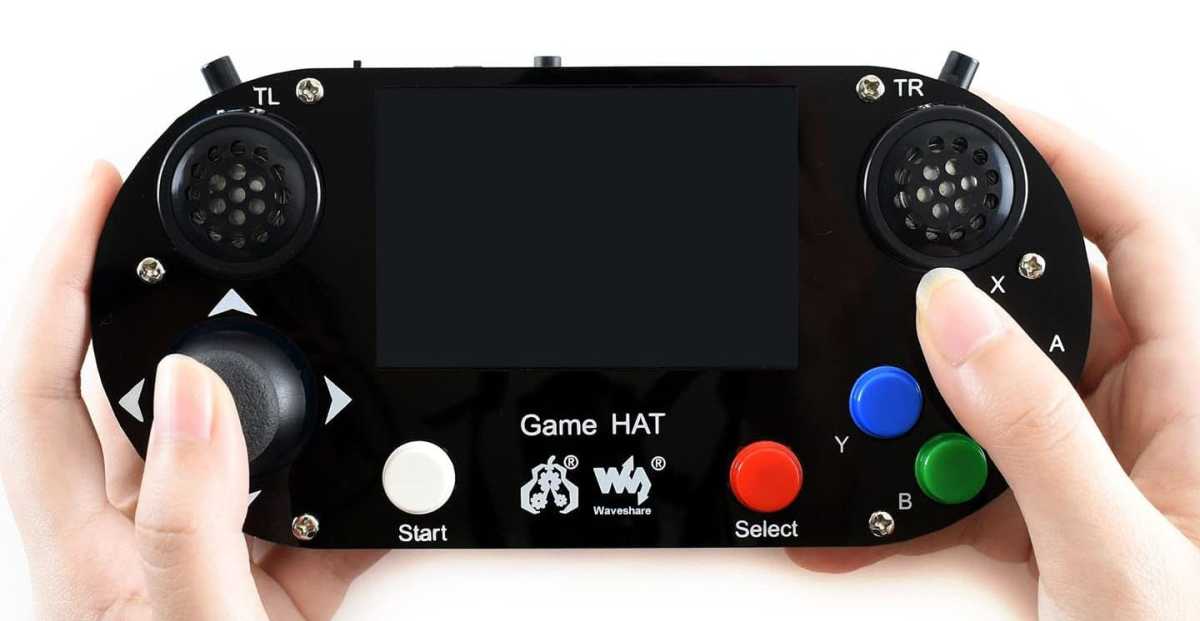
Wer hängt nun an wem? Egal - das Game HAT macht aus dem kleinen Computer eine Minispielkonsole und ist damit die ideale Basis für Retro-Pie.

Who is connected to whom? It doesn’t matter — the Game HAT turns the small computer into a mini-game console, making it the ideal basis for retro games.

Waveshare

We presented the Retro-Pie project many years ago: The aim is to transform the small circuit board into a game console. The ideal companion for this project is the Game HAT from Waveshare. However, it is sometimes only available in Germany with a waiting period.

The term “HAT” doesn’t really fit here, because the Raspberry Pi is connected to the hardware of the gamepad. The Game HAT comes with a 3.5-inch screen with a resolution of 480×320 pixels and 60 FPS. This should easily suffice for classic games.

Two small speakers and a connection option for headphones are integrated. The usual buttons familiar from other gamepads are grouped around it. There are also two triggers on the top of the housing. However, these are quite delicate — so you shouldn’t play quite so wildly in order to keep the game fun for as long as possible.

It is very easy to set up. A battery is required to power the entire system so that you can play anytime and anywhere. You can find the specifications for purchasing the external power source in the product description and in the project wiki.

The manufacturer states that up to two hours of battery life are possible. However, this is very optimistic. In practice and when actively playing a game, the playing time is more likely to be a good hour. However, this does not detract from the fun with the extension, which costs around $45.

Machine learning with the Pi
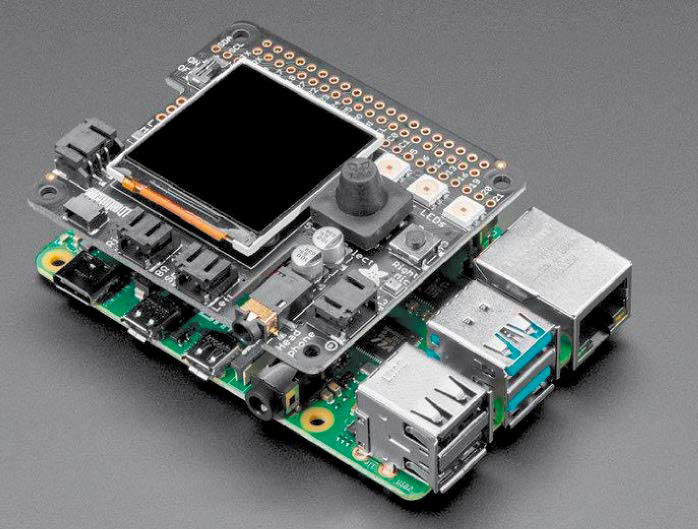
Für maschinelles Lernen sind zunächst viele Proben zu ziehen, etwa für die Bilderkennung. Dieser Aufsatz stellt eine Vielzahl von Schnittstellen bereit, erwartet aber eine solide Einarbeitung.

For machine learning, many samples must first be taken — for example, for image recognition. This add-on provides a large number of interfaces, but requires solid familiarisation.

IDG

Fascinating projects are possible with the Braincraft HAT. However, you also need to be willing to familiarize yourself with the complex subject matter. The extension is not for a “quick project” at a weekend.

The idea behind the add-on is to offer (even professional users) a way to create “brains” for machine learning in a wide variety of locations. Professionals also like to talk about edge computing in this context.

The “eyes” and other senses still need to be added to the combination of HAT and circuit board. But thanks to the versatile connection options, this is quite easy to do. The Braincraft HAT has a 240×240 TFT IPS screen to output feedback from the system, slots for camera connection cables for image processing projects, a five-way joystick, left and right microphones, stereo headphone output, stereo 1W speaker output, and three RGB dotstar LEDs. A Stemma QT connection allows the connection of thermal sensors. Optionally, you can also install a fan on the underside, which then keeps the board at a comfortable temperature for computing-intensive projects.

For a good $40, you get a very solid basis for your projects. The manufacturer shows the versatile possibilities in a series of videos on the product page.

Display: ‘Let there be touch’

Input directly on the screen? That’s no problem either. The resistive 3.5-inch display from Waveshare is a real HAT, which you simply attach to the GPIO bar as usual. The scope of delivery also includes the matching stylus. The drivers enable problem-free operation under Ubuntu Mate or Retropie. For around $40, you can add this simple input option to the Raspberry.

A touch display with a resolution of 800×480 pixels is available from the same manufacturer, which is significantly larger at 5 inches and capacitive (i.e. reacts to simple touch without pressure). This transforms the Pi into a small tablet. The drivers work excellently. As with other tablets, you can control the brightness of the screen directly on the desktop.

However, this display is not a direct HAT: Instead, you connect the board via a camera bar and cable. It wouldn’t have made much sense the other way round, as the screen is larger than the board itself. The advantage of this design is that the GPIO pins remain available and accessible.

And if you don’t want to design your own housing with a 3D printer, you can find a whole range of housings in electronics stores, some of which also have a stand to build a kind of kiosk system.

The street price for the larger display is around $50.

Essential HATs for hobbyists
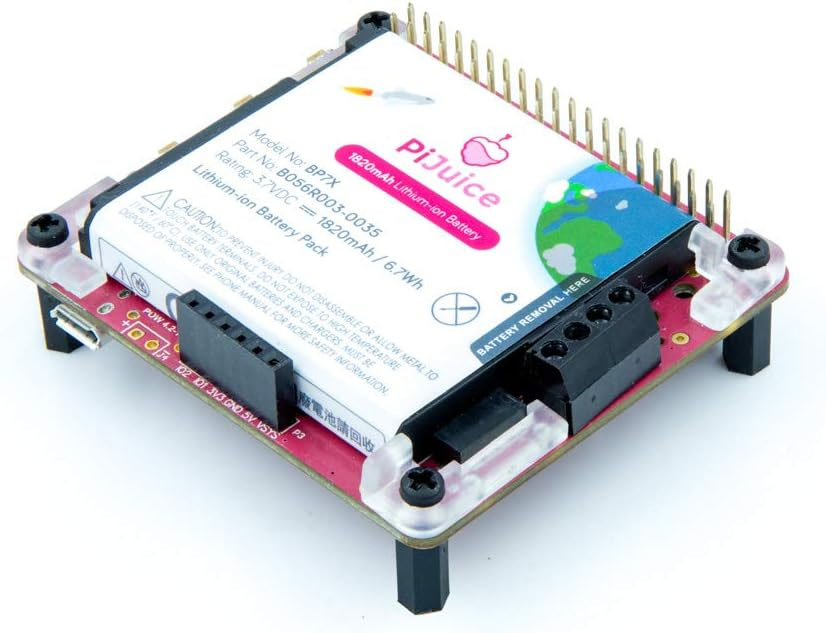
Viel Leistung, die aber ihren Preis hat: Mit diesem HAT spendieren Sie dem Raspberry Pi eine externe Stromversorgung mit großer Kapazität.

A lot of power, but at a price: With this HAT you can give the Raspberry Pi an external power supply with a large capacity.

PiJuice

One of the challenges for all outdoor projects is supplying the computer with power. This is because there is not always a power socket near the place of use. You can find a whole range of circuit boards that can supply the Raspi with power independently in the well-known electrical shops under the keyword “UPS.” These are often battery packs into which you only need to insert conventional rechargeable batteries. Waveshare, for example, has the UPS HAT on offer.

The Pi Juice is more expensive. For a good $50 upwards, you get a battery with a capacity of 1820 mAh. Performance has its price. Longer delivery times are also to be expected. The circuit board includes a Real Time Clock so that time controls and time stamps remain accurate.

Do you have a network switch that can supply power to devices connected via Ethernet cable? Then the official PoE+ HAT is a good choice for supplying the minicomputer with power via the Ethernet cable. The board can cope with input voltages from 37 to 57V and then supplies a constant 5V to the board. An integrated fan allows the higher temperature at the interface to dissipate. Before buying, however, you should check the voltage and therefore the power supplied by the network switch. If this is suitable, the $20 are a sensible investment for many work situations.
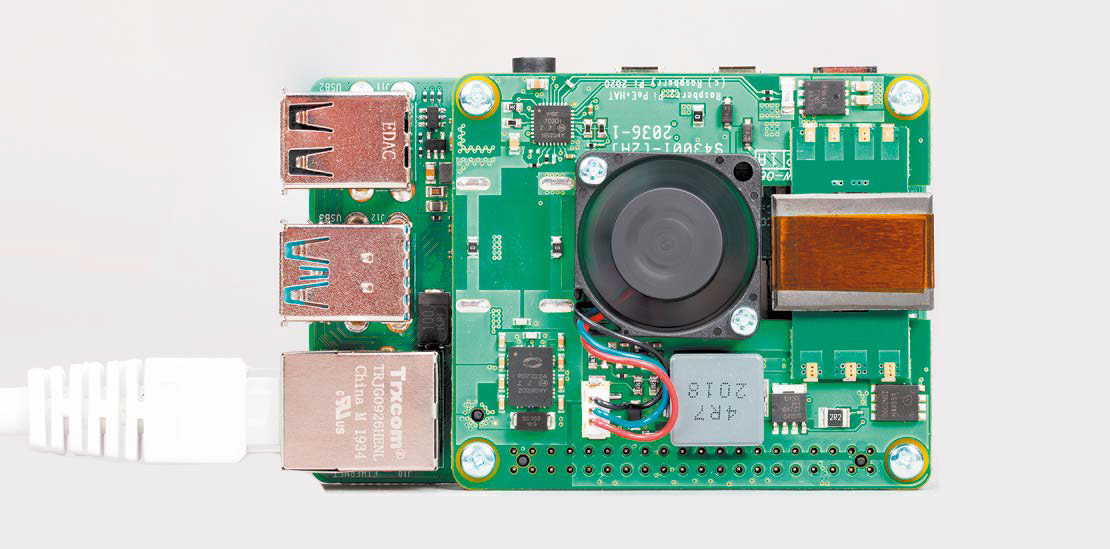
Sofern Sie einen Netzwerkswitch besitzen, der als Stromversorgung dienen kann, ist dieses HAT das passende Gegenstück.

If you have a network switch that can be used as a power supply, this HAT is the right counterpart.

IDG

Getting started with robotics

Admittedly: At around $60 for a pure starter kit, the Trilobot from Pimoroni is no bargain. However, it forms the basis for entering the fascinating world of robotics. This is ensured by the extensive software library which, as usual from the manufacturer, is well documented.

What else do you need to buy to enjoy the full fun? Of course, you need a Raspberry Pi with the SD card as a basis. As this is the base for a mobile robot, you will also need a power supply that is independent of location. The excellent instructions show you how to attach the battery pack. You should definitely consult these before purchasing additional parts. A Raspberry Pi v2 camera is also quickly added to the shopping list so that you can also “see” from the robot’s perspective.

And what do you get for your money? Well, in this case too, “HAT” is rather misleading, because you actually install the Raspberry Pi 4 in the construction. This comprises a circuit board on which there are two electric motors that propel the wheels, which are reminiscent of a lunar vehicle. To avoid collisions, the kit has ultrasonic distance sensors. And to make driving the robot look really cool, RGB LEDs on the underside provide atmospheric lighting. The kit is of course also great for all employees in educational institutions to teach the basics of robotics.

Take note before you buy!

There is a wide range of HATs for the Raspberry family. Before buying, it is best to consider a few basic requirements.

Firstly, the most obvious: If you have given the Raspberry a housing, you will probably have to make a new investment. This is because the add-on will naturally increase the overall height and the hardware will no longer fit into the housing.

Then check the compatibility: The manufacturer’s product description should explicitly mention the Raspberry model you are using. The expansion board must fit both mechanically and on the connection side.

The extension must also be controllable. Software is therefore required in order to benefit from it. Find out in advance how this is done. In most cases, you will be able to access the components and pins via Python (libraries). Check whether the manufacturer provides tutorials or sample applications on their website.

via PCWorld https://www.pcworld.com

January 19, 2024 at 06:32AM

Meet the Disney Imagineer Behind the VR Breakthough That Is the ‘HoloTile’

https://gizmodo.com/vr-breakthough-holotile-disney-imagineering-lanny-smoot-1851178431

The legacy of invention and technology that comes out of Disney Imagineering is some of the closest we’ll get to a sci-fi future. And two of Disney Parks’ most recent incredible projects come from Lanny Smoot, a Disney legend who has already patented over 100 inventions, 74 of which are at Disney Imagineering—including Madame Leota’s floating head.

Spoilers of the Week Feb.11th

You’ll be familiar with his work on that incredible lightsaber he made as real as possible with retractable “laser” action. And now he’s made a very real HoloDeck-inspired invention, a game-changer for the world of VR. “We call it the HoloTile floor,” Smoot shared in a video released by Disney Parks to celebrate his induction into the National Inventors Hall of Fame; he’s only the second Disney inventor to become a member. The first was Walt Disney himself, for his work on the multi-plane camera.

Smoot’s legacy includes a number of Imagineering feats; as mentioned above, he’s the brains behind that Star Wars lightsaber wielded by Rey in promotional videos shot around Galaxy’s Edge to introduce the tech seen up close on Star Wars’ now-shuttered Galactic Starcruiser. In the video interview he does say it’s made for the parks, so hopefully we’ll see it pop up at special events or as part of future shows in Batuu. But the star of the video is certainly the HoloTile floor itself.

Smoot describes it as a “omnidirectional floor” you can walk on in any direction you want. He explained, “It will automatically do whatever it needs to have me stay on the floor. And what’s amazing about this is multiple people can be on it and all walking independently. They can walk in virtual reality and so many other things.” Take a look at the image below which gives you a glimpse at the rotating tiles, which simulate the act of walking throughout a space while not leaving that tile mat. It’s so wild to see how you can walk through places like Disneyland in VR on a HoloTile.

He continued, “Imagine a number of people being in a room, being able to be somewhere else collaboratively and moving around … doing sightseeing. Imagine theatrical stages that might have these embedded in them so dancers can do amazing moves. There’s so many applications for this type of technology.” He added they don’t know yet where the company will use it, but we are very excited to find out. Based on some the demonstration seen in the video, we wonder if it might be paired with his lightsaber for Star Wars stage shows—we definitely think the interviewer was practicing Force-pushing Smoot on a chair over the HoloTiles near the end. The Imagineer looks to be having a blast, and he clearly loves his job. Smoot admits, “It gives me an amazing opportunity to use these inventions that I’ve made in service of people having fun.”

Watch the video interview and tech demonstration below!

Disney Imagineer Makes History | Disney Parks

Hopefully we’ll be seeing the HoloTile in action soon at Disney Parks.


Want more io9 news? Check out when to expect the latest Marvel, Star Wars, and Star Trek releases, what’s next for the DC Universe on film and TV, and everything you need to know about the future of Doctor Who.

via Gizmodo https://gizmodo.com

January 18, 2024 at 07:09PM

‘Stablecoins’ Enabled $40 Billion in Crypto Crime Since 2022

https://www.wired.com/story/stablecoin-sanctions-violations-crypto-crime/

Stablecoins, cryptocurrencies pegged to a stable value like the US dollar, were created with the promise of bringing the frictionless, border-crossing fluidity of Bitcoin to a form of digital money with far less volatility. That combination has proved to be wildly popular, rocketing the total value of stablecoin transactions since 2022 past even that of Bitcoin itself.

It turns out, however, that as stablecoins have become popular among legitimate users over the past two years, they were even more popular among a different kind of user: those exploiting them for billions of dollars of international sanctions evasion and scams.

As part of its annual crime report, cryptocurrency-tracing firm Chainalysis today released new numbers on the disproportionate use of stablecoins for both of those massive categories of illicit crypto transactions over the last year. By analyzing blockchains, Chainalysis determined that stablecoins were used in fully 70 percent of crypto scam transactions in 2023, 83 percent of crypto payments to sanctioned countries like Iran and Russia, and 84 percent of crypto payments to specifically sanctioned individuals and companies. Those numbers far outstrip stablecoins’ growing overall use—including for legitimate purposes—which accounted for 59 percent of all cryptocurrency transaction volume in 2023.

In total, Chainalysis measured $40 billion in illicit stablecoin transactions in 2022 and 2023 combined. The largest single category of that stablecoin-enabled crime was sanctions evasion. In fact, across all cryptocurrencies, sanctions evasion accounted for more than half of the $24.2 billion in criminal transactions Chainalysis observed in 2023, with stablecoins representing the vast majority of those transactions.

The attraction of stablecoins for both sanctioned people and countries, argues Andrew Fierman, Chainalysis’ head of sanctions strategy, is that it allows targets of sanctions to circumvent any attempt to deny them a stable currency like the US dollar. “Whether it’s an individual located in Iran or a bad guy trying to launder money—either way, there’s a benefit to the stability of the US dollar that people are looking to obtain,” Fierman says. “If you’re in a jurisdiction where you don’t have access to the US dollar due to sanctions, stablecoins become an interesting play.”

As examples, Fierman points to Nobitex, the largest cryptocurrency exchange operating in the sanctioned country of Iran, as well as Garantex, a notorious exchange based in Russia that has been specifically sanctioned for its widespread criminal use. Stablecoin usage on Nobitex outstrips bitcoin by a 9:1 ratio, and on Garantex by a 5:1 ratio, Chainalysis found. That’s a stark difference from the roughly 1:1 ratio between stablecoins and bitcoins on a few nonsanctioned mainstream exchanges that Chainalysis checked for comparison.

Chainalysis concedes that the analysis in its report excludes some cryptocurrencies like Monero and Zcash that are designed to be harder or impossible to trace with blockchain analysis. It also says it based its numbers on the type of cryptocurrency sent directly to an illicit actor, which may leave out other currencies used in money laundering processes that repeatedly swap one type of cryptocurrency for another to make tracing more difficult.

via Wired Top Stories https://www.wired.com

January 18, 2024 at 08:06AM

Google’s Circle to Search is the Coolest New Feature on Your Pixel 8, Galaxy S24

https://www.droid-life.com/2024/01/17/google-circle-to-search-pixel-8-galaxy-s24/

Ready for one of the biggest feature introductions to Google Search on Android in some time? The introduction of it starts today and it should hit select devices by the end of the month. It’s called “Circle to Search” and it looks pretty awesome.

Google announced Circle to Search as a part of the Galaxy S24 launch because the S24 Series are a few of the select devices capable of performing this action. The other two devices at the moment are the Pixel 8 and Pixel 8 Pro. Everyone else, it’s either time to consider buying a new device or remaining incredibly patient until Google tells us if they’ll expand this to others.

What is Circle to Search in Google Search? As the name suggests, you get to circle items anywhere on your phone to then search about them. You can also scribble over top of them, tap, or highlight a word, all of which will get you instant search results about objects or words.

To do this, you’ll long press on the navigation bar at the bottom of your device (or long-press the home button) to initiate. Once done, a Google-powered overlay appears that lets you swipe, scribble over, tap, or circle to get the search started. The results should be related and I’m sure you can figure out why this is useful.

Google Circle to Search

In a blog post, Google provides some ideas, like searching for items a person is wearing in an Instagram post, finding out what a phrase means that you keep seeing on the internet, or by circling an object and then using multisearch to also ask a question with it.

This should work over almost any screen, including videos, text messages, and other apps. The idea is that you can perform a search of items on your screen at any time and then get specific info. After your search is over, you can swipe away the overlay and get right back to what you were doing. This, of course, is using Google AI, but whatever.

Multisearch using Google Lens. In addition to circling items to search, Google is expanding Google Lens into the multisearch world I described above. Now, you can use Lens to point your camera at an object and then use the image of that object to ask for additional information.

For example, you might see a plant and want to know when exactly it needs to be watered. Google Lens with Google Search and AI could help you figure that out, as it identifies the plant and then finds information (like when to water) about it. For another example, you can look at the image below where you’ll see someone taking a picture of a board game and asking how to play it. The results identify the game and then use AI to summarize how you might get started playing it.

Google Lens Multisearch

When can you use Circle to Search and multisearch in Google Lens? Soon! Circle to Search launches January 31 on the Pixel 8, Pixel 8 Pro, and Galaxy S24 Series. Google Lens with multisearch launches today, you just need to get the latest update to the Google App.

Pretty cool stuff, right?

// Google

Read the original post: Google’s Circle to Search is the Coolest New Feature on Your Pixel 8, Galaxy S24

via Droid Life: A Droid Community Blog https://ift.tt/snZAVcg

January 17, 2024 at 12:07PM

A Flaw in Millions of Apple, AMD, and Qualcomm GPUs Could Expose AI Data

https://www.wired.com/story/leftoverlocals-gpu-vulnerability-generative-ai/

As more companies ramp up development of artificial intelligence systems, they are increasingly turning to graphics processing unit (GPU) chips for the computing power they need to run large language models (LLMs) and to crunch data quickly at massive scale. Between video game processing and AI, demand for GPUs has never been higher, and chipmakers are rushing to bolster supply. In new findings released today, though, researchers are highlighting a vulnerability in multiple brands and models of mainstream GPUs—including Apple, Qualcomm, and AMD chips—that could allow an attacker to steal large quantities of data from a GPU’s memory.

The silicon industry has spent years refining the security of central processing units, or CPUs, so they don’t leak data in memory even when they are built to optimize for speed. However, since GPUs were designed for raw graphics processing power, they haven’t been architected to the same degree with data privacy as a priority. As generative AI and other machine learning applications expand the uses of these chips, though, researchers from New York–based security firm Trail of Bits say that vulnerabilities in GPUs are an increasingly urgent concern.

“There is a broader security concern about these GPUs not being as secure as they should be and leaking a significant amount of data,” Heidy Khlaaf, Trail of Bits’ engineering director for AI and machine learning assurance, tells WIRED. “We’re looking at anywhere from 5 megabytes to 180 megabytes. In the CPU world, even a bit is too much to reveal.”

To exploit the vulnerability, which the researchers call LeftoverLocals, attackers would need to already have established some amount of operating system access on a target’s device. Modern computers and servers are specifically designed to silo data so multiple users can share the same processing resources without being able to access each others’ data. But a LeftoverLocals attack breaks down these walls. Exploiting the vulnerability would allow a hacker to exfiltrate data they shouldn’t be able to access from the local memory of vulnerable GPUs, exposing whatever data happens to be there for the taking, which could include queries and responses generated by LLMs as well as the weights driving the response.

In their proof of concept, as seen in the GIF below, the researchers demonstrate an attack where a target—shown on the left—asks the open source LLM Llama.cpp to provide details about WIRED magazine. Within seconds, the attacker’s device—shown on the right—collects the majority of the response provided by the LLM by carrying out a LeftoverLocals attack on vulnerable GPU memory. The attack program the researchers created uses less than 10 lines of code.

An attacker (right) exploits the LeftoverLocals vulnerability to listen to LLM conversationsVideo: Trail of Bits

Last summer, the researchers tested 11 chips from seven GPU makers and multiple corresponding programming frameworks. They found the LeftoverLocals vulnerability in GPUs from Apple, AMD, and Qualcomm, and launched a far-reaching coordinated disclosure of the vulnerability in September in collaboration with the US-CERT Coordination Center and the Khronos Group, a standards body focused on 3D graphics, machine learning, and virtual and augmented reality.

The researchers did not find evidence that Nvidia, Intel, or Arm GPUs contain the LeftoverLocals vulnerability, but Apple, Qualcomm, and AMD all confirmed to WIRED that they are impacted. This means that well-known chips like the AMD Radeon RX 7900 XT and devices like Apple’s iPhone 12 Pro and M2 MacBook Air are vulnerable. The researchers did not find the flaw in the Imagination GPUs they tested, but others may be vulnerable.

An Apple spokesperson acknowledged LeftoverLocals and noted that the company shipped fixes with its latest M3 and A17 processors, which it unveiled at the end of 2023. This means that the vulnerability is seemingly still present in millions of existing iPhones, iPads, and MacBooks that depend on previous generations of Apple silicon. On January 10, the Trail of Bits researchers retested the vulnerability on a number of Apple devices. They found that Apple’s M2 MacBook Air was still vulnerable, but the iPad Air 3rd generation A12 appeared to have been patched.

via Wired Top Stories https://www.wired.com

January 16, 2024 at 11:09AM

How a 27-Year-Old Codebreaker Busted the Myth of Bitcoin’s Anonymity

https://www.wired.com/story/27-year-old-codebreaker-busted-myth-bitcoins-anonymity/

Just over a decade ago, Bitcoin appeared to many of its adherents to be the crypto-anarchist holy grail: truly private digital cash for the internet.

Satoshi Nakamoto, the cryptocurrency’s mysterious and unidentifiable inventor, had stated in an email introducing Bitcoin that “participants can be anonymous.” And the Silk Road dark-web drug market seemed like living proof of that potential, enabling the sale of hundreds of millions of dollars in illegal drugs and other contraband for bitcoin while flaunting its impunity from law enforcement.

This is the story of the revelation in late 2013 that Bitcoin was, in fact, the opposite of untraceable—that its blockchain would actually allow researchers, tech companies, and law enforcement to trace and identify users with even more transparency than the existing financial system. That discovery would upend the world of cybercrime. Bitcoin tracing would, over the next few years, solve the mystery of the theft of a half-billion dollar stash of bitcoins from the world’s first crypto exchange, help enable the biggest dark-web drug market takedown in history, lead to the arrest of hundreds of pedophiles around the world in the bust of the dark web’s largest child sexual abuse video site, and result in the first-, second-, and third-biggest law enforcement monetary seizures in the history of the US Justice Department.

That 180-degree flip in the world’s understanding of cryptocurrency’s privacy properties, and the epic game of cat-and-mouse that followed, is the larger saga that unfolds in the book Tracers in the Dark: The Global Hunt for the Crime Lords of Cryptocurrency, out this week in paperback.

All of it began with the work of a young, puzzle-loving mathematician named Sarah Meiklejohn, the first researcher to pull out traceable patterns in the apparent noise of Bitcoin’s blockchain. This excerpt from Tracers in the Dark reveals how Meiklejohn came to the discoveries that would launch that new era of crypto criminal justice.

In early 2013, the shelves of a windowless storage room in a building of the University of California, San Diego, began to fill up with strange, seemingly random objects. A Casio calculator. A pair of alpaca wool socks. A small stack of Magic: The Gathering cards. A Super Mario Bros. 3 cartridge for the original Nintendo. A plastic Guy Fawkes mask of the kind popularized by the hacker group Anonymous. An album by the classic rock band Boston on CD.

Periodically, the door would open, the light would turn on, and a petite, dark-haired graduate student named Sarah Meiklejohn would enter the room and add to the growing piles of miscellaneous artifacts. Then Meiklejohn would walk back out the door, down the hall, up the stairs, and into an office she shared with other graduate students at the UC San Diego computer science department. One wall of the room was almost entirely glass, and it looked out onto the sunbaked vista of Sorrento Valley and the rolling hills beyond. But Meiklejohn’s desk faced away from that expanse. She was wholly focused on the screen of her laptop, where she was quickly becoming one of the strangest, most hyperactive Bitcoin users in the world.

via Wired Top Stories https://www.wired.com

January 17, 2024 at 05:03AM

‘Star Trek’ on Mars? Curiosity rover spots Starfleet symbol on Red Planet

https://www.space.com/curiosity-mars-rover-star-trek-symbol-rock

Did someone leave a communicator badge lying on Mars?

NASA’s long-running Curiosity rover mission just spotted a familiar shape to "Star Trek" fans: The iconic delta-shaped emblem that Starfleet officers typically wear on their uniforms. Unfortunately, it would be highly illogical to say that a Starfleet landing party walked near Curiosity’s roving grounds, as the image was of a mere Mars rock that just so happens to resemble the "Star Trek" symbol.

The image was originally posted on the Mars Curiosity raw images site provided by NASA’s Jet Propulsion Laboratory (JPL). It was taken with the rover’s left navigation camera on Mars day, or sol, 4062 of the mission on Jan. 9.

Amateur astronomer Scott Atkinson spotted the Trekkie symbol and joked about it on X, formerly Twitter. "I bet the Star Trek fans on the @MarsCuriosity team smiled like Cheshire Cats when they saw this new image appear on their screens," Atkinson posted on Jan. 10, alongside the image and a close-up of the delta sign.

Related: NASA spacecraft spots ‘Star Trek’ logo on Mars

Curiosity landed on Mars on Aug. 5, 2012 and continues to roll on in its long-standing search for the conditions of life on the Red Planet. As a part of that long mission, it is climbing a mountain nicknamed Mount Sharp (or Aeolis Mons) and peering at the layers embedded in it to see how water flowed in the ancient past of Mars.

"Different layers of Mount Sharp represent different eras of Martian history. As Curiosity ascends, scientists learn more about how the landscape changed over time," JPL officials wrote in September 2023. The rover is now in a zone that is filled with sulfate, the statement added, "which may be the highest elevation layer it will ever visit."

Curiosity took the pictures while it was about to do "contact science on a flat block of dark-toned bedrock", according to a Jan. 9 update on the mission’s blog. One of its near-term goals will be to examine, in the rocks, "composition and texture of the dark bands we’ve been observing from orbit" using several instruments.

A Starfleet communicator badge worn by Nyota Uhura (Lt. Celia Rose-Gooding) in "Star Trek: Strange New Worlds." (Image credit: Star Trek Explorer)

The success of Curiosity at Gale Crater allowed NASA to send a follow-up rover mission, Perseverance, to the Red Planet’s Jezero Crater in 2020. Perseverance is hunting for signs of ancient Red Planet life. 

NASA is also planning a Mars sample return mission that should bring back caches of rocks that Perseverance is laying aside, but funding and technology issues will likely push back its expected 2031 return date.

Join our Space Forums to keep talking space on the latest missions, night sky and more! And if you have a news tip, correction or comment, let us know at: community@space.com.

via Space https://www.space.com

January 16, 2024 at 02:37PM