A nerdy father of two, a husband of a beautiful and understanding wife, an engineer who loves anime and tinkering with PCs and games, but most of all, loves God.
Cold weather is still one of the biggest real-world hurdles for EVs. When temperatures drop, battery chemistry slows down, internal resistance goes up, and the car has to work harder just to keep the battery and cabin warm. Even with the latest thermal management tech, range loss is something you can’t fully escape.
To see just how much cold weather hits EV range, Norwegian publication Motor ran its annual winter test. They took a wide mix of EVs through snowy highways and mountain roads, with temperatures dropping to -31°C (-24°F). According to the publication, each car was driven in normal conditions until it couldn’t safely go any farther.
At the end of the test, every EV in the test fell short of its certified range, and plenty lost more than a third of what’s promised. Of note, WLTP ratings, used in Europe, are more generous than US EPA numbers.
But here’s what really stood out: it wasn’t about which EV went the farthest, but which ones came closest to their rated range. And most of those top performers aren’t sold in the US.
Lucid
Highlights from the Test
Motor’s results highlight how much winter can cut into range, even for high-end, long-range EVs. The Lucid Air managed the longest real-world run at 323 miles, but that’s still a 46 percent drop from its 597-mile WLTP rating. The Mercedes-Benz CLA went from 441 miles to 262, a 41 percent hit. The Audi A6 e-tron dropped from 406 miles to 250, losing 38 percent.
Other big-name EVs saw the same kind of drop. The BMW iX managed 241 miles, down from a 398-mile WLTP figure – a 39 percent loss. The Tesla Model Y hit 223 miles versus its 391-mile rating, down 43 percent. Even the new Hyundai Ioniq 9 only managed 230 miles on an official 373-mile range, a 38 percent decline.
Least Affected EVs – All Not Sold in America
When ranked by percentage deviation rather than total distance, a different set of EVs emerges as the top performers. Compared to EVs that lost over 40 percent of their range, these models clearly have the edge in winter consistency. Most of them focus on smaller size, efficiency, and moderate power rather than headlining figures.
Model
WLTP Range (miles)
Achieved Range (miles)
Deviation
MG6S EV
301
214
-29%
Hyundai Inster
224
159
-29%
MG IM6
314
219
-30%
KGM Musso
235
163
-31%
Voyah Courage
273
186
-32%
Here’s the catch: none of these top winter performers are sold in America. Some are built in China, like the MGS6 EV; others are for Europe or select global markets, like the Hyundai Inster and KGM Musso. For now, American buyers can’t get their hands on the EVs that seem best suited for extreme cold.
Norway’s latest winter test drives home a simple point: if you live somewhere that’s cold for much of the year, range consistency matters more than big battery numbers.
Space is getting crowded — nowadays, over 45,000 human-made objects orbit Earth. A portion of that figure is indeed represented by the thousands of satellites humans use for internet, GPS and other communications, but it also takes into account space junk from humanity’s previous space escapades.
Thus, figuring how to prevent collisions has become more important as space agencies continue to rocket new technology into low Earth orbit — and there’s already a brisk launch schedule planned for 2026. As such, researchers at the Lawrence Livermore National Laboratory (LLNL) in California have developed a new method for modeling orbits in cislunar space, which refers to the space between and around Earth and the moon.
"When you have a million orbits, you can get a really rich analysis using machine learning applications," LLNL scientist Denvir Higgins said in an announcement. "You can try to predict the lifetime of the orbit, try to predict stability or try to do anomaly detection to see if an orbit is moving in a strange way."
The researchers found that about half of the orbits they modeled remained stable for at least one year, and just under 10% remained stable for the full six years of the simulation.
"If you want to know where a satellite is in a week, there’s no equation that can actually tell you where it’s going to be," LLNL scientist Travis Yeager said in the release. "You have to step forward a little bit at a time."
The amount of computing power required to track a million obits over a six-year period in a simulated environment is significant. LLNL said they used 1.6 million CPU hours, which would take more than 182 years to process on a single computer. But using the lab’s Quartz and Ruby supercomputers, it only took three days to run the simulations.
Get the Space.com Newsletter
Breaking space news, the latest updates on rocket launches, skywatching events and more!
This work could be helpful in the future for determining busy intersections for satellites, LLNL says. The lab also noted that, as countries continue to launch satellites without worldwide coordination, this could be a useful tool.
If Google keeps bothering you to pay for cloud storage, it’s not just you. You only get a relatively measly 15GB of storage free of charge with a Google account, and you have to split that across Gmail, Google Photos, and Google Drive.
That 15GB can fill up quickly, but it doesn’t have to. We’ve curated a few tricks to help trim down space in all three of these key Google apps. That can mean you won’t have to pay Google every month for file space in the cloud.
These tips focus on the various web apps, but you’ll find you can access the same features from the mobile apps too (though the buttons and menus may be laid out differently).
Gmail
In Gmail, scroll down to the bottom of your inbox and click the X% of X GB link to see how much space Gmail is using (the exact label will vary depending on your Gmail usage). Once you know the severity of the situation, you can start doing something about it.
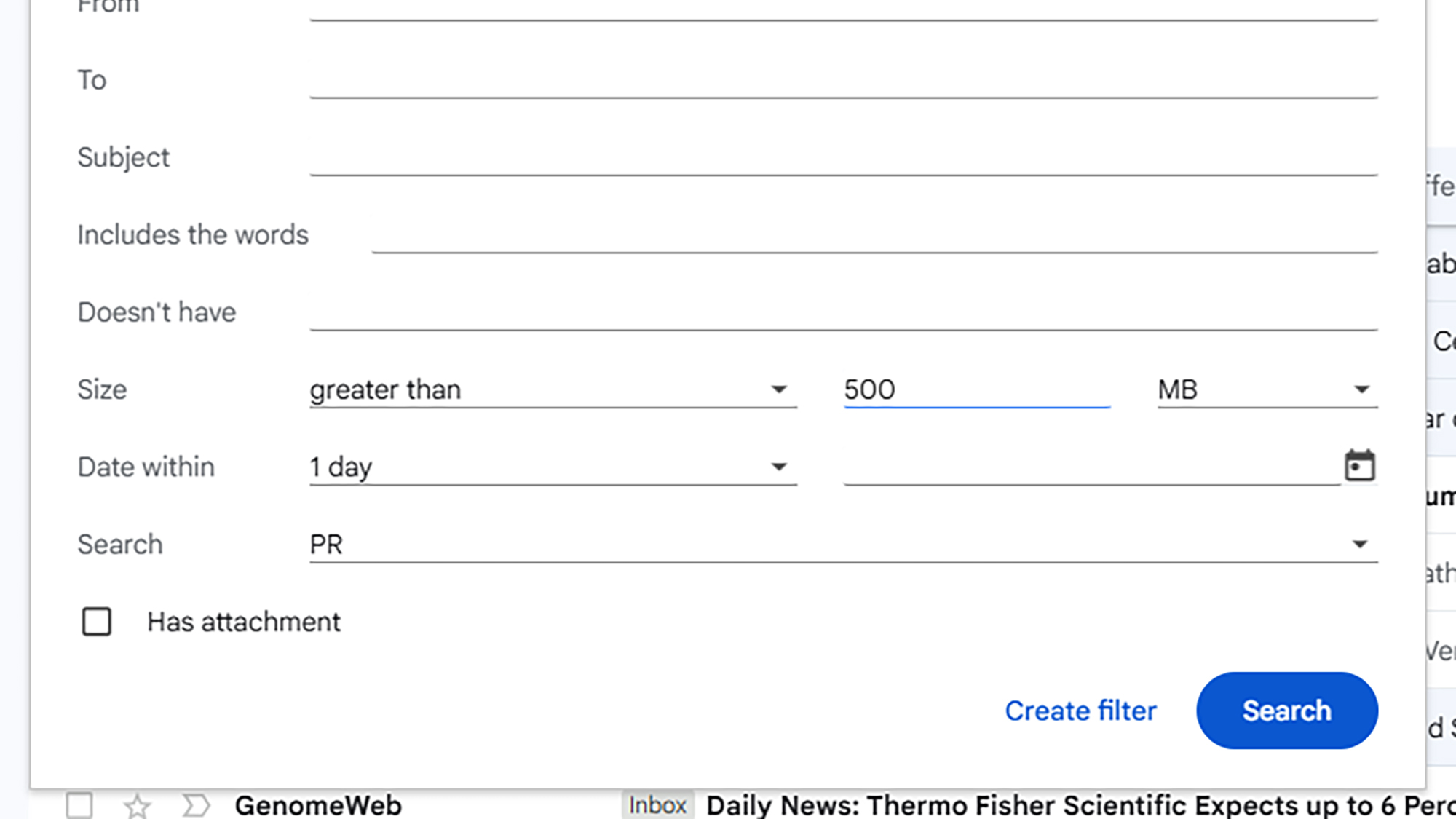
The search box up at the top of the screen is your main tool here: Click the slider icon to the right of it to see your options. You can search for a particular sender, for example, or a particular email subject if there are groups of emails you know you no longer need. Use the Size field to look for large emails, and the Has attachment box to find emails with bulky files attached.
You can search for emails based on size in Gmail. Screenshot: Google
Once a certain set of search results are shown—all the newsletters you’ve ever been sent from a particular site, for example—click the group selection box up in the top left corner, then click the Select all link at the top. With that done, you can click the trash can icon to delete all the messages at once.
You can also click All Mail (on the left) and then the older arrow (top right) to go back through time. It might take you a while to get all the way to the oldest emails in your inbox, but you can probably now do without a lot of them (note that there’s also a date option in the search panel).
Google Photos
Google Photos is actually pretty helpful when it comes to clearing out storage and saving you some room. You can see how much cloud storage space the app is taking up by clicking on the storage bar at the bottom of the left-hand navigation pane.
The same screen that tells you how much room Google Photos is taking up also gives you some suggestions for clearing out space. You might see links including Large photos and videos, Screenshots, Blurry photos, and Unsupported videos. Click on any of these links to see matching images and video clips, which can then be deleted if you want.
Google Photos will give you some suggestions about what to delete. Screenshot: Google
There should also be a link labeled Convert existing photos and videos to Storage saver. Click on this to compress your existing photos and videos to free up space. Note that this is an operation that can’t be undone, so make sure you want to do it—you can follow the Learn more link to get information on exactly how it works.
Note that there won’t be any duplicates in Google Photos—the app makes sure these are filtered out automatically at the upload stage. You can of course use the standard search tool to find and delete photos and videos as well. Maybe search for a year or month and select the files you don’t really need any more via the check boxes. Use the trash can icon (top right) to delete them once selected.
Over to Google Drive, and here you get the same storage bar on the left-hand navigation pane as you do in Google Photos. Click on the bar to see a breakdown of how your cloud storage space is being used up, including how much Google Drive accounts for.
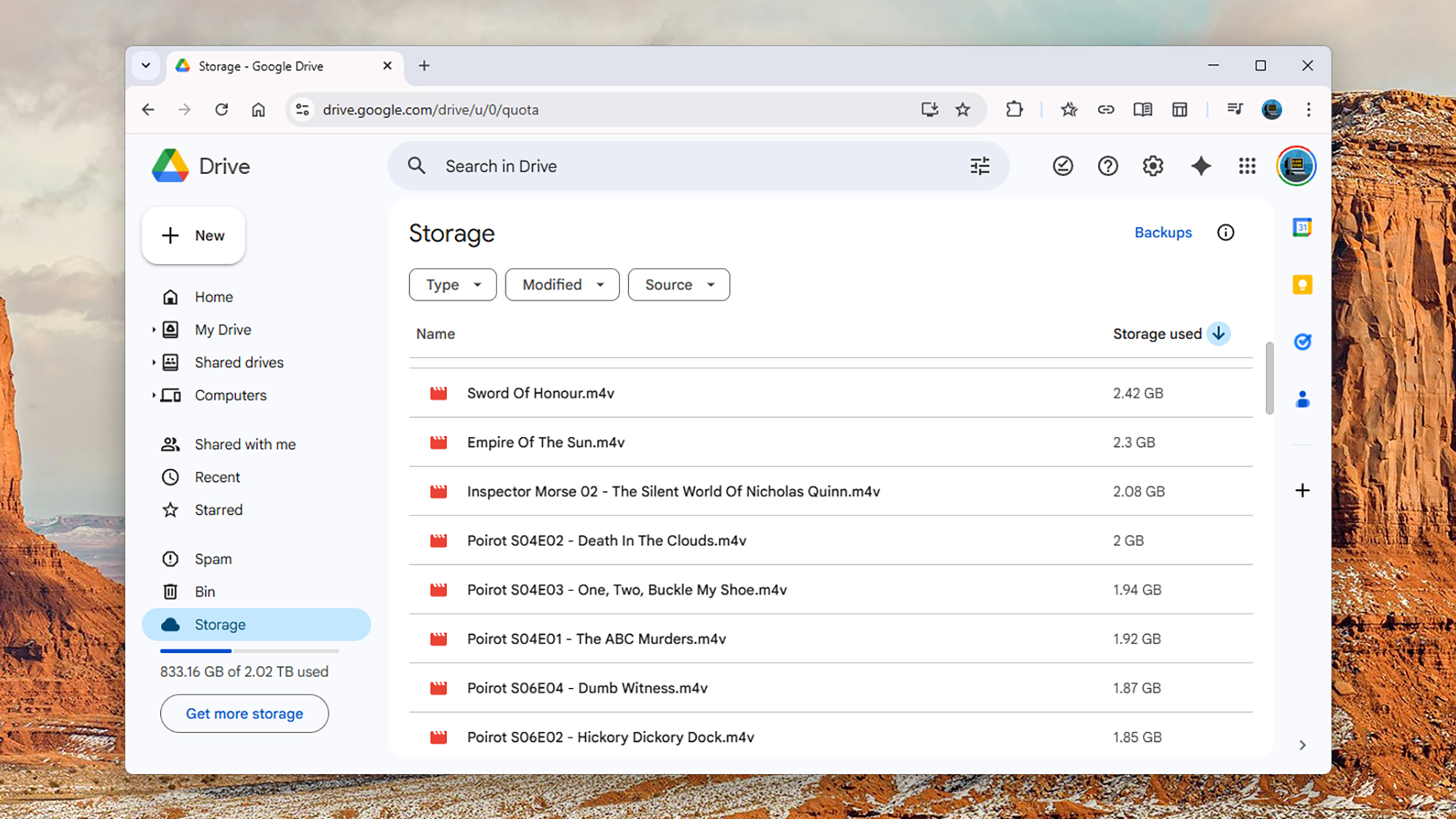
Underneath the storage breakdown, you’ll see the biggest files currently saved in your Google Drive account, with the largest at the top. If you see anything you know you don’t need any more, you can click on the filename and then on the trash can icon at the top of the list, freeing up the space.
Google Drive will show you the biggest files in your storage. Screenshot: Google
You can do your own investigating by clicking on the Home link on the left, then using the search bar up at the top: Click the sliders icon just to the right of the search bar to see all the options. You can look for particular types of files for example (like videos), or look for files older than a certain date.
On every search result page you can sort by Date modified (so you can quickly get to the oldest and most out of date files), and on every folder view you can sort by File size (so you can quickly get to the biggest files). If you need to delete entire folders at once, click on the folder name at the top of the screen, then Move to trash.
Use alternative apps
There is a strategy you can use across all of these apps to free up space, which is to use alternative apps. You could even use the Google apps to sync your files somewhere else (like your laptop), and then back them up in a different way using a method of your choice—maybe an external hard drive, perhaps.
You can easily download individual files and folders from Google Drive and Google Photos, but getting your emails out of Gmail is a little more difficult. One way of doing it is to use a desktop email client (instructions here), but bear in mind if you delete emails in Gmail the local copies will be deleted to, by default—if you want to keep them, export them first.
You can download all your files via Google Takeout. Screenshot: Google
There’s also the very useful Google Takeout service: From this web portal you can select Drive, Mail, and Google Photos to download everything from the three apps and save them to a local computer. When that’s done, you can delete files from the cloud (just make sure your computer copies have backups somewhere else).
For the most comprehensive clean out of your Google cloud storage, you’ll probably want to combine a few different methods for deleting your files—and these apps offer plenty of help along the way too. If you stay below the 15GB limit then it’s one less subscription to have to worry about or pay for.
Tesla is facing another lawsuit alleging a passenger was trapped inside one of its vehicles after a crash.
The mother of a 20-year-old man who died last October filed a wrongful death lawsuit against Tesla in federal court in Massachusetts on Wednesday.
The lawsuit alleges that Samuel Tremblett was unable to escape from a 2021 Model Y after crashing into a tree in Easton, Massachusetts, around 1 a.m. on October 29.
“Unable to open the doors, Mr. Tremblett was trapped in the Tesla vehicle and died from thermal injuries and smoke inhalation before he was able to be rescued,” the lawsuit reads.
The filing even includes a transcript of part of the 911 call Tremblett made after the crash. According to the suit, Tremblet told a dispatcher:
I’m stuck in a car crash… I can’t get out, please help me… I can’t breathe…. It’s on fire, it’s on fire. Help please… I am going to die… I’m dying. Help. [… I’m dying… Help… Help.
Officers responding to the incident said that the fires were too severe to save Tremblett’s life, and there were four separate explosions within the first ten minutes upon their arrival at the scene of the accident.
Neither Tesla nor the plaintiff’s attorneys immediately responded to Gizmodo’s request for comment.
This lawsuit is the latest to highlight what appears to be a faulty design in Tesla’s electric door handles.
According to the lawsuit, during an electrical system failure, the vehicles’ electronic door handles can malfunction. And while Teslas do include manual door releases, the lawsuit alleges, “the inconspicuous location and markings are not readily discernible, particularly to an occupant who needs to exit the vehicle quickly, escaping a post-crash fire.”
The lawsuit includes images from the Model Y owner’s manual showing that the front door mechanical releases are located near the window switches. But for the rear doors, passengers must first remove a mat from the bottom of the door pocket and then pull a tab to access a release cable. The manual notes that not all Model Ys are equipped with manual releases for rear doors.
Federal regulators have already been investigating the issue. The National Highway Traffic Safety Administration (NSTSA) opened a preliminary probe in September into Tesla’s electrically powered door handles in 2021 Model Y vehicles, the same model Tremblett was driving. The ongoing review covers nearly 175,000 vehicles and is examining how widespread and serious the problem may be.
This isn’t the first lawsuit filed against Tesla over its door design. The parents of two college students who died in a Cybertruck crash filed separate lawsuits in October, alleging the truck’s electric doors with hidden manual releases trapped the victims inside. And a Bloomberg investigation last year found at least 15 deaths in a dozen incidents over the past decade in which occupants or rescuers were unable to open the doors of a crashed Tesla that caught fire.
And it’s not just the U.S. where this is becoming an issue. Just this week, China announced it is banning hidden door handles on cars starting next year. All vehicles will be required to include a mechanical release function.
In a world of ever-improving computing hardware—both classical and quantum—one team of engineers is veering off the familiar path. And the unusual device, based on a century-old physics concept, appears to be surprisingly capable of addressing some difficult computing challenges.
The new device, described in a recent Nature paper, is specifically an Ising machine. Based on the physics model of the same name, the processor uses pulses of light instead of binary bits to find the best mathematical solutions to real-life problems, such as protein folding, cryptography, or traffic routing. It’s made of relatively accessible components, operates at room temperature, and can juggle billions of operations per second.
“This breakthrough shows that it is possible to build a practical and scalable machine that can tackle extremely difficult problems,” the researchers said in a statement.
Realizing an old physics idea
The new machine’s specialty lies in optimization problems, or challenges in which the goal is to select the best option from a large number of potential solutions. One real-life example involves finding the most efficient route for delivering packages. The number of possible routes increases exponentially as the number of packages increases, so finding the best—optimized—route becomes increasingly difficult.
“With five stops, there are only 12 possible routes. With 10 stops, there are 180,000. With 20 stops, there are more than 60 million billion options,” explained Bhavin J. Shastri, study senior author and a physicist at Queen’s University in Canada, in the release.
When there are 50 stops, Shastri continued, that inflates the number of solutions so much that it’d take “longer than the age of the universe” to check them all. This is where an Ising model can come in handy.
This model represents such problems as a collection of interacting magnets whose spins point up or down. Over time, this collection of magnets naturally falls into an equilibrium that represents the lowest possible energy state. Mathematically, that translates into the most efficient solution to optimization problems, the researchers explained.
A “computer” running on light
Instead of magnets, the new device uses pulses of light that loop around the hardware and “gradually settle into a configuration that represents a good solution, much like a group reaching a consensus after many quick exchanges,” according to the researchers. “It’s a way to turn light into a problem solver,” Shastri added.
What’s more, the team built the system using components commonly found in commercial internet infrastructure, such as standard lasers, fiber-optic cables, and modulators. The resulting machine needed just five basic components to achieve 256 spins (65,536 couplings), allowing it to process billions of operations per second.
Impressively, the machine also remained stable for hours at room temperature. That’s a significant improvement over earlier Ising machines, as well as supercomputers and quantum processors that require extremely cold temperatures and specialized materials, the team said.
Optimized, just for specific tasks
All that said, the Ising machine won’t be replacing supercomputers and quantum computers anytime soon, if ever. As the team admits, the system is highly optimized for very specific applications and isn’t meant to be a general computing device.
Still, the practicality of scaling and operating the new system holds great potential for the problems it is good at solving, the team added. Accordingly, the researchers shared that their next steps are to develop pilot projects with industry partners to see how and whether the machine could address real-world optimization problems.
Without meaningful deterrents, Big Tech companies will do what’s profitable, regardless of the cost to consumers. But a new bipartisan bill could add a check that would make them think twice, at least in one area. On Wednesday, Senators Ruben Gallego (D-AZ) and Bernie Moreno (R-OH) introduced legislation that would require social platforms to crack down on scam ads.
The Safeguarding Consumers from Advertising Misconduct (SCAM) Act would require platforms to take reasonable steps to prevent fraudulent or deceptive ads that they profit from. If they don’t, the Federal Trade Commission (FTC) and state attorneys general could take civil legal action against them.
The bill’s sponsors, Ruben Gallego (L) and Bernie Moreno
Ruben Gallego / Bluesky / Bernie Moreno
The backdrop to the SCAM Act is a Reuters report from last November. Meta reportedly estimated that up to 10 percent of its 2024 revenue came from scam ads. The company is said to have calculated that as much as $16 billion of its revenue that year was from scams, including "fraudulent e-commerce and investment schemes, illegal online casinos and the sale of banned medical products."
Making matters worse, Meta reportedly refused to block small fraudsters until their ads were flagged at least eight times. Meanwhile, bigger spenders were said to have accrued at least 500 strikes without being removed. Executives reportedly wrestled with how to get the problem under control — but only without affecting the company’s bottom line. At one point, managers were told not to take any action that could cost Meta more than 0.15 percent of its total revenue. (See what I mean about needing meaningful deterrents?)
According to the FTC and noted in the text of the bill, Americans’ estimated total loss from fraud in 2024 (adjusted for underreporting) was nearly $196 billion. An estimated $81.5 billion of that came from seniors.
"If a company is making money from running ads on their site, it has a responsibility to make sure those ads aren’t fraudulent," Sen. Gallego said in a statement. "This bipartisan bill will hold social media companies accountable and protect consumers’ money online."
"It is critical that we protect American consumers from deceptive ads and shameless fraudsters who make millions taking advantage of legal loopholes," Moreno added. "We can’t sit by while social media companies have business models that knowingly enable scams that target the American people."
Correction, February 5, 2026, 8:18AM ET: This story originally stated that Americans’ estimated loss from fraud in 2024 was $19 billion. It was nearly $196 billion. We apologize for the error.
This article originally appeared on Engadget at https://ift.tt/Bp513AP