Galaxy Z Flip 4 Review: The Foldable to Buy

https://www.droid-life.com/2022/09/09/galaxy-z-flip-4-review-the-foldable-to-buy/

I’m just going to come right out and say it – the Galaxy Z Flip 4 has mostly won me over. This is a foldable experience, at this stage of my life, that I could absolutely get behind.

I’ve had a Galaxy Z Flip 4 in pocket for almost a full month now. Samsung sent us one for review shortly after they announced it, plus I pre-ordered my own and have used one of the two since I unboxed the Bora Purple version on August 11. For review purposes, this is a long time to be with a phone, much longer than we often spend with phones.

At this point, I really do know all that I need to know about this phone in order to tell you what I think. You might already know enough too, so let’s just jump into it – this is our Galaxy Z Flip 4 review.
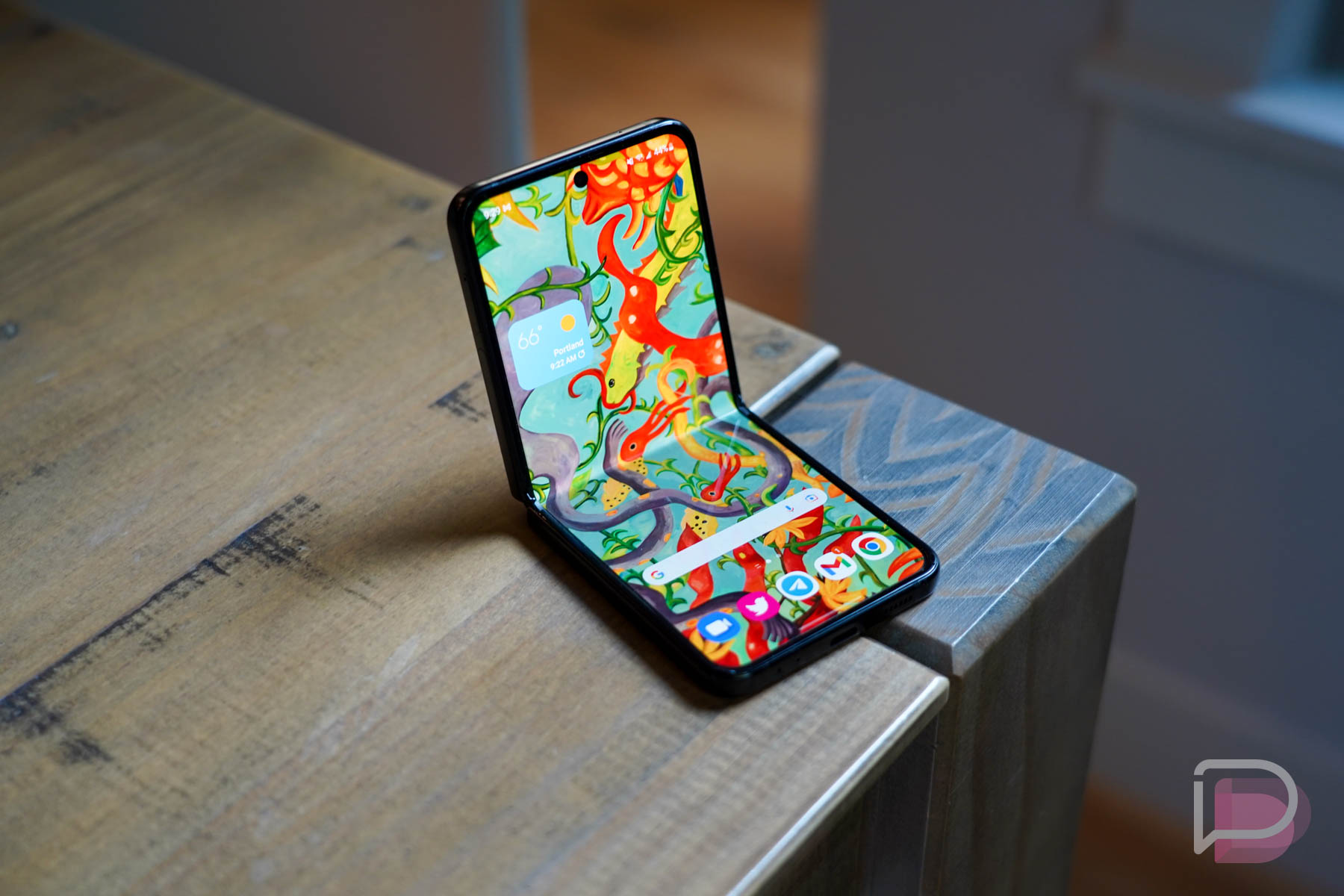
Galaxy Z Flip 4 Review

What do I like about the Galaxy Z Flip 4?

Backing up for a minute before we dive in, here’s a recap of the Flip 4. This is Samsung’s new $1,000 foldable flip phone with a Snapdragon 8+ Gen 1, 8GB RAM, up to 512GB storage, two displays (one that’s 120Hz), a 3700mAh battery, dual rear cameras, and a freaking hinge that folds the phone in half. It comes in graphite, purple, gold, or blue, plus you can make a custom color combination through Samsung’s Bespoke program.

OK, now onto what I like.

Size, design, and durability. Flip phones are not a category of phone that I’ve had much praise for. If you go back to my review of the Moto Razr when it returned, you’ll know that I was not kind. I also skipped the first couple generations of Samsung’s Flip series, then gave the Flip 3 a serious try last year before returning it. For reasons I still cannot quite explain, the Flip 4 has got me.

In the opening of this review, I mentioned that the phone makes sense for “this stage of my life.” I think what I mean by that is that I’m loving the ultra-portability of a folding phone that’s this small. I can toss it in any pocket, it’s light enough to handle when I need to, and the clamshell styling also has me less worried about how I handle it. I’ve chucked this phone around the house or car and I’m just not worried about it. I don’t even know if I’m more active now than I was a year ago, but folding a phone into a little square and then moving about has been refreshing in 2022.

With this Flip 4, Samsung has really refined the overall design. We have flattened edges that are properly grippy. The new hinge is stiff without being difficult, so opening and closing the phone is not at all the nuisance of some other foldables. The width of the phone, when open, is also perfect for my hand. You can easily get your paws around it and hold it for lengthy sessions without tiring. It may be tall as hell, but it’s not a phone that you’ll struggle to hold.

For the past month, the Flip 4 that I made in white with a black frame has held up well. I’ve used it a ton. It’s been tossed onto plenty of outdoor brewery tables. My kid has used it for mobile gaming. And the screen is still flawless, as is the outer body. I’ve even set it in a bunch of weird places, because I use Flex Mode for Google Duo calls with my wife, and yeah, it looks great.

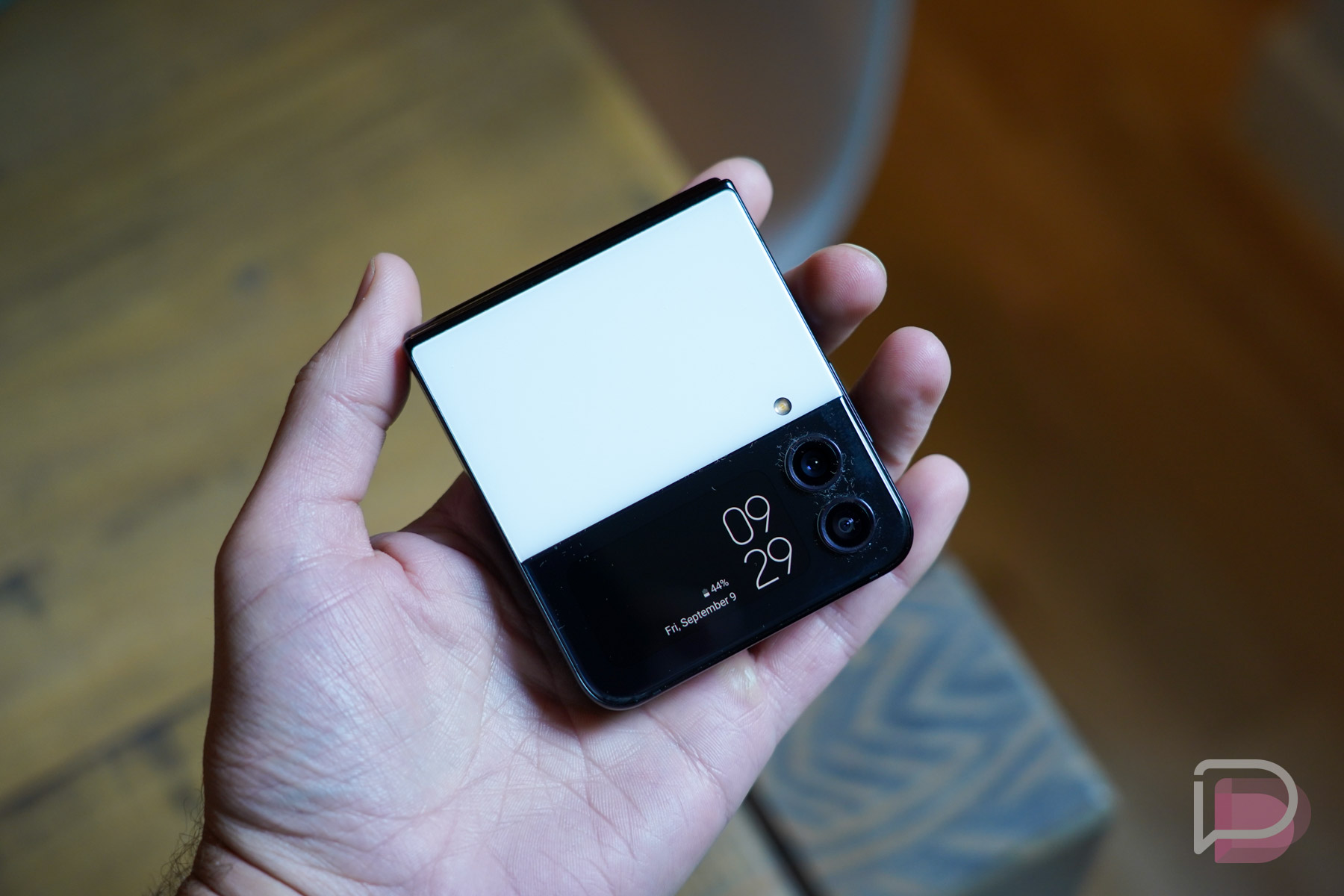
I know that this phone isn’t that much different than last year’s model, but everything about it has felt right this time. The phone is also quite the looker, at least in this white-black combo that I made.
Performance and battery life. This new Snapdragon 8+ Gen 1 chip is doing a lot right. The phones I tested earlier in the year that used the 8 Gen 1 might have run smoothly, but none were as efficient as this chip and the Galaxy Z Flip 4 really shows that.

As far as general performance goes, yep, the phone is buttery smooth and feels fast. Not only do you have plenty of RAM (8GB) and fast storage, you have a 120Hz display that looks great no matter the content on screen. But when you do throw on a game or watch a video or utilize multiwindow, the phone doesn’t heat up and it stays humming. This chip seems to run so much differently than the earlier 8 Gen 1 that I’m not sure they really compare.

Now, when it comes to efficiency, you have to remember that this phone only has a 3700mAh battery. Sure, that’s bigger than last year’s, but it is also small when compared to almost any other flagship-level phone. Most phones have batteries over 4000mAh. The only phone that doesn’t is the regular Galaxy S22, which also happens to have a 3700mAh cell. The battery life on that phone is awful – so bad I couldn’t bring myself to use it for long and used it as my trade-in for this Flip 4 after only a few weeks of use.

The Bora Purple Flip 4 that I tested initially was easily getting 4 hours of screen-on time in a day with 20% battery remaining. Again, for a battery this small, and knowing what I was getting for the Galaxy S22 with the same size battery, this is pretty incredible battery stuff. When I switched over to this white-black model, I haven’t had the same battery life, but I’m also had a Galaxy Watch 5 Pro attached and I actually think it’s draining battery. I say that because the phone warned me today that the Wear OS app (which it shouldn’t need to use) was causing battery drain. Also, I didn’t attach a smartwatch to the purple model.

If there is one complaint, it is once again in the charging speed department. Samsung is not like the rest of the big Android industry players when it comes to pushing charging tech. This Flip 4 can charge at 25W wired speeds, but that’s not really that fast. The claim is that it can charge from 0% to 50% in 30 minutes. However, that’s actually pretty bad. 30 minutes is a long time to only get to 50% when you consider the OnePlus 8T can go from 1% to 100% in 20 minutes. Samsung really needs to step up their charging game.

So overall, I think this phone runs like few phones I’ve tested from Samsung with this 8+ Gen 1 chip and also gets surprisingly good battery life that should get most people through a full day.

Displays. I’ve been opening a closing Samsung’s foldable phones for 4 years now, probably open and close this phone 100 times a day, and yet I still find myself amazed at the fact that I can do that to a display over and over again. Foldables are wild, man. Technology really can be fun in 2022, even if it’s something we should have grown used to after a few years.

Anyways, the displays on this phone are good! The inside foldable display is the star, measuring in at 6.7 inches with a 1080p resolution and 120Hz refresh rate. Because it’s a fancy foldable piece of glass, you might worry that it’s not up to the same color standards as a phone like the Galaxy S22, but I’d argue that it is. Colors here are excellent, without that old school punchiness in older AMOLED screens. In the “Vivid” setting, I get a great balance of natural colors and a pop of color here and there. Out of the box, this phone’s main display is so pleasing to the eye.

Of course, since this is Samsung, you get lots of options to customize the screen experience. There is a dark mode, adaptive brightness (on the main screen), a blue light filter, and advanced color profile settings. In general use, the screen is very responsive to the touch with decent viewing angles, gets plenty bright in outdoor situations, as well as dim enough in bed at night. I really have no complaints about the display. There aren’t any huge tradeoffs here compared to a normal smartphone display, other than you should probably take a bit of extra care with it.

If there is something you’ll need to get used to, it’s the feel of the display. Obviously, there is a bit of a dip or crease in the middle where it folds and you will indeed notice that as you swipe across the screen. I’m used to it at this point, but even my mom pointed it out as being a thing when she stopped by a couple of weeks ago. I can also tell you that my wife bought a Flip 4 and finally ditched her Note 20 Ultra, and she hasn’t complained about the dip yet.
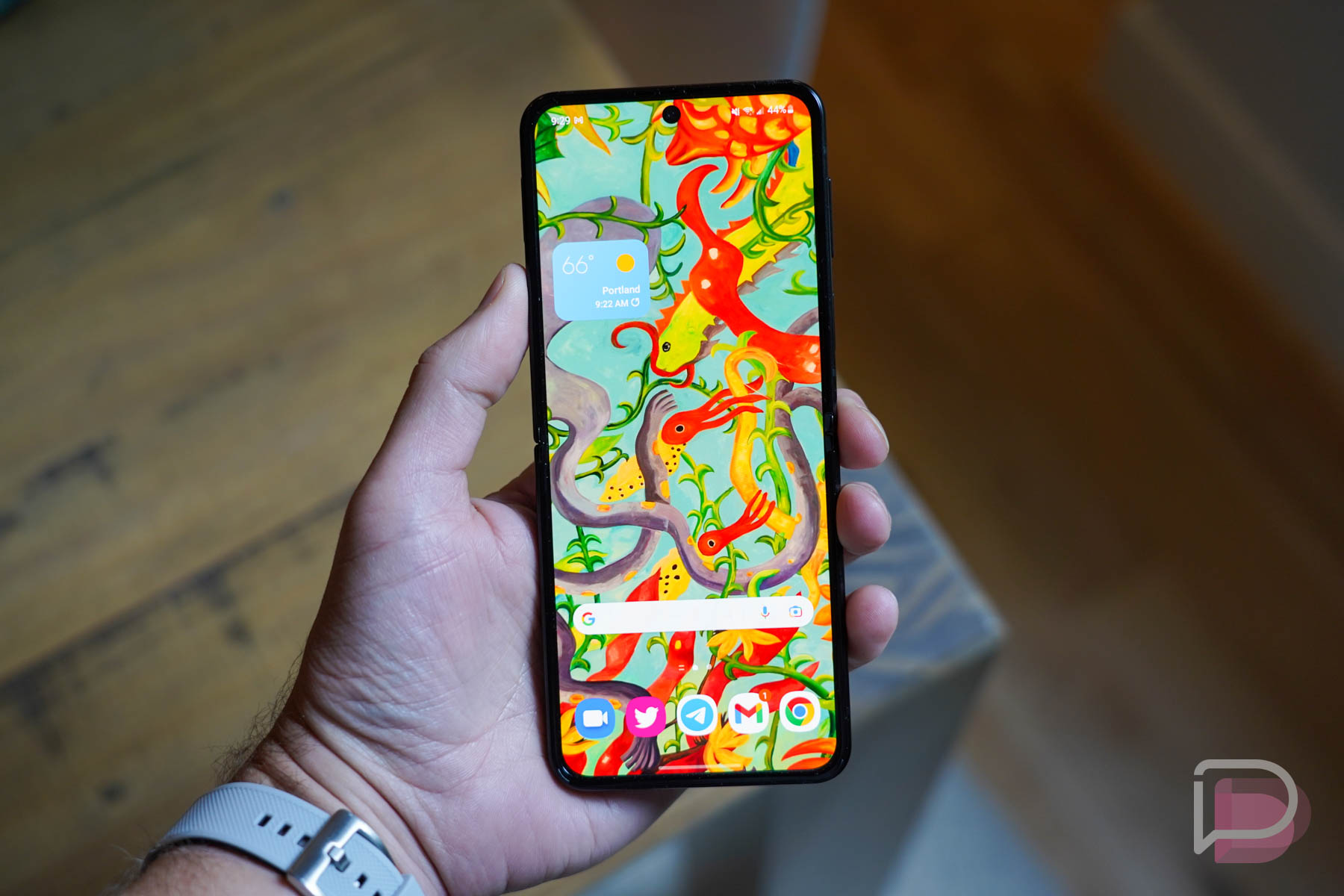
But the other thing is that the screen has a softness to it that you might not be ready for. Unlike the glass on your normal phone that feels as hard as any piece of glass, the Flip 4’s screen really does feel softer. It’s quite pleasing to use, although I could see the flipside of that idea and someone missing rigidity you might be used to on other phones. It’s also kind of a fingerprint magnet and needs to be wiped regularly.

As for the cover screen, it has limited uses, but mostly does what it needs to. It’ll show you the time and gives you limited interaction options with notifications. You can use widgets on it to control music, see the weather, run timers or setup alarms, that sort of thing. You can customize. it with different colors and backgrounds and really make it your own, which is fun. I can tell you that I really haven’t found much use for it other than being a clock, a battery meter, and taking quick glances at notifications before then opening the phone to deal with them. In a way, I treat the cover display like a smartwatch.

You may think that this cover display needs to do more, like give you a keyboard to type or let you run full apps, but I’m not sure that would make for a good experience. It’s small enough to show you information that then lets you decide if it’s time to open your phone and deal with something or not. I’m really not sure you want it to do anything else – I sure don’t.

I do have a complaint about using it as a viewfinder. One of the cool features of the display is to use it in conjunction with the rear cameras to take higher-quality selfies. Unfortunately, the viewfinder doesn’t show you the full picture, so framing can be somewhat difficult and the final shot often includes a lot of extra space you might not have wanted. I’m sure someone could get used to it or crop heavily.

For a double-screened experience, in a package this small, Samsung has dialed in what they want to accomplish. I think for the most part this all works together, especially if you treat the cover display like I do, as I would a smartwatch that’s good for notifications, telling the time, a timer or two, and not much else. In addition to that, you get an excellent internal display that also happens to fold in half.

Software. One of the biggest reasons we do our “First 10 Things” series is because Samsung’s One UI skin has become as bloated as ever and most of the stuff they include needs to be turned off or buried away. Once you do that, this is a decent software skin and we all know that Samsung is king of updates. Buying a phone like the Flip 4 means a yearly cycle of skin updates with new features as well as one of the longest support periods in the world of Android.

Out of the box at launch, this phone is running One UI 4.1.1 and Android 12. It’ll see an update to Android 13 quite soon I’d imagine, as Samsung typically updates its recently launched phones in a hurry. They’ll also push monthly security patches for a number of years, with official support ending after a full 5 years of updates that includes 4 OS upgrades.

I’m hesitant to re-tell the story of the rest of the software here because I’ve written about One UI and its features more times than I care to. Like, if you want to know what’s great and not about One UI, feel free to dive into my Galaxy S22 Ultra review (or watch our First 10 Things video below). This phone basically does everything that phone does, outside of the S Pen stuff. It has tons of display settings, ways to customize sound and vibrations like few other phones offer, wallpapers and themes, plenty of security choices (both fingerprints and face unlock), battery and device management, and some advanced settings. It’s One UI and it’s mostly good once you figure out what you need and don’t need.
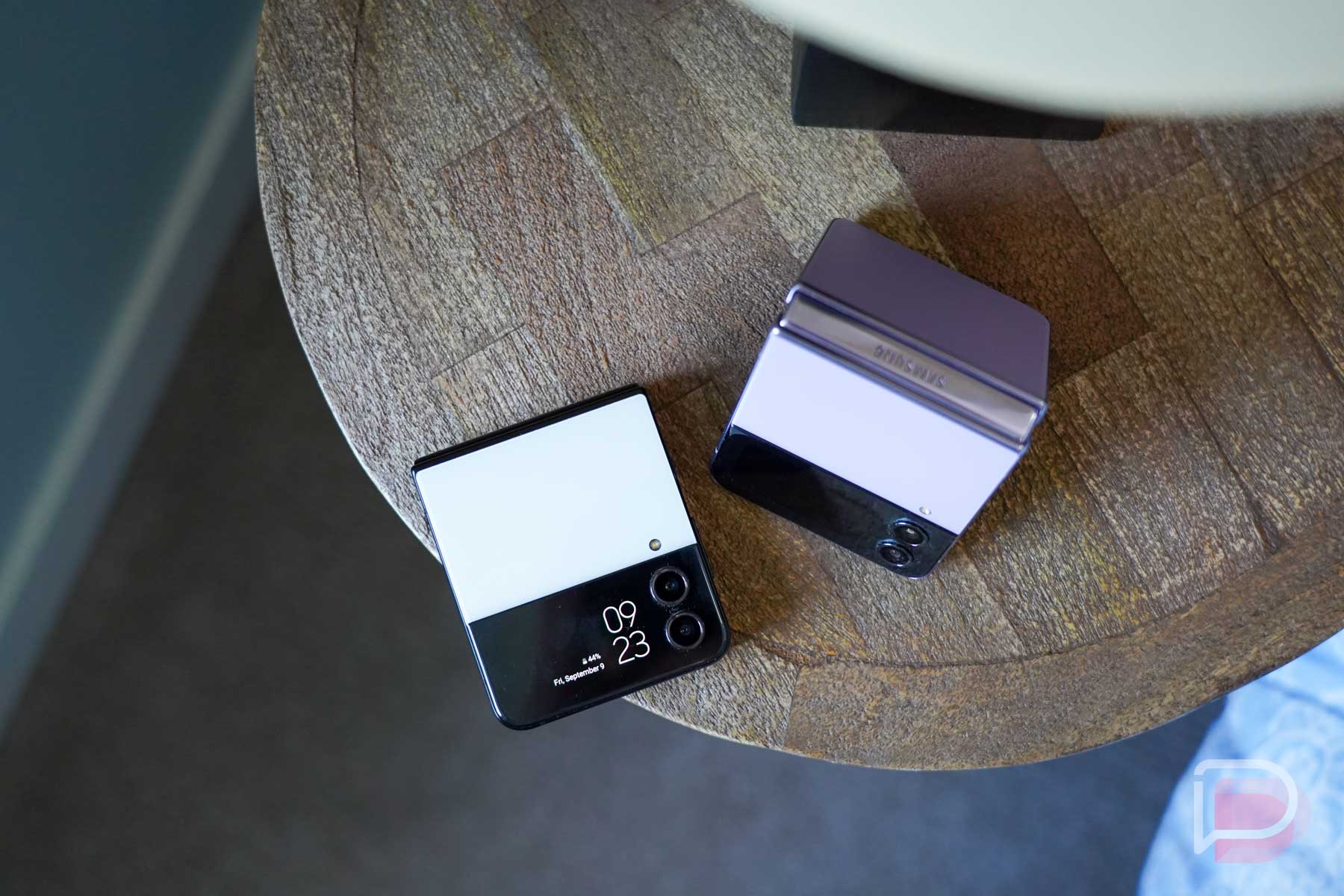
What I’d like to highlight is the stuff Samsung included that makes the Flip 4 special, and well, it’s not much. The only real feature you’ll find that utilizes the folding display is something called Flex Mode. It’s actually quite useful because it lets you fold the phone to a 90-degree angle, set it on a surface, and then run apps that show up in the top portion of the phone. Using the camera viewfinder in this way, calling over video, or even running an app like Twitter or Chrome is kind of nice. Even Instagram, if you were lying in bed and set the phone in Flex Mode on your chest in the ultra-laziest fashion, can be used this way. So yeah, Flex Mode is neat.

Other than that, it’s just Samsung’s One UI and that comes with tons of software support. You gotta love that.

Fingerprint reader. It feels weird pointing out a fingerprint reader, but because Samsung used a side-mounted fingerprint reader that isn’t in the display, I have to confirm how good it is. In-display fingerprint readers are almost all bad and I wish companies would stop using them. My opinion on that idea becomes clearer every time I use a classic fingerprint reader like Samsung used on the Flip 4. This thing reads your finger every single time, but it also does so in an instant. Rarely has it told me I scanned improperly or asked me to do it again. I have zero complaints about this reader and really just want the world to know that this is the way.
What’s bugging me about it?

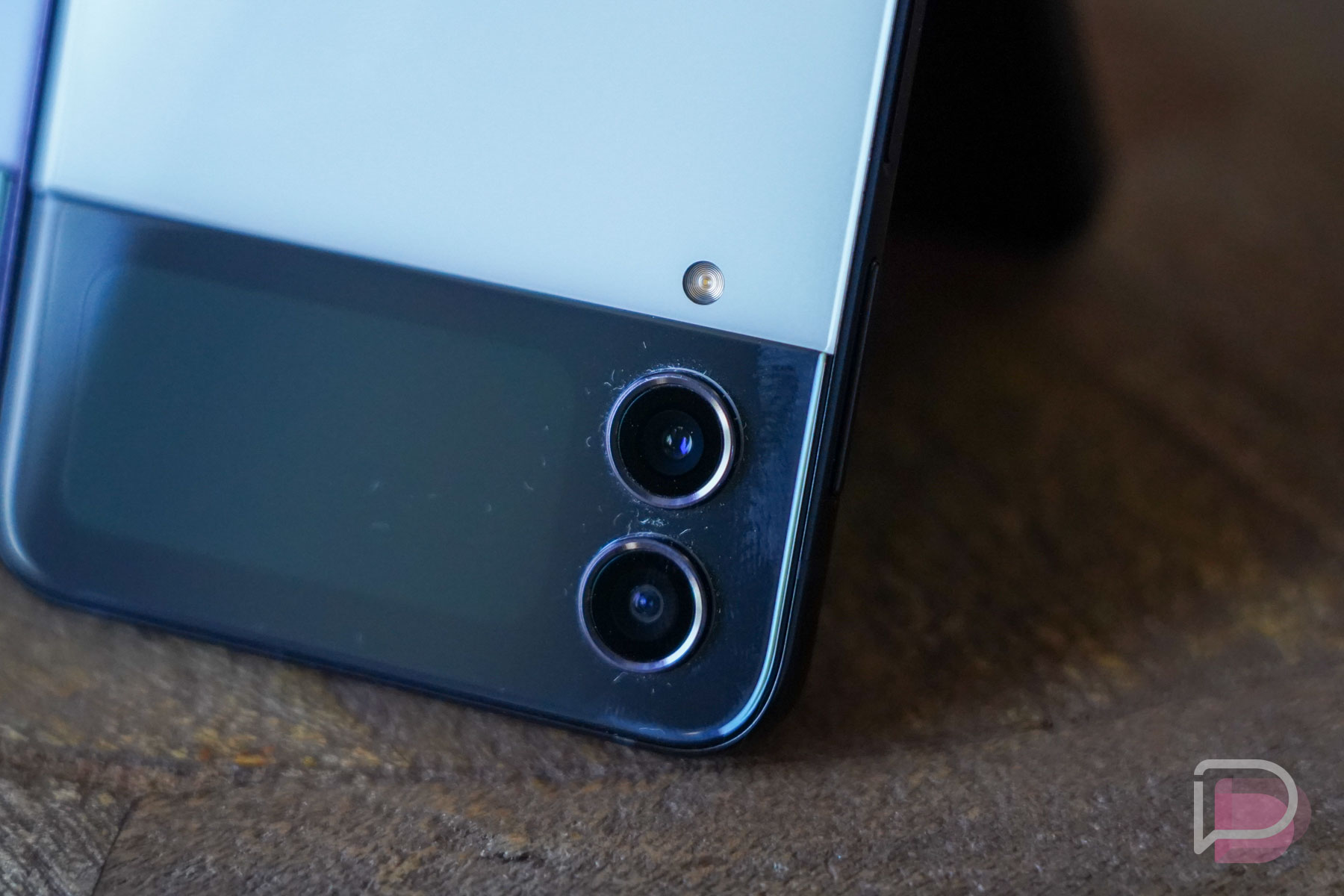
Camera. If there is one area that would make me hesitate from using the Flip 4 going forward, it would be in the camera. Samsung kept the same dual 12MP wide-ultrawide setup from the Flip 3 and probably hoped that the new chip inside would improve things and it probably did on some level. Did it do enough? Eh, I guess that depends on your needs.

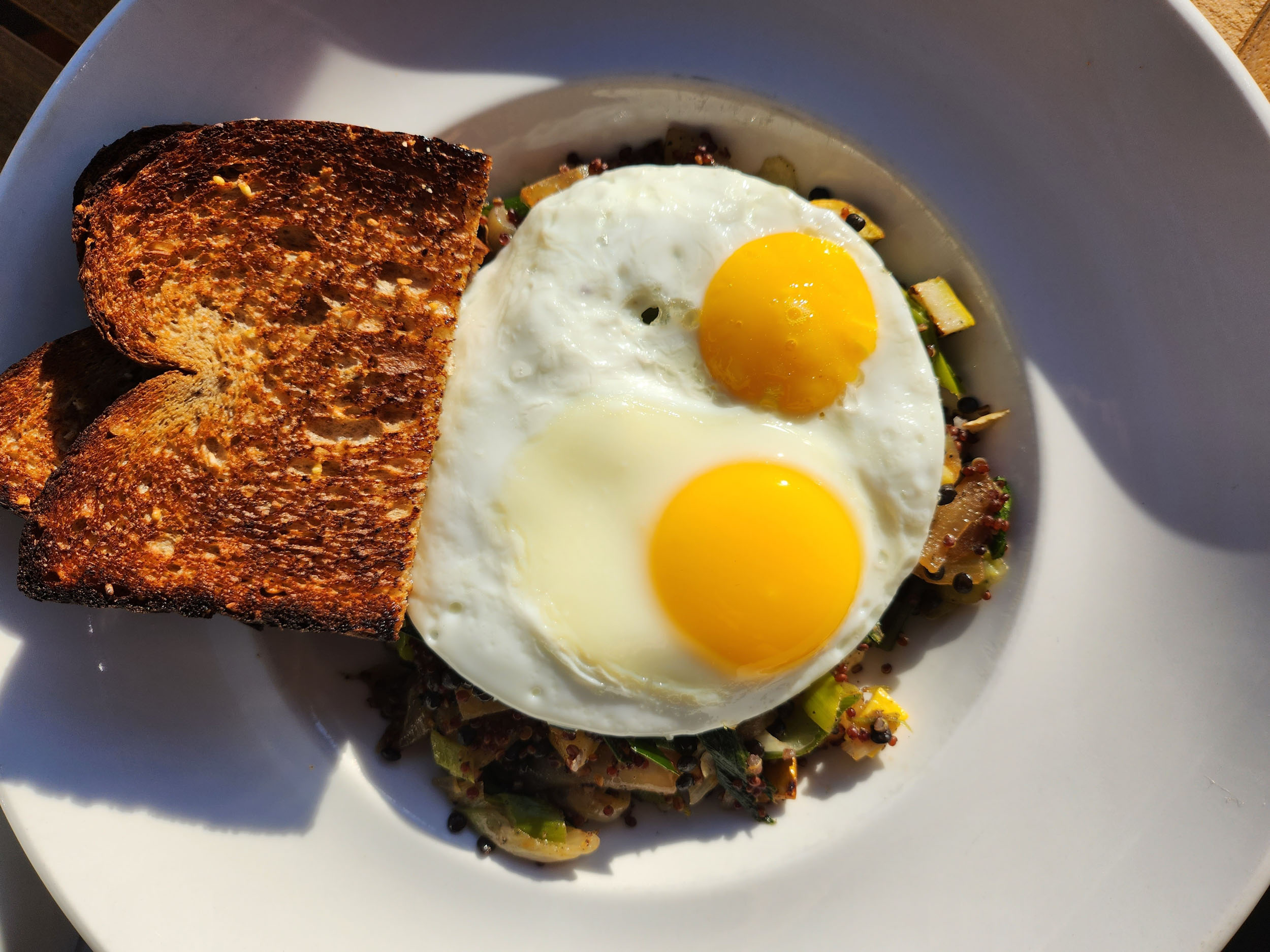
I took a ton of outdoor shots that all came out pretty good if not excellent at times. The weather has been stellar in Oregon over the summer and so all of my summertime pictures from family adventures are solid. But like any non-top-tier camera, it’s when indoors or with poor lighting that you hoped for more. I can’t tell you how many pictures I tried to take of my kitten walking around my house and each one is blurry. I even stopped taking indoor food shots because I wanted to keep my appetite. I also had a ton of issues with lens flares with the sun around that I didn’t notice until after the photo was snapped and my picture had a giant half ring through it. You’ll see a couple of examples below.

Did I stop taking photos with the Flip 4 because of major frustrations? No. I still used it a lot. It was often the only camera I had on me and many of the photos I took were totally great. In fact, I’d still say that this camera is quite good most of the time. My issue is that this is a $1,000 phone with a camera you’d probably find in a $500-$600 phone. I compared it at times to the Pixel 6 and found similar shots. I know that the story with Samsung’s expensive foldable phones from the beginning has been that they need top tier cameras, but I just want to be clear that it’s still the case with the Flip 4.

This camera is fine most of the time – it’s just not all of the time.

As far as camera software goes, you have portrait modes, video at up to 4K/60fps, a night mode, pro camera and video modes, and plenty of other settings, including QR scanning. It’s a well-stocked camera app, just like every other Samsung phone.

Unfolding it all the time. As much as I’ve enjoyed the size and design of the Galaxy Z Flip 4, I have got to admit that unfolding a phone all day can be tiresome. It has that little cover display that will help you out at times, but it’s limited in function and you almost always have to fully open the phone to do anything. After days and weeks of unfolding and folding over and over again, I’ve got to admit that I’m kind of looking forward to taking a break from the Flip 4 and going back to a regular phone. It’ll be a good test to see if I could truly live with the Flip 4 or if my life is better served with a classic smartphone design.

As I’ve been writing this review, I tossed my SIM card into a Pixel 6 to get prepared for the Pixel 7 and can already tell you that I’m not so sure I don’t want the Flip 4 back already. Sure, flipping and unflipping can be tiresome, but the compact nature of the Flip is really, really appealing. I’ve been doing it a month and my hands and routines are all used to it. I guess time will truly tell how this story ends.

Video

Unboxing and first look

First 10 things to do

Should you buy a Galaxy Z Flip 4?

It took me several years to come around to the idea of a flip phone and I think the Flip 4 finally convinced me that this could be a really nice future. The compact size of the Flip might be the option for those of us who don’t like all of the oversized phones that companies keep making. The phone is quite tall, but its thinner profile makes for a device that is easy to handle and that can’t be said for so many phones these days.

Outside of size, the software here is good, the battery life is better than expected, durability also is, performance is top notch, and the camera can probably pass the test for most people. The only thing I worry about is whether or not people will like to constantly fold and unfold this phone for the next couple of years. Knowing the popularity of the Fold and Flip series, I’m guessing most will be just fine.

This is an expensive phone at $1,000, but you all know how to get it at a steep discount using Samsung’s trade-in program. I think you’ll enjoy the Galaxy Z Flip 4.

Read the original post: Galaxy Z Flip 4 Review: The Foldable to Buy

via Droid Life: A Droid Community Blog https://ift.tt/sxYDSlQ

September 9, 2022 at 12:22PM

Logitech About To Reveal Its Steam Deck Competitor | GameSpot News

https://www.gamespot.com/videos/logitech-about-to-reveal-its-steam-deck-competitor-gamespot-news/2300-6459483/


Logitech is unveiling a new gaming handheld, a September Nintendo Direct is happening, and confusion over the new Assassin’s Creed. All this and more on today’s GameSpot News.

Logitech is unveiling its own gaming device on September 21. In the wake of Valve’s successful handheld, Steam Deck, the PC peripheral manufacturer is attempting its own portable gaming console, although it will be significantly different compared to what is available on the market already.

The product, which Logitech is partnering with gaming giant Tencent on, will have a focus on streaming games. The company revealed that it is working with Microsoft and Nvidia to make sure that their services, Xbox Cloud Gaming and GeForce Now respectively, work smoothly on the device.

It seems, however, that the device won’t solely be for streaming games. Images of the device that leaked in August showed a ‘Google Play’ front and center on the console’s homescreen, which if indicative of the final OS that will ship with the device, suggests that the hardware’s processor will be beefy enough to run native Android games as well.

A tease for the September 21 event suggests that the device will have a yellow button adorned with the Logitech logo, identical to the one in the leaks, possibly confirming the validity of those images.

From one handheld to another, a Nintendo Direct is happening tomorrow, September 13, the company not breaking its streak of having a September Direct every year since 2016. It will include “roughly 40 minutes” of new information, focusing on games coming to Nintendo Switch this winter.

Multiple games are rumored to be part of the presentation, including two ports of The Legend of Zelda–Wind Waker HD and Twilight Princess HD–as well as a remaster of the original Metroid Prime. Pokemon Scarlet and Violet, which are scheduled to release on November 18, should feature during the event as well. Other than Metroid Prime 4 and the Breath of the Wild sequel, Nintendo’s first party slate of officially announced games after Scarlet and Violet is completely unknown.

Here’s hoping for Mario Kart 9! Just kidding. They’re going to sell Mario Kart 8 forever. Why do you think it’s logo is infinity?

Another showcase of games that happened over the weekend was Ubisoft Forward, which included a presentation on Assassin’s Creed celebrating its 15th anniversary. A smaller, AC1 inspired title called Mirage will release early next year, set in Baghdad and featuring a young Basim, a side character in 2020’s Assassin’s Creed Valhalla.

Two additional games for console and PC, similar in scope to the recent, larger entries, were also announced; Project Red will allow players to finally climb around feudal Japan as a shinobi, and the spooky Project Hexe which is rumored to be set during the Holy Roman Empire and focus on the witch trials of that period. Red and Hexe will kick of Ubisoft’s hub for Assassin’s Creed, Infinity, which Ubisoft has confirmed will feature multiplayer elements in the future.

via GameSpot’s PC Reviews https://ift.tt/GdfRiWb

September 12, 2022 at 06:00PM

The Future According to People Living in The 1920s

https://www.geeksaresexy.net/2022/09/02/the-future-according-to-people-living-in-the-1920s/

“Futurism” is what people believed the future would be like at a given time. Similarly, “retrofuturism” is futurism of the past. Most people think of Victorian futurism (steampunk) and 1950s/1960s futurism (atompunk). 1920s futurism sits right in the middle, mostly forgotten. Technically, it’s grouped in with “dieselpunk,” which extends into the WWII period, but I think the aesthetic of the 1920s is a bit different. For example, in the 1920s version of the future, zeppelins and airships are all over the place, though by WWII, zeppelins were a thing of the past. In this video, I’ll explain a little bit about the 1920s conception of the future, then show a lot of examples from a 1920s science and technology magazine called “Science And Invention.”

[The1920sChannel]

Click This Link for the Full Post > The Future According to People Living in The 1920s

via [Geeks Are Sexy] Technology News https://ift.tt/xOQRIAD

September 2, 2022 at 07:09AM

Link Finds a Chicken: An AI-Generated Photo Gallery

https://www.geeksaresexy.net/2022/09/01/link-finds-a-chicken-an-ai-generated-photo-gallery/

After Mario and Peach Hunt for Mushrooms, here’s another really weird edition of “DALL-E the AI generates photorealistic artwork of a video game character”, this time featuring link finding chickens! Thanks to Dan Leveille who is a master of all things DALL-E for entertaining us with these.


[Source: Dan Leveille]

Click This Link for the Full Post > Link Finds a Chicken: An AI-Generated Photo Gallery

via [Geeks Are Sexy] Technology News https://ift.tt/xOQRIAD

September 1, 2022 at 11:42AM

Single-Dose ‘Polypill’ Found to Save Lives, Prevent Heart Attacks in Major New Trial

https://gizmodo.com/heart-disease-polypill-trinomia-trial-1849469736


Image: Shutterstock (Shutterstock)

A three-in-one drug combo can help people with a history of heart attacks stay healthy, new research shows. The randomized clinical trial found that people who took the bundled medication, also known as a polypill, went on to experience fewer heart attacks, strokes, or cardiovascular-related deaths than those given standard care. The findings may pave the way for the polypill to become a common heart treatment moving forward.

The basic concept of the polypill has been around for over two decades. Many medical conditions require taking multiple medications, which can be a time-consuming task and added burden for patients. So by taking these individual drugs and putting them into a single pill, the theory goes, you can make it easier for patients to adhere to their treatment. There are already standard treatments for some conditions, such as HIV, that are given as a combination medication. But the original inspiration for the polypill was as a way to improve the treatment of cardiovascular disease. And now, this strategy seems to have passed its biggest test yet with flying colors.

In 2015, the “Secondary prEvention of CardiovascUlar disease in the Elderly”—or SECURE—trial began. It was meant to test out a fixed dose combination of three generic drugs already known to improve heart disease outcomes: aspirin, a common statin known as atorvastatin, and the ACE inhibitor ramipril. The combo drug is manufactured by the pharmaceutical company Ferrer and is approved in the EU and some other countries as Trinomia.

About 2,500 heart attack survivors over the age of 65 were included in the trial, which was sponsored by the EU and conducted in seven European countries. The patients were randomized to either receive Trinomia or standard treatment. They were then tracked over the next five years, with the researchers primarily looking for incidents of cardiovascular-related death, along with nonfatal heart attacks, strokes, and blocked coronary arteries that needed urgent treatment.

Ultimately, 12.7% of patients in the control group experienced at least one of these outcomes, compared to 9.5% of those in the polypill group, amounting to a 24% reduction in risk. When it came to deaths in particular, those who took the polypill were 33% less likely to die than control patients. And other data showed that people on the polypill were more likely to keep taking it as recommended—exactly as hoped. The study’s findings were published Friday in the New England Journal of Medicine.

G/O Media may get a commission

“Treatment with a polypill containing aspirin, ramipril, and atorvastatin within 6 months after myocardial infarction resulted in a significantly lower risk of major adverse cardiovascular events than usual care,” the authors wrote.

The SECURE trial is the first of its kind to test the polypill for heart attack survivors. Many experts in the field have been waiting for the study’s findings to emerge, and it’s this sort of gold standard data that can lead to the wider acceptance of a novel treatment approach in medicine. Given these results, it’s likely that more countries will decide to approve Trinomia. (Notably, the U.S. has not approved Trinomia, though it has approved other polypills.) So the drug may very well someday become a new standard of care for survivors at risk of future heart complications.

“The SECURE study findings suggest that the polypill could become an integral element of strategies to prevent recurrent cardiovascular events in patients who have had a heart attack. By simplifying treatment and improving adherence, this approach has the potential to reduce the risk of recurrent cardiovascular disease and death on a global scale,” said senior study author Valentin Fuster, the physician-in-chief at Mount Sinai Hospital in New York as well as the general director of the Spanish National Center for Cardiovascular Research, in a statement released by Mount Sinai.

via Gizmodo https://gizmodo.com

August 29, 2022 at 01:55PM

Rocket Lab Seeks to Answer ‘Are We Alone?’ by Launching First Private Mission to Venus

https://gizmodo.com/rocket-lab-mission-to-venus-clouds-life-1849430459


An illustration of the small spacecraft that Rocket Lab is currently developing to cruise through Venus’ clouds.
Illustration: Rocket Lab

SpaceX might have its sights set on Mars, but Rocket Lab is seeking to become the first private company to reach Venus and explore its clouds for signs of potential habitability.

Rocket Lab revealed new details about its self-funded mission to the Venusian clouds in a recent paper published in the journal Aerospace. The California-based company is building a small probe that’s designed to fly through the planet’s upper atmosphere for a duration of roughly five minutes and at altitudes between 29 and 37 miles (48 to 60 kilometers) above the surface. The company is hoping to launch its spacecraft in May 2023 and have the probe reach Venus in October of that same year, with a backup launch window in January 2025.

The probe is designed to fly aboard the company’s trusty Electron rocket—the “only reusable orbital-class small rocket” currently in existence, according to the company. Electron will send the probe on a 100-mile (165-kilometer) orbit above Earth; then, the rocket’s high-energy upper stage Photon will perform a series of burns to raise the probe’s orbit to where it can achieve escape velocity from Earth’s gravitational pull.

Rocket Lab is no stranger to audacious feats; the company pulled off a daring stunt in May by using a helicopter to catch a falling rocket mid-air. Sending a probe to Venus, however, is a major step beyond, as the second planet from the Sun is located some 38 million miles (61 million kilometers) from Earth at its nearest proximity. It’s closer to Earth than Mars, but Venus is far less welcoming of spacecraft due to its extremely hot atmosphere and air pressure that’s 90 times higher than that of Earth’s.

A mission like this to Venus would signal a new era of planetary exploration, in which private companies, and not just government space agencies, make attempts to explore distant bodies. Rocket Lab is also slated to launch twin spacecraft to Mars in 2024 as part of a subcontract with the University of California Berkeley Space Sciences Laboratory. Two other private space companies, Impulse Space and Relativity Space, recently announced a joint venture to launch a mission to Mars as early as 2024.

Rocket Lab’s self-funded science mission sounds noble, and possibly even important, but there’s more to this mission than sniffing the Venusian atmosphere for possible biosignatures. It’s possible that Rocket Lab is using the mission to test its spacecraft in anticipation of national space agencies, like NASA or the European Space Agency, wanting to further outsource similar projects. And as the Rocket Lab study points out, the mission will also put its Photon spacecraft to the test and demonstrate the success of a “high-performance, low-cost, fast-turnaround deep space entry mission delivering Decadal-class science with small spacecraft and small launch vehicles.” Though not stated in the study, this technology could eventually be leveraged to support commercialized supply chains (or other linkages) between celestial bodies, such as supporting colonists on Mars. Rocket Lab also wants to initiate a campaign of smaller missions to explore Venus, the paper says.

NASA hasn’t sent a dedicated probe to Venus since the Magellan program, which arrived at the planet in 1989 and wrapped up science operations in 1994. That is set to change later this decade, as NASA’s DAVINCI mission is scheduled to launch to Venus in 2029. The probe will plunge through Venus’ atmosphere prior to landing on its surface. DAVINCI is one of three upcoming Venus missions, as Venus is very hot right now, both literally and figuratively.

Indeed, Venus boasts temperatures that reach up to 880 degrees Fahrenheit (471 degrees Celsius), while featuring a thick, carbon dioxide-rich atmosphere and a volcanic landscape. The planet is not fit for habitability today, but scientists believe it may have started off with similar conditions to Earth and over time became the hellish world it is today.

In September 2020, a group of scientists claimed that Venus may have signs of life in its clouds based on a detection of what might be phosphine in the Venusian atmosphere. Phosphine is considered a biosignature gas on Earth. That’s the main driving force behind Rocket Lab’s mission to Venus—to help gather further evidence of potential life in the Venusian clouds. “We’re sending our Photon spacecraft to Venus in search of life,” Rocket Lab wrote on Twitter. However, the phosphine detection was largely met with skepticism, with scientists raising doubts over the data, among other quibbles.

Rocket Lab’s search for life in Venus’ clouds may turn up empty, but a mission to the planet’s atmosphere could answer key questions about its past. A 2019 study from NASA’s Goddard Institute for Space Studies suggested that Venus may have once had oceans on its surface for about 2 to 3 billion years, indicating potentially habitable conditions during its early history. Either way, and should Rocket Lab successfully make it to Venus, it’ll set a new standard for private space ambitions.

More: NASA’s DAVINCI Mission Will Plunge Through the Hellish Atmosphere of Venus

via Gizmodo https://gizmodo.com

August 25, 2022 at 08:35AM

The Joy of Playing the Same Sims Family for Years

https://www.wired.com/story/joy-playing-same-sims-family-for-years/


One day in 2014, 32-year-old musician AJ Luca texted her friend with some sad and shocking news. “Gina Marie’s mom,” the message began, “just died on the kitchen floor.” Immediately, without hesitation, Luca’s friend replied with her condolences. Gina Marie’s mom, Marie LaRosa, was a successful businesswoman who founded a large resort company with her husband. She died suddenly, of old age, while cooking. Gina Marie took over the family business after both of her parents passed. And all of this makes sense—none of this is weird—if you ignore the fact that Gina Marie and her mom are Sims.

It’s safe to say that New Jersey-based Luca has always been invested in her Sims. Her (real life) friend immediately knew what Luca’s text about Marie LaRosa meant—and sent commiserations, even though Marie was just a bunch of pixels in one of the best-selling video game series of all time. “My husband and my parents are on a first-name basis with my Sims,” Luca says, “I talk about them like they’re humans.” When catching up with family in the evening, Luca might say something like, “Cash Covington married Alysha today!”

Gina Marie and her mom were characters Luca created in The Sims 3, but when she bought a gaming laptop to play The Sims 4 in 2017, she made a new family: The Holts. Elementary school teacher Amy O’Grady married detective Jon Holt, and together they had five children: master painter Sadie, programmer Jon David, famous athlete Bobby, pro-gamer Paul, and veterinarian Andrea. Today, Amy and Jon have eight grandchildren. All it took was five years of Luca’s life.

For half a decade, Luca has been playing with the same Sims family—which has expanded through marriage to include the Covingtons and the McDermotts. As someone who has never played with the same Sim for longer than a week (and as someone who has forced more than one Sim to swim themselves to death) I am fascinated by Luca’s gameplay—and the gameplay of 21-year-old substitute teacher Shannon, who is also based in New Jersey.

Shannon (who declined to give her last name for privacy reasons) has been playing with the same Sims family for seven years. While Luca periodically turns off the game’s aging feature so that Jon and Amy Holt do not die, Shannon doesn’t—meaning the first man and woman of her Sims family, John and Laura Jones, have long since passed. “She got electrocuted while fixing the dishwasher, I still remember it,” Shannon says of Laura’s passing, “It was very sad.”

There are now 11 generations of Joneses. Shannon uses the (non-Sims related) ancestry app Quick Family Tree to keep track of her characters, and also shares the family’s progress on her social media accounts @simmingshannon. Here viewers leave comments like, “bruh why did this make me emotional.” Unsurprisingly, Shannon herself is emotionally attached to her Sims.

“I’m always taking pictures of them, and I have this huge wall in their house that’s just full of family photos from every generation. It is emotional, you get a little attached,” Shannon says. She calls playing the Sims an “escape” and “a way to explore different parts of life in a safe space before going out into the real world.” In the future—the real world—she hopes to have a big family of her own.

via Wired Top Stories https://www.wired.com

August 23, 2022 at 06:14AM