
Ayaneo’s Air Pro is a taste of the portable PC gaming future

https://www.engadget.com/ayaneo-air-pro-gaming-handheld-review-180003707.html?src=rss

It’s been a bumper year for gaming on the go. For a spell, it kinda felt like Nintendo was the only name in town, but it’s since become one of the more exciting corners of gaming. Today, there are handheld options for everything from AAA to Indie to retro and beyond. Whatsmore, the current generation of mobile processors means we’re seeing surprisingly capable hardware. The main problem, now, is that the software side of things hasn’t quite caught up. There’s perhaps no better demonstration of this than the Ayaneo Air Pro: a stellar example of what can be done, and what needs improving, in the burgeoning handheld PC world.

If you’re not familiar with Ayaneo, that’s understandable. The company hasn’t been around all that long, but it’s already making a name for itself thanks to remarkably good hardware that brings PC gaming into the portable realm. If you imagine a Steam Deck, but with Windows and a fraction of the size, you wouldn’t be far off.

Before we dive into the gaming experience, the hardware itself is worth a closer look. The Air Pro is impressively well made. It has a similar footprint to Nintendo’s Switch Lite, but it’s thicker (.85 vs .55 inches) and heavier (.88lbs vs .55). In terms of build quality, honestly the Ayaneo feels far superior. The Hall effect analog sticks and triggers are smooth with a nice amount of travel. The D-pad is responsive and the buttons are the right kind of snappy. The centerpiece is the stunning 5.5-inch OLED display – a first on Windows gaming handheld Ayaneo is fond of reminding us. It’s a delight to hold and feels premium in almost every regard. Even the fingerprint reader in the power button somehow adds a dash of sophistication.

A close up of the left side of the Ayaneo Air Pro handheld gaming PC.
James Trew / Engadget

As this is basically a PC, there are quite a few different configurations available. Some using AMD’s 5560U chipset and others running the 5825U with assorted amounts of RAM and storage depending on your budget. And you will need a sizable budget as you’ll soon find out.

The Air Pro doesn’t quite have the grunt of Valve’s venerable Steam Deck, but it does run Windows 11 out of the box and can run a surprising amount of high-end games in a more-than-playable fashion. And while the Steam Deck outguns it in terms of processing power, the Air Pro is legitimately portable without too much of a performance tradeoff.

Beyond size and the internals, the other main difference is price. Valve’s handheld tops out at $650 for the 512GB version while the Air Pro starts at $699 (5560U/16GB RAM/512GB storage). You can bring that figure right up to $1,399 if you want the faster silicon, 32GB of RAM and 2TB of storage – that’s obviously quite spendy. The model we tested was somewhere between middle and top with the superior processor, 16GB of RAM and 1TB storage (though all models have expandable memory via a microSD card slot).

There are other gaming handhelds that run Windows, but many are too underpowered to handle a lot of bigger games. Anbernic’s Win600, for example, runs on an older AMD Athlon Silver 3050e chipset with Radeon Vega 3 graphics. This is a significant step down, but then the Win600 only costs $375. Ayn’s Odin can also run Windows, but the ARM-based version which brings with it some compatibility issues. GPD has been in this space for a while, but its Win 3 is looking a little underpowered now (though its Win 4 is coming this month and it looks suitably beefy).

Perhaps most tellingly there are manymore handhelds in the works from companies like Ayn, the aforementioned GPD and others. There’s even a new flagship from the company itself, the Ayaneo 2, that really should cause potential Steam Deck buyers some headaches. These un-released models all have something in common: AMD’s 6800U chipset. It seems there was always an appetite for PC gaming on the go, just we didn’t quite have the required hardware to run it. Until recently.

Technical limitations are one thing, but there’s another more philosophical question that needs answering: Why make a pocketable PC when you can stream a lot of AAA games without the need for expensive, power hungry dedicated hardware? While it’s true streaming is more viable than ever, that approach requires that you have a console or gaming PC in the first place or a subscription to something like GeForce Now or Xbox Cloud which isn’t economically favorable for many folks (not to mention the libraries might not have what you want). Not to mention its dependence on a network connection – good luck with that on in-flight WiFi.

A screenshot of Ayaspace, the game launcher Ayaneo uses on its Windows-based gaming handhelds.
James Trew / Engadget

Which brings us back to the real issue: Windows isn’t ready to be used on tiny screens and neither are many of the games that run on it. Ayaneo has tried hard to ameliorate this issue by adding its own launcher called Ayaspace. It serves as a front-end for all your games and manages to provide a vague console-like experience. But it’s not long before the spell is broken and you find yourself using an analog stick as a mouse trying to log-in to Steam and then using a tiny onscreen keyboard to peck out your credentials.

Ayaneo has at least tried to solve some of these inevitable problems. The Air Pro, for example, has two buttons along the top (between LB and RB) that will pull up the onscreen keyboard, double for ESC and other essential Windows shortcuts to make navigating bearable. But you will likely need to plug in a mouse and keyboard at some point just to get something simple done.

It’ll also soon become apparent that AAA games weren’t necessarily made with a small screen in mind. For the most part, games look incredible on the Air Pro’s OLED display. Even when playing games at 720p (the display is 1080p) they still look incredible – but it’s often a necessary tradeoff for performance. You will likely find yourself wishing that display was just a little bit bigger. Not least to get rid of those bezels, but just for general quality of life.

Not least for games where there’s a lot of text. Titles like Disco Elysium, for example, have a lot of written dialog – and while it’s easy enough to read for the most part, it’s noticeably more fatiguing than if you were on a desktop. Thankfully, the display is sharp and the resolution is high enough that it’s all still very legible, but there’s just that vague sense of a UI that wasn’t built for a display of this size.

Ayaneo Air Pro handheld gaming PC
James Trew / Engadget

If you’re thinking “Why not just run SteamOS on it” you wouldn’t be alone. It’s been done with varying degrees of success. The bigger issue might just come down to the practicality (millions of games available, wide hardware support) and reach of Windows. There are some more mundane challenges with SteamOS that don’t make it a shoo-in replacement for these handhelds. Primarily, game compatibility. If it’s not available on Steam, you can probably still install it on SteamOS but it might involve flipping to desktop mode or other workarounds which breaks the “console” experience you might have been seeking in the first place.

More importantly, some users are actually reporting better battery life with Windows on the Steam Deck despite expecting it to be worse. The claims are that it’s broadly equivalent but in some cases even better than Valve’s native operating system thanks to a combination of factors. PC gaming has a lot of variables, so this isn’t necessarily that surprising. This isn’t always going to be the case, but it’s at least not a strong incentive for making SteamOS the go-to platform for portable PC gaming.

Battery life is especially important with a handheld and it would be a lie to say it’s something that the Ayaneo Air Pro excels at. Or even does adequately at. Depending on what you’re playing and the power drain – usually called TDP – required for it to run satisfactorily. More demanding games will need a TDP of 12 Watts or above and you can hope for about an hour and 45 minutes battery life at this intensity. Some games can run just fine at 8W which will extend play time to around 2.3 hours. You can get over three hours of life on the lowest 5W setting but this won’t be enough for anything but the lightest of games but it’s good for general setup tasks and the like.

Needless to say, this isn’t ideal for a handheld, especially as your battery pack likely won’t cut it – unless it can deliver 65W, which most can’t.

In short, the Ayaneo Air Pro represents a lot of hope and shines a light on some challenges. Hope in that true PC gaming on the go in a pocket-friendly format and on fantastic hardware, feels like it might finally be here. It’s the challenges that are a little more complicated. Windows has a lot of advantages, but also plenty of practical drawbacks. Whether it’s a case of adapting the hardware around these, or just a matter of a smart software overlay is being figured out in real time it seems.

Ayaneo Air Pro handheld gaming PC
James Trew / Engadget

Making a truly “console” experience will require some clever thinking and equally clever software. Ayaneo, for its part, is also working on its own Ayaneo OS that’s Linux-based like SteamOS. Whether this will resolve some of the challenges remains to be seen, but it’s clearly something that’s being worked on. But that just accounts for one company. With other manufacturers with ties to Windows like GPD there’s a risk of ending up with a mishmash of approaches. Hopefully, though, with more competition comes more innovation (or more ideas to be “borrowed”).

For some, the exciting part is to finally have more options to enjoy high-end gaming away from the PC. Not everyone is looking to spend more time at a desktop, or maybe you just want to scratch that Elden-itch while waiting for a flight. Whatever your preference, things are about to get a lot more interesting.

via Engadget http://www.engadget.com

December 7, 2022 at 12:09PM
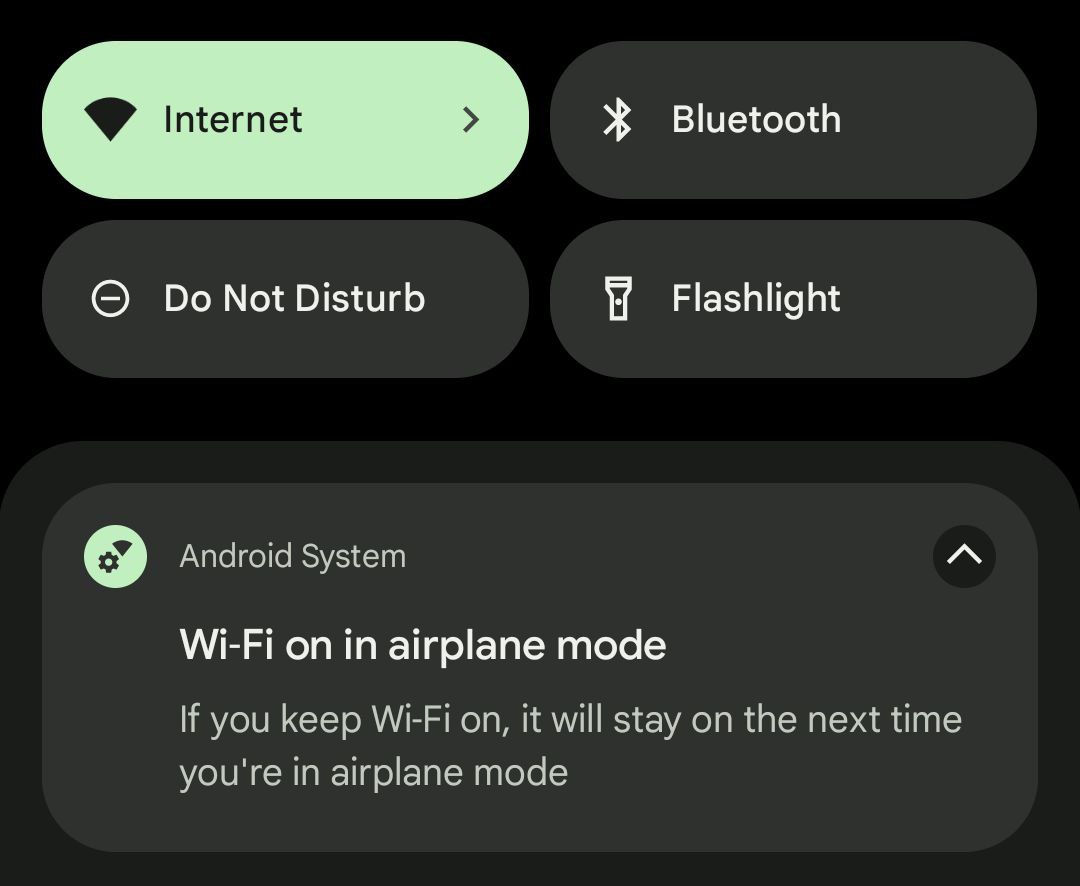
Pixel Owners Can Keep WiFi Going Even After Toggling Airplane Mode

https://www.droid-life.com/2022/12/07/pixel-owners-can-keep-wifi-going-even-after-toggling-airplane-mode/

Thanks to a recent change in Android 13 for Pixel phones, when a user toggles Airplane mode, you can now have it so that your WiFi connection will stay put. Before this recent change, Airplane mode would disable your cell connection and WiFi connection, but now, you can choose what happens.

To get this up and running, simply toggle Airplane mode on your Pixel device, and then turn on WiFi. Once connected, toggle Airplane mode off and now the phone will remember your setting. It’s that easy.

This is just like Android 11’s change for Bluetooth. Before Android 11, Airplane mode would disable everything, but now, it too can be toggled on and kept on following a switch into Airplane mode.

Supes handy.

// 9to5Google | Google Support

Read the original post: Pixel Owners Can Keep WiFi Going Even After Toggling Airplane Mode

via Droid Life: A Droid Community Blog https://ift.tt/wgAJCQ9

December 7, 2022 at 10:51AM

Toyota Corolla Cross H2 uses race-derived hydrogen combustion technology

https://www.autoblog.com/2022/12/06/toyota-corolla-cross-h2-hydrogen-combustion-prototype-testing/


Many have accused Toyota of dragging its feet on EVs, but the company is not treating battery electrics like a foregone conclusion. Like a college freshman who’s just dumped their high school sweetheart, it’s keeping its options open. It’s been campaigning a hydrogen combustion race car (note that it’s not a fuel cell vehicle but a conventional piston engine that burns H2), and the first road car derived from that technology has entered the prototype stage.

The Toyota Corolla Cross H2 Concept is powered by a version of the turbocharged 1.6-liter three-cylinder found in the GR Yaris and GR Corolla. That means it still has pistons, rods and a crankshaft. And instead of using hydrogen in an electrochemical process to power a car electrically, the engine employs a modified fuel delivery system, injectors and ignition setup to burn the element.

It adopts the hydrogen storage technology put forth by the Mirai, but can be built easily using traditional ICE manufacturing methods. Toyota says the system has quicker refueling times than charging a BEV and reduces dependency on precious metals like nickel and lithium, both required for electric vehicles

In one year of campaigning what is essentially a GR Corolla that runs on hydrogen in Japan’s Super Taikyu endurance series, Toyota has been able to markedly improve efficiency of the hydrogen combustion engine. By the end of the season, Toyota says it upped horsepower by 24% and torque by 33%, putting it on par with gasoline engines. The race car didn’t have the range of an equivalent petrol car, but engineers managed to increase the distance covered on a tank of H2 by 30% over the season. Similarly, refueling time was greatly reduced, from about 5 minutes to just 90 seconds.

The race Corolla had four tanks of hydrogen stuffed in the cargo area, but the Corolla Cross H2 will test real world practicality. It can carry five occupants and their luggage. It will soon begin winter testing in Japan.

Toyota estimates that the Corolla Cross H2 is only 40% of the way to commercialization, and doesn’t yet know if it can bring it to market. The prototype’s reveal took place at the same EU conference where the company announced an EV manual transmission and an expansion to six electric vehicles in the BZ family, so Toyota isn’t under any illusions that EVs will be a big part of the future.

On the other hand, Toyota sells cars in 170 countries with very different infrastructures and driving habits. Toyota believes that with a multi-technology approach — which includes battery electrics, hybrid-electrics, plug-in hybrid electrics, hydrogen fuel cells and hydrogen combustion cars — they have a better chance of achieving zero emissions.

Simultaneously Toyota is working with companies researching green hydrogen production and transport so that it has many avenues to get to carbon neutrality. The race cars are fueled with hydrogen fuel created from renewable energy. If nothing else, the firm is proving that even in a non-gasoline future, motorsports is still an important crucible for developing technology that can filter down to road cars.

Related video:

via Autoblog https://ift.tt/OrsYPK7

December 6, 2022 at 07:48AM

Tesla delivers first Semis to Pepsi, reveals some new details

https://www.autoblog.com/2022/12/01/tesla-semi-delivery-pepsi-frito-lay/


DETROIT — Tesla delivered its first electric semis to PepsiCo Thursday, more than three years after Elon Musk said his company would start making the trucks.

The Austin, Texas, company formally delivered the trucks in a “delivery event” at a factory near Reno, Nevada. The event was livestreamed, including on Twitter, which Musk now owns.

Musk drove one of three Tesla Semis in front of a crowd inside the factory. One was white, one was painted with a Pepsi logo, and another with Frito-Lay colors.

PepsiCo, which is based in Purchase, New York, is taking part in a zero-emissions freight project at a Frito-Lay facility in Modesto, California. That project is being funded by a $15.4 million clean-freight technology grant from the California Air Resources Board that includes 15 Tesla battery-electric tractors and other electric- and natural-gas powered trucks.

Electric semis also would be eligible for a federal tax credit of up to $40,000.

At an event in November of 2017 unveiling the Tesla Semi, Musk said production would begin in 2019 and the trucks would be able to follow each other autonomously in a convoy. But during Tesla’s third-quarter earnings conference call in October he said the company’s “Full Self Driving” system is not quite ready to be driverless.

“It’s been a long journey, a long five years,” Musk said, “but this is going to really revolutionize the roads.”

Musk said the truck has a tri-motor powertrain, based on the same one in the Model S/X Plaid. Two of the drive units would free-spin at times on the highway for maximum efficiency, while the other two units would engage when torque and acceleration is called for, say when tackling a grade. A video clip shown during the event (above) showed the truck pulling a 6% grade on Donner Pass, and passing traffic.

The truck’s regenerative capabilities capture energy on a downhill grade, preventing the threat of brake failure and a runaway truck, Musk said — “a significant safety improvement for the truck driver and the other people on the road.”

Of the motors, Musk said, “One of them is more powerful than the diesel engine on a semi truck.” (The drive unit in a Tesla Model S Plaid has an output of 1,020 horsepower and 1,050 pound-feet of torque. A diesel semi typically has around 500-600 horsepower, but its torque can range from 1,000 to 2,000 pound-feet.)

Musk said that when the tractor is being driven without a trailer, it’s “like an elephant moving like a cheetah.”

Musk said the truck has a range per charge of 500 miles (800 kilometers) when pulling an 82,000-pound (37,000-kilo) load. The normal load limit for a semi is 80,000 pounds, but Musk said an extra 2,000 pounds is allowed for an electric truck.

Musk said the company successfully completed a 500-mile test of the Semi‘s driving range on Nov. 15 between Fremont and San Diego. The company plans to ramp up Semi production to make 50,000 trucks in 2024 in North America.

To service the Semi, Musk said Tesla has developed a “megawatt-class” V4 DC Supercharger that’s “next-generation liquid-cooled,” allowing a user to “shove a megawatt” through a typically sized charging cable — “it’s going to be used for Cybertruck, too.” The charger is promised for next year.

Competitors working on hydrogen-powered semis say battery-powered trucks won’t work for long-haul carriers because it will take too long to recharge the huge batteries. Musk said hydrogen isn’t needed for heavy trucking. Musk said Tesla’s interest in the Semi was based in the fact that commercial trucking amounts to 20% of transportation greenhouse emissions, and 33% of particulates.

Tesla said its other vehicles would used the powertrain in the Semi, and that the company will use the truck in its own supply chain to ship auto components.


via Autoblog https://ift.tt/6JZUpHI

December 1, 2022 at 08:57PM

Airbus is building an aircraft hydrogen fuel cell powertrain

https://www.engadget.com/airbus-reveals-hydrogen-powered-aircraft-fuel-cell-engine-142256225.html


As part of its goal to have zero-emission aircraft enter service by 2035, Airbus has announced the development of a hydrogen fuel cell designed for airplanes. Unlike Rolls-Royce’s recently announced jet engine that burns hydrogen directly, it would use an electric motor just like fuel-cell cars, while emitting only H2O. It could eventually be employed in commercial aircraft that could carry up to 100 passengers around 1,000 nautical miles (1,150 miles), the company said.

Airbus plans to test the engine by the middle of the decade on its A380 MSN1 aircraft, “currently being modified to carry liquid hydrogen tanks.” However, the technology appears to be designed for smaller, regional aircraft that use more efficient propeller, rather than jet, engines. As you can see on the rendering above, the fuel cell and propeller motor are attached to an A380 for testing, not necessarily as full propulsion for the large airliner. 

“Fuel cells are a potential solution to help us achieve our zero-emission ambition, and we are focused on developing and testing this technology to understand if it is feasible and viable for a 2035 entry-into-service of a zero-emission aircraft,” said Airbus VP for zero-emission aircraft, Glenn Llewellyn. 

The company didn’t provide any more details, but fuel cells are a well-known technology for cars. They’re far less efficient than battery electric vehicles (BEVs) if you count fuel production and conversion to electricity. However, they have more range, are faster to refuel and lighter — with the latter, of course, being essential for aircraft.  

As mentioned, Rolls-Royce just announced the successful test of a jet engine powered by burning hydrogen directly, another possible technology for future air transport. The company converted a Rolls-Royce AE 2100-A, a regional aircraft engine used in turboprop commuter planes, to work with the novel fuel source. However, the tech could theoretically be scaled up for larger planes.

There are still some major hurdles to overcome before hydrogen could ever be used to power airplanes. It takes four times as much hydrogen as regular fuel by weight for the same range, and the fuel must be kept under pressure. Still, it might be the only option available for aircraft in the near future, as battery technology is still much too heavy unless used for very short flights.

via Autoblog https://ift.tt/6JZUpHI

December 4, 2022 at 09:08AM

How ‘Buy Now, Pay Later’ Really Works

https://www.wired.com/story/gadget-lab-podcast-576/


Money is tight these days. Holiday shopping, ballooning inflation, and a looming recession have forced people to more carefully consider their finances. Those factors might help explain the explosion of “buy now, pay later” services. BNPL plans offered by companies like Affirm, AfterPay, and Klarna let you spread the cost of a purchase—anything from a Peloton bike to a basket of groceries—over multiple installments, without the fees or interest rates of most credit cards. Of course, free money always comes with a catch.

Content

This content can also be viewed on the site it originates from.

This week on Gadget Lab, we dig into the buy now, pay later phenomenon and what it means for the future of shopping.

Show Notes

Read Lauren’s interview with Max Levchin. Check out more of WIRED’s reporting about buy now, pay later programs. Follow our coverage of all things ecommerce.

Recommendations

Michael Calore is @snackfight. Lauren is @LaurenGoode. Bling the main hotline at @GadgetLab. The show is produced by Boone Ashworth (@booneashworth). Our theme music is by Solar Keys.

If you have feedback about the show, or just want to enter to win a $50 gift card, take our brief listener survey here.

How to Listen

You can always listen to this week’s podcast through the audio player on this page, but if you want to subscribe for free to get every episode, here’s how:

If you’re on an iPhone or iPad, open the app called Podcasts, or just tap this link. You can also download an app like Overcast or Pocket Casts, and search for Gadget Lab. If you use Android, you can find us in the Google Podcasts app just by tapping here. We’re on Spotify too. And in case you really need it, here’s the RSS feed.

via Wired Top Stories https://www.wired.com

December 1, 2022 at 07:17AM

There’s Finally a Hidden Setting to Stop Chrome From Killing Your Laptop’s Battery

https://lifehacker.com/there-s-finally-a-hidden-setting-to-stop-chrome-from-ki-1849835503


Photo: monticello (Shutterstock)

From all the web browsers to choose from these days, Chrome is still the most popular for some reason. Practially everyone uses it, and as such, everyone knows it’s a battery hog—and the more tabs you open and the more extensions you use, the worse the energy drain becomes. While we’ve tried to help you out in the past with workarounds to limit Chrome’s energy use, they’re no longer necessary. Google finally has implemented an official “low power mode” solution you can enable in one step.

As reported by How-To Geek, Google dropped the new “Energy Saver” feature alongside the release of Chrome 108. When you enable the option, Chrome will preserve your battery by minimizing background activity, visuals, and frame rates. You will likely notice a change in performance when browsing with those three components limited. Animations and scrolling may feel choppy, and Chrome’s overall speediness may be diminished. But I’ll take it if it means I can actually get a full day’s work done without staying tethered to my charger.

That said, at this point it’s unclear how much battery Energy Saver will actually preserve, since the feature is so new. Still, it seems worth trying, even to squeeze an extra few minutes of juice from my MacBook.

How to enable Low-Power Mode in Chrome 108

The first step is to update Chrome to at least version 108. If it hasn’t updated automatically, you can force an update ton Windows, Mac, or Linux by clicking the three dots in the top-right corner, choosing Help > About Google Chrome. Hit “Relaunch” once Chrome loads the update.

G/O Media may get a commission

13% Off

Meta Quest 2 Bundle

Enter a new reality
This bundle packs in the Meta Quest VR headset itself, two controllers, Beat Saber, and Resident Evil 4 as well, which is everything you need to have a good time.

Then you’ll have to do a little digging, because Google hasn’t (yet) made the new option user-facing—there’s no obvious battery-saver setting; instead, the feature is hidden behind a feature flag. (Google launches experimental new features as flags it doesn’t consider ready for the general public, but which are good enough for tinkerers to try out. The company warns that enabling flags can mess with your browser and its data, but Energy Saver seems like a relatively safe one to try.)

If you want tinker with Energy Saver, type chrome://flags into the address bar, then hit enter. Here, click the “Search flags” field and type “battery” to pull up “Enable the battery saver mode feature in the settings” (it’s identifying flag is “#battery-saver-mode-available”). Click “Default,” change the setting to “Enabled,” then hit “Relaunch” to reboot the app. Once Chrome opens back up, head to Settings, then click on the new “Performance” tab to see “Energy Saver.”

From here, you have two options. You can either have Energy Saver kick on when your laptop hits 20% battery, or you can choose to keep the feature on anytime your laptop is unplugged. I didn’t bring my charger to work today, so I know which option I’m picking.

via Lifehacker https://lifehacker.com

November 30, 2022 at 09:56AM