What are sundogs and how do they form?

https://www.space.com/sundogs-definition-formation-science


A sundog is a concentrated patch of sunlight that is occasionally seen to the right or the left of the sun or even on both sides of our star in the sky simultaneously.

Also called mock suns or parhelia, meaning “with the sun,” according to the National Weather Service (opens in new tab). Sundogs are part of a family of atmospheric optical illusions including moon haloes and the closely related sun haloes. All of these phenomena are caused by the refraction of sunlight by ice crystals in the atmosphere. 

Sundogs typically appear as a pair of patches of light with subtle colors which manifest at the same altitude over the horizon as the sun. They can appear in a variety of forms, sometimes as colorful spots, or other times, so intense and bright they appear to be two additional suns in the sky. 

Related: Red lightning: The electrifying weather phenomenon explained

The name “sundog” is believed to date back to Greek mythology according to Almanac, though this isn’t the definitive origin of the name. The name may reflect the belief that as Zeus the father of all gods and the god of the sky in Greek mythology, walked his dogs through the sky they often appeared as companions to the sun as two “false suns.”

What causes sundogs?

Vivid sundogs seen over western Iowa as arctic air and wind drive snow and ice over the region.  (Image credit: Mike Hollingshead via Getty Images)

(opens in new tab)

Sundogs are formed when light passes through hexagonal plate crystals of ice, suspended in cirrus or cirrostratus clouds located at altitudes of around 20,000 feet (6,000 meters) and higher, up to 40,000 feet (12,000 meters). 

These ice crystals can also be found much closer to the ground in extremely cold climates where temperatures drop below -22 degrees Fahrenheit (-30 degrees Celsius) as a meteorological phenomenon called “diamond dust.”

As ice crystals drift downwards their hexagonal faces are orientated approximately horizontally. Rays of sunlight enter through a side edge face and then exit through another edge face that is inclined 60 degrees to the first.

Taking these two refractions causes the sunlight to deviate by at least 22 degrees depending on the angle at which it entered the ice crystal, according to science site Atmospheric Optics. This causes light to ring the sun at a distance of 22degrees as sun-haloes. When the light is concentrated as spots next to the sun. also separated by 22 degrees it appears as sundogs. 

Suitably for a phenomenon with a canine-inspired moniker, sundogs can often appear with ‘tails’ of light stretching out from them. These tails are created by the reflection of light from the vertical sides of the flat hexagonal ice crystals.

The sundog rainbow

Sundogs can appear as a sort of rainbow either side of the sun. (Image credit: Katie Vasbinder via Getty Images)

(opens in new tab)

The inner edges of sundogs closer to the sun tend to have a reddish hue than the outer edges which are blue in color. The middles of sundogs tend to be yellow or orange. The reason for this variation in color is rooted in the physics of light that gives rise to the ordering also seen in rainbows.

Light from the sun is white and made up of light of all different colors. When it passes through a prism the white light of the sun is split into its constituent colors. 

This happens because the degree at which light is refracted when passes through a medium, in this case, the ice crystal, is refracted depends on its frequency. The variation is called the index of refraction. 

Low-frequency long-wavelength red light is refracted less strongly than high-frequency blue light so red light stays closer to the sun, while blue light is dispersed further out.

The effect is similar to that which causes a rainbow to appear with a set order of colors, red, orange, yellow, green, blue, indigo, and violet (which can be remembered with the simple mnemonic ROY G.BIV) through rainbows are caused by raindrops, not by ice.

If the colors in a sundog were more prominent you’d see them spreading away from the sun in this order but orientated vertically rather than horizontally as with a rainbow. 

Sundogs don’t only vary in color, however. They can also come in a variety of shapes and sizes depending on the size of the ice crystals that create them. 

These hexagonal crystals rarely remain exactly horizontal as they descend through the atmosphere. Rather they wobble as they fall to Earth, the amount a crystal wobbles as it descends increases with its size. 

Crystals that wobble the most, and thus larger crystals, create sundogs that are taller. These can become so tall that eventually, they are difficult to distinguish from just fragments of a 22 degree halo around the sun.

Double solar halo captured in East Greenland. (Image credit: Posnov via Getty Images )

(opens in new tab)

Every dog has its day: Where and when can you see sundogs?

Sundogs can be seen worldwide and can appear at any time when the sun is above the horizon. There are, however, conditions that not only make sundogs more likely to manifest but also boost their brightness making them more likely to see.

The most obvious condition improving the quality of sundogs is the proximity of the sun to the horizon. The closer the sun is to the horizon the more conspicuous sundogs are. When the sun is high in the sky sunlight can’t pass through ice crystals as easily.

Because sundogs are more common when the sun is close to the horizon, the best time to look for these solar illusions is in the morning or evening when the sun is rising or setting.

The fact that ice is key to the creation of sundogs means you are more likely to see them during winter, especially the further north you go.

That means the frigid winter mornings of December in the northern hemisphere provide the ideal time to go sundog hunting.

If you’re looking for equipment to catch the perfect sundog photograph, our guides to the best cameras for astrophotography and best lenses for astrophotography can help. 

Additional Reading

The reason we know sundogs aren’t related to a god taking his dogs for a walk is probably thanks to Isaac Newton‘s work with optics in the 1600s. Read about what inspired Newton to experiment with prisms and light and the results these experiments delivered on the Molecular Expressions website which also allows you to play with prisms yourself.  

Bibliography

Sun Dog, Britannica, [Accessed 12/13/22], [https://www.britannica.com/science/sun-dog (opens in new tab)]

What Are Sundogs? Rainbows Beside the Sun!, Alamanac, [Accessed 12/13/22], [https://www.almanac.com/what-are-sundogs-rainbows-beside-sun (opens in new tab)]

Sun Dog Formation, Atmospheric Optics, [Accessed 12/13/22], [https://atoptics.co.uk/halo/dogfm.htm (opens in new tab)]

What Causes Halos, Sundogs and Sun Pillars?, Nation Weather Service, [Accessed 12/11/22], [https://www.weather.gov/arx/why_halos_sundogs_pillars (opens in new tab)]

via Space https://ift.tt/cQSID39

December 23, 2022 at 08:09AM
Pixel 6a, Pixel 7 Pro Voted Best Cameras by the People

https://www.droid-life.com/2022/12/22/pixel-6a-pixel-7-pro-voted-best-cameras-by-the-people/

Who doesn’t love a good camera battle that aims to crown a phone as the best in the business? I’m (especially) here for it when the battle takes in lots of data, various camera modes, prices, and more to help truly decide what might be the best smartphone camera available. We got that this week and the Google phones from 2022 kind of dominated.

You all know MKBHD. You may also know that he runs a camera battle each year that is typically based on a bracket system that attempts to crown a winner based on people’s votes. It’s fun, but not that scientific. For 2022, he changed it up and went all-in on a data approach with dozens of phones and a custom website created to help score all of them in a head-to-head battle system for top spots in standard photos, night/low-light mode, and portrait mode. This appears to be a serious setup with results you should be able to take real info from, because in the end, hundreds of thousands of people voted and have decided which phones take the best photos.

You’ll want to watch his video below for a longer explanation of how this new system plays out, but for this post, we’ll just get right into which phones are awesome at what, and also which phones are garbage.

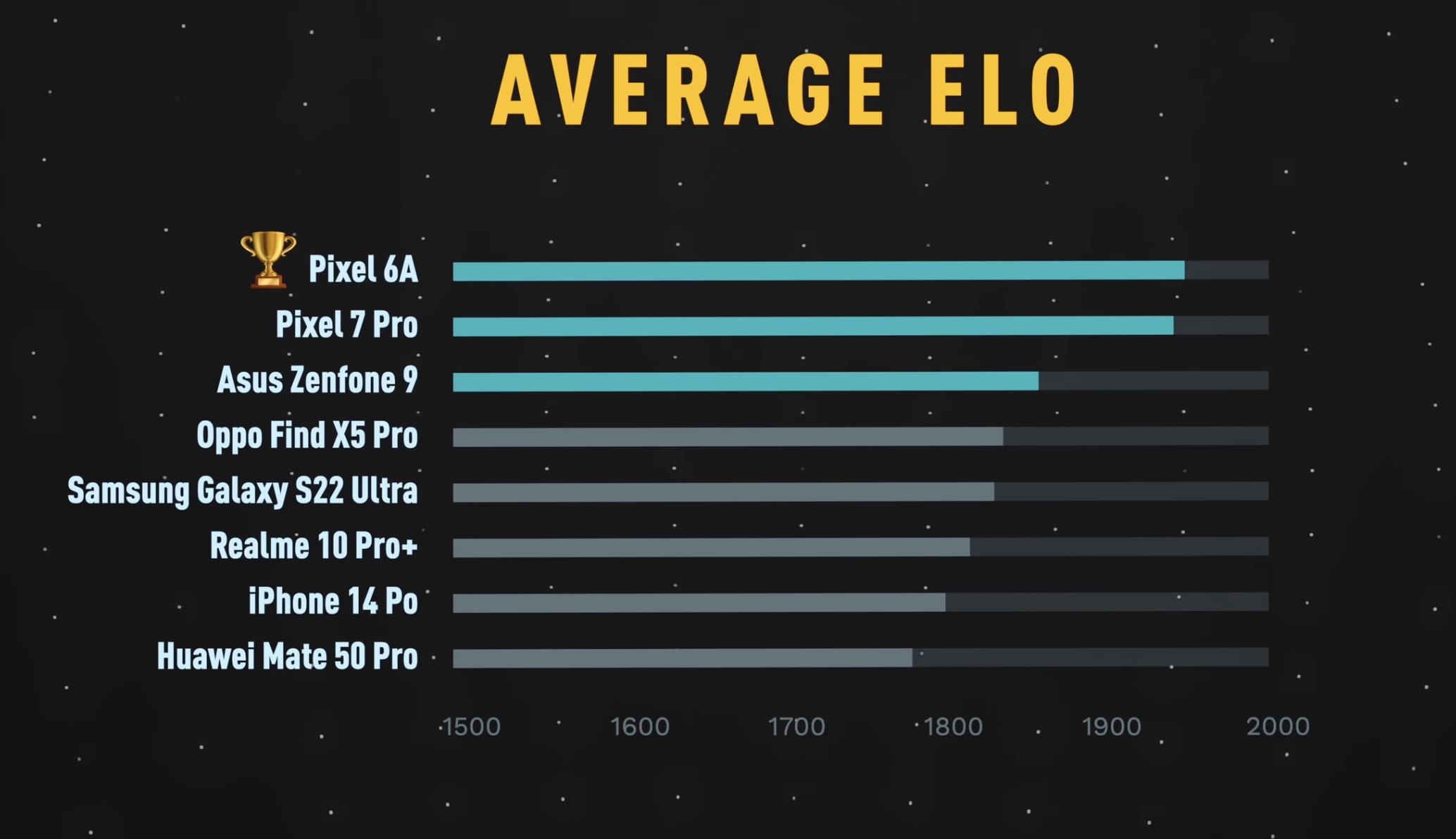
The top overall spot, with the highest overall score based on this voting system, is the Pixel 6a. Not a joke, man. In second place was the Pixel 7 Pro, followed by the Asus Zenfone 9.

Best Smartphone Camera 2022

Further breaking that down, the Pixel 6a took 3rd (standard), 2nd (low-light), and 2nd (portrait) across all categories, while the Pixel 7 Pro was 2nd (standard), 4th (low-light), and 1st (portrait). Because I know you are curious, the iPhone 14 Pro came in at 6th (standard), 10th (low-light), and 5th (portrait).

There is a deeper breakdown about the value of a phone and how it performed, which is cool. The Pixel 6a, as you can imagine, also won the “Votes Per Dollar” category. At $449 and with a camera as good as you all said it is, yeah, that makes sense. There’s also plenty of talk about which photos appear to get higher votes based on brightness or darkness and amount of blur and so on. Again, watch the video.

Oh, you want to know which cameras are absolute buns? Here you go.

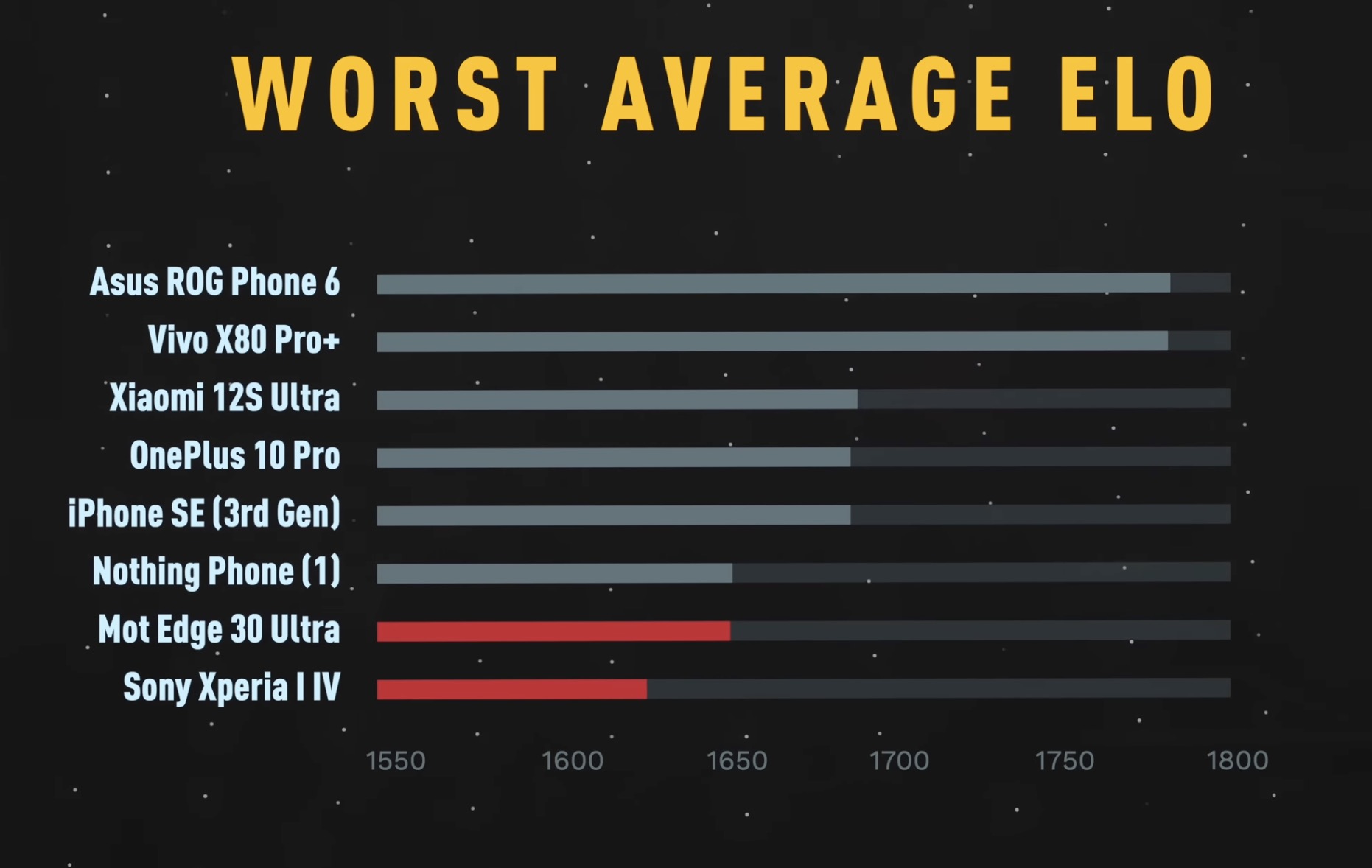
Worst Smartphone Camera 2022

That’s right, the Moto Edge 30 Ultra and the Sony Xperia 1 IV are terrible. The Nothing Phone (1) shouldn’t get a pass for being absolutely awful too. At least it doesn’t cost $1,000 or more like those other two bad phones I just mentioned.

So there you have it – the Pixel 6a and the Pixel 7 Pro are essentially the best smartphone cameras you can buy according to millions of votes by people like you and I. Good job, Google.

Read the original post: Pixel 6a, Pixel 7 Pro Voted Best Cameras by the People

via Droid Life: A Droid Community Blog https://ift.tt/JT0EVtK

December 22, 2022 at 11:35AM

Wind farms on Mars could power future astronaut bases

https://www.space.com/mars-wind-power-support-red-planet-missions


Although the air on Mars is thin, winds there are strong enough to generate power that can support missions on the Red Planet, a new study finds.

The atmosphere on Mars is very thin compared to Earth’s, possessing only about 1% the density, so the winds there only carry about 1% the force of our planet’s. As such, researchers have long disregarded wind energy there as a viable source of energy for missions.

“The biggest challenges for wind energy on Mars is that even fast winds don’t carry much force,” Victoria Hartwick, a research scientist at NASA Ames Research Center in Mountain View, California, told Space.com.

However, recently scientists have focused on creating wind turbines that can operate in extreme locations and extract power even from slow winds. Both factors might prove useful in building wind turbines useful on Mars, Hartwick and her colleagues noted in a new study.

Related: Perseverance Mars rover figures out how devils and winds fill the Red Planet’s skies with dust

If wind power could prove useful on the Red Planet, it might play important roles that other forms of power do not. For instance, the amount of energy from solar power varies over the course of the day and seasons and across latitudes, and dust storms can prevent it from working. Although nuclear power can provide a continuous source of energy, it poses risks such as meltdowns and long-term waste disposal.

After wind resource analyst Clara St. Martin described state-of-the-art modeling techniques used to discover prime areas for wind turbines on Earth, Hartwick and her colleagues wanted to see what might happen if they applied similar methods on global models of Martian climate. 

The researchers found they “could comprehensively assess the wind power potential across the entire surface and throughout the entire Mars year,” Hartwick said. 

Hartwick and colleagues calculated the amount of power four different wind turbines might generate on Mars. These included commercial-scale machines such as the 300-kilowatt Enercon E3, which possesses a 100-foot-diameter (33-meter) rotor, and the five-kilowatt Aeolos V, which has a 15-foot-diameter (4.5-meter) rotor.

The researchers found that Martian wind power maximized at night, revealing it could help compensate for solar power. Wind power was also strong during global dust storms and during winter seasons in polar and middle latitudes, periods when solar power is weakest. ”We were able to identify 13 broad regions with stable wind resources,” Hartwick said.

The scientists discovered that out of 50 proposed Martian landing sites, wind speeds at 40 of the sites could supply at least some useful power. At three sites, wind speeds could generate 24 kilowatts — enough to support a six-crew team — for more than 35% of the year. At seven others, wind energy can supply more than 50% of total power needed either during winter months or dusty times. If wind power is needed only for scientific instruments, it could prove useful for another 30 sites.

All in all, when combined with solar arrays, wind turbines on Mars could increase the amount of time that power exceeds estimated missions requirements from about 40% for solar arrays alone to more than 60 to 90% when using wind power across a broad fraction of the Martian surface. 

“This means some really scientifically interesting regions that might have previously been disregarded due to energy limitations might be accessible to human missions if wind turbines can be utilized,” Hartwick said.

The scientists encourage future research to investigate wind turbines that might operate efficiently under Martian conditions and extract more power from Martian winds. “We really hope that many groups will use this research as a stepping off point for their own work,” Hartwick said.

The scientists detailed their findings (opens in new tab) Dec. 19 in the journal Nature Astronomy. 

Follow us on Twitter @Spacedotcom (opens in new tab) or on Facebook (opens in new tab)

Join our Space Forums to keep talking space on the latest missions, night sky and more! And if you have a news tip, correction or comment, let us know at: community@space.com.

via Space https://ift.tt/4pyeDf0

December 22, 2022 at 07:17AM

Robocall company may receive the largest FCC fine ever

https://www.engadget.com/robocall-company-may-receive-the-largest-fine-ever-from-the-fcc-110759522.html

The FCC has proposed a $299,997,000 fine against "the largest robocall firm" it has ever investigated, the regulator announced. It would be the FCC’s largest fine ever, and targets a firm that made over 5 billion calls in three months, enough "to have called each person in the United States 15 times," it wrote. 

The operation is run by Roy Cox, Jr. and Michael Aaron Jones via their Sumco Panama company, along with other domestic and foreign entities. In July of this year, the FCC issued its first ever "K4 Notice" and "N2 Order" directing all US telephone providers to stop carrying traffic related to the car warranty scam calls. "This resulted in a massive, 99 percent drop in the volume of such calls since June, according to [spam blocking app] RoboKiller," the FCC wrote. 

The FCC proposed its largest-ever fine because it found the robocallers met the criteria for "egregious violations." Consumers described the calls as "incessant" and "harassment," and the robocallers used dirty practices like calling health care workers from spoofed hospital numbers. The firm also violated multiple FCC rules, like failing to identify the caller at the start of a message. 

In the calls, a message would open with something like "we’ve been trying to reach you concerning your car’s extended warranty," and prompt you to speak to a scam "warranty specialist." Robokiller advises users to avoid the calls in the first place if possible, not follow prompts, and above all, never provide personal information like banking details.

via Engadget http://www.engadget.com

December 22, 2022 at 05:13AM

XRAI Glass Wants to Subtitle Life for Deaf and Hearing-Impaired Users

https://www.wired.com/story/xrai-glass-caption-ar-glasses-first-look/


Following a conversation can be a challenge for the deaf and hard of hearing. But what if you could pop on a pair of glasses and have subtitles appear in real time? That’s the promise of a newly released app called XRAI Glass. It works with augmented reality glasses called Nreal Air (sold separately by a different company) to subtitle conversations. 

The XRAI name (pronounced x-ray) refers to XR, as in mixed reality, and AI, as in artificial intelligence, says Mitchell Feldman, the company’s chief marketing officer. I met with the team for a demo. The glasses need to be plugged into a smartphone to work, which means you also need the XRAI Glass app (currently available for Android only). 

When I put the glasses on, I can see text floating in the center of my vision. As Feldman continues to talk, it quickly clear I’m reading a pretty accurate transcription of what he’s saying. At first, it looks cut off, like the scrolling text at the beginning of a Star Wars movie just before it fades, but after a few adjustments with the glasses, I can see our speech clearly, and we chat for a while. There is a slight delay as the text appears. When I start to speak, there is an even longer delay before different sentences are attributed to speakers—this speaker attribution is called diarization, and it happens in the cloud.

XRAI via Simon Hill

XRAI doesn’t just transcribe in real time; it also saves a searchable transcript of each conversation. Feldman demonstrates this by giving me a spiel about himself and then saying to XRAI, “Tell me about Mitchell,” prompting it to replay his speech. Each transcription is also viewable on your phone. Speech is encrypted and uploaded to the cloud to be processed, then it’s immediately deleted—XRAI staff cannot view it; the user just gets the transcript back. “We can’t access it even if we wanted to,” says Dan Scarfe, chief executive officer at XRAI. “We designed ourselves out of the flow of data deliberately.” You can try to use it on device exclusively, but the experience is less accurate. 

via Wired Top Stories https://www.wired.com

December 21, 2022 at 07:09AM

Shock wave from sun has opened up a crack in Earth’s magnetic field, and it could trigger a geomagnetic storm

https://www.livescience.com/shock-wave-opens-crack-in-magnetosphere


A mysterious shock wave in a gust of solar wind has sent a barrage of high-speed material smashing into Earth’s magnetic field, opening up a crack in the magnetosphere. The barrage of plasma could lead to a geomagnetic storm today (Dec. 19), according to SpaceWeather.com (opens in new tab).

The shockwave’s origins aren’t exactly known, but scientists think it could have come from a coronal mass ejection launched by the sunspot AR3165, a fizzing region on the sun’s surface that released a flurry of at least eight solar flares on Dec. 14, causing a brief radio blackout over the Atlantic Ocean. 

Sunspots are areas on the sun’s surface where powerful magnetic fields, created by the flow of electrical charges, knot into kinks before suddenly snapping. The resulting release of energy launches bursts of radiation called solar flares, or plumes of solar material called coronal mass ejections (CMEs). Once launched, CMEs travel at speeds in the millions of miles per hour, sweeping up charged particles from the solar wind to form a giant, combined wavefront that (if pointed toward Earth) can trigger geomagnetic storms.

Related: Listen to the terrifying rumble of Earth’s magnetic field being assaulted by a solar storm

Geomagnetic storms occur when energetic solar debris (mostly consisting of electrons, protons and alpha particles) gets absorbed by, and subsequently compresses, Earth’s magnetic field. The solar particles zip through the atmosphere near the poles where Earth’s protective magnetic field is weakest and agitate oxygen and nitrogen molecules — causing them to release energy in the form of light to form colorful auroras such as the northern lights. 

The storms can also create cracks in the magnetosphere which remain open for hours at a time, enabling some solar material to stream through and disrupt satellites, radio communications, and power systems.

Thankfully today’s potential storm, predicted to be a G-1 class, will be fairly weak. It may cause minor fluctuations in power grids and impair some satellite functions — including those for mobile devices and GPS systems. It could also cause an aurora to appear as far south as Michigan and Maine (opens in new tab)

More extreme geomagnetic storms, however, can have far more serious effects. They can not only warp our planet’s magnetic field powerfully enough to send satellites tumbling to Earth, but can disrupt electrical systems and even cripple the internet (opens in new tab)

The upcoming storm is just the latest in a string of solar attacks fired at Earth as the sun ramps up into the most active phase of its roughly 11-year solar cycle.

Astronomers have known since 1775 that solar activity rises and falls in cycles, but recently, the sun has been more active than expected, with nearly double the sunspot appearances predicted by the National Oceanic and Atmospheric Administration (opens in new tab).

NASA’s Solar Dynamics Observatory spacecraft captured this shot of a solar flare erupting from the sunspot AR3165 (center) on Dec. 14, 2022. (Image credit: NASA/SDO)

Scientists anticipate that the sun’s activity will steadily climb for the next few years, reaching an overall maximum in 2025 before decreasing again.

The largest solar storm in recent history was the 1859 Carrington Event, which released roughly the same energy as 10 billion 1-megaton atomic bombs. After slamming into Earth, the powerful stream of solar particles fried telegraph systems around the world and caused auroras brighter than the light of the full moon to appear as far south as the Caribbean.

If a similar event were to happen today, scientists warn it would cause trillions of dollars’ worth of damage, trigger widespread blackouts, and endanger thousands of lives. A previous solar storm in 1989 released a billion-ton plume of gas that caused a blackout across the entire Canadian province of Quebec, NASA reported (opens in new tab).

But this may not even scratch the surface of what our star is capable of hurling at us. Scientists are also investigating the cause of a series of sudden and colossal spikes in radiation levels recorded in ancient tree rings across Earth’s history. A leading theory is that the spikes could have come from solar storms 80 times more powerful than the Carrington Event, but scientists have yet to rule out some other potentially unknown cosmic source.

Originally published on LiveScience.com.

Join our Space Forums to keep talking space on the latest missions, night sky and more! And if you have a news tip, correction or comment, let us know at: community@space.com.

via Space https://ift.tt/s8pU716

December 20, 2022 at 12:34PM