The console wars ended a while ago, in case you didn’t know. But if they were still raging on, a talented hardware modder in China created a device force a lasting peace. It’s a massive and very cleverly designed triangular box that contains an Xbox, PlayStation, and Switch 2. They all work and can be easily swapped between with the press of a button.
As first spotted by Tom’s Hardware, Chinese tech and computer expert ??? XNZ has created an all-in-one mega console which she anointed the “Ningtendo PXBOX 5,” a name that just rolls right off the tongue. According to XNZ, the idea behind this wild device came from her wanting to play various console-exclusive games without having to get up and manually power on and off each machine to switch between them.
The design of the monster machine is inspired by the 2013 Apple Mac Pro, aka the one that looked like a trash can. And while she didn’t use the actual innards of an old Mac, the inside of that strange computer was a triangular setup that ended up being the perfect design to house three disassembled gaming console. A fan at the bottom is then used to cool the consoles.
But creating a triangular heatsink for that would be expensive, so XNZ used an ancient method known as lost-wax casting to create the high-end piece of tech. Essentially, you first create an object out of an easy to melt piece of material, like wax or plastic, and then coat it in a heat-resistant material. Then you heat the object and all the soft insides melt and you can pour molten metal inside, which hardens and cools into your desired shape. Nifty!
The end product is an impressive device but it might not be the most practical. The power supply she used only allows one console at a time to play a game, though the others can idle in the background. A big button on top switches the HDMI input between the consoles. Probably easier and cheaper to just buy the consoles and an HDMI switcher with a remote, but that’s not nearly as cool as the Ningtendo PXBOX 5.
Corporations don’t have feelings. And yet, they want others to think they do—and that we’re being too rough on them.
Twice this past week, major tech companies appealed to empathy. One bid bubbled up in a Wccftech interview with Micron, when the memory producer was asked if it and other suppliers were abandoning consumers. The response: “Our viewpoint is that we are trying to help consumers around the world. We’re just doing it through different channels. […] What’s going on right now is that the TAM [ed: Total Addressable Market] and data center is growing just absolutely tremendously. And we want to make sure that, as a company, we help fulfill that TAM as well.”
Welcome to The Full Nerd newsletter—your weekly dose of hardware talk from the enthusiasts at PCWorld. Missed the surprising topics on our YouTube show or latest news from across the web? You’re in the right place.
The other came from Nvidia, with CEO Jensen Huang calling gloomy views of AI “extremely hurtful” during a discussion on the No Priors podcast. Huang’s take: “I think we’ve done a lot of damage lately with very well-respected people who have painted a doomer narrative, end of the world narrative, science fiction narrative. […] It’s not helpful to people, it’s not helpful to the industry, it’s not helpful to society, it’s not helpful to the governments.”
I was struck by the argument Huang went on to present in that same podcast segment, which suggests AI is going through growing pains while reaching the goal of functionality, and such negativity hinders and slows that progress—as well as that of the podcast hosts, who seeded the idea of self-interest as the motivator for regulatory action. That those seeking regulation may be trying to freeze out new startups, not save humanity.
So expensive. And not going to drop in price anytime soon, either, no matter how you buy it as a consumer.
Foundry
There’s a lesson here for those of us in the stands—everyone is looking out for their own interests, including consumers. And we should be smart about appeals to emotion, because they’re not always in the interest of the listener.
Meanwhile, inflation and interest rates continue to depress consumer spending power here in the U.S., which is reflected abroad as well. AI has also torched jobs—it’s fueled thousands of layoffs already.
Sure, in the grand scheme of things, the fevered pace of tech often has led to good outcomes in the end. But that doesn’t change the individual impact of incomes lost, plans destroyed, security evaporated. So when a company makes a play for my agreement through emotion, I always wonder: Who benefits from this vision?
In this case, consumers not being completely shut out isn’t the win Micron delicately posited. RAM now costs triple what it did just bare months ago—many will still be effectively shut out from upgrades and replacement PCs. For Nvidia’s part, the hints that zero regulation benefits progress ignores the human element: As the saying goes, regulations are often written in blood. How much regulation is warranted is a different conversation, and a reasonable one to have.
But you can’t have a reasonable discussion without some critique or outright criticism. When companies appeal to emotion, I wonder why it doesn’t cut both ways. I wonder who benefits. In the case of technology right now, certainly not individuals. This approach isn’t a fair tactic. None of us should accept it as such.
In this episode of The Full Nerd
In this episode of The Full Nerd, Will Smith, Adam Patrick Murray, Alaina Yee, and Michael Crider give CES 2026 a final send-off with a look at the smaller things we liked at the show. I’m still considering building my own E-Ink picture display now. If technology can save me from my sad bachelor-esque habits, I’m for it.
Also, Will did make me feel better that I’m not as bad as I thought, regarding home decor. I have a couch, sir. And even a coffee table!
I was not in the majority on my opinion of the show floor robots, though.
And if you need more hardware talk during the rest of the week, come join our Discord community—it’s full of cool, laid-back nerds.
This week’s quieter nerd news
I can’t say I’m mad about the slow flow of news this week—I guess everyone’s still wrung out from CES 2026…or just tired from counting all the mentions of AI from the keynotes. (I would like to note that Will and I got our count through pure, old-fashioned grit.)
Still, there’s plenty to eye with speculation. Or outright suspicion. (I’m giving that supposed Steam Machine pricing some side-eye.)
I guess my old Sandy Bridge system could get revived again…
kingston.com
Digging deep into the archives: Apparently, Chinese DIY builders are now recommissioning DDR3 motherboards for use. I never thought I could justify my continued use of my Sandy Bridge system, but here we are.
Necessity is the mother of invention: Or at least, the precipitator of modding laptop RAM to work as desktop RAM, because it works out to be cheaper.
I am not all-in: Google Gemini can now connect with Gmail, Photos, Search, and YouTube to provide more personalized answers to an individual’s questions. It’s currently set as opt-out, and Google pinky-swears it’s not training the model on any accessible data…but the company also is reminding everyone that, you know, your data is living already on its servers. Yeah.
On the inside: I like me a good factory tour. I was very pleased when I saw a notification for this Gamers Nexus video, which gives a cool peek into production of Intel Arc cards at Sparkle.
Uh, congrats, Linux? Security researchers have uncovered a new, previously unknown—and more advanced—malware targeting Linux cloud servers. An unwanted (but I guess predictable) reminder that bad actors go after people, not platforms.
ICYMI: Nvidia DLSS 4.5 (at least, the super resolution part) is live—if you have a compatible card, you can try it out right now.
Valve
I’m dubious: Buried deep in a Czech retailer’s website were two possible indicators of the upcoming Steam Machine’s price, with both the entry-level and upgrade versions circling the $1,000 mark. Placeholder, or a sign of the times? My vote’s for the former.
Oooooh: Is AMD taking a page out of Nvidia’s playbook? Rumor has it that Team Red will drop its new Gorgon Point CPUs just days ahead of Panther Lake’s imminent launch. (Shhh, don’t tell Brad I’m spreading scuttlebutt.)
Cool…but I don’t have a problem, Brad: Brad raved about this particular software demo among those he saw at CES 2026. I admit it’s interesting, but I want to stress I have no issues with how many tabs I keep open. I live a comfortable life.
I winced: Those deep in the memory trenches predict years of RAM shortages, given the current climate—the best estimate came from Micron, with things beginning to ease in mid-2027. Yeah.
Thanks, I hate it: Verizon made a deal to allow its users to unlock phones after 60 days. A new FCC ruling says it no longer has to. I guess it’s back to unlocked phones only for me…
Gosh, what a banger of a start to the new year. I thought I’d spend most of this week sneaking in complaints about crowded gyms. Yes, it’s absolutely other people’s fault I ate too much and drank a ton of Will’s excellent eggnog. (Thanks again for sharing that with us!)
Catch you all next week!
Alaina
This newsletter is dedicated to the memory of Gordon Mah Ung, founder and host of The Full Nerd, and executive editor of hardware at PCWorld.
China is looking to take over Earth’s orbit with a staggering number of satellites, all of which serve an unknown purpose.
The Institute of Radio Spectrum Utilization and Technological Innovation in China filed a request with the International Telecommunications Union to operate two satellite constellations. Each constellation would include 96,714 units, totaling nearly 200,000 satellites to be launched into low Earth orbit.
It’s not yet clear what type of satellites would make up the two constellations, or why China needs so many of them. If they were to launch, however, they would exponentially increase the total number of satellites currently orbiting our planet.
Satellite overdose
The two constellations are named CTC-1 and CTC-2, according to PC Mag. Although there’s little information about the Chinese institute behind the request or the purpose of the constellations, one of the filings indicates that they plan on using a wide range of radio frequencies.
The filings also suggest that the satellites will be deployed across orbital altitudes ranging from 186 to 372 miles (300 to 600 kilometers) above Earth’s surface, and even higher orbits reaching 12,427 miles (20,000 km). By comparison, SpaceX’s Starlink satellites orbit at around 342 miles (500 km) above the Earth.
Although the recent filings were for two separate constellations, they do suggest China’s intent on dominating the satellite industry. The filings may be a way to secure China’s spot in Earth orbit ahead of attempts by other countries.
China is already constructing two constellations in space, Guowang and Qianfan, each of which will consist of more than 10,000 satellites. The country’s recent filings have not yet been examined by a regulatory body.
Crowded orbit
SpaceX operates the world’s largest constellation of satellites, with more than 9,400 Starlinks currently in orbit. Roughly 12,000 satellites are currently orbiting Earth, but that number is set to increase over the years as the space industry continues to grow.
The number of satellites in orbit has increased dramatically over the past five years alone. In 2020, there were approximately 2,500 to 3,000 satellites orbiting Earth. Studies estimate that by 2040, there will be around 560,000 active satellites based on planned launches by companies like SpaceX.
This past week, the Federal Communications Commission approved SpaceX’s request to deploy another 7,500 of its Starlink satellites. SpaceX plans to launch up to 42,000 Starlink satellites and so far has received approval for 30,000.
Automakers have spent decades refining engines, suspensions, and software, but Hyundai is aiming at something far more basic: how people actually get in and out of cars. A newly published patent application shows the company experimenting with a double-sliding-door setup that feels less inspired by minivans and more by subways and commuter trains.
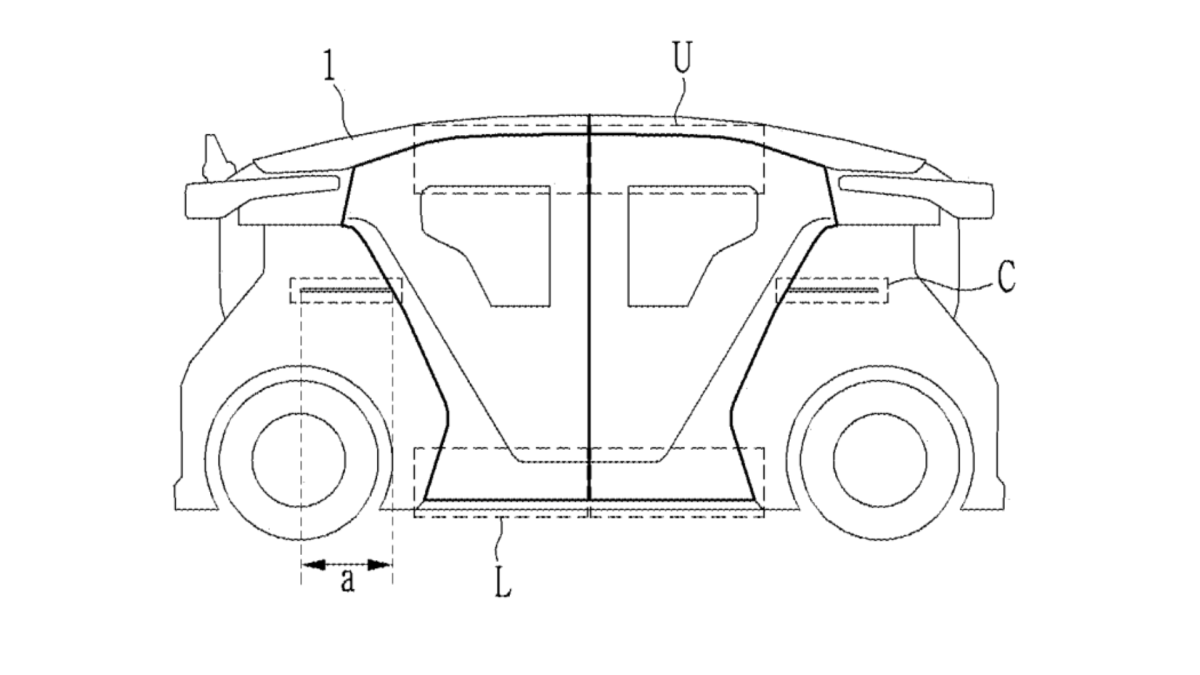
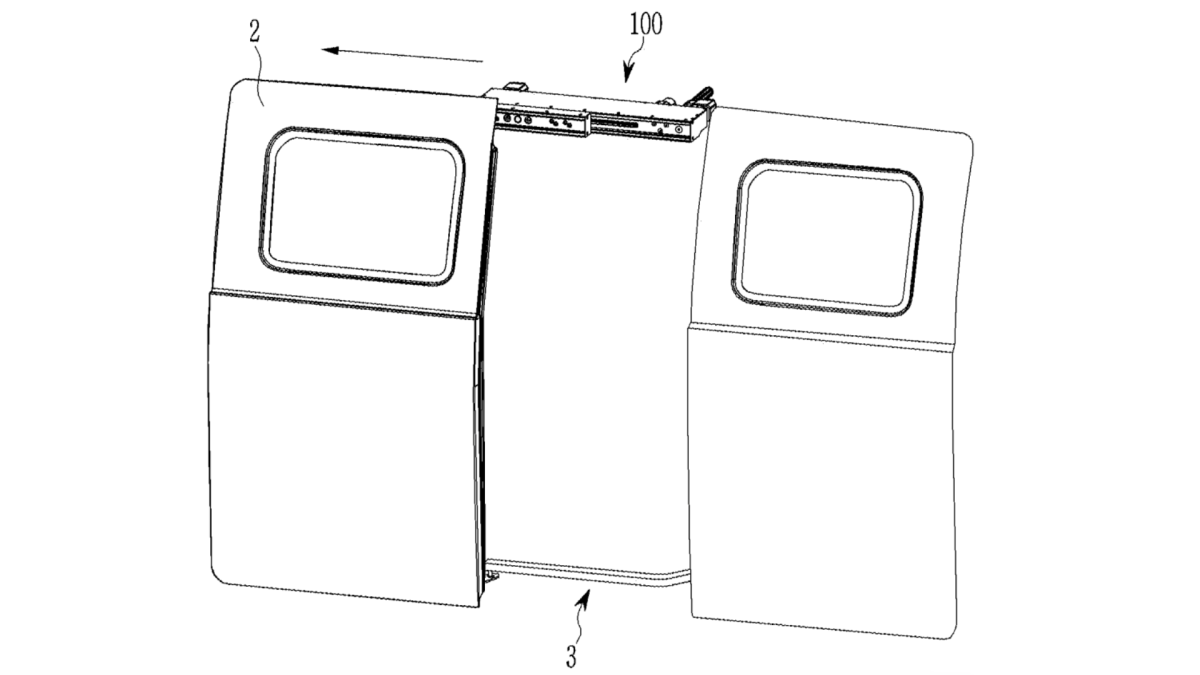
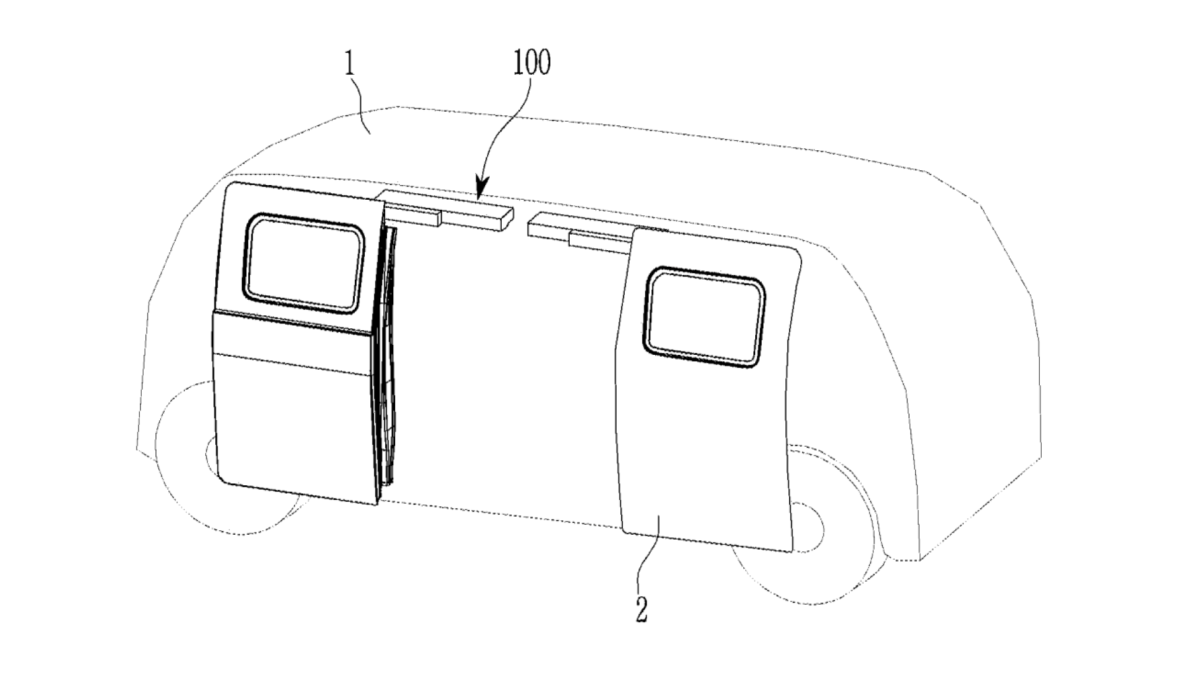
Published by the United States Patent and Trademark Office (USPTO) in January 2026 (you can look it up yourself using patent no. 12523084), the filing outlines a door system where two panels meet in the middle and slide away from each other along a shared rail system. The goal appears simple but ambitious: create a wider, cleaner opening without the packaging compromises of a single large sliding door or the clearance issues of hinged doors.
USPTO
Subway Logic Applied to Passenger Cars
The most striking thing about Hyundai’s idea is how familiar it feels if you’ve ever boarded a train. Instead of one door moving rearward, the opening splits at the center, with each door sliding outward in opposite directions. That symmetry could make entering and exiting faster and more intuitive, especially in crowded urban environments or curbside pickup scenarios.
From the patent illustrations, the mechanism lives largely in the roof structure, using synchronized motors and rails to keep movement smooth and controlled. This approach could reduce door weight per panel while still delivering a wide opening, which is ideal for families, rideshare passengers, or anyone dealing with child seats or bulky cargo. It’s easy to imagine this layout shining in autonomous shuttles or robotaxis, where passenger flow matters more than driver-focused design.
USPTO
Big Ideas, With the Usual Patent Caveats
Of course, patents are not promises. Automakers routinely file applications to protect ideas long before, or even if, they reach production. Hyundai, like every major manufacturer, uses patents to stake out future possibilities rather than confirm upcoming models. Any trademarks or technologies referenced in the filing are not guaranteed to appear on a showroom vehicle.
Still, this application reveals something important about Hyundai’s mindset. As cars evolve into shared, semi-autonomous spaces, the act of getting in and out becomes part of the user experience. Whether or not these double sliding doors ever make it to production, the concept suggests there may be a smarter, more transit-inspired way to think about vehicle access, and Hyundai clearly wants to catch that train of thought.
I love movies, and especially when I can watch them for free: And while streaming the latest Hollywood blockbusters might come at a price (at least for those wanting to stay on the right side of the law), there’s an ever-growing collection of older films that you can get at online without paying a dime.
The site WikiFlix (as spotted by the fine folks at Gizmodo) lists movies available to stream that are now in the public domain. The way that copyright works in the U.S. basically means that copyright expires on films after a period of 95 years—so with every year that passes, a batch of new flicks become available to view by anyone, free of charge.
If you’re looking for something classic for your next movie night, it’s well worth a look.
There are plenty of categories to choose from. Credit: Lifehacker
WikiFlix is straightforward to use, right from the homepage. It tracks films added to sites such as Wikimedia Commons, YouTube, and the Internet Archive, and whenever you click through on a movie, you can also see where it has come from. When you’ve made your pick, it streams right in your browser window.
The home page is split up into categories that you can browse through—including female directions, animations, and biographical films, the last time I checked—and there’s also a search button up in the top right corner if you know what you’re looking for. Next to the search button is an account button, which enables you to sign up for a MediaWiki account if you want to be able to contribute to the site too.
Hover over the main WikiFlix heading at the top of the page and a quick link to Movies by year pops up. This is a useful way of finding the most recent flicks added to WikiFlix, and digging back into the archive—not all of the movies here are in the public domain because their copyright has expired, and you will find more recent titles too.
Click through on any thumbnail to get more information about each movie. You can typically get information on the director, cast, and running time, and a plot summary is included too. Some of the entries come with trailers (although you can also search for these separately on sites like YouTube).
Each movie comes with a cast list. Credit: Lifehacker
Start streaming a movie, and the usual playback controls appear, though the interface does depend to some extent on the site that’s hosting the movie. For films hosted on YouTube, for example, you can typically adjust the playback quality and speed. Some movies come with subtitles too.
Obviously a site like this is going to skew towards older, classic movies, but there’s plenty to explore here: Metropolis, It’s a Wonderful Life, All Quiet on the Western Front, Nosferatu, Charlie Chaplin comedy The Gold Rush, and lots more.
Free movie repositories aren’t quite as rare online as you might think. We’ve written before about the best free and legal streaming services for movies and TV, featuring ad-supported streaming platforms such as Tubi and PlutoTV. Again, the emphasis is on older films, but there’s a huge amount on offer at no charge.
Delivery services show few signs of losing interest among Americans. While they often include significant surcharges over in-person shopping, it also means not having to press a button to get a case unlocked for deodorant or detergent. And Wing and Walmart have been able to capitalize on a drone delivery service in two regions so far, and the companies are looking to cover a wider part of the U.S.
Wing, an Alphabet-owned company, said on Sunday that it will boost its drone delivery service to Houston starting on Thursday, with planned expansions in Orlando, Tampa, and Charlotte in the coming weeks, making the option available to customers at 150 Walmart locations. By 2027, the company said it would add locations in cities such as Los Angeles, Miami, St. Louis, and Cincinnati, bringing the total store count to 270.
Six Walmart Supercenters in the Atlanta area added drone delivery last month in the holiday shopping season, Wing said. Dallas-Fort Worth Metroplex was the first region to engage in the Wing-Walmart partnership in August 2023.
“We’ve spent years building our technology to ensure that when you realize you’re out of eggs or need over-the-counter medicine, the solution is just a few taps away, seamlessly integrated into existing store operations,” Wing CEO Adam Woodworth said in Sunday’s news release. “We believe even the smallest package deserves the speed and reliability of a great delivery service. Working with Walmart has allowed us to prove that delivering these critical, everyday items in minutes makes a significant difference for families.”
Wing claimed on Sunday that the top 25% of customers ordered three times a week through the Walmart app. In the Atlanta locations, for example, it offers delivery within 5 minutes of order fulfillment on items such as produce, dairy, non-perishable groceries, household products, over-the-counter medicine, and children’s toys.
Last year, Wendy’s partnered with Wing for a drone delivery program in Virginia. Wing has also previously partnered with PepsiCo during last year’s Super Bowl.
The International Space Station (ISS) is one of the most unique environments where life has ever existed, out in the low orbit of Earth. And research out today finds that bacteriophages—the viruses that prey on bacteria—can behave quite peculiarly in space.
Scientists studied how phages interacted with Escherichia coli bacteria aboard the ISS and compared them to pairs grown on Earth. The space-dwelling phages took longer to infect their hosts, while both the bacteria and viruses developed unusual mutations in response to each other and the microgravity conditions of the ISS, they found. The findings also suggest that phages in space could develop mutations useful to humans back home.
“Microbes continue to evolve under microgravity, and they do so in ways that are not always predictable from Earth-based experiments,” senior study author Vatsan Raman, a biomolecular and cellular engineer at the University of Wisconsin–Madison, told Gizmodo.
Phages in space
Studies have documented that many microbes and other tiny living things can thrive aboard the ISS, including the microorganisms left behind by touring astronauts. But according to Raman, there’s been relatively little research examining how these space microbes interact with each other, especially phages and the bacteria they infect to make more of themselves.
“Most microbial evolution experiments implicitly assume Earth-like physical conditions, but spaceflight changes fundamental aspects of the environment—how fluids mix, how cells encounter one another, and how physical forces shape cellular physiology,” he explained. “Phage infection depends critically on transport, encounter rates, and host physiology, all of which could plausibly change in space. We wanted to test whether microgravity simply slows these processes down, or whether it pushes phages and bacteria along different evolutionary paths altogether.”
They focused on a particular kind of phage that loves to munch on E. coli, known as T7.
The ISS phages were slower to infect their prey at first, likely because fluids don’t mix the same way under microgravity conditions, according to Raman. But once infection occurred, both the phages and bacteria rapidly adapted and often very differently from their Earth counterparts. The bacteria evolved in ways that seemed to boost their defenses against phage infection and enhance their survivability in space, while the phages evolved to more easily infect E. coli. What’s more, some of the genetic changes seen in the space phages were unlike anything seen on Earth.
“The main takeaway is that microgravity doesn’t just delay phage infection—it reshapes how phages and bacteria evolve together,” Raman said. “We observed mutations appearing in unexpected genes, including ones that are poorly characterized in standard laboratory settings.”
The team’s findings were published Tuesday in PLOS Biology.
What this means
The findings obviously have implications for space travel, especially longer-duration missions. The microbes living aboard the ISS and other space stations in the future aren’t just static tourists, and it’s certainly possible they could evolve in ways that have a real impact on the health of astronauts and the environment in general, Raman says.
That scary possibility aside, space phages could also help humanity. The team’s experiments on Earth found that several of the changes seen aboard the ISS made the phages better at attacking T7-resistant strains of E. coli that cause urinary tract infections in people.
Phages are already being developed as an alternative treatment for drug-resistant infections. And while it would be impractical to routinely run these sorts of experiments on the ISS, learning exactly how microgravity can shape the evolution of these microbes could allow scientists like Raman to apply those lessons to studies conducted on Earth.
“I hope this work encourages researchers to think of space not just as a place to reproduce Earth experiments, but as a fundamentally different physical environment that can uncover new biology—insights that ultimately circle back to improve research and applications here on Earth,” he said.
Looking ahead, the researchers now hope to better understand the specific genes and mutations in T7 phages that emerged under microgravity, particularly the ones not easily created in a standard lab. They also hope that similar studies in the future will reveal how space can change the biology of more complex microbial communities or medically relevant bacteria.